Oilfield fleet operators juggle dozens of compliance deadlines every single year. Miss one IFTA filing window and your entire fleet loses operating authority. Skip an annual DOT inspection and vehicles get placed out of service at the worst possible moment on a remote well site. The consequences are not abstract fines on paper. They are real trucks sitting idle, crews sent home, and operators losing thousands of dollars per hour in delayed production. An annual compliance calendar is not a nice-to-have planning tool. It is the operational backbone that keeps your oilfield fleet legal, moving, and generating revenue twelve months a year.
Oilfield fleet operators manage an average of 40 to 60 compliance deadlines annually across IFTA, IRP, DOT inspections, HAZMAT certifications, drug and alcohol testing, vehicle registrations, and state-specific permits. Missing a single deadline costs 500 to 10000 dollars in penalties and can result in complete fleet shutdown. A structured annual compliance calendar reduces missed deadlines by 90 percent and cuts compliance-related downtime by 60 percent.
Why Oilfield Fleets Need a Dedicated Compliance Calendar
Oilfield operations operate in a compliance environment that is significantly more complex than standard commercial trucking. Your fleet likely crosses multiple state lines serving well sites across different jurisdictions, each with unique permit requirements. Heavy haul permits, oversize load permits, seasonal weight restrictions, and county-level road use agreements all carry their own deadlines. Add HAZMAT compliance for fleets transporting crude oil, produced water, or chemicals, and the deadline count multiplies further. Drug and alcohol testing programs under FMCSA Part 382 require random testing rate calculations, annual calendar year resets, and pre-employment testing documentation that must stay current for every driver.
The oilfield environment itself creates urgency that other fleets do not face. A truck placed out of service at a warehouse dock causes inconvenience. A truck placed out of service at a remote well site twenty miles from the nearest highway creates a logistical nightmare. Towing costs alone can exceed 3000 dollars for a heavy-duty oilfield truck recovered from a lease road. Production delays caused by missing compliance documentation cost operators far more than any fine. When a frac crew cannot move because water trucks lack current HAZMAT permits, the daily production loss can reach 50000 to 100000 dollars. These are the real-world stakes that make a compliance calendar essential, not optional.
The Hidden Costs of Disorganized Compliance Tracking
Most oilfield fleet operators track compliance deadlines through spreadsheets, wall calendars, or individual memory. These methods work until they do not. A spreadsheet gets overwritten. A calendar notification gets dismissed during a busy dispatch morning. A key employee leaves and takes their mental deadline map with them. The moment any tracking method fails, deadlines start slipping. Research shows fleets using manual compliance tracking miss 15 to 25 percent of their annual deadlines. For a fleet with 50 compliance obligations, that means 8 to 13 missed deadlines per year. Each missed deadline carries an average cost of 1200 to 3500 dollars in penalties, late fees, and operational disruptions.
What Happens When Deadlines Slip in Oilfield Operations
Consider a realistic scenario. Your IFTA quarterly filing deadline is April 30. Your fuel tax coordinator is handling a breakdown emergency that week and the filing gets pushed to May 3. That three-day delay triggers late penalties in every jurisdiction where your fleet operated. If you ran in six states, you face six separate penalty assessments. Each state applies its own penalty formula, typically 50 dollars or 10 percent of tax owed per state. Your 200 dollar tax liability suddenly becomes 600 dollars in penalties across those states. Multiply this across four quarterly filings and the annual penalty cost from late IFTA alone reaches 2000 to 4000 dollars. This is entirely preventable with a calendar that triggers preparation reminders 30 days before each deadline. You can sign up for FleetRabbit to automate these reminders and eliminate manual tracking gaps entirely.
FleetRabbit builds your complete annual compliance calendar automatically, tracking IFTA, IRP, DOT inspections, HAZMAT certifications, drug testing, and every permit deadline. Get advance warnings at 30, 14, and 7 days before each deadline. Assign tasks to team members and track completion in real-time.
Building Your Oilfield Fleet Annual Compliance Calendar
A comprehensive oilfield fleet compliance calendar organizes every deadline into a structured monthly format. The calendar must cover federal requirements, state-specific obligations, and operational certifications that your specific fleet type demands. Below is the framework that oilfield operators should follow when constructing their annual compliance template.
Quarterly Compliance Obligations
| Deadline | Due Date | What is Required | Penalty for Missing |
|---|---|---|---|
| IFTA Q1 Filing | January 31 | Fuel tax report for January through March of prior year across all jurisdictions | 50 dollars or 10 percent per state, interest accrues monthly |
| IFTA Q2 Filing | April 30 | Fuel tax report for April through June across all jurisdictions | 50 dollars or 10 percent per state, interest accrues monthly |
| IFTA Q3 Filing | July 31 | Fuel tax report for July through September across all jurisdictions | 50 dollars or 10 percent per state, interest accrues monthly |
| IFTA Q4 Filing | October 31 | Fuel tax report for October through December across all jurisdictions | 50 dollars or 10 percent per state, interest accrues monthly |
| DOT Drug Testing Rate | January 1 | FMCSA announces annual random testing rate, update your testing calendar accordingly | Non-compliance during audit results in 5000 to 15000 dollar fines |
| UCR Registration | December 31 | Unified Carrier Registration renewal for interstate operating authority | Late fee of 100 dollars plus inability to operate interstate |
Monthly Compliance Checkpoints
Beyond quarterly deadlines, oilfield fleets carry monthly and rolling compliance obligations. Driver qualification files must be reviewed annually. Medical cards expire on individual schedules requiring month-by-month tracking. Vehicle insurance certificates need verification that coverage remains active and meets minimum requirements for each state of operation. HAZMAT training recertification follows a three-year cycle but requires documented annual refresher training. Cargo tank inspections for fleets hauling liquids operate on a separate annual or biennial schedule depending on tank type and jurisdiction.
Driver Compliance Tracking Within the Calendar
Every driver in your oilfield fleet carries their own compliance timeline that must integrate into the master calendar. CDL medical certificates expire every two years but some drivers receive one-year certifications based on health conditions. Driver license renewals follow state-specific cycles. Annual driver qualification file reviews must be completed within 12 months of the last review. Random drug and alcohol testing selections must be made and completed throughout the year at the mandated testing rate. A compliance calendar that only tracks vehicle deadlines while ignoring driver deadlines creates a dangerous gap. When a driver gets pulled over at a well site checkpoint with an expired medical card, the vehicle goes out of service regardless of whether the truck itself is fully compliant.
Oilfield-Specific Compliance Requirements
Standard fleet compliance calendars miss critical obligations that are unique to oilfield operations. Well site access permits from individual operators or landowners carry their own renewal schedules. County road use agreements often require annual renewal with updated insurance certificates and vehicle lists. Overweight and oversize permits for moving rig components, frac equipment, or heavy water tanks operate on trip-specific or annual blanket permit schedules. State oil and gas commission requirements add another layer of reporting and permitting that varies by production basin.
Basin-Specific Compliance Variations
Compliance obligations shift significantly depending on which basin your fleet operates in. The Permian Basin in Texas and New Mexico carries different state permit requirements than the Bakken in North Dakota or the Marcellus in Pennsylvania. Texas requires Texas DOT annual vehicle inspections in addition to federal DOT inspections. North Dakota enforces seasonal weight restrictions that change road accessibility for heavy oilfield trucks. Pennsylvania requires additional environmental permits for water hauling operations related to fracking activity. Your compliance calendar must account for the specific regulatory environment of every basin where your fleet operates, not just a generic federal checklist.
Specialized Equipment Inspection Schedules
Oilfield fleets operate specialized equipment that carries inspection requirements beyond standard truck inspections. Vacuum trailers require annual vacuum system integrity testing. Winch trucks need annual winch cable and brake system certifications. Water tanks require interior inspection and cleanliness certification. Pressure vessels on pump trucks require hydrostatic testing on regulated intervals. Each piece of specialized equipment adds deadlines to your calendar that standard fleet compliance tools do not track. Missing a vacuum trailer certification means that unit cannot legally transport produced water, removing it from revenue service until the inspection is completed and documentation is filed.
FleetRabbit pre-loads compliance deadlines for every major oilfield basin including Permian, Bakken, Marcellus, Eagle Ford, and DJ Basin. Add your specialized equipment inspection schedules and driver timelines to build a complete compliance picture. Automated alerts ensure nothing falls through the cracks.
Annual Compliance Calendar Month-by-Month Template
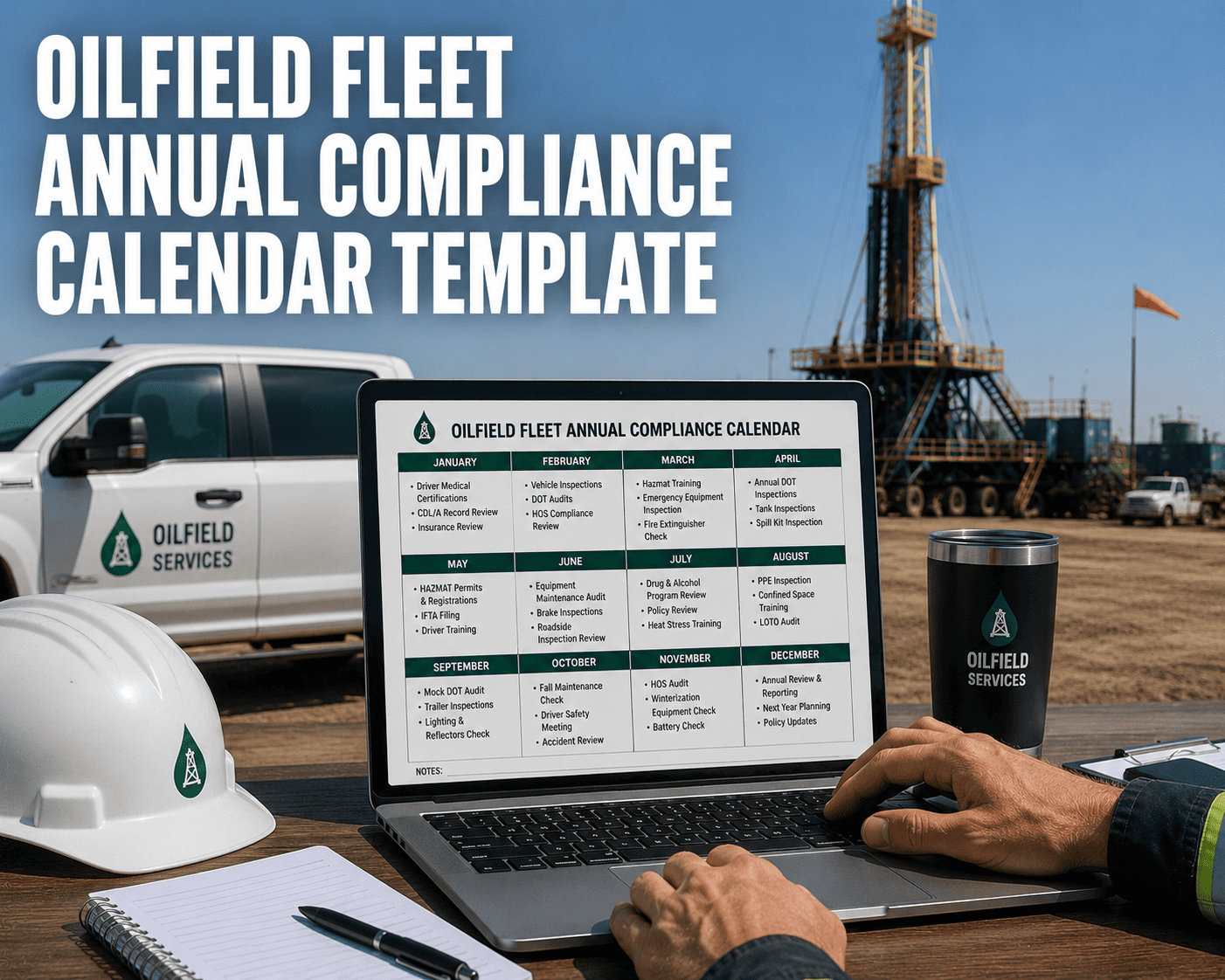
The following month-by-month structure provides the framework for your oilfield fleet compliance calendar. Each month includes fixed deadlines and recommended preparation windows. Use this as your starting template and customize it with your basin-specific and equipment-specific obligations.
January Through March
January kicks off with IFTA Q1 filing due January 31 and UCR registration renewal deadline of December 31 from the prior year carrying into January resolution. February is your preparation window for IRP renewals that begin in many jurisdictions during March. March marks the start of IRP renewal processing in most base jurisdictions, requiring updated mileage records and application submissions. During this quarter, complete all annual driver qualification file reviews that have not yet been finished from the prior calendar year. Verify that all drivers have current medical certificates and that no CDL renewals are coming due in the next 90 days. If you are still managing compliance manually, this is the quarter to book a demo with FleetRabbit and transition to automated tracking before the busier mid-year deadline season arrives.
April Through June
April brings IFTA Q2 filing due April 30, which also coincides with many state annual report deadlines for business entities. May is a critical preparation month because June brings a convergence of deadlines including potential IRP late renewal penalties, state permit renewals, and mid-year HAZMAT refresher training deadlines. Use May to audit all vehicle inspection stickers and identify any units approaching their annual DOT inspection anniversary in the next 60 days. June requires IFTA Q2 preparation completion and filing, plus processing any remaining IRP renewals before late penalties activate. This is also the quarter to schedule and complete any cargo tank inspections that are due on a calendar-year basis rather than anniversary basis.
July Through September
July delivers IFTA Q3 filing due July 31, often during peak oilfield activity when dispatch demands are highest. This conflict between operational urgency and compliance deadlines is exactly why advance calendar reminders matter. August provides a window to focus on specialized equipment inspections before fall maintenance season. Schedule vacuum pump certifications, winch inspections, and pressure vessel testing during this month. September is preparation month for the year-end compliance rush. Begin compiling mileage data for IFTA Q4 and IRP renewal calculations. Review all driver qualification files to identify any annual reviews still outstanding before the calendar year closes.
October Through December
October brings IFTA Q4 filing due October 31 and marks the official start of IRP renewal season in most jurisdictions. November is the primary IRP renewal processing month where applications must be submitted to receive renewed plates by January 1. Missing this window means starting the new year with expired plates. December closes the compliance year with UCR renewal, final driver qualification file reviews, and year-end mileage reconciliation for IFTA and IRP calculations. Use December to audit your entire compliance calendar from the past year, identify any gaps or near-misses, and update your template for the coming year. This annual review process is where you discover which tracking methods failed and where automation would have prevented problems.
| Month | Key Deadlines | Preparation Actions | Common Oilfield Additions |
|---|---|---|---|
| January | IFTA Q1 filing, UCR resolution | Complete prior-year DQ file reviews, verify medical cards | Update well site access agreements for new year |
| February | State annual reports | Begin IRP renewal preparation, compile mileage data | Renew county road use agreements |
| March | IRP renewal processing begins | Submit IRP applications, update vehicle inventory | Submit updated equipment lists to operators |
| April | IFTA Q2 filing | Audit DOT inspection stickers, schedule upcoming inspections | Renew seasonal weight permits for spring restrictions |
| May | State permit renewals, HAZMAT refreshers | Complete mid-year HAZMAT training, verify ELD compliance | Update spill response plans and training documentation |
| June | IFTA Q2 prep, IRP late penalties activate | Finalize IRP renewals, cargo tank inspections | Submit production reporting to state oil and gas commissions |
| July | IFTA Q3 filing | Schedule specialized equipment inspections | Verify oversize permit currency for summer move season |
| August | Equipment certification deadlines | Complete vacuum, winch, and pressure vessel certifications | Prepare for fall seasonal weight restriction changes |
| September | Pre-year-end preparation | Audit DQ files, compile Q4 mileage data | Renew operator contracts with updated compliance docs |
| October | IFTA Q4 filing, IRP renewal season opens | Submit IRP renewal applications, reconcile year-end mileage | Update insurance certificates for all operator agreements |
| November | IRP primary processing month | Track IRP application status, resolve discrepancies | Submit updated vehicle lists to all well site operators |
| December | UCR renewal, year-end close | Annual compliance audit, update calendar template for next year | File year-end reports with state oil and gas commissions |
How Technology Transforms Compliance Calendar Management
Paper calendars and spreadsheets cannot match what modern fleet compliance platforms deliver. Automated compliance tracking systems like FleetRabbit maintain a living calendar that updates dynamically as deadlines approach, tasks are completed, and new obligations are added. Unlike static spreadsheets that require manual updates every time a deadline changes or a new vehicle enters the fleet, automated systems recalculate compliance timelines instantly when fleet composition changes. Adding a new water tanker to your fleet automatically generates all associated compliance deadlines including IFTA decal ordering, IRP registration, DOT inspection scheduling, and any specialized tank inspection requirements.
Multi-Tier Alert Systems Prevent Deadline Failures
The most critical advantage of automated compliance calendars is the multi-tier alert system. A single calendar entry on a wall calendar is easy to overlook. An automated system sends alerts at 30, 14, and 7 days before each deadline, escalating urgency as the date approaches. Tasks can be assigned to specific team members with accountability tracking showing who is responsible and whether they have completed the required action. If an IFTA filing task is assigned to your fuel tax coordinator and the 14-day alert shows the task still pending, a supervisor gets notified to intervene before the deadline arrives. This escalation framework catches problems when they are still fixable, not after penalties have already been assessed.
Integration With Fleet Operations Data
Advanced compliance platforms integrate with your fleet management data to automate compliance calculations that otherwise consume hours of manual effort. IFTA fuel tax calculations pull mileage data from GPS tracking and fuel purchase data from fuel cards, automatically generating jurisdiction-by-jurisdiction fuel consumption reports. IRP renewal mileage calculations use the same integrated data to produce accurate distance reports for apportioned registration applications. This integration eliminates the manual data compilation that causes most filing delays and errors. When your compliance calendar is connected to your operational data, deadline preparation becomes a review and approval process rather than a manual data gathering exercise. This is the operational advantage that separates fleets struggling with compliance from fleets that handle it effortlessly.
Turning Your Calendar Into an Operational Advantage
The most successful oilfield fleet operators do not view compliance as a burden to endure. They treat their compliance calendar as an operational planning tool that drives efficiency. When you know exactly when IFTA filings are due, you can schedule fuel data reconciliation into your monthly accounting workflow rather than treating it as an emergency interruption. When IRP renewal timelines are clear months in advance, you can coordinate vehicle replacement decisions with registration cycles to avoid registering vehicles you plan to retire. When DOT inspection schedules are mapped across your entire fleet, you can stagger inspections to avoid pulling multiple trucks out of service simultaneously during busy periods.
This proactive approach transforms compliance from a reactive cost center into a planned operational activity that minimizes disruption and maximizes fleet availability. Fleets that master compliance calendar management consistently achieve 95 to 98 percent vehicle availability rates compared to 85 to 90 percent for fleets operating without structured compliance planning. That 5 to 13 percent availability improvement translates directly to revenue. For a 30-vehicle oilfield fleet generating 8000 dollars daily in combined revenue, a 10 percent availability improvement recovers 240000 dollars annually in revenue that would otherwise be lost to compliance-related downtime.
The difference between fleets that struggle with compliance and fleets that handle it confidently comes down to one thing. A structured, automated calendar that makes every deadline visible, every task assignable, and every completion verifiable. If your oilfield fleet is still tracking compliance deadlines on spreadsheets or wall calendars, the risk of a costly missed deadline grows with every passing month. The template and framework provided here gives you the structure. The technology to automate it is available right now. The only question is whether you will implement it before or after your next compliance failure.
Stop relying on spreadsheets and memory to track 40 to 60 annual compliance deadlines. FleetRabbit builds your complete oilfield fleet compliance calendar automatically with multi-tier alerts, task assignments, and basin-specific requirements pre-loaded. Start your free trial today and see every deadline for the next 12 months organized and tracked from day one.