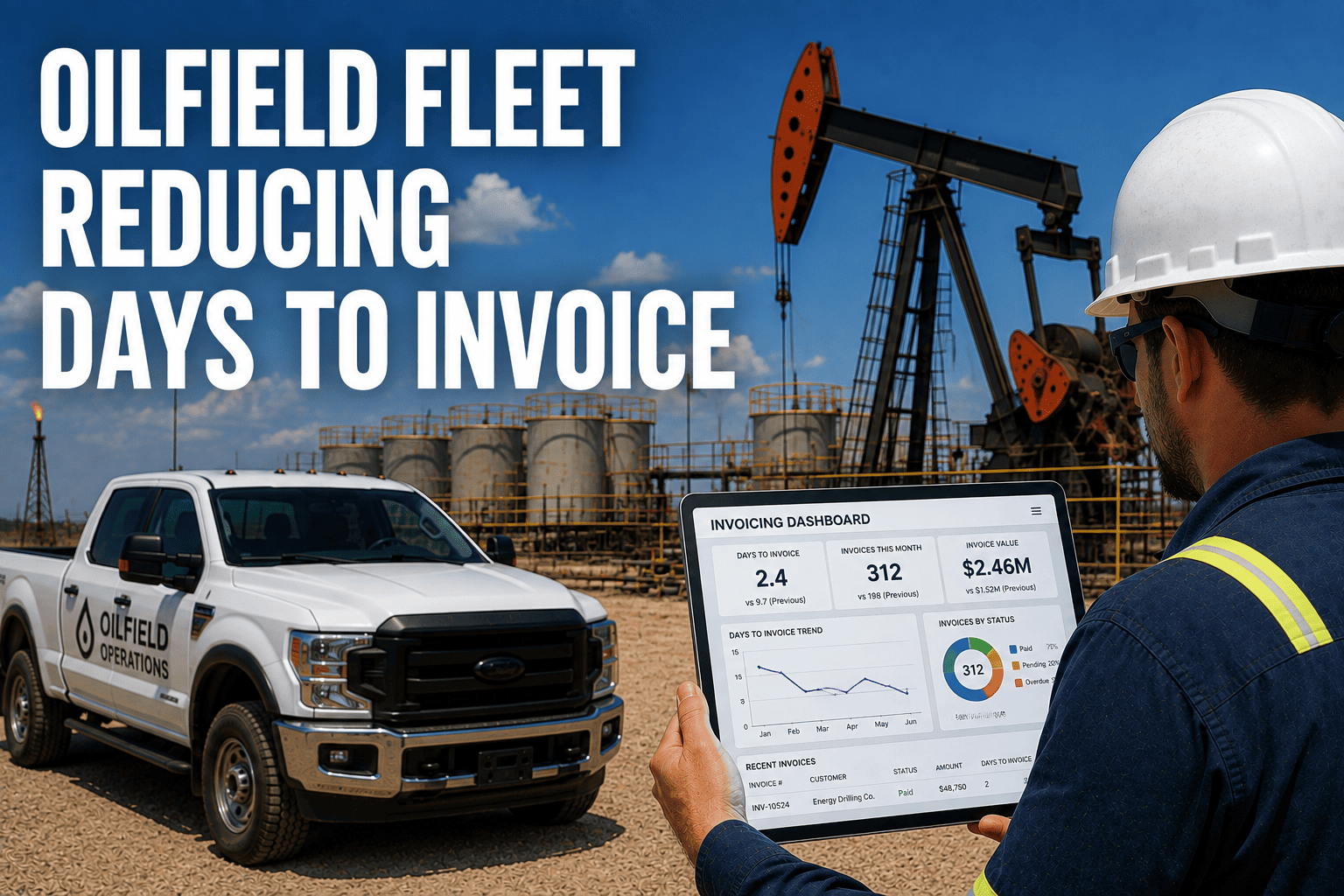
In the oilfield service industry, cash flow is king. Yet, many fleet managers struggle with prolonged days-to-invoice cycles because they rely on manual, paper-based field tickets. When drivers return days later with crumpled, incomplete paperwork, your billing department is already operating at a deficit. Reducing days-to-invoice requires capturing field data digitally the moment a service job is completed. FleetRabbit provides the tools to digitize your field tickets and accelerate your billing cycle. You can sign up for FleetRabbit to modernize your billing today, or book a demo to see our revenue management platform in action.
Oilfield service companies relying on paper field tickets average 15 to 25 days-to-invoice. This delay drains working capital and increases Days Sales Outstanding (DSO) dramatically. Implementing digital field ticketing reduces days-to-invoice to 1 to 3 days, accelerating cash flow and eliminating the administrative bottleneck of manual data entry.
Understanding the Oilfield Billing Bottleneck
The oilfield billing bottleneck begins the moment a service truck leaves the yard. Traditional workflows require drivers to manually fill out carbon-copy tickets detailing hours, materials used, and job specifics. Upon returning to the terminal, these tickets are handed to supervisors, sorted, and eventually delivered to the accounting department. This multi-step, manual transit process is inherently slow and prone to data loss. By the time the ticket reaches accounting, days have passed, and the memory of the job has faded, making it difficult to verify discrepancies.
The Problem with Paper Field Tickets
Paper tickets are the root cause of extended days-to-invoice metrics. They are easily lost in messy cabs, damaged by weather, or rendered useless by illegible handwriting. When a ticket is incomplete, the billing team must track down the driver to clarify details, further delaying the invoice. Furthermore, paper tickets do not capture time-stamped proof of service, giving customers an easy out to dispute charges or delay payment. The inefficiency of paper creates a ripple effect that strangles cash flow and increases administrative overhead.
Lost Data and Illegible Handwriting
Illegible handwriting is more than a nuisance; it is a direct revenue leak. If the billing clerk cannot read the material quantity, they either guess incorrectly or delay the invoice to investigate. Lost tickets mean completely unbilled revenue, a surprisingly common issue in fast-paced oilfield operations. Without a digital audit trail, you are entirely dependent on the driver's organizational skills and memory. To eliminate these leaks, you can sign up for FleetRabbit to digitize your field data, or book a demo to see our mobile app in action.
FleetRabbit's digital field ticketing captures job details, materials, and customer signatures on a mobile app, syncing instantly to your back office. Stop waiting days for paper tickets and accelerate your cash flow today. Start your free trial to modernize your billing cycle.
The Financial Impact of High Days-to-Invoice
Breaking down the financial impact of a high days-to-invoice metric reveals where operational improvements create the biggest returns. Revenue tied up in unpaid invoices represents a massive carrying cost. For an oilfield service company billing 100,000 dollars daily, a 20-day days-to-invoice cycle means 2 million dollars is constantly sitting in limbo. Shortening that cycle to 5 days frees up over 1.5 million dollars in working capital. Administrative overhead consumes another large portion of the impact, as clerks spend hours chasing down paper and entering data manually instead of focusing on collections and dispute resolution.
| Billing Challenge | Typical Financial Impact | Root Cause | FleetRabbit Solution |
|---|---|---|---|
| Delayed Invoicing | 15 to 25 days DSO | Paper tickets sitting in trucks waiting for end-of-week turn-in | Mobile app ticket submission instantly upon job completion |
| Unbilled Revenue | 2,000 to 10,000 dollars | Lost or damaged paper tickets that never reach accounting | Cloud-based digital records that cannot be lost or destroyed |
| Customer Disputes | 5 to 15 percent short pay | Lack of timestamped proof of service or customer signature | On-site digital signature capture and GPS-stamped tickets |
| Data Entry Errors | 500 to 2,000 dollars per month | Manual transcription of illegible handwriting into accounting software | Seamless API integration eliminating manual data entry |
| Admin Overhead | 40 hours per week | Sorting, filing, and chasing down drivers for ticket clarification | Automated routing of digital tickets directly to the back office |
Strategies to Accelerate Service Billing
Accelerating your oilfield service billing requires a fundamental shift from physical documents to digital workflows. The most effective strategy is implementing a mobile field ticketing application. Drivers use a tablet or smartphone to input job details, hours, and materials while still on location. This data is instantly transmitted to the cloud, where the back office can review, approve, and convert the ticket into an invoice the same day. This immediate data flow eliminates the transit delay and drastically reduces the days-to-invoice metric.
Digital Field Ticketing
Digital field ticketing standardizes the data capture process. The mobile app can enforce required fields, ensuring a driver cannot submit a ticket without logging arrival times, departure times, and material usage. This eliminates the problem of incomplete data. Furthermore, the app can automatically calculate costs based on pre-loaded service rates, removing the need for the back office to manually look up pricing. By streamlining the data entry and calculation phase, digital ticketing cuts administrative time by up to 70 percent.
Automated Approval Workflows
Once a digital ticket is submitted, automated workflows route it to the appropriate supervisor for instant approval. If a ticket includes overtime or unusual material usage, the system can automatically flag it for review while processing standard tickets without delay. This intelligent routing ensures that invoices are generated and sent to the customer within 24 hours of job completion, rather than weeks later. To implement these automated workflows, you can sign up for FleetRabbit to modernize your billing, or book a demo to see our revenue management platform in action.
How FleetRabbit Optimizes Revenue Cycles
Modern revenue cycle management requires technology that connects the field directly to accounting. FleetRabbit's integrated platform combines GPS tracking, mobile field ticketing, and back-office integration into a single dashboard. Drivers complete digital tickets on their mobile devices, capturing customer signatures and job photos on-site. The data syncs instantly, allowing billing clerks to generate invoices the same day. This integration eliminates the blind spots of manual paper handling and ensures your billing cycle is 100 percent accurate and immediately actionable.
Real-Time Job Capture
Real-time job capture means your back office knows exactly when a service is completed. Telematics integration allows the system to automatically suggest job start and end times based on truck GPS location, reducing the driver's manual data entry. Drivers simply verify the times, add materials, and capture the customer's signature. This instant verification drastically reduces the opportunity for customer disputes, as every ticket is backed by GPS timestamps and digital signatures. Disputes are resolved in minutes using attached photos and location data, rather than weeks of back-and-forth emails.
Seamless Accounting Integration
FleetRabbit does not operate in a silo. Our platform integrates seamlessly with your existing accounting software, such as QuickBooks or specialized oilfield ERP systems. Once a digital ticket is approved, the data flows directly into your accounting system, ready to be printed or emailed as an invoice. This seamless integration eliminates manual double-entry, reducing human error and freeing up your accounting team to focus on collections and cash flow management. The result is a lean, highly efficient billing operation that maximizes working capital.
Key Takeaways for Faster Billing
Reducing days-to-invoice is the most critical financial strategy for oilfield service fleets. A 20-day billing cycle strangles cash flow and limits operational growth. Fleets relying on paper tickets are losing thousands in unbilled revenue and administrative overhead. A defensible and accelerated billing program shifts the focus from manual data entry to instant digital capture, demonstrating that the fleet actively manages its revenue cycle to the highest standard.
Implementing a comprehensive digital field ticketing system reduces days-to-invoice by up to 80 percent and improves cash flow within weeks. The return on investment is immediate, not just in recovered working capital, but in reduced administrative labor, eliminated data entry errors, and successfully disputed short-pays. Oilfield operators demand efficiency, and FleetRabbit provides the exact digital documentation they require to keep finances moving.
The path forward is clear. Evaluate your current days-to-invoice metric and ask if your money is sitting in paper trucks right now. If you are relying on manual processes, you are losing capital. Fleet managers who address billing systematically protect their profitability and operational reliability. You can sign up for FleetRabbit to modernize your billing today, or book a demo to see our revenue management platform in action.
Frequently Asked Questions About Days-to-Invoice
Every day a paper ticket sits in a truck is a day your cash flow is tied up. FleetRabbit transforms your paper tickets into instant digital invoices, reducing your days-to-invoice and accelerating your working capital. See an 80 percent reduction in billing time within weeks. Start your free trial today with no credit card required.