Most oilfield fleet managers did not take the job to sit in spreadsheets. Yet ask any of them where the week goes and the answer is the same. Hours get eaten reconciling paper DVIRs, building IFTA fuel tax reports from fuel card PDFs, assembling maintenance cost summaries from three different systems, and answering the same operator billing question for the fourth time this month. By Friday, the manager who should be coaching drivers and tightening routes has instead spent fifteen or twenty hours pushing data between systems that do not talk to each other. This guide breaks down where reporting time actually goes, what it costs, and how to automate the stack so managers get their week back.
Oilfield fleet managers spend 12 to 22 hours per week on manual reporting tasks, plus another 8 to 15 hours during month-end close. At a fully loaded labor cost of 45 to 60 dollars per hour, that is 28,000 to 65,000 dollars per manager per year spent pushing data between disconnected systems. Automating the reporting stack cuts that time by 60 to 80 percent and reduces reporting errors from 8 to 15 percent down to under 1 percent, freeing managers to focus on safety, routing, and profitability.
Where the Reporting Hours Actually Go
Ask a fleet manager to account for their week and they will describe the same six reporting categories. The bar chart below shows where the hours land, using the high end of each range to illustrate the weekly burden. Together these six categories consume 16 to 30 hours per week for the typical oilfield fleet manager, with billing reconciliation and IFTA fuel tax preparation eating the largest share.
Manual Versus Automated Reporting Stack
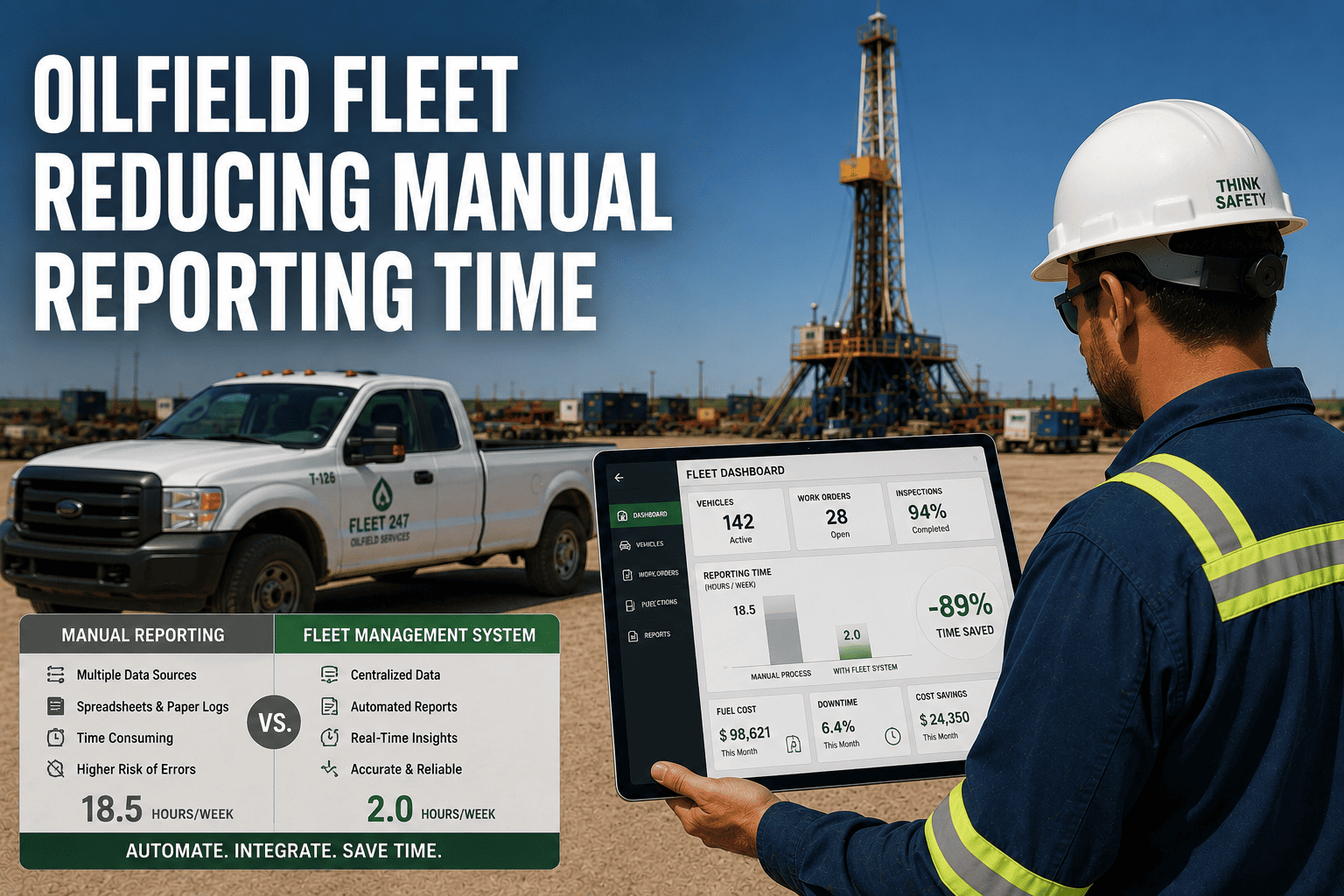
The gap between a manual reporting stack and an automated one is not measured in convenience. It is measured in hours, dollars, and the quality of decisions a manager can make. The comparison below shows what changes when the same data your systems already capture flows into reports automatically instead of being pushed through spreadsheets by hand.
Manual Reporting Stack
- 16 to 30 hours per week on routine reporting
- 8 to 15 additional hours at month-end close
- 8 to 15 percent error rate from data transcription
- 28,000 to 65,000 dollars annual labor cost per manager
- Decisions delayed by days waiting for report compilation
- Same billing questions answered repeatedly for operators
Automated Reporting Stack
- 3 to 6 hours per week on reporting oversight
- Month-end close completes in hours, not days
- Under 1 percent error rate with system calculations
- Manager freed for safety, routing, and profitability
- Real-time dashboards replace scheduled report runs
- Operators get self-serve access to their own data
FleetRabbit pulls GPS, fuel, maintenance, DVIR, and HOS data into one platform where reports build themselves. Recover 12 to 22 hours per week, push error rates under 1 percent, and get your month-end close down to a single afternoon. Start free or book a 30-minute walkthrough to see it on your data.
The Five Reports That Eat the Most Time
Not all reports consume the same hours. These five categories account for the majority of manual reporting time in oilfield fleets, and each one has a specific automation pattern that eliminates the manual work without losing accuracy or auditability.
Operator Billing and Trip Ticket Reconciliation
5 to 9 hrs/weekMatching paper or PDF trip tickets against GPS records, fuel receipts, and load confirmations to build accurate operator invoices. Each discrepancy means a phone call, a re-check, and a delayed invoice. Automation ties GPS-tracked trips, load tickets, and fuel data into billing-ready exports that reconcile themselves.
IFTA Quarterly Fuel Tax Preparation
3 to 6 hrs/weekPulling fuel purchase records from fuel card portals, matching them against state-by-state mileage from telematics, and calculating tax liability across every jurisdiction. One missed receipt or wrong state-line mile means an amended return. Automation aggregates fuel and mileage data into IFTA-ready reports that update continuously through the quarter.
Maintenance and Repair Cost Reports
3 to 5 hrs/weekPulling work orders, parts invoices, and labor hours from the shop into a spreadsheet that shows cost per truck, cost per mile, and trend over time. Manual aggregation means the report is already weeks old when the manager reads it. Automation surfaces maintenance costs live, by truck and component, with no manual assembly.
DVIR Compliance Summaries
2 to 4 hrs/weekCollecting paper or app-based driver vehicle inspection reports, verifying every required defect was corrected, and building a compliance summary for DOT or operator audits. Missing reports or unclosed defects become audit findings. Automation tracks every DVIR, flags unclosed defects, and exports audit-ready summaries in one click.
HOS and ELD Compliance Audits
2 to 3 hrs/weekReviewing driver hours-of-service records for violations, building exception reports, and documenting corrective action for any driver approaching limits. Manual review means violations are often caught days late. Automation flags approaching limits in real time and compiles compliance reports on demand.
How FleetRabbit Automates the Reporting Stack
FleetRabbit was built for oilfield fleets where the reporting burden is heaviest because the data sources are most fragmented. GPS, fuel cards, telematics, maintenance shops, and driver apps all capture data independently, and the fleet manager becomes the human bridge between them. FleetRabbit replaces that bridge with a single platform where reports build themselves from live source data.
Live Data, No Manual Aggregation
GPS, fuel, maintenance, DVIR, and HOS data flow into one platform continuously. Reports build themselves from live data instead of being assembled from exports and spreadsheets at the end of the week.
Scheduled Report Delivery
Set the schedule once. Weekly, monthly, and quarterly reports deliver automatically to the right inbox or dashboard. No more late-night month-end crunches rebuilding the same spreadsheet from scratch.
One-Click Operator Billing Exports
Trip tickets, GPS miles, and fuel costs tied together and exportable as billing-ready packages. Billing disputes collapse because every line item is backed by system-tracked data the operator can verify themselves.
Error-Proof Calculations
IFTA tax, cost per mile, and compliance summaries are calculated by the system from source data, not by hand. Error rates drop from 8 to 15 percent to under 1 percent, and audit findings from calculation mistakes disappear.
Getting started takes minutes. You can start a free FleetRabbit account and connect your first trucks today, or book a 30-minute demo and we will walk through the specific reports eating your week and what automation recovers.
Frequently Asked Questions About Manual Reporting Time
Key Takeaways On Reducing Manual Reporting Time
Manual reporting is the silent tax on oilfield fleet management. The hours are real, the cost is measurable, and the opportunity is recoverable. A manager spending 18 hours per week on manual reports is losing 45,000 dollars a year in labor and far more in delayed decisions, billing disputes, and compliance findings that automated systems would have prevented before they happened.
The reporting stack does not need more spreadsheets or another person in the back office. It needs the data you already capture to flow into reports automatically. FleetRabbit was built to do exactly that for oilfield fleets, and the first automated reports typically run within days of onboarding. The question is not whether automation saves time. The question is how many more weeks you spend rebuilding the same reports before you let it.
Every hour spent pushing data between systems is an hour not spent on safety, routing, and profitability. FleetRabbit automates the reporting stack from live data, cutting reporting time by 60 to 80 percent and pushing error rates under 1 percent. Start free today or book a 30-minute demo and we will show you exactly which reports are eating your week.