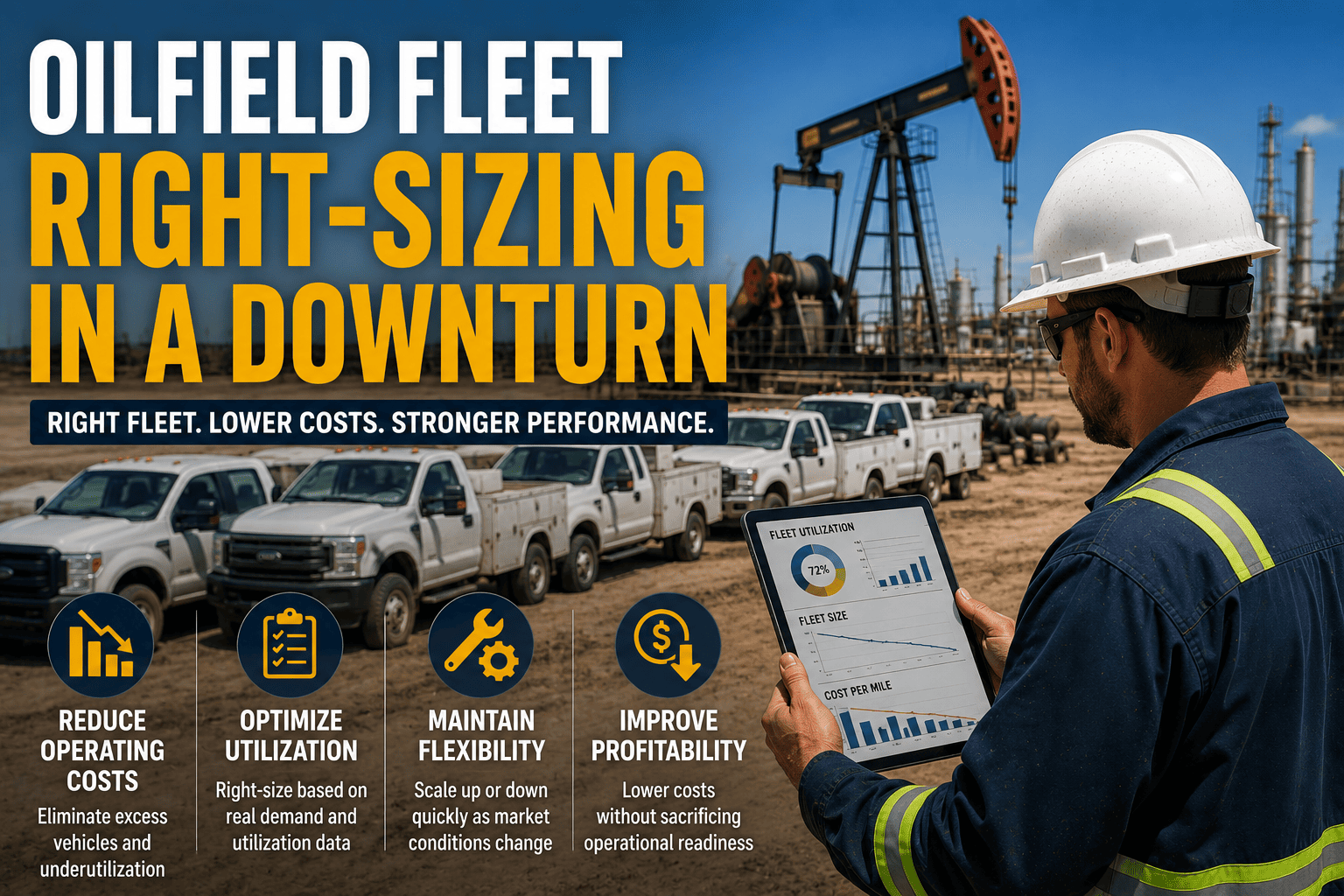
When drilling activity slows and day rates drop, the instinct is to cut costs everywhere at once, but a fleet is not something you can shrink by gut feeling without risking a scramble the moment activity picks back up. Oilfield operators commonly carry 20 to 30 percent excess fleet capacity as a safety margin for peak demand, and every one of those underutilized vehicles keeps costing $800 to $2,500 a month in lease payments, insurance, and overhead whether it moves or not. In a downturn, that safety margin turns into a direct hit to margin. Right-sizing is not about slashing the fleet blindly, it is about knowing exactly which vehicles are earning their keep and which are quietly draining cash while parked in a staging yard.
Oilfield fleets typically run with 20 to 30 percent excess capacity built in for peak demand, and each underused vehicle costs $800 to $2,500 monthly in carrying costs alone. Data-driven redeployment and right-sizing efforts commonly unlock 15 to 22 percent utilization improvement and an 8 to 14 percent fleet size reduction while maintaining full operational capacity, since the goal is cutting waste, not cutting capability.
Why Idle Vehicles Cost More Than They Look Like They Do
A parked truck does not stop costing money just because it stopped moving. Depreciation continues on schedule regardless of mileage. Insurance premiums are typically based on the vehicle being in the fleet, not on how often it leaves the yard. Registration, permits, and baseline maintenance to keep the unit road-ready all continue whether the truck runs one mile or a thousand miles that month. A single underutilized vehicle can quietly cost several thousand dollars a year in pure carrying cost, and across a fleet of a hundred units, that adds up to a six-figure drain most fleet managers never see itemized in a single report.
The Hidden Math Behind An Oversized Fleet
The reason this waste stays invisible is that it does not show up as a line item, it shows up as a pattern spread across dozens of individual accounts, depreciation schedules, insurance bills, and lot maintenance tickets. Without a system tracking actual deployment hours against available hours per vehicle, per site, and per week, a fleet manager sees only that some trucks sit around more than others, without the data to say confidently which ones can be cut without risking a service gap when activity rebounds.
FleetRabbit tracks deployment hours, engine hours, and idle time across every vehicle and site, so you know exactly which units are earning their carrying cost and which ones are quietly bleeding cash in a staging yard.
A Three-Way Decision Framework: Keep, Park, Or Retire
Right-sizing works best as a structured decision, not a blanket cut. Every vehicle in the fleet falls into one of three categories once utilization, maintenance cost, and redeployment potential are compared side by side.
| Decision | Utilization Signal | Best For | Action To Take |
|---|---|---|---|
| Keep | Consistently above 70 to 90 percent of available operating time | Core assets covering high-demand sites or routes | Retain and monitor for over-utilization stress rather than reducing |
| Redeploy Or Park | Below 40 to 55 percent, but with seasonal or backup value | Vehicles suited to intermittent or standby demand | Move to a lower-demand site, pool across projects, or place in short-term standby status |
| Retire Or Sell | Chronically low utilization with high maintenance cost relative to value | Aging units with rising repair frequency and falling resale value | Dispose of the asset and, if needed, cover gaps through short-term rental |
Setting A Utilization Threshold That Actually Reflects Your Fleet
Utilization is not one single percentage, it needs to be measured as deployed hours against available hours, tracked per vehicle over a rolling window rather than a single snapshot. A vehicle averaging 45 percent time utilization over a single slow week might simply be between projects. The same vehicle averaging 45 percent over a rolling 13-week window is a structural underperformer worth moving into the park-or-retire conversation.
Separating Structural Idle Time From Wasteful Idle Time
Not all idle capacity is the same problem. Some vehicles sit idle because of a genuine coverage gap, the truck is in the wrong zone for current demand, which redeployment solves without cutting a single asset. Other vehicles sit idle because the fleet is simply carrying more capacity than current activity requires, and that is the capacity right-sizing is meant to trim.
Right-Sizing Without Losing Response Capacity
The risk every fleet manager weighs against cost-cutting is getting caught short when activity rebounds and having to scramble for rental equipment at premium rates. A blended approach reduces that risk: retire the chronic underperformers permanently, but keep a rental relationship in place to cover short-term spikes instead of owning capacity year-round for demand that only shows up occasionally. Some oilfield operators have preserved hundreds of thousands of dollars in capital by shifting a portion of their fleet mix to flexible rental coverage rather than owning every unit outright, without sacrificing response time when a site needs equipment fast.
Fleet managers preparing for a right-sizing review can sign up for a free trial and pull 90 days of utilization data across their fleet to see exactly which vehicles fall into the keep, park, or retire category before making a single cut. Having that data in hand turns a right-sizing decision from a guess made under budget pressure into a documented, defensible plan that protects operational capacity while cutting real waste.
FleetRabbit turns 90 days of deployment data into a clear keep, park, or retire recommendation for every vehicle, so your right-sizing decisions hold up under scrutiny and protect the capacity you need for the next upswing.
A downturn punishes fleets carrying capacity they cannot justify, but cutting the wrong vehicle can cost you more than it saves. FleetRabbit shows exactly which units to keep, redeploy, or retire based on real utilization data, so your fleet stays lean without losing the ability to respond when things pick back up. Get started with no credit card required.