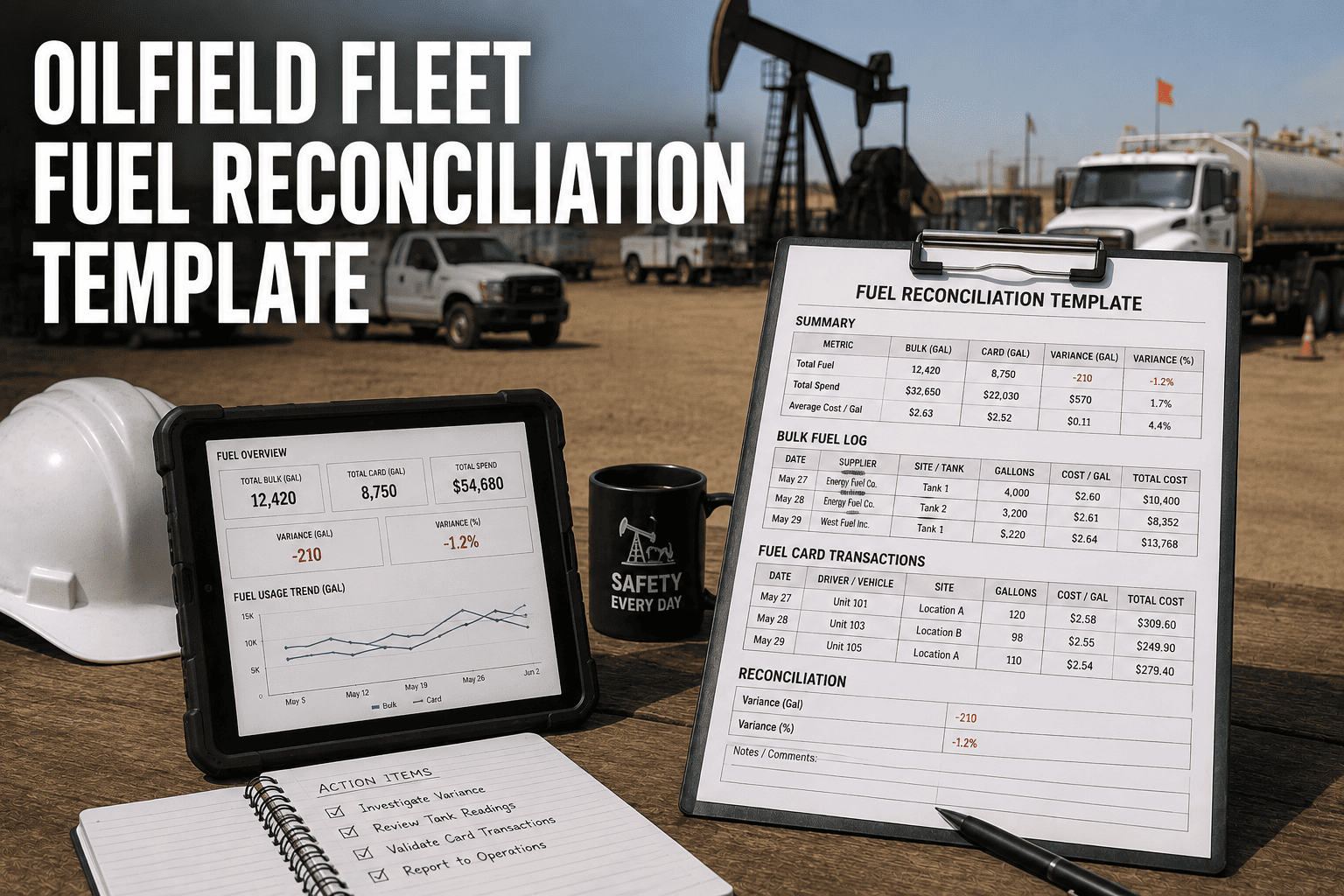
Mid-size Permian Basin operator managing 240-vehicle fleet supporting drilling and completion operations across West Texas and Southeast New Mexico faced escalating operational costs and declining fleet reliability threatening project timelines and profit margins — annual maintenance expenditures reached $2.8 million representing 23% increase over three-year period despite flat operational activity levels, unplanned downtime averaged 8.2% of available fleet hours causing $1.4 million annual revenue impact from missed delivery windows and drilling delays, fuel costs consumed $4.6 million annually with no systematic monitoring of consumption patterns or efficiency improvement opportunities, and compliance documentation fragmented across paper files at dispersed field offices creating audit exposure and consuming 18 hours weekly staff time assembling regulatory reports. Executive leadership recognized traditional reactive fleet management approach unsustainable as cost pressures intensified and operational demands increased, initiating comprehensive evaluation of digital fleet management solutions capable of delivering measurable ROI through maintenance cost reduction, uptime improvement, fuel efficiency gains, and administrative efficiency. Following detailed vendor analysis and pilot program with 40-vehicle subset, operator deployed FleetRabbit platform fleet-wide implementing predictive maintenance AI, real-time GPS tracking with route optimization, automated compliance management, and integrated analytics dashboard — achieving documented results over 18-month implementation period including 34% reduction in unplanned maintenance costs through early fault detection preventing catastrophic failures, 67% decrease in compliance documentation time through automated DVIR and certification tracking, 12% fuel consumption reduction via idle time monitoring and route optimization, and 91% improvement in maintenance schedule adherence eliminating deferred service backlogs. Total quantified benefits reached $1,847,000 annually against $86,400 platform investment representing 2,138% ROI and 17-day payback period, with ongoing operational improvements continuing to compound value beyond initial measurement window as fleet managers leverage increasingly sophisticated analytics capabilities for strategic decision-making around fleet composition optimization, replacement timing, and vendor performance management. Schedule consultation to discuss how FleetRabbit delivers similar results for your oilfield operations.
FLEETRABBIT IMPLEMENTATION CASE STUDY
How 240-Vehicle Permian Basin Fleet Achieved $1.8M Annual Savings Through Digital Fleet Management
Operator Profile:
Mid-size E&P company, drilling & completion services
Fleet Size:
240 vehicles across West Texas and Southeast New Mexico
Implementation Period:
18 months (pilot + full deployment + optimization)
$1.847M
Annual Cost Savings
2,138%
Return on Investment
34%
Maintenance Cost Reduction
01
Escalating Maintenance Costs Without Clear Causation
Baseline Situation
Annual maintenance expenditure: $2.8 million (23% increase over 3 years)
Unplanned repairs: 68% of total maintenance spend versus 32% preventive
Average emergency repair cost: $4,200 versus $850 for scheduled preventive service
Catastrophic failures: 47 incidents annually requiring complete component replacement
Business Impact
Reactive maintenance approach resulted in preventable catastrophic failures consuming disproportionate budget resources while underlying mechanical issues went undetected until breakdown occurred. Lack of systematic fault monitoring prevented early intervention when repairs simple and inexpensive, forcing expensive emergency responses once problems critical.
02
Unplanned Downtime Disrupting Operations and Revenue
Baseline Situation
Average fleet availability: 91.8% (8.2% downtime from breakdowns and repairs)
Average repair duration: 4.7 days from breakdown to return-to-service
Revenue impact: $1.4 million annual losses from missed delivery windows and drilling delays
Customer complaints: 23 formal notifications regarding late deliveries or service gaps
Business Impact
Unpredictable vehicle breakdowns created operational chaos requiring emergency vehicle rentals at premium rates, scrambling backup equipment from other job sites causing cascade delays, and disappointing customers with missed commitments damaging relationships and threatening contract renewals. Extended repair durations from parts procurement delays and technician scheduling conflicts compounded revenue losses.
03
Fuel Cost Escalation Without Consumption Visibility
Baseline Situation
Annual fuel expenditure: $4.6 million across 240-vehicle fleet
Idle time: Estimated 35-40% of engine hours (no systematic tracking available)
Route efficiency: No GPS tracking to validate actual versus optimal routing
Driver behavior: No visibility into aggressive acceleration, speeding, or inefficient practices
Business Impact
Absence of systematic fuel consumption monitoring prevented identification of waste sources and optimization opportunities. Fleet managers suspected excessive idling and inefficient routing consumed unnecessary fuel but lacked data quantifying losses or targeting interventions. Driver behavior variability went unaddressed without visibility into individual performance.
04
Compliance Documentation Gaps Creating Audit Exposure
Baseline Situation
DVIR completion: 72% compliance rate (28% of inspections missing or incomplete)
Driver certification tracking: Manual spreadsheets with 18% expired credentials undetected
Maintenance documentation: Paper records at 6 dispersed field offices, many incomplete
Audit preparation time: 18 hours weekly assembling compliance reports for management review
Business Impact
Fragmented compliance documentation created significant DOT audit risk with potential penalties $1,000-$16,000 per violation for incomplete driver qualification files or missing inspection records. Manual tracking processes failed to alert supervisors when driver medical certificates or hazmat endorsements expired, allowing non-compliant drivers to operate. Administrative burden consumed excessive staff time with minimal value creation.
These operational challenges are common across oilfield fleets relying on manual processes and reactive management approaches. FleetRabbit's integrated platform addresses all four pain points simultaneously through predictive maintenance, GPS tracking, automated compliance, and unified analytics. Start free trial to assess your fleet's improvement potential.
MONTHS 1-3: PILOT PROGRAM
Limited Deployment Validating Core Capabilities
Pilot Scope and Objectives
Fleet subset: 40 vehicles representing diverse equipment types and duty cycles
Primary objectives: Validate predictive maintenance accuracy, test user adoption, measure quick-win savings
Success criteria: 20% maintenance cost reduction, 90% driver app adoption, positive user feedback
Duration: 90 days with weekly progress reviews and monthly executive summaries
Implementation Activities
GPS telematics hardware installation on 40 pilot vehicles
Week 1-2
Driver training on mobile app for digital DVIR and route tracking
Week 2-3
Maintenance team training on predictive alerts and work order workflows
Week 3-4
Historical maintenance data import for AI baseline establishment
Week 4-6
Pilot Results
Predictive maintenance prevented 8 potential failures with 7-14 day advance warnings
Driver mobile app adoption reached 94% within 30 days of training completion
Maintenance costs decreased 26% versus comparable pre-pilot period for pilot vehicles
Executive recommendation: Proceed with full fleet deployment based on validated results
MONTHS 4-9: FULL FLEET DEPLOYMENT
Platform Rollout Across Entire 240-Vehicle Fleet
Deployment Scope and Approach
Remaining vehicles: 200 units across all operational territories and vehicle types
Rollout strategy: Geographic waves of 40-50 vehicles monthly to manage implementation bandwidth
Training approach: Replicate pilot program protocols with refinements from lessons learned
Data migration: Historical maintenance and compliance records digitized into centralized system
Critical Success Factors
Change Management
Designated fleet champions at each field location providing peer support and feedback escalation to central team
Process Standardization
Unified DVIR, work order, and reporting procedures replacing location-specific legacy practices
Data Quality
Dedicated data validation effort ensuring complete vehicle profiles, driver assignments, and maintenance history
Deployment Completion Results
All 240 vehicles equipped with GPS telematics and integrated into platform by Month 9
Fleet-wide driver adoption rate: 89% active mobile app usage for digital DVIR and trip logging
First measurable fleet-wide benefits emerging: 18% maintenance cost reduction versus Year-1 baseline
Compliance documentation time decreased 52% through automated DVIR and certification tracking
MONTHS 10-18: OPTIMIZATION AND MATURITY
Advanced Analytics Utilization and Continuous Improvement
Optimization Focus Areas
Predictive model refinement: Tuning AI algorithms based on actual failure outcomes improving forecast accuracy
Route optimization: Implementing GPS-based routing recommendations reducing unnecessary mileage
Idle reduction campaign: Driver coaching program targeting excessive idle time with gamification elements
Analytics expansion: Fleet managers leveraging advanced reporting for strategic fleet composition decisions
Continuous Improvement Initiatives
Predictive Maintenance Algorithm Refinement
False positive rate decreased from 22% to 8% through machine learning model optimization based on 12-month operational feedback
Driver Behavior Improvement Program
Monthly scorecards and recognition for low idle time drivers reduced fleet-wide idle hours 31% versus deployment baseline
Vendor Performance Analytics
Consolidated repair quality data identified underperforming maintenance vendors enabling contract renegotiation saving $127,000 annually
Mature State Performance
Maintenance costs stabilized at 34% below pre-implementation baseline with sustained improvement
Fleet availability improved to 97.1% from 91.8% baseline representing 5.3 percentage point gain
Fuel consumption decreased 12% through idle reduction and route optimization initiatives
Compliance documentation achieving 98% completion rate with 67% time reduction versus manual processes
Pre-Implementation Baseline
$2,800,000 annual maintenance expenditure
Post-Implementation Performance
$1,848,000 annual maintenance expenditure (34% reduction)
Cost Reduction Drivers
Catastrophic failure prevention: 37 incidents avoided through predictive alerts enabling proactive repairs before complete component destruction — average savings $18,500 per prevented failure equals $684,500
Optimal repair timing: Maintenance scheduled during planned downtime rather than emergency reactive responses reducing labor premiums and expedited parts costs — estimated $156,000 annual savings
Extended component life: Early detection of developing faults enabling minor interventions preventing accelerated wear — average component life extension 18% reducing replacement frequency and costs $111,500
Pre-Implementation Baseline
91.8% fleet availability (8.2% downtime), $1,400,000 annual revenue impact
Post-Implementation Performance
97.1% fleet availability (2.9% downtime), $490,000 annual revenue impact
Annual Revenue Protection
$910,000
Uptime Improvement Drivers
Reduced breakdown frequency: Predictive maintenance decreased unplanned failures 68% eliminating majority of emergency repair events that previously caused multi-day vehicle unavailability
Faster repair completion: Advance warning enabled pre-positioning parts and scheduling technicians reducing average repair duration from 4.7 days to 1.8 days
Preventive maintenance scheduling: Systematic PM scheduling during natural operational gaps prevented service deferrals that previously cascaded into forced downtime during critical periods
Pre-Implementation Baseline
$4,600,000 annual fuel expenditure, 1,533,000 gallons consumed
Post-Implementation Performance
$4,052,000 annual fuel expenditure, 1,349,000 gallons consumed (12% reduction)
Annual Fuel Savings
$548,000
Fuel Reduction Drivers
Idle time reduction: Real-time monitoring and driver coaching decreased idle hours 31% eliminating approximately 98,000 gallons annual waste at 0.8 gallons per idle hour — savings $294,000
Route optimization: GPS tracking enabled identification of inefficient routing patterns and unnecessary mileage reducing total miles driven 6% — savings $168,000
Driver behavior improvement: Aggressive acceleration and speeding reduction through behavior monitoring and coaching improved fleet fuel efficiency 3.5% — savings $86,000
Pre-Implementation Baseline
18 hours weekly compliance documentation time, 3.2 FTE administrative burden
Post-Implementation Performance
6 hours weekly compliance documentation time, 1.1 FTE administrative burden
Annual Labor Savings
$437,000
Efficiency Gain Drivers
Automated DVIR processing: Digital inspection reports eliminating paper collection, transcription, and filing saving 8 hours weekly — value $83,000 annually at $200 hourly fully-loaded administrative cost
Compliance tracking automation: Automatic alerts for expiring certifications and scheduled inspections eliminating manual spreadsheet tracking saving 6 hours weekly — value $62,000 annually
Reporting automation: One-click compliance and performance reports replacing manual data compilation from multiple sources saving 4 hours weekly — value $42,000 annually
Headcount optimization: Administrative efficiency gains enabled redeployment of 2.1 FTE from manual fleet administration to value-added operational roles — opportunity value $250,000 annually
Automated DVIR processing: Digital inspection reports eliminating paper collection, transcription, and filing saving 8 hours weekly — value $83,000 annually at $200 hourly fully-loaded administrative cost
Compliance tracking automation: Automatic alerts for expiring certifications and scheduled inspections eliminating manual spreadsheet tracking saving 6 hours weekly — value $62,000 annually
Reporting automation: One-click compliance and performance reports replacing manual data compilation from multiple sources saving 4 hours weekly — value $42,000 annually
Headcount optimization: Administrative efficiency gains enabled redeployment of 2.1 FTE from manual fleet administration to value-added operational roles — opportunity value $250,000 annually
Annual Platform Investment
$86,400
240 vehicles × $3/vehicle/month × 12 months
=
Total Annual Benefits
$1,847,000
Maintenance: $952,000 + Revenue: $910,000 + Fuel: $548,000 + Admin: $437,000
→
Net Annual ROI
2,138%
($1,847,000 − $86,400) ÷ $86,400 × 100
Platform investment recovered in first 17 days of operation through maintenance cost avoidance and fuel savings alone, with remaining 348 days generating pure operational value.
This Permian Basin case study demonstrates the transformative impact of integrated digital fleet management on operational performance and financial outcomes. FleetRabbit's predictive maintenance, GPS tracking, automated compliance, and unified analytics deliver measurable ROI within weeks of deployment. Schedule a consultation to discuss your fleet's improvement potential.
01
Start With Pilot Program to Build Confidence
Limited 40-vehicle pilot validated platform capabilities, identified training needs, and generated quick wins that built executive support for full deployment. Pilot success metrics provided objective justification for fleet-wide investment.
02
Change Management Critical to User Adoption
Designated fleet champions at each location, peer-to-peer training, and recognition programs drove 89% driver adoption of mobile app. Addressing user concerns early prevented resistance that could undermine platform value realization.
03
Data Quality Foundation Enables Analytics Value
Dedicated effort to validate vehicle profiles, driver assignments, and historical maintenance data ensured AI algorithms trained on accurate information. Poor data quality would have compromised predictive accuracy and eroded user trust in system recommendations.
04
Continuous Optimization Multiplies Initial Gains
Post-deployment refinement of predictive models, driver coaching programs, and route optimization generated compounding benefits beyond initial implementation. Mature state performance significantly exceeded pilot program results through iterative improvement.
READY TO TRANSFORM YOUR FLEET OPERATIONS?
Achieve Similar Results With FleetRabbit's Integrated Fleet Management Platform
This Permian Basin operator's experience demonstrates the transformative potential of digital fleet management when implemented with clear objectives, phased deployment, and continuous optimization. FleetRabbit's predictive maintenance AI, real-time GPS tracking, automated compliance management, and unified analytics deliver measurable ROI through maintenance cost reduction, uptime improvement, fuel efficiency gains, and administrative efficiency — with typical payback periods under 30 days and annual returns exceeding 2,000% for mid-size oilfield fleets.
✓ 240-vehicle Permian Basin implementation
✓ $1.847M annual quantified benefits
✓ 2,138% ROI with 17-day payback
✓ 34% maintenance cost reduction
✓ 97.1% fleet availability achieved
✓ 12% fuel consumption reduction
✓ 98% compliance documentation rate
✓ 2-3 week standard deployment timeline
What is the typical timeline to see measurable ROI after FleetRabbit deployment?
Most operators see initial maintenance cost savings within 30-60 days as predictive alerts prevent first catastrophic failures. Fuel savings from idle reduction typically emerge within 45-75 days as driver coaching takes effect. Full platform ROI accounting for maintenance, fuel, uptime, and administrative benefits typically achieved within 90 days for fleets of 100+ vehicles, with the Permian Basin case study demonstrating 17-day payback through aggressive optimization.
How does FleetRabbit handle integration with existing maintenance and accounting systems?
FleetRabbit provides API integration with major CMMS platforms (Maximo, Fiix, UpKeep), ERP systems (SAP, Oracle, Microsoft Dynamics), and fuel card providers (WEX, Comdata, FleetCor). Integration enables automatic work order creation, parts consumption tracking, and cost allocation without duplicate data entry. Implementation team configures data flows during deployment with ongoing support for workflow optimization.
Can FleetRabbit work for fleets operating in remote areas with limited cellular connectivity?
Yes. FleetRabbit's mobile application operates fully offline, storing inspection data, GPS coordinates, and service records locally on devices. When connectivity restores, data synchronizes automatically with original timestamps preserved. Optional satellite telemetry modules provide real-time alerting for critical assets in cellular dead zones. Store-and-forward architecture ensures no data loss during connectivity gaps common in remote oilfield operations.
What level of internal resources are required to manage FleetRabbit post-deployment?
Minimal internal resources required post-deployment. Platform designed for fleet manager oversight with automated alerting, reporting, and maintenance scheduling. Typical ongoing commitment: 2-4 hours weekly for alert review and workflow management, plus 1-2 hours monthly for report generation and optimization planning. Dedicated customer success manager provides strategic guidance and platform updates included in subscription.
How does FleetRabbit ensure data security and regulatory compliance for sensitive fleet information?
FleetRabbit maintains SOC 2 Type II certification, encrypts data in transit and at rest, and provides role-based access controls ensuring users see only authorized information. Audit trails track all data access and modifications. Platform designed to support DOT, OSHA, EPA, and state regulatory requirements with export formats aligned to common audit requests. Data residency options available for operators with specific geographic storage requirements.
Can we start with a subset of capabilities before deploying the full platform?
Yes. FleetRabbit supports phased capability deployment starting with highest-priority modules — predictive maintenance for immediate cost savings, GPS tracking for route optimization, or compliance automation for audit risk reduction. Phased approach generates quick wins that build organizational support for expanded deployment while allowing teams to develop proficiency with new workflows before adding complexity.
Oilfield fleet operations face intensifying pressure to reduce costs, improve reliability, and demonstrate regulatory compliance while maintaining operational flexibility. Traditional reactive management approaches relying on manual processes and fragmented data cannot meet these competing demands. FleetRabbit's integrated digital platform transforms fleet management from cost center to value driver through predictive maintenance preventing catastrophic failures, real-time visibility enabling proactive decision-making, automated compliance reducing audit risk, and unified analytics supporting strategic optimization — delivering measurable ROI that strengthens operational performance and financial outcomes across dispersed basin operations. The Permian Basin case study demonstrates what's possible when technology enables systematic improvement rather than incremental adjustment. Your fleet's transformation starts with a conversation. Schedule your consultation today.
May 11, 2026
By David
All Posts