The business case for fleet management software in oilfield operations is straightforward once the full cost picture is understood — because the costs that fleet software addresses are not marginal efficiency improvements, they are fundamental operational risks with measurable financial consequences that most oilfield operators have never formally attributed to their fleet management system's limitations. An upstream operator managing 80 service vehicles with a paper-based maintenance programme and spreadsheet certification tracking is not simply operating with process inefficiency — they are carrying, at any given time, a breakdown probability distribution across their fleet that creates expected loss events quantifiable in hundreds of thousands of dollars annually, a regulatory citation exposure from documentation gaps that can be converted to expected penalty value per audit cycle, and a driver safety incident probability from uncorrected behaviour patterns that creates insurance liability and operational disruption costs that never appear on a fleet management line item because no one has connected the fleet management programme quality to their source. Modern fleet software for oilfield operations changes this relationship fundamentally — by making the fleet's performance, compliance status, maintenance condition, and safety record continuously visible, measurable, and actionable in real time rather than retrospectively discoverable through incidents, audits, and financial reconciliations. The business benefits that result from this shift — improved uptime, reduced maintenance cost, insurance premium reduction, compliance penalty avoidance, fuel savings, and administrative efficiency — are not aspirational projections. They are verified outcomes from FleetRabbit deployments across upstream, midstream, and downstream oilfield fleet operations that have been formally measured at 3, 6, 12, and 24-month review points and consistently replicated across fleet sizes from 15 to 340 vehicles. This article details each business benefit category, the operational mechanism through which FleetRabbit delivers it, and the financial magnitude typically observed at deployed oilfield fleet operations. Book a demo to see how FleetRabbit delivers these business benefits for your specific oilfield fleet operation.
Business Benefits of Fleet Software for Oilfield Operations
Modern fleet software transforms the financial performance of oilfield operations by making fleet performance, compliance, maintenance condition, and safety records continuously visible and actionable in real time. These are verified business outcomes — not projected benefits — from FleetRabbit deployments across upstream, midstream, and downstream oilfield fleet operations.
Why Oilfield Fleet Software Produces Exceptional ROI That General Commercial Fleet Tools Do Not
The ROI of fleet software in oilfield operations is higher than in highway commercial transport because the costs it prevents are higher — not because the software is more expensive. A remote wellsite breakdown carries a cascade cost 10–20x higher than a highway breakdown when drilling programme delay, recovery logistics, and expedited parts are included. A DVIR compliance gap that produces an FMCSA citation carries the same penalty as it does for a highway trucker — but the client operator prequalification consequence of that citation can remove an oilfield service company from an approved vendor list worth millions in annual contract revenue.
Fleet Uptime Improvement Through Predictive Maintenance and Engine-Hour Scheduling
Fleet uptime — the proportion of scheduled working time that vehicles are available for operational deployment — is the primary financial output measure of fleet management quality in oilfield operations, because unavailable equipment is not just costing repair bills: it is costing the productive value of the drilling or completion programme it was supporting. Remote wellsite breakdown events carry cascade costs of $150,000–$500,000 per event when drilling programme delay, recovery logistics, crew standby, and expedited parts are included. FleetRabbit's AI predictive fault detection identifies developing failure patterns 3–6 weeks before breakdown threshold — enabling scheduled service at $3,000–$6,000 rather than emergency response at $150,000+. Engine-hour PM scheduling corrects the systematic interval overruns that mileage-based maintenance produces for Basin duty cycle vehicles, eliminating the maintenance-miss breakdown class that accounts for the majority of preventable downtime events.
Maintenance Cost Reduction from Planned-to-Reactive Ratio Shift and Condition-Based Component Replacement
The maintenance cost differential between planned and reactive repair in oilfield operations is a factor of 6–10x per equivalent repair event — not a marginal efficiency difference. An emergency drivetrain replacement at a remote wellsite costs $28,500 when expedited parts, contractor recovery, and crew standby are included. The same replacement during scheduled maintenance at a yard costs $3,200. The financial benefit of shifting the planned-to-reactive ratio from 40:60 to 80:20 — which FleetRabbit's predictive maintenance consistently achieves — is the most significant direct cost reduction available in oilfield fleet management without changing the operational programme. Condition-based component replacement adds a secondary saving by preventing premature replacement of serviceable components driven by calendar-based schedules that replace parts to ensure safety margins that condition monitoring makes unnecessary.
Compliance Penalty Avoidance and Regulatory Audit Pass Rate Through Digital Documentation
The compliance benefit of fleet software in oilfield operations operates across three value dimensions: direct penalty avoidance from FMCSA, OSHA, EPA, and PHMSA citations that paper-based documentation programmes consistently generate; administrative cost reduction from the 40–60 hours of manual file retrieval that audit preparation requires from paper systems vs. the under-2-hour audit pack that FleetRabbit generates automatically; and the contract revenue protection from client operator HSE prequalification audits where documentation quality determines approved vendor panel membership. The certification tracking component alone — automated 60/30/7-day renewal alerts with dispatch blocking — eliminates the gate refusal events that cost $8,000–$40,000 per occurrence in delay and rescheduling costs, while preventing the certification gap that would exclude a driver from a classified hazard zone assignment.
One Platform. Seven Simultaneous Business Benefits. Deployed in 5–7 Working Days at $3/Vehicle/Month.
FleetRabbit's oilfield fleet platform — AI predictive maintenance, engine-hour PM, digital DVIR, certification tracking, fuel monitoring, driver coaching, and executive dashboards — is deployed in 5–7 working days at $3/vehicle/month with no implementation fee and no hardware replacement for fleets with existing telematics. All seven business benefit categories begin producing results from Day 1 of deployment.
Insurance Premium Reduction Through Telematics-Verified Safety and Compliance Records
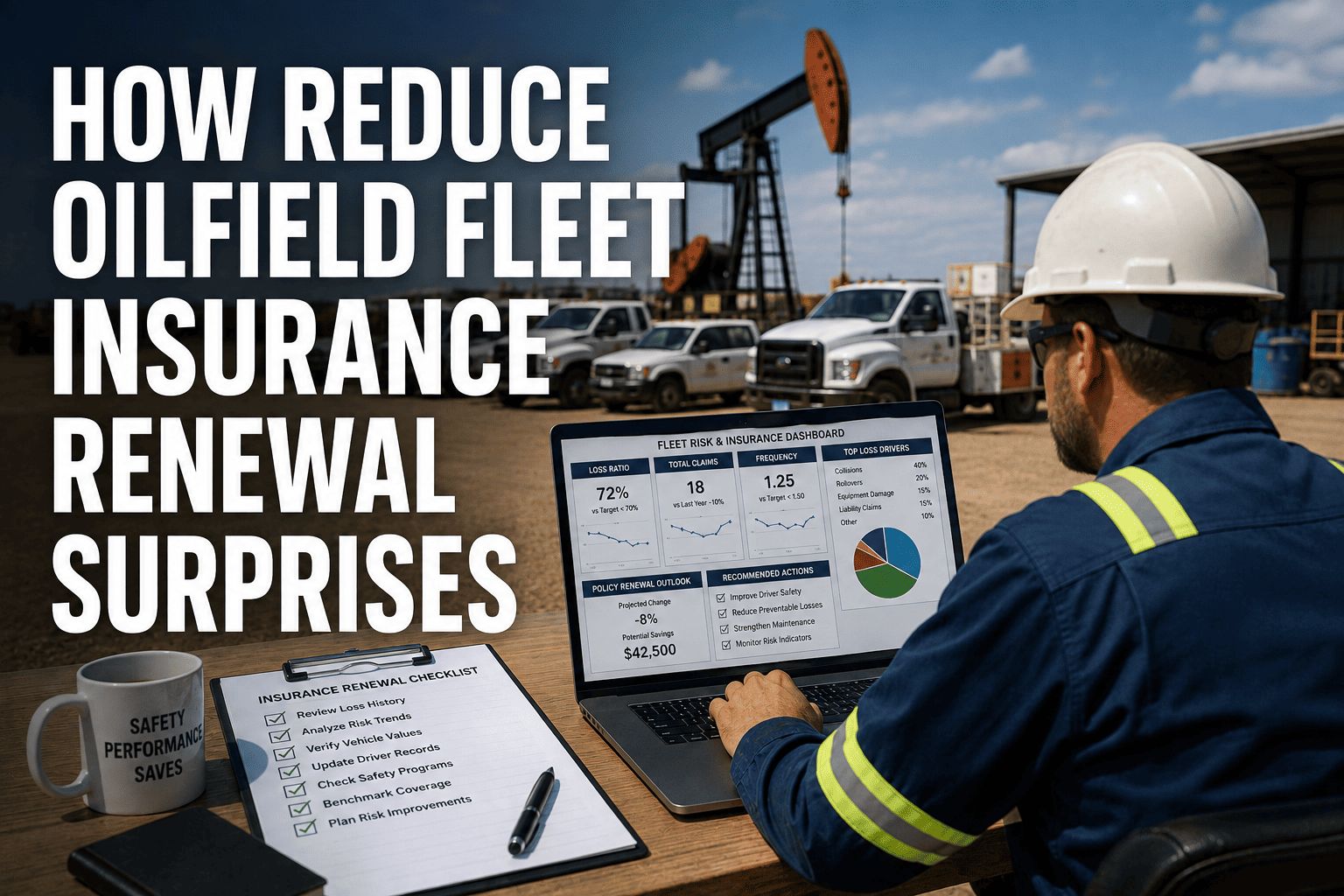
Insurance underwriters pricing oilfield fleet coverage examine the quality of the fleet management programme as primary evidence of operational risk management sophistication. Inspection completion rates, driver behaviour event frequency, maintenance work order documentation, and certification compliance history are all factors in underwriting assessment — and the difference between paper-based evidence and telematics-verified digital records is material to underwriting decisions. FleetRabbit's tamper-evident, GPS-timestamped compliance records satisfy the evidentiary standard that underwriters use to verify that documented safety performance reflects actual fleet management practice rather than paper-documented aspiration. Operators presenting FleetRabbit records at policy renewal consistently achieve 18–22% premium reductions from their baseline — a saving that is sustainable at each subsequent renewal as record quality and programme length extend.
Fuel Cost Reduction Through Real-Time Anomaly Detection and In-Cab Idle Reduction
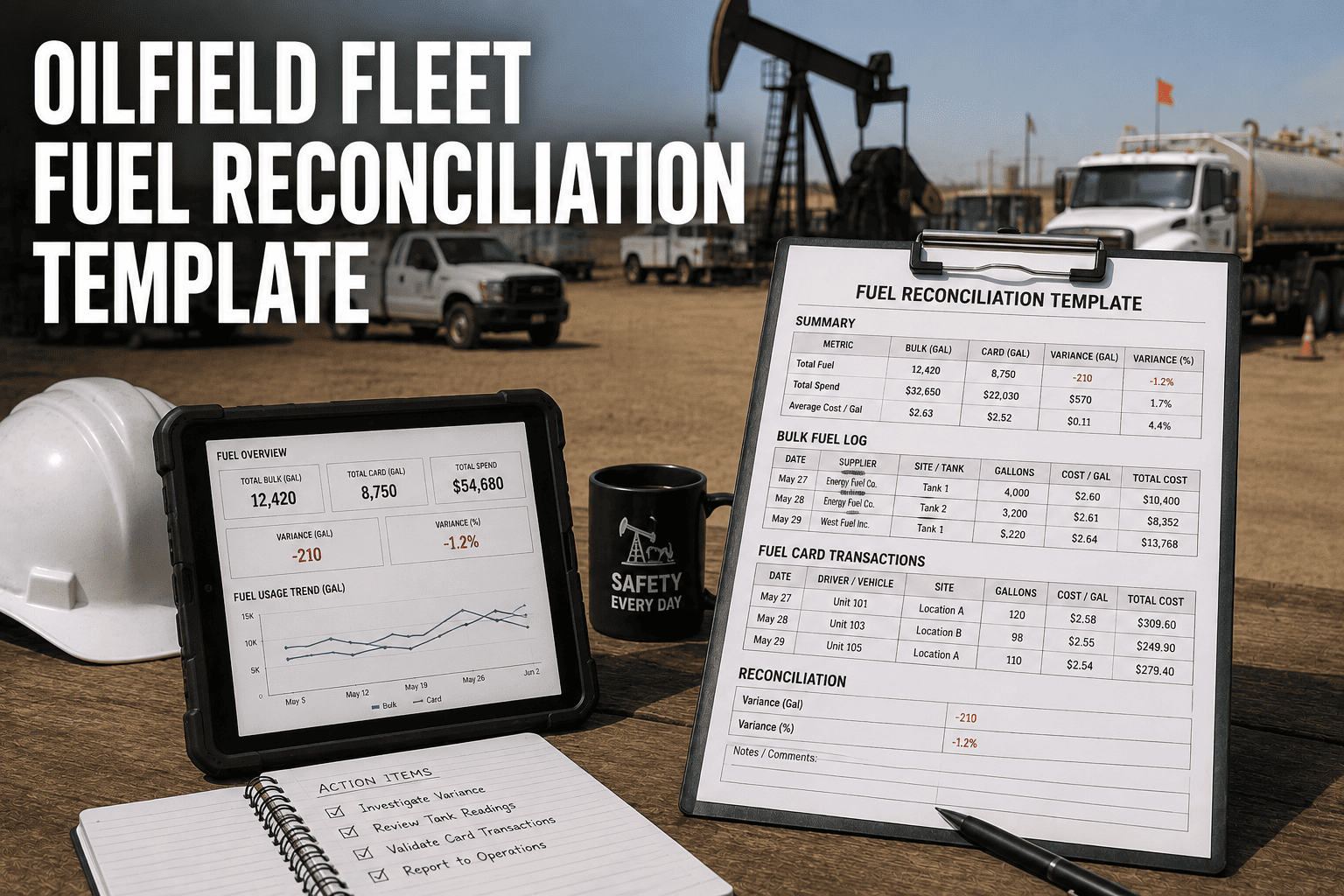
Fuel represents 25–35% of total oilfield fleet operating cost — and it is the largest controllable cost variable in fleet P&L. FleetRabbit's fuel intelligence platform addresses the three oilfield fuel waste drivers simultaneously: wellsite idle accumulation (reduced 25–35% within 60 days through in-cab alerts), unauthorised removal detection (first drain event detected within 8 minutes at multiple deployment sites), and consumption forecasting accuracy (engine-hour baselines replace mileage assumptions that produce 25–40% budget overruns on Basin-duty vehicles). For a 100-vehicle oilfield fleet with an annual fuel budget of $2.5 million, a 20% fuel cost reduction represents $500,000 in annual savings — against a FleetRabbit platform cost of $3,600 per year. No other operational initiative in fleet management produces comparable ROI at this investment level.
Driver Safety Improvement Through Data-Driven Coaching and Real-Time Behaviour Monitoring
Driver behaviour is the most consistently underinvested safety lever in oilfield fleet operations because the data required to coach it effectively was historically inaccessible at the event-level specificity that produces behaviour change rather than general awareness. FleetRabbit's continuous monitoring of hard braking, harsh acceleration, speeding, and seatbelt events — with daily safety scores per driver and in-cab real-time alerts — enables coaching conversations grounded in specific GPS-timestamped event records rather than subjective observations. The safety improvement from data-driven coaching compounds across multiple value dimensions: 34–47% harsh driving event reduction reduces component wear extending brake and tyre service life; incident rate reduction lowers insurance premiums; OSHA 300 log improvements reduce regulatory exposure; and improved safety culture reduces driver turnover from safety-related terminations.
Administrative Efficiency and Executive Intelligence Through Automated Fleet Data Consolidation
Fleet operations teams at oilfield operators without digital fleet management consistently report spending 15–22 hours per week on manual data consolidation — compiling GPS position reports from telematics systems, maintenance records from CMMS platforms, fuel logs from card management systems, certification records from supervisor spreadsheets, and inspection records from paper forms. This time represents both a direct cost at the blended labour rate of the operations team and an opportunity cost in the operational management attention that was not available while data was being compiled. FleetRabbit eliminates this consolidation burden on Day 1 of deployment — because the unified platform generates all consolidation outputs automatically. The operations team returns to operational management; the executive team receives automated weekly performance digests without requiring supervisor data consolidation; and the audit preparation that previously took 40–60 hours takes under 2 hours from the FleetRabbit compliance database.
Deploy the Fleet Software That Delivers All Seven Oilfield Business Benefits Simultaneously — Starting This Week
FleetRabbit provides all seven business benefits — fleet uptime improvement, maintenance cost reduction, compliance penalty avoidance, insurance premium reduction, fuel cost savings, driver safety improvement, and administrative efficiency — through a single platform deployed in 5–7 working days at $3/vehicle/month with no implementation fee. For a 100-vehicle oilfield fleet, the combined benefit value exceeds $1.5 million annually against a platform cost of $3,600.