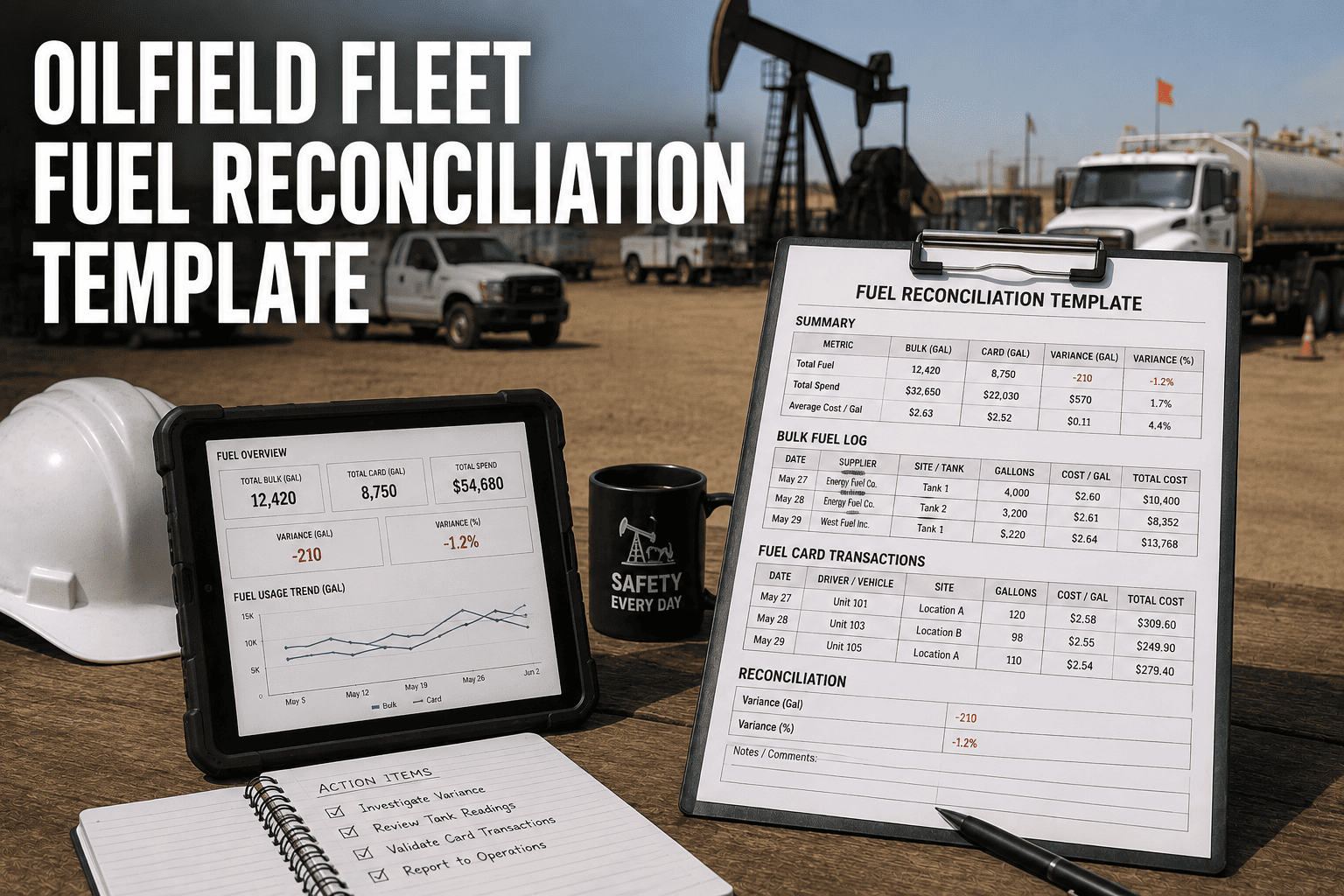
Fuel represents 25–35% of total oilfield fleet operating cost for most upstream and midstream operators — and it is the single largest controllable cost variable in fleet operations, with the emphasis on controllable. Unlike maintenance capital expenditure, insurance premiums, or regulatory compliance costs, fuel cost responds directly and measurably to monitoring and management interventions. Operators who deploy real-time fuel intelligence — cross-referencing tank telemetry, GPS engine status, shift schedules, and route data — consistently achieve 15–25% fuel cost reduction within 90 days of deployment, not through driver restrictions or operational cuts, but through the identification and elimination of specific waste patterns that were occurring without management visibility. The fuel efficiency challenge in oilfield fleet operations has three components that highway commercial transport fleets do not face simultaneously: extreme idle accumulation at wellsite locations where frac trucks and service vehicles run continuously at high load for 40–60% of their shift without the odometer advancing; fuel drain and unauthorised removal events at remote wellsite bowser locations and tanker vehicles during non-supervised hours that manual monitoring cannot detect until the monthly financial reconciliation shows variance; and consumption forecasting based on mileage assumptions that bear no relationship to the actual fuel consumption pattern of vehicles spending the majority of their working hours at idle or high-pump-load rather than travelling. FleetRabbit's oilfield fuel intelligence platform addresses all three components — detecting anomalies within 8 minutes of occurrence, reducing wellsite idle through real-time in-cab alerts, and providing the consumption data precision that makes accurate forecasting and budgeting possible for the first time for most oilfield fleet operators. This article details the specific fuel efficiency and cost control capabilities that FleetRabbit deploys for oilfield fleet operations, the financial outcomes operators achieve, and the operational mechanisms through which those outcomes are delivered. Book a demo to see FleetRabbit's oilfield fuel intelligence platform for your fleet operation.
Oilfield Fuel Efficiency and Cost Control Solutions for Fleet Operations
Fuel is 25–35% of oilfield fleet operating cost — and the most controllable line item in fleet P&L. FleetRabbit's real-time fuel intelligence detects drain anomalies in under 8 minutes, reduces wellsite idle by 25–35% within 60 days, and provides the consumption accuracy that makes actual oilfield fuel budgeting possible for the first time.
Where Oilfield Fleet Fuel Cost Is Being Lost — and Why Standard Monitoring Systems Miss It
Oilfield fuel waste does not look like highway commercial fleet fuel waste. The three dominant waste drivers in oilfield operations are structurally invisible to monitoring systems designed for highway operations — because they occur in conditions that highway telematics assumptions do not account for.
Wellsite Idle Accumulation
Frac trucks, service vehicles, and compression support assets run continuously at high load while supporting wellsite operations without the odometer advancing — accumulating fuel consumption at engine-hour rates that mileage-based monitoring completely misses because it measures distance travelled rather than engine running time. A frac truck consuming 12–18 litres per hour at wellsite idle for 6 hours per shift is burning $72–$108 in unlogged fuel consumption per shift that appears in the daily mileage report as zero. Across a 25-vehicle fleet operating 300 days per year, this idle waste accumulates to $540,000–$810,000 annually — entirely invisible in per-kilometre fuel efficiency metrics.
Off-Hours Fuel Drain and Unauthorised Removal
Remote wellsite bowsers, tanker vehicles parked at staging areas overnight, and fleet vehicles with accessible fuel caps present unauthorised removal opportunities that standard monitoring systems cannot detect because they check tank levels at fill events or at fixed daily intervals — not continuously. An unauthorised drain event occurring at 02:30 from a crude oil tanker at a remote staging area will not appear in a system that reads tank levels at shift start the following morning. By that point, the vehicle has been dispatched, the scene has been disturbed, and the daily variance from the forecasting model is 0.4% — below the threshold that triggers review in monthly financial reconciliation processes that examine aggregate variance, not per-vehicle per-shift anomalies.
Inaccurate Consumption Forecasting from Mileage Assumptions
Oilfield fleet fuel budgets built on mileage-based consumption models — multiplying monthly distance by a per-kilometre fuel efficiency figure — are systematically wrong for Basin operations where the majority of fuel consumption occurs during engine operation at wellsite idle and high-load pump operation rather than transit. A fleet travelling 15,000 km per month but accumulating 4,000 engine hours at wellsite will consume dramatically more fuel than a highway-duty model predicts for the same distance — producing a consistent 25–40% budget overrun that finance teams attribute to fuel price variance rather than consumption model error. The consequence is not just financial reporting inaccuracy — it is the absence of the accurate baseline required to measure whether any fuel efficiency initiative is working.
Real-Time Detection. In-Cab Idle Reduction. Engine-Hour Consumption Accuracy. All From $3/Vehicle/Month.
FleetRabbit's fuel intelligence module unifies tank telemetry, GPS engine status, shift schedules, and route data — detecting anomalies within 8 minutes, reducing idle through in-cab alerts, and building the consumption baselines that make accurate oilfield fuel budgeting possible. Deployed in 5–7 working days with no hardware replacement for fleets with existing telematics.
How FleetRabbit's Oilfield Fuel Intelligence Platform Delivers Cost Control
Multi-Variable Fuel Anomaly Detection — Tank Telemetry Crossed With GPS, Engine Status, and Shift Schedule
Standard fuel monitoring systems check tank levels. FleetRabbit's fuel intelligence platform cross-references tank telemetry simultaneously with GPS vehicle position, engine on/off status, driver shift schedule, and configured route corridor — enabling it to distinguish between legitimate consumption events (engine running, vehicle on route, driver on shift, fuel level declining at expected rate) and anomalous events (fuel level declining with engine off, vehicle stationary, driver off shift, or fuel drop exceeding rate consistent with engine consumption). This multi-variable approach eliminates the false positives from evaporation and measurement variance that single-variable monitoring systems produce, while detecting the genuine drain events that single-variable systems miss.
In-Cab Idle Reduction Alerts — Configurable Threshold by Vehicle Type and Duty Cycle
FleetRabbit's idle monitoring configures independent alert thresholds per vehicle type and duty cycle — recognising that a frac truck supporting an active well completion may legitimately idle for longer periods than a service truck waiting at a yard gate. When a vehicle exceeds the configured idle threshold for its class, the driver receives an in-cab alert from the FleetRabbit mobile app, and the fleet manager receives a notification that a specific vehicle is at excessive idle. The combination of driver awareness and management visibility produces the behaviour change that reduces idle accumulation — not through performance scoring penalties, but through transparency about specific events that drivers themselves did not realise were occurring at the frequency the data revealed.
Per-Vehicle Engine-Hour Consumption Baseline — The Accurate Foundation for Oilfield Fuel Budgeting
FleetRabbit builds actual consumption baselines per vehicle from engine-hour data within 30 days of deployment — establishing what each specific vehicle consumes per engine hour at idle, at productive load, and in transit for its actual duty cycle in the actual basin environment where it operates. This per-vehicle baseline replaces the manufacturer's handbook consumption figure that most fleet fuel budgets use — a figure calibrated for highway duty that can be 40–60% lower than actual Basin consumption for wellsite-intensive assets. With an accurate engine-hour consumption baseline per vehicle, fleet managers can produce fuel budgets that reflect actual operational conditions, identify individual vehicles consuming above baseline as candidates for investigation or maintenance attention, and measure the actual fuel saving from idle reduction initiatives against a verifiable before-and-after comparison.
ESG Fuel Carbon Reporting — Scope 1 Emissions From Verified Consumption Data
FleetRabbit's fuel consumption data — captured per vehicle per shift from engine-hour monitoring — provides the verified Scope 1 emission baseline that investor ESG covenants, operator client Scope 3 reporting obligations, and SEC climate disclosure requirements demand. Fuel consumption per vehicle class is converted to CO2 equivalent using GHG Protocol, DEFRA, or EPA emission factors per fuel type, producing an auditable Scope 1 fleet carbon figure with source data linkage to specific vehicle telemetry records. Idle reduction achievements appear simultaneously in the fuel cost reduction report and in the ESG carbon reduction report — as quantified emission reduction outcomes attributable to specific operational changes rather than generic efficiency improvements. For oilfield operators managing investor ESG covenant reporting or major operator client Scope 3 submissions, FleetRabbit eliminates the manual data assembly that makes these reports take weeks to produce.
Fuel Cost Intelligence for Executive Decision-Making and Financial Reporting
Fuel cost control in oilfield fleet operations is a finance and operations leadership decision as much as a fleet management operational one — because the magnitude of potential savings and the ESG reporting implications operate at the executive and board level, not just the fleet manager level.
Portfolio Fuel Intelligence Without Manual Data Assembly
FleetRabbit provides live fuel consumption trending per vehicle class and per operational site — updated continuously without requiring field supervisor data consolidation. Operations VPs see fuel variance from baseline per site, idle rate per vehicle type, and consumption trending against budget in the same executive dashboard that shows fleet health and compliance status.
Accurate Fuel Budget Forecasting From Engine-Hour Consumption Data
FleetRabbit's engine-hour consumption baselines replace the mileage-based forecasting models that produce 25–40% budget variance for oilfield fleet fuel lines. Finance directors receive per-vehicle, per-site consumption reports that enable fuel budget construction reflecting actual Basin operational conditions — and monthly variance reporting that distinguishes price variance from consumption variance for accurate financial analysis.
Fuel Theft Event Evidence Package for Incident Investigation
When FleetRabbit detects a fuel drain anomaly, the alert includes GPS position, engine status log, shift schedule comparison, tank telemetry history, and drain volume estimate — the complete forensic package required to escalate an investigation. HSE directors receive the same evidence quality from a fuel theft detection alert that they would previously have assembled manually from multiple systems in 3–4 hours.
Verified Scope 1 Emission Data for ESG Covenant and Investor Reporting
FleetRabbit's fuel consumption data provides the verified Scope 1 fleet carbon baseline that investor ESG covenants, operator client Scope 3 requirements, and SEC climate disclosure rules require — with audit-trail linkage from reported figures to source vehicle telemetry data that satisfies third-party assurance standards. Idle reduction achievements are reportable as quantified emission reduction outcomes with specific attribution to operational changes.
Reduce Oilfield Fleet Fuel Costs by 25–35% — Real-Time Detection, In-Cab Alerts, and Consumption Accuracy Starting This Week
FleetRabbit deploys multi-variable fuel anomaly detection, in-cab idle reduction alerts, engine-hour consumption baseline tracking, and ESG carbon reporting on your oilfield fleet in 5–7 working days at $3/vehicle/month. At that price, the idle reduction savings from a 25-vehicle fleet pay for the platform 38x over in the first year — before any drain event prevention or budget accuracy improvement is counted.