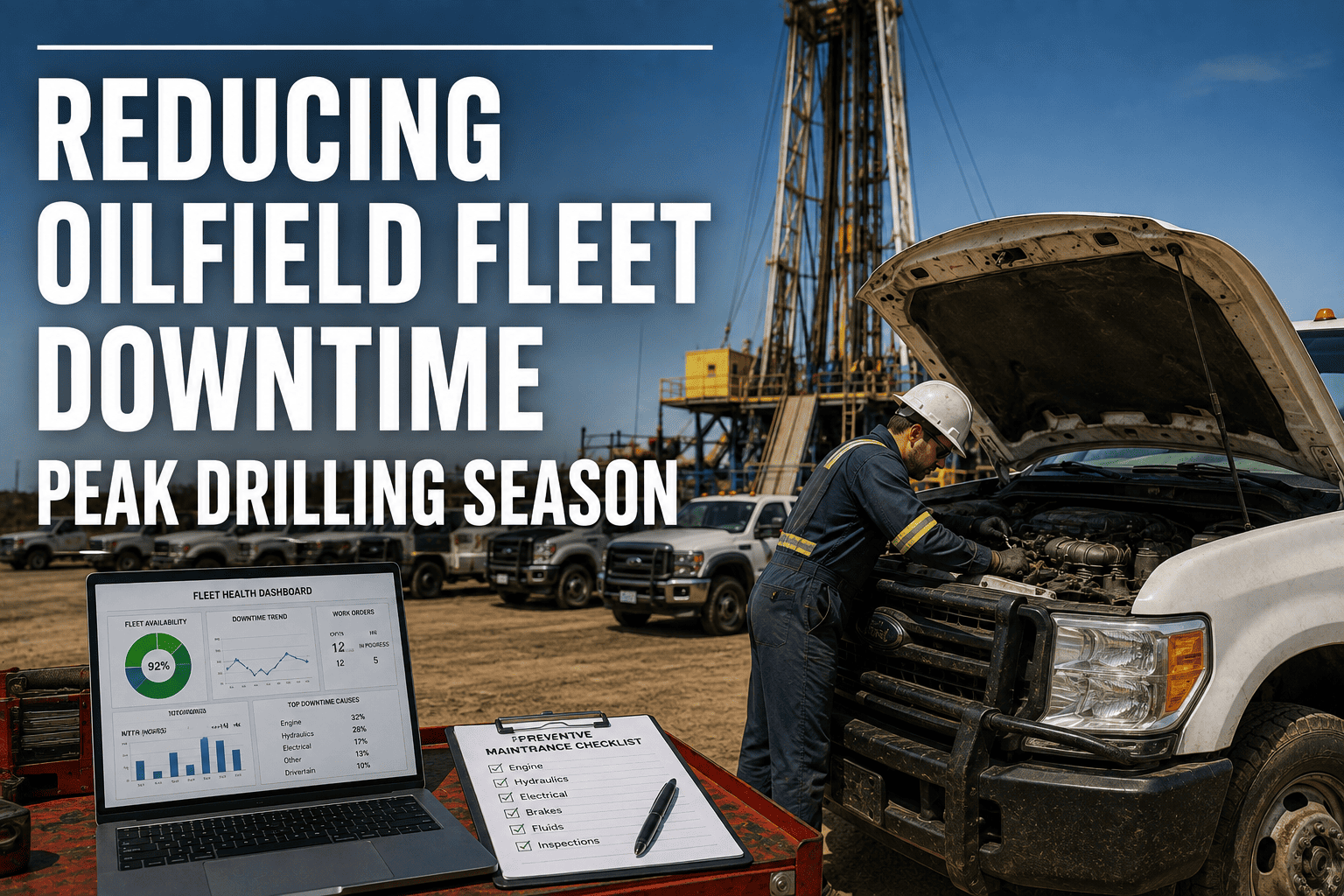
A wellhead service truck rolls to a stop 40 miles from the nearest workshop. No cell signal, no spare parts on hand, a crew standing around with nothing to do. The repair invoice that eventually lands on a manager's desk might read $4,000. The actual cost of that afternoon is rarely anywhere close to that number, because the invoice only captures the smallest piece of what just happened.
A single unplanned breakdown on an active oilfield site typically costs $25,000 to $90,000 once deferred production, emergency logistics, and crew standby time are counted, even though the visible repair order usually represents only 20 to 35 percent of that total. Remote well-pad breakdowns carry 3 to 5 times the recovery cost of yard-adjacent ones, and reactive repairs overall run 4 to 6 times more than the same work done on a planned schedule. FleetRabbit's predictive maintenance has cut breakdown rates by up to 73 percent in deployed oilfield fleets.
The Invoice Only Tells Part Of The Story
Fleet managers who track repair costs by invoice are, almost by definition, undercounting the real damage a breakdown does. The mechanic's bill is easy to see and easy to file. Everything else, the truck sitting idle, the crew waiting, the well shut in while a part gets sourced, is scattered across other departments' budgets and rarely gets added back to the incident.
What Actually Shows Up On The Repair Order
Labor and parts for an emergency oilfield repair typically fall in the $20,000 to $50,000 range for a critical pump or compressor, and considerably less for a routine truck failure. That number feels large on its own, which is exactly why it usually stops the analysis there.
Where The Other 65 To 80 Percent Hides
The remaining share of a breakdown's cost accumulates in production disruption, emergency logistics, contractor standby, and the schedule cascade that follows once one asset goes down. A vacuum tanker failing on location delays fluid disposal and shuts in the well. A wireline truck breakdown can push completion operations back an entire shift. None of that appears on the mechanic's invoice, yet all of it is real money leaving the operation.
Why This Matters For Budgeting
Preventing a single average breakdown incident of roughly $15,000 in direct impact often delivers more financial value than optimizing dozens of routine maintenance tasks, simply because so much of the cost is invisible until leadership adds up every affected department.
FleetRabbit's predictive maintenance AI monitors engine diagnostics, fault codes, and usage stress continuously, flagging at-risk vehicles 7 to 14 days before breakdown. Sign up and see which vehicles in your fleet are already showing warning signs.
Why Remote Location Multiplies The Bill
Distance is the single biggest cost multiplier in oilfield breakdown economics. A failure in the yard gets a technician on scene in minutes with a full parts room nearby. A failure on a remote lease road turns the same repair into a logistics operation.
Every Extra Mile Adds Recovery Cost
Emergency technician dispatch across 60 to 120 mile lease road distances, plus specialist equipment transport for anything that cannot be driven out, is why remote well-pad breakdowns carry 3 to 5 times the recovery cost of a yard-adjacent failure doing the exact same repair.
Reactive Beats Nobody, Not Even The Budget
Reactive maintenance in oilfield environments costs 4 to 6 times more than the same intervention performed on a planned schedule, once after-hours labor, expedited shipping, and contractor mobilization are added in.
| Breakdown Scenario | Cost Driver | Relative Impact |
|---|---|---|
| Yard-Adjacent Failure | Technician on site within minutes, parts on hand | Baseline repair cost |
| Remote Well-Pad Failure | 60 to 120 mile technician dispatch, specialist transport | 3 to 5 times baseline |
| Reactive vs Planned Repair | After-hours labor, expedited parts, contractor mobilization | 4 to 6 times baseline |
| Full Incident Including Production Loss | Deferred production, crew standby, cascading schedule impact | $25,000 to $90,000 total |
Catching The Failure Before It Cascades
The economics only work one way: preventing the breakdown is always cheaper than recovering from it. Oilfield equipment wears through heat cycling, load stress, and idle burn, not mileage, which is exactly why odometer-based service schedules miss so much. A vacuum tanker idling on location for six hours a day is destroying its engine on a timeline that a mileage-based plan never sees coming.
Engine-Hour Tracking Catches What Mileage Misses
Tracking engine hours, fault codes, and load stress in real time for every vehicle surfaces the warning signs weeks before a failure. In one 280-vehicle Permian Basin fleet, 78 percent of catastrophic failures had detectable warning signs weeks in advance, signs invisible to manual inspection but clear to continuous monitoring.
A Prioritized Work Order Beats A Roadside Emergency
Instead of a truck stopping cold on a lease road, a fleet manager receives a prioritized work order with a recommended action before the vehicle even leaves the yard. That single change is what has driven breakdown rates down by up to 73 percent in fleets that have made the switch. If your team is still finding out about failures after they happen, it is worth seeing this in action, and you can book a demo to walk through what predictive monitoring would catch in your own fleet.
FleetRabbit tracks engine hours, fault codes, and load stress across every vehicle, so failures get caught in the yard instead of on a lease road 60 miles out. Start your free trial and see which assets need attention first.
The Bottom Line On Remote Breakdowns
The repair invoice was never the real number. It is the visible fraction of a cost that keeps growing the moment a truck stops on a remote lease road, through recovery logistics, standby time, and deferred production that rarely gets traced back to the original failure. For oilfield fleets, the fastest way to control that cost is not negotiating better repair rates, it is catching the failure before it happens.
If your fleet is still finding out about breakdowns after a truck has already stopped, that is a fixable problem. You can sign up for a free trial and start seeing early warning signs on your own vehicles, or book a demo to see exactly how predictive monitoring fits your fleet.
Every unplanned breakdown carries recovery logistics, crew standby, and deferred production on top of the repair bill. FleetRabbit's predictive maintenance flags at-risk vehicles days before failure, keeping trucks out of the recovery cycle entirely.