Freight billing errors persist for a structural reason rather than a careless one: carriers issue invoices from their own rate cards, not from your negotiated contracts. Invoice generation and contract negotiation live in separate systems, and the reconciliation between them is rarely automated unless someone deliberately builds it. The result is a benchmark that has held steady for years — somewhere between 5% and 10% of freight and parcel invoices carry an error, most of them favouring the carrier, and most going unrecovered. What makes a plant different from a general shipper is that you already hold the evidence that settles the largest error category. Accessorials are the most common source of overcharges, and the accessorials that generate the most argument — detention, waiting, layover, lumper — are all claims about time spent at your site. You recorded that time at the barrier. Book a 30-minute session and bring last month's accessorial lines — we'll match them against your own gate and dock events in Fleet Rabbit and show you how many are already contradicted by data you generated.
2026 GUIDE · FREIGHT AUDIT
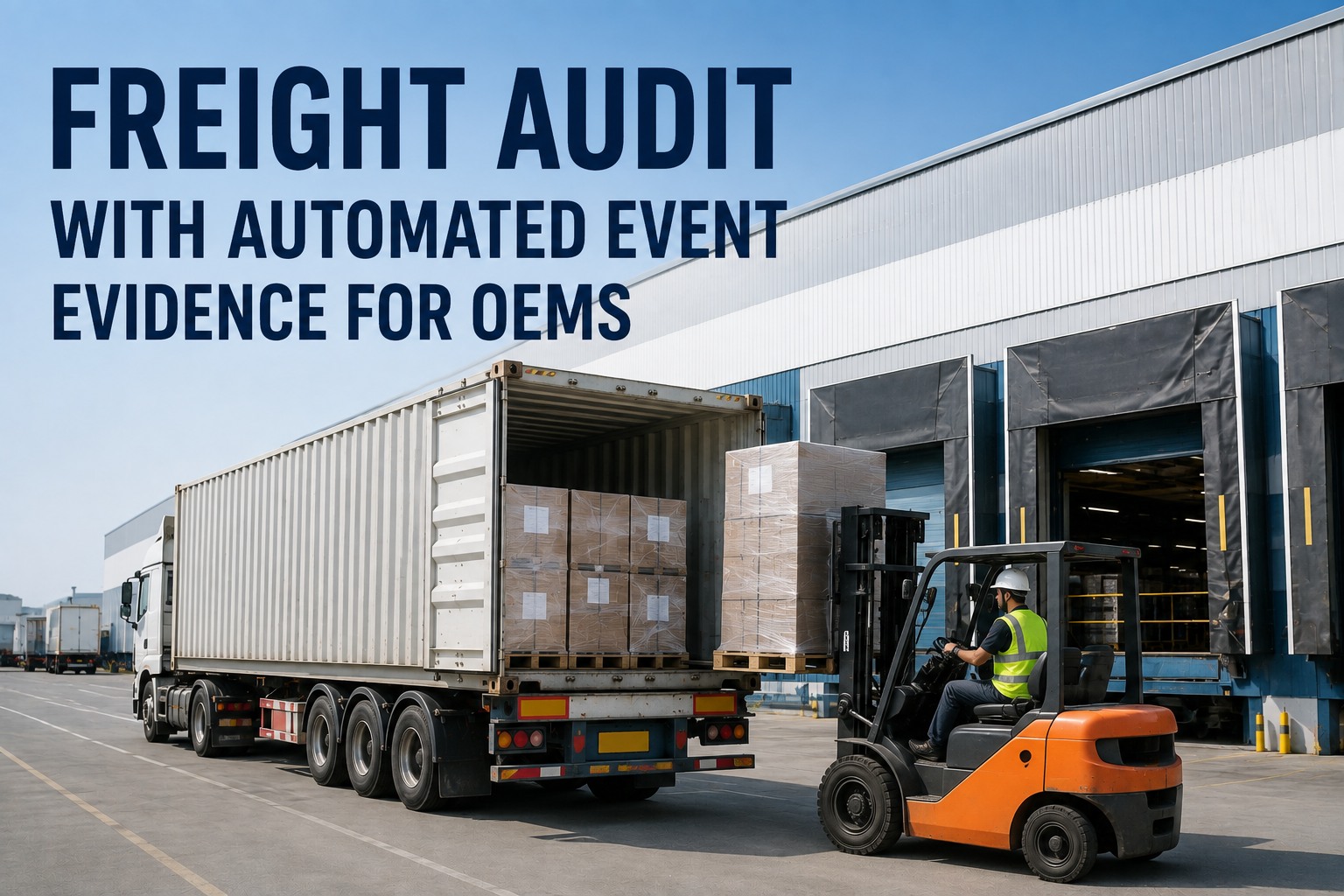
Freight Audit With Automated Event Evidence
Matching invoiced accessorials against observed gate and dock events, tolerances that catch real money, risk-based triage, and turning recovery into pattern closure at renewal.
What the invoice claims
What your gate recorded
Detention, 3.5 hrs
Gate-in to gate-out: 1.9 hrs
Waiting time, 2 hrs
Door assigned on arrival
Layover, 1 day
Confirmed — held overnight
Two of these three are disputable from records you already generate. The third is legitimate, and paying it promptly is what makes the first two credible.
The Scale, in Round Numbers
Published benchmarks cluster tightly enough to plan against, even though the exact figure varies by programme and mode.
5–10%
of freight and parcel invoices carry some kind of error, per the long-standing working benchmark
2–5%
of total freight spend lost to overbilling across most shipper categories — most of it unrecovered without a systematic process
3–8%
of audited freight spend typically recovered by teams who automate the reconciliation
The arithmetic that gets it approved
On a $5M freight programme with a 5% error rate, a systematic audit recovers roughly $250,000 a year. Even on pessimistic assumptions — a 2% error rate and catching only half of it — that is $50,000, which exceeds the annual cost of most audit processes. Recovered overbilling typically exceeds the cost of the process within the first month, which is why this is one of the few logistics business cases that rarely needs a second meeting.
Where the Errors Actually Are
They are not random. They concentrate in predictable patterns, which is what makes automation viable and what makes recovery-only programmes wasteful.
Accessorial charges
The most common source of overcharges. Detention, waiting, liftgate, inside delivery, lumper and layover — applied automatically by carrier billing systems based on address classifications, shipment dimensions or routing rules rather than by anyone checking what happened.
Why it recursThe charge is generated by a rule, not by an observation
Fuel surcharge
The most common and least visible error type. The calculation uses a carrier-specific table that changes weekly — without the correct table for each carrier and the effective date for each load, verification is impossible. Most shippers accept these charges without checking.
Why it recursSmall per invoice, repeating on every single bill
Rate misapplication
Incorrect rate tables applied after a contract update, missing discounts, or the wrong service level billed. Systematic rather than occasional, because the error lives in a configuration.
Why it recursNobody re-tests the rate table after a contract change
Reweigh and reclassification
On less-than-truckload freight, carrier-initiated reweighs and reclassifications are a consistent source of invoice surprises — and they are difficult to contest without your own dimensional and weight records.
Why it recursThe carrier's measurement is the only measurement in evidence
Duplicates
The same charge submitted twice, often with a different invoice number, frequently emerging from one particular submission workflow rather than randomly across a carrier's billing.
Why it recursEach one clears approval individually because each looks plausible
Measurement errors
Incorrect weights, dimensions, pallet quantities and mileage. Small individually, and multiplied across thousands of shipments a year into a material number.
Why it recursIndividually below the threshold at which anyone queries it
Evidence match
You already own the evidence for the largest error category.
Bring one carrier's accessorial lines from last month and your gate log to a short call. We'll match them shipment by shipment in Fleet Rabbit — arrival, door assignment, unload start, departure — and produce the disputable list with the supporting timestamps attached. Most plants have never put the two datasets side by side, and the first pass is usually the persuasive one.
Accessorials a Plant Can Validate From Its Own Events
This is the section that makes a plant different from a general shipper. Six charge types, each a claim about something that happened at your fence.
← Swipe to see all columns →
The pattern is worth stating plainly. Every one of these is a claim about time or activity at your facility, and in every case the carrier's version is currently the only version in evidence. Capturing the timestamps you already generate turns an unwinnable argument into an arithmetic one — and it works in both directions, because it also confirms the legitimate charges quickly, which is what keeps the carrier relationship workable.
Set Tolerances That Catch Real Money
Tolerance design decides how much of the error value you actually see. Too wide and the audit is decorative; too tight and it drowns in noise.
Linehaul
Around ±1%
Tight enough to catch rate misapplication without flagging rounding differences on every load.
Fuel surcharge
±$5 to $10
Practical range for truckload. Requires holding the correct carrier table and effective date, which is the actual work.
Accessorials
Exact — no tolerance
An unauthorised charge is always a dispute regardless of size. Applying a tolerance here is how accessorial creep survives.
The common mistake
±$50 flat
Misses meaningful overbilling entirely. A tolerance set for convenience rather than for materiality.
Audit the audit
If the system approves invoices automatically, somebody has to sample approved invoices periodically to verify the matching logic is still correct. A systematic error in a fuel surcharge calculation that produces false approvals will compound across hundreds of invoices before it surfaces in a financial review — and it will surface as your problem rather than the carrier's. Sample monthly, and re-test after every contract change.
Triage Rather Than Audit Everything
A full line-item audit of every invoice is rarely the efficient answer. A risk-based filter captures most of the value for a fraction of the effort.
1Every invoice above a value thresholdSet it where the tail of your distribution starts. Large invoices carry large errors and justify individual attention.
2Every less-than-truckload invoiceReweighs, reclassifications and accessorial density make LTL structurally error-prone relative to truckload.
3Every invoice carrying an accessorialThe largest error category by value, and now the one you can validate against your own event record.
→The return on those three filtersRoughly 85% to 90% of error value at 30% to 40% of the effort of a full audit — run weekly against incoming invoices rather than in a quarterly batch.
Recovery Is the Start, Not the Point
Most operators treat freight audit as a one-time recovery exercise. The ones who compound the saving use the audit data as a continuous input to how they buy freight.
Recovery-only programme
Finds each error after it has already cost money
Files claims, collects credits, moves on
The same error category reappears next month
Value plateaus at the recovery rate
Useful, and it does almost nothing about the conditions that created the errors.
Pattern-closing programme
Identifies which carriers overbill most often and on which charge types
Feeds that evidence directly into contract renewal
Raises specific patterns — an accessorial application rate several times the peer average on comparable lanes is a conversation
Closes the source, so the recovery rate falls for the right reason
Recovery declining because errors stopped is the outcome you are aiming for.
One caution on interpreting your own numbers: a falling recovery rate is only good news if the error rate fell with it. Track both, and track catch rate separately — otherwise a degrading audit process looks identical to an improving carrier base, and the two call for opposite responses.
When Automation Is Not Worth It
Worth being straight about, because the payback assumptions break below a certain scale.
Under roughly 75 loads a monthManual audit is faster to operate than to automate. Build the discipline first and revisit the tooling when volume grows.
No rate source of truthWithout a system holding contracted rates and accessorial schedules, there is nothing to match against — the rate table is the prerequisite, not the output.
Freight spend below about $1MThe recoverable value may not clear the cost of the process. Run the three filters manually and weekly instead.
No event data at allRate matching still works, but the accessorial validation that generates most of the value needs gate and dock timestamps to compare against.
Twenty minutes on your accessorial spend and your gate log
On an architecture review we'll take a month of invoices and your event data into Fleet Rabbit, run the three-filter triage, and show the accessorial lines your own timestamps contradict — with the evidence packaged the way a carrier billing department will accept it. You keep the disputable list either way, and most teams find the first month pays for the exercise several times over.
Frequently Asked Questions
How much freight overbilling should we expect?
Published benchmarks put 5% to 10% of freight and parcel invoices as carrying some kind of error, and overbilling at roughly 2% to 5% of total freight spend across most shipper categories — with most errors favouring the carrier and most going unrecovered without a systematic process. Teams that automate the reconciliation typically recover 3% to 8% of audited spend. On a $5M programme even conservative assumptions produce a recovery well above the cost of running the audit.
Why do these errors keep happening?
The cause is structural rather than careless. Carriers issue invoices based on their own rate cards, not on your negotiated contracts — the invoice generation process and the contract negotiation process run in separate systems, and the reconciliation between them is rarely automated without a deliberate audit process. On top of that, many accessorials are applied automatically by carrier billing systems based on address classification, shipment dimensions or routing rules, so nobody on either side is checking what actually happened.
Which charge type produces the most recoverable value?
Accessorials, consistently. They are the most common source of overcharges, and for a plant they are also the most contestable — detention, waiting, layover, lumper and redelivery are all claims about time or activity at your own facility. Fuel surcharge is a close second by volume and the least visible, because the calculation uses a carrier-specific table that changes weekly and cannot be verified without holding the correct table and effective date for each load.
What evidence actually wins an accessorial dispute?
Your own timestamps. Gate-in and gate-out against the appointment time and the contracted free window settles detention; door assignment and unload start settles waiting time; departure records settle layover; and the receipt record settles who performed the unloading. In each case the carrier's account is currently the only version in evidence, which is why these charges are so rarely contested. Capturing what you already generate converts the argument from opinion into arithmetic.
Do we need to audit every invoice?
No, and a full line-item audit is usually the wrong use of effort. A risk-based filter — every invoice above a value threshold, every LTL invoice, and every invoice carrying an accessorial — catches roughly 85% to 90% of error value at 30% to 40% of the effort of auditing everything. Run it weekly against incoming invoices rather than as a quarterly batch, because dispute windows and carrier goodwill both shrink with age.
What tolerance should we apply?
Roughly ±1% on linehaul and about ±$5 to $10 on fuel surcharge for truckload — and no tolerance at all on accessorials, since an unauthorised charge is always a dispute regardless of size. A flat ±$50 tolerance, which is common, misses meaningful overbilling entirely. Separately, sample your automatically approved invoices periodically: a systematic error in the matching logic will compound across hundreds of invoices before anyone notices it in a financial review.
How do we stop the same errors recurring?
Use the audit data at renewal rather than only in accounts payable. The findings tell you which carriers overbill most often and on which charge types, and a carrier whose accessorial application rate runs several times the peer average on comparable lanes is a specific, evidenced conversation rather than a general complaint. That is the difference between a recovery exercise, which finds each error after it has cost money, and a programme that finds the pattern and closes it.
Bring a carrier's twelve-month accessorial profile to a session and we'll build the renewal case with you.
Match the Invoice to What Happened
Accessorials validated against your own gate and dock events, tolerances set for materiality rather than convenience, three filters run weekly instead of everything run quarterly, and the findings carried into renewal so the recovery rate falls for the right reason.
Bring a month of invoices and your gate log · Works alongside existing TMS and audit providers · Free tier available
August 21, 2026
By Alex Rowan
All Articles