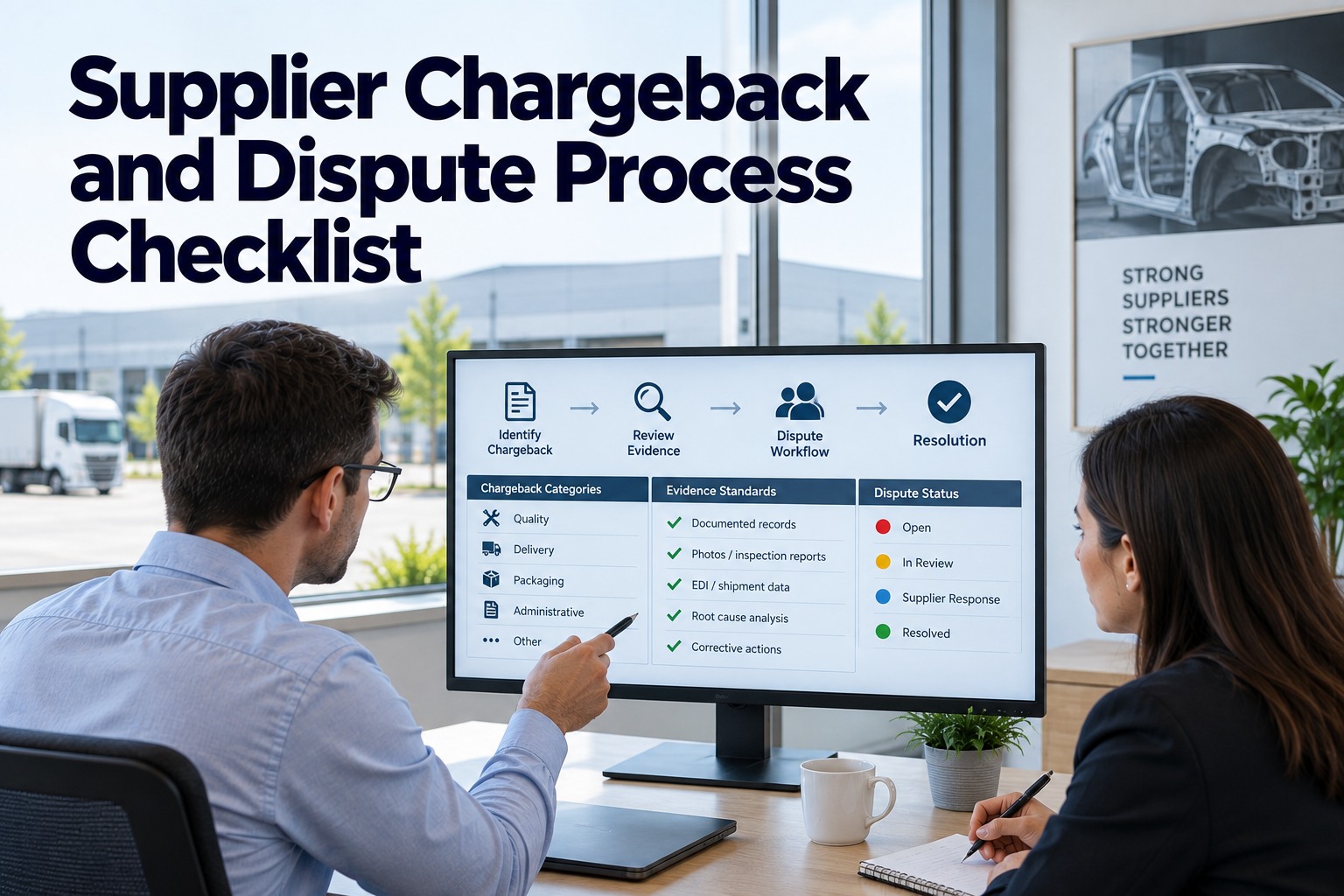
A supplier chargeback is not judged on what happened. It is judged against the reason code it was raised under — which means the dispute was won or lost weeks earlier, at the moment the shipment was labelled, packed and despatched, by whether anyone captured evidence matching that specific code. By the time a deduction appears on a remittance, the money has already moved and the argument is retrospective. Worth clearing up a common confusion first: this has nothing to do with consumer card chargebacks. Those involve a cardholder disputing a transaction with their bank under regulated network rules. A supplier chargeback is a business-to-business deduction between customer and supplier under contractual terms, with entirely different timelines, evidence standards and consequences. Request an enterprise demo to see deductions matched back to the shipment records that would defend them.
Supplier Management · Deductions & Disputes
Supplier Chargeback and Dispute Process
Categorising deductions so patterns become visible, matching evidence to the specific reason code rather than to the story, choosing which to contest, and doing it without damaging a relationship you still need.
Deduction notice
Funds already withheld
Reason codeThe only thing the reviewer assesses against
AmountDeducted, not invoiced
Response windowRunning from the notice, not from when you noticed
Required backupDefined by the code — and captured, or not, at the time of shipment
Every Deduction Has a Code, and the Code Has a Document
The structural insight that changes how a dispute programme is built. Customers do not raise deductions in prose — each one is linked to a specific reason code, and each code has a defined backup document.
Swipe to see all columns
Read the right-hand column and the uncomfortable conclusion follows. Almost none of this evidence can be created after the deduction arrives. The dispute programme people invest in is the visible half; the half that determines outcomes is what gets captured routinely at booking, despatch and handover by people who have no idea a dispute is coming.
The Reviewer Assesses the Code, Not the Narrative
A principle drawn from dispute handling generally, and the reason well-written rebuttals lose.
What suppliers submit
An explanation of what happened
A clear account of the circumstances, why it was reasonable, and what has since been improved. Persuasive to a human reading it sympathetically, and largely irrelevant to the assessment being made.
What gets assessed
Whether the evidence matches the code
The deduction was raised under a specific reason. The question is whether documentation exists that directly contradicts that specific reason — not whether the overall situation was understandable. A rebuttal that argues context against a code that requires a document will fail regardless of how well it reads.
This is why the first step in any dispute is not writing anything. It is identifying the exact code and establishing what document that code requires, then determining whether you hold it. If you do not, the case is closed before it opens — and the correct response is to fix the capture gap rather than to argue.
Supplier response outcomes
Approved
Rejected
No response
The third one is more common than it should be
Claims that get ignored are a documented outcome category in their own right, and they distort every recovery figure that only counts approvals against rejections. Track response rate, approval rate and average response time per supplier — those feed supplier quality scoring and inform sourcing decisions, which makes silence a measurable behaviour rather than an absence of one.
Fight Selectively, Not Comprehensively
The organisations recovering the most are not the ones contesting everything.
01Contest where the evidence and the code alignA deduction raised for late delivery against a shipment with timestamped, located proof of on-time handover is worth pursuing hard. The math and the code are both on your side, and the case is short.
02Concede where they do not, and fix the causeWhere the evidence does not exist, time spent building an argument is time better spent closing the capture gap that produced the exposure. Conceding a defensible-looking deduction you cannot actually document is a commercial decision, not a defeat.
03Weigh the recovery against the relationshipContesting a small deduction with a customer whose next platform award matters more is arithmetic that rarely favours the dispute. That calculation should be made deliberately rather than by whoever happens to be handling the queue.
04Treat the pattern as the real prizeIndividual recoveries are useful. A category showing the same code repeatedly is telling you about a process defect that will keep generating deductions until it is fixed — which is worth more than any single credit.
The underlying observation is worth stating plainly: the larger win is fewer disputes to fight. A dispute function that grows to handle rising volume has been optimised in the wrong direction — the same effort applied upstream removes the deductions instead of contesting them.
Four Ways Money Comes Back
Each has different accounting consequences, and each has to be tracked against the original claim or the reconciliation fails later.
Credit noteThe supplier issues a credit against future orders. Common, clean, and easy to lose track of if it is not linked to the claim that generated it.
Debit noteThe customer deducts the amount from upcoming payments. Fastest for the customer and the one most likely to surprise the supplier's finance team.
Direct paymentLess common, but the cleanest to reconcile since it settles independently of trading activity.
Replacement shipmentParts instead of money. Frequently the best commercial outcome and the worst tracked, because it settles a financial claim with a physical movement that lives in a different system entirely.
The requirement across all four is the same: each recovery method must be tracked against the original claim for audit and accounting purposes. An unlinked credit is functionally the same as no credit, because at year end nobody can demonstrate the claim was ever settled.
The Arithmetic Worth Running
A worked example, using published assumptions from adjacent claim handling. Substitute your own numbers — the shape is what matters.
Claim volume and value500 claims per month at an average of $75
Annual exposure$450,000
Share attributable to a supplier60%
Recovery rate on eligible claims80%
$216,000
Recovered annually — from claims that already existed, on costs already incurred
Two things to take from that. The recovery rate is the only variable you control directly, and it is almost entirely a function of documentation quality rather than of negotiating effort. And for context on why this matters at all: warranty costs are commonly cited at one to three per cent of revenue, so even partial recovery moves a number that shows up at group level.
Preserving the Relationship While Disputing
Five practices. A recovery programme that costs you standing with a customer you cannot replace has not made money.
Framing
Dispute the attribution, not the deduction"This charge is wrong" invites a defence. "This shipment shows on-time delivery at 06:14 with location confirmation, so the delay appears to have occurred after handover" invites a correction. The second is the same argument without the accusation.
Selection
Contest fewer, betterA supplier or customer who disputes everything is treated as a difficult counterparty and eventually gets less benefit of the doubt on the marginal cases. Selectivity buys you credibility on the ones that matter.
Cadence
Handle deductions in the operational review, not by correspondenceA standing agenda item in the monthly review depersonalises it. Individual disputes arriving as isolated emails feel adversarial in a way that the same items reviewed as a category do not.
Reciprocity
Concede clearly when you are wrongAccepting a valid deduction quickly and saying what has changed as a result builds the credibility you will draw on when you contest the next one. It also costs nothing, since the money was going anyway.
Prevention
Share what you fixedA deduction category that stops appearing is more valuable to the relationship than any individual recovery, and telling the customer what changed converts a compliance failure into evidence of a functioning corrective process.
Match a quarter of deductions back to the records that would have defended them
We'll take a set of deduction notices and the corresponding shipment, delivery and inspection records into Fleet Rabbit and sort them three ways — defensible with evidence you already hold, indefensible because the evidence was never captured, and recurring under the same code. The third group is usually the largest, and it is the one worth acting on. You keep the analysis either way.
Building the Workflow
Six stages. Two of them happen before any deduction exists.
1Capture evidence routinely at the eventTimestamped and located proof of delivery, the message as transmitted with its acknowledgement, outgoing inspection results per lot, routing authorisations. None of this is dispute work — it is operational recording that happens to be admissible later.
2Map each customer's codes to required backupA reference table linking every reason code your customers use to the specific document that answers it. Built once, consulted every time, and the single highest-leverage artefact in the whole process.
3Triage on arrival against that mapWithin days, not weeks. Three buckets: evidence held and contest, evidence absent and concede, unclear and investigate. Most deductions are decidable in minutes once the map exists — the delay is almost always in finding out what the code requires.
4Submit against the code, brieflyThe document, the reference, one sentence connecting them. Length is not persuasive here, and a long submission suggests the evidence is doing less work than the argument.
5Track the settlement method to the claimCredit note, debit note, direct payment or replacement — linked to the original claim so it can be reconciled and audited rather than located later.
6Report by category, monthlyDeduction value by reason code, contest rate, success rate and recovery method. The categories that repeat are process defects wearing a financial costume, and they are the reason to run this at all.
Frequently Asked Questions
How is this different from a card chargeback?Entirely. A consumer chargeback involves a cardholder disputing a transaction with their bank under regulated card network rules, with defined statutory timeframes. A supplier chargeback is a business-to-business deduction raised by a customer against a supplier under contractual terms — different timelines, different evidence standards, different escalation and no regulator. Most published guidance on "chargeback disputes" refers to the card mechanism and does not apply.
Why do well-argued disputes still fail?Because the assessment is made against the reason code the deduction was raised under, not against the overall circumstances. A rebuttal explaining why something was reasonable will lose against a code that requires a specific document if that document is absent. The first step in any dispute is therefore identifying the exact code and establishing what backup it requires — not drafting a response.
What evidence actually defends a deduction?It depends on the category. Transport and routing deductions need the routing instruction and any authorisation to deviate. Documentation and labelling need the message as transmitted with its acknowledgement. Delivery performance needs timestamped, located proof of handover. Quality and sorting need your outgoing inspection record for that lot. The common factor is that all of it must be captured at the time of the event — none of it can be created after the notice arrives.
Should we contest everything?No. Contest where the evidence directly answers the code, concede where it does not and fix the capture gap instead, and weigh small recoveries against the relationship with a customer whose next award matters more. Organisations recovering the most are not the ones fighting everything — they are the ones fighting selectively with evidence, on cases where the code and the documentation align. The larger win is fewer deductions to fight at all.
What outcomes should we expect from suppliers we charge back?Three: approved, rejected — usually on grounds of misuse, coverage or insufficient documentation — and no response, which is documented as more common than it should be. Track response rate, approval rate and average response time per supplier, since those feed supplier quality scoring and inform sourcing decisions. Treating silence as a measurable behaviour rather than an absence is what makes it addressable.
How does money actually come back?Four ways: a credit note against future orders, a debit note deducted from upcoming payments, direct payment, or a replacement shipment of parts instead of money. Each carries different accounting consequences and each must be tracked against the original claim for audit purposes. Replacement shipments are the most commonly mistracked, because they settle a financial claim through a physical movement recorded in a different system.
Where should we start?Build the map linking every reason code your customers use to the specific document that answers it. It is the highest-leverage artefact in the process, because most deductions become decidable within minutes once it exists — the delay is almost always in working out what the code requires. Then check whether that evidence is being captured routinely at booking, despatch and handover. Start free with three assets and close the capture gap before the next quarter's deductions.
Win It at Despatch, Not at Dispute
Map each customer's reason codes to the document that answers them, capture that evidence routinely at booking, despatch and handover rather than assembling it under deadline, triage arrivals into contest, concede and investigate within days, track every settlement method back to its claim, and report by category — because a code that keeps recurring is a process defect, and fixing it is worth more than any individual recovery.
Deduction categories, reason codes, response windows and evidence requirements are set by each customer's supplier agreement and compliance documentation, and vary considerably between them. The worked example uses published assumptions from adjacent claim handling and is illustrative — substitute your own figures.