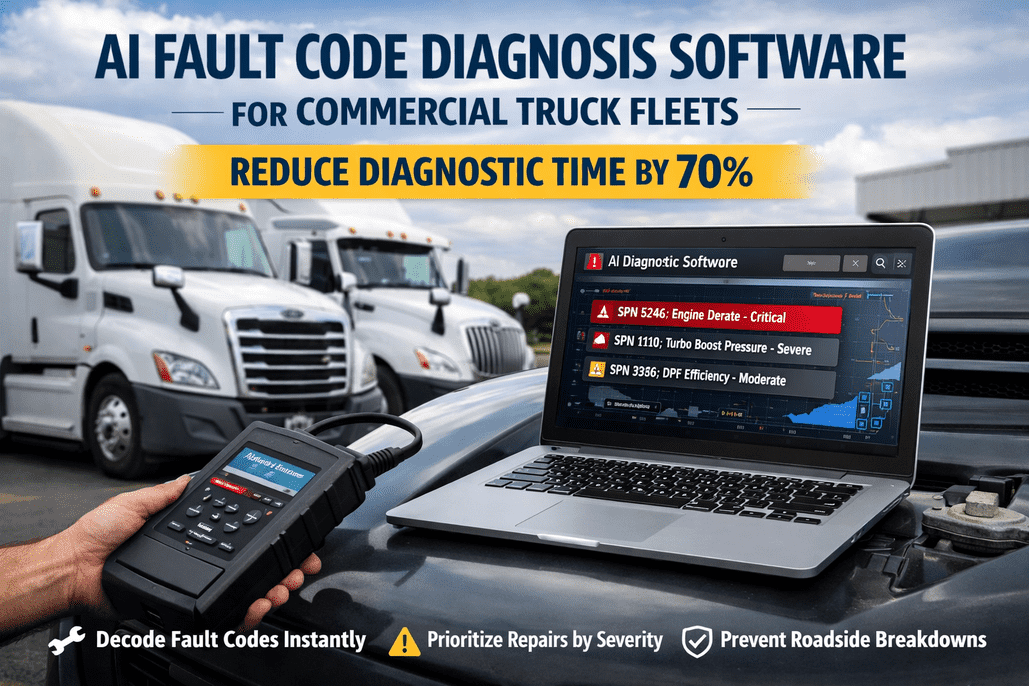
Modern commercial trucks generate thousands of diagnostic trouble codes (DTCs) — and in any given fleet, roughly 10% of vehicles have a high-severity fault active at any time. Yet most fleets still rely on manual code lookups, dealer visits, and technician guesswork to interpret what these codes actually mean. AI fault code diagnosis software changes this entirely by instantly decoding engine fault codes, prioritizing repairs by severity, and predicting failures before they strand your trucks roadside. The result: 70% faster diagnostic time, fewer emergency breakdowns, and trucks that stay on the road earning revenue. Start diagnosing smarter with FleetRabbit.
Why Traditional Fault Code Diagnosis Fails Fleet Operations
Your trucks speak in codes — P0171, SPN 3226, FMI 14 — but without context, these codes are just noise. A single check engine light could mean anything from a loose gas cap to imminent engine seizure. Traditional diagnostic workflows force technicians to manually look up each code, cross-reference OEM documentation, and make educated guesses about severity. That process takes 2-4 hours per vehicle and still gets it wrong 30% of the time.
Manual Code Lookup is Slow
Technicians spend 45+ minutes per vehicle cross-referencing DTCs against OEM manuals, J1939 SPN/FMI tables, and historical repair data. Multiply that across a fleet and you're losing hundreds of wrench hours monthly.
Severity Misclassification
Without AI, a P0128 coolant temperature code gets treated the same as a P0335 crankshaft position failure. Fleets waste resources on low-priority codes while critical issues cause mid-route breakdowns.
Codes Without Context
A DTC alone doesn't tell you the root cause. The same code can indicate three different failures depending on vehicle age, mileage, operating conditions, and related codes. Manual diagnosis misses these correlations.
Reactive, Not Proactive
DTCs only fire after the failure threshold is crossed. By design, they're reactive. Without AI pattern analysis on pending codes and sensor trends, you're always one step behind the breakdown.
Anatomy of a Diagnostic Trouble Code
Before AI can prioritize and diagnose fault codes, it helps to understand their structure. Commercial trucks use two primary diagnostic protocols: OBD-II for light/medium-duty and J1939 for heavy-duty Class 6-8 vehicles. Here's how each code breaks down.
How AI Fault Code Diagnosis Works
AI-powered diagnostics go far beyond simple code lookup. The system ingests raw fault data from your vehicle's ECM via telematics, then applies machine learning models trained on millions of repair records to deliver instant, actionable diagnosis.
Data Ingestion
Telematics devices pull DTCs, sensor readings, and operational data from ECM, transmission, brake, and ABS controllers in real time via J1939/OBD-II protocols.
Code Correlation
AI cross-references active, pending, and historical codes to identify related faults. A single symptom may involve 3-5 connected DTCs — AI maps the relationships humans miss.
Severity Classification
Each fault is scored and classified into Critical (stop now), Urgent (service within 48 hrs), Moderate (schedule service), or Informational (monitor only) — eliminating guesswork.
Actionable Output
Plain-language diagnosis with root cause, recommended repair steps, estimated parts and labor, and automatic work order generation — delivered to technicians and fleet managers instantly.
Stop Guessing. Start Diagnosing with AI.
FleetRabbit decodes every DTC across your entire fleet in seconds — not hours. Get severity-ranked alerts, root cause analysis, and automated work orders from one dashboard.
DTC Severity Matrix: How AI Prioritizes Repairs
Not every fault code demands an emergency response. AI diagnosis classifies each DTC into four severity tiers, ensuring your technicians focus on what matters most — preventing breakdowns without wasting time on informational alerts.
Immediate Action Required
Engine overheating, low oil pressure, brake system failure, crankshaft position faults. Truck must be safely stopped and serviced immediately. Engine derate or shutdown is imminent.
Service Within 48 Hours
Emission system faults, DEF quality issues, turbo underboost conditions. Continued operation risks derate (60% horsepower loss) within 1-2 drive cycles if unresolved.
Schedule Next Service
EGR valve performance, coolant thermostat below threshold, minor sensor irregularities. No immediate risk but degraded efficiency. Can be addressed during next planned service window.
Monitor Only
Pending codes, intermittent sensor glitches, minor evaporative system leaks. AI continues monitoring these codes and escalates automatically if patterns indicate deterioration.
Live Fleet Diagnostic Dashboard
See every active fault across your fleet at a glance — color-coded by severity, with AI-generated diagnosis and recommended next steps for each vehicle. No more scattered spreadsheets or dealer phone calls.
Your Entire Fleet's Health. One Screen.
Every fault code decoded, severity-ranked, and paired with AI repair recommendations — in real time. See it live with a free FleetRabbit account.
OEM Telematics Integration
FleetRabbit connects directly to major OEM telematics platforms, pulling fault code data without requiring additional hardware on most modern trucks. Whether your fleet runs Cummins, Navistar, Detroit Diesel, PACCAR, or Volvo — the diagnostic data flows automatically.
ROI: Manual vs AI-Powered Diagnostics
Why DOT Inspectors Now Care About Your Fault Codes
Recent regulatory changes have made DTCs a focal point during DOT inspections. Inspectors now use ELD transfer features to pull current and inactive fault codes during Level-I stops. Unresolved emission faults can escalate from a warning to an Out-of-Service order, and EPA-tier engines will automatically derate — cutting horsepower by up to 60% — if certain sensor codes go uncleared for two drive cycles. OEMs can also deny warranty claims if telematics show trucks ran repeatedly with active severe DTCs. AI diagnostic software ensures every code is addressed, documented, and resolved before it becomes a compliance liability. Schedule a demo to see DOT compliance features.
Frequently Asked Questions
AI fault code diagnosis software is a fleet management tool that automatically reads, interprets, and prioritizes Diagnostic Trouble Codes (DTCs) from commercial trucks using artificial intelligence. Unlike manual code lookup, AI cross-references active codes with historical repair data, vehicle-specific patterns, and OEM fault libraries to deliver instant root cause analysis, severity classification, and recommended repair actions — reducing diagnostic time by up to 70%.
A standard scanner reads and displays fault codes — that's it. You still need a technician to manually look up each code, determine severity, and figure out the root cause. AI diagnostic software automates the entire process: it decodes codes instantly, correlates related faults, classifies severity into tiers (Critical/Urgent/Moderate/Info), and generates repair recommendations with confidence scores. It also monitors pending codes and sensor trends to predict failures before they trigger a hard DTC.
Yes. FleetRabbit supports OBD-II codes (used on light and medium-duty Class 1-5 vehicles) and J1939 SPN/FMI codes (used on heavy-duty Class 6-8 trucks and buses). The platform also handles manufacturer-specific codes from Cummins, Detroit Diesel, PACCAR, Navistar, and Volvo — providing full coverage for mixed fleets running different engine platforms.
In most cases, no. If your trucks already have telematics devices (Geotab, Samsara, Motive, or OEM-native systems), FleetRabbit integrates directly via API. For trucks without telematics, a simple J1939/OBD-II adapter plugged into the diagnostic port enables full fault code transmission. Most fleets are fully operational within 48 hours of signup. Sign up to check your fleet's compatibility.
Absolutely. DOT inspectors now pull fault codes during Level-I inspections via ELD transfer. Unresolved emission codes can result in Out-of-Service orders, and EPA-tier engines automatically derate after two drive cycles with active DTCs. AI diagnostics ensure every code is caught, triaged, and resolved before it becomes a violation — and maintains the digital documentation needed to demonstrate compliance during audits.
Fleets typically see 70% faster diagnostic times, 45% fewer roadside breakdowns, and $8,200+ in savings per truck annually. The savings come from eliminating dealer diagnostic fees, reducing misdiagnosed repairs, minimizing unplanned downtime, and catching critical faults before they cause cascading mechanical damage. Most fleets achieve full ROI within 60 days.
Decode Every Fault. Fix What Matters First.
FleetRabbit's AI diagnostic engine turns raw DTCs into instant, actionable intelligence — so your trucks spend less time in the shop and more time on the road.