Here is the number that should decide how seriously you take this. Roughly 29 per cent of roadside inspection failures trace back to fault codes that were already known and already logged — captured by the ELD, recorded somewhere, and never acted on. Not undetected problems. Detected ones that died in an inbox. That is a failure of routing rather than of monitoring, and it costs more in 2026 than it did last year, because FMCSA has overhauled its Safety Measurement System and split Vehicle Maintenance — already the largest violation category by volume — into two separate scoring categories. Your ELD is generating the evidence. The question is whether anything downstream turns it into a completed repair before an inspector finds it first. Ask us to check how many of your logged defects actually closed last quarter — most fleets have never counted.
Compliance · ELD and Maintenance Data
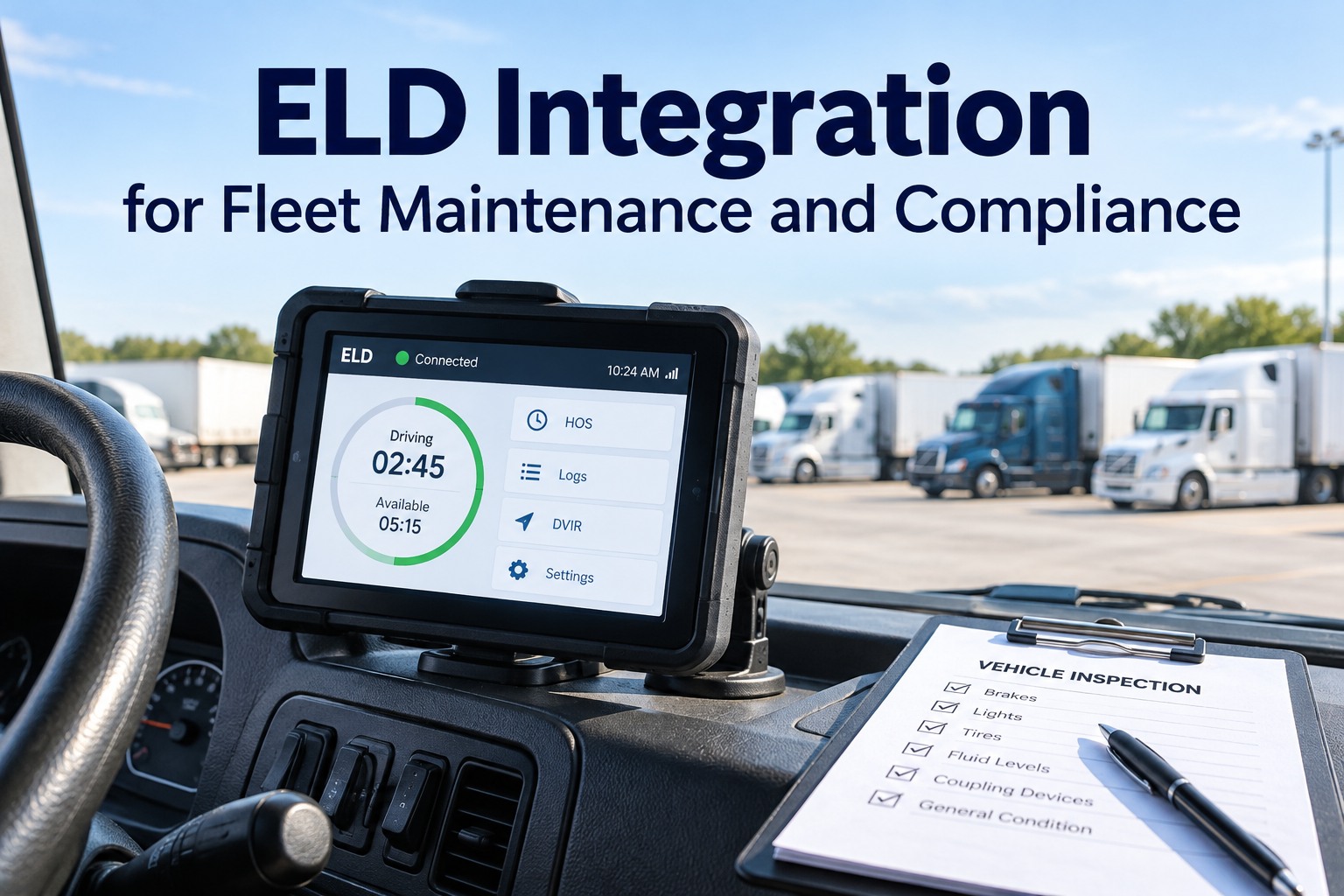
ELD Integration for Fleet Maintenance and Compliance
The fault was logged. The defect was reported. Whether either became a repair is a different system's answer — and it is the one an inspector is testing.
Known, Logged, Ignored
Three words that describe the most common preventable inspection failure in the industry.
29%
of roadside inspection failures trace back to fault codes that were already known and already logged
Nobody missed these. Somebody just did not close them.
The ELD captured the code. It appeared as an alert. In many cases a driver also logged the defect on a daily inspection report. Then it sat — in an inbox, in a report tab, in a folder — while the vehicle went back out. The failure is not detection and it is not diligence. It is that an alert and a work order are different objects, and only one of them has an owner, a due date and a closure.
The same pattern shows in inspection reporting: defects get reported, then nobody follows up on the repair before the truck goes back out. That is the specific compliance risk under the daily inspection rule, and it is what a Vehicle Maintenance citation usually documents.
What Actually Changed in 2026
Described as the most significant enforcement update since the ELD mandate itself. Four changes, and the second one directly concerns maintenance.
Swipe to see all columns
Two figures give that table its weight. Only around 7 per cent of motor carriers complete a DOT audit without a single violation, and penalties now reach $19,277 per hours-of-service infraction under the inflation-adjusted civil penalty schedule. The remaining 93 per cent are dealing with fines, out-of-service orders and score damage that follows them into insurance renewals for years.
Three Streams, Three Destinations
An ELD produces more than logs. Each stream has a place it should end up, and only one of them usually does.
Hours of service
→
Dispatch, and it usually gets there
The stream everyone built for. Predictive alerts ahead of a driver's limit are reported to cut violations dramatically, but this is the flow fleets already have working.
Engine hours and odometer
→
Preventive schedules — often still manual
Engine-hour triggers replace calendar estimates so intervals align with actual utilisation and manufacturer specification rather than assumed mileage. Most fleets still key odometer readings by hand.
Fault codes and defects
→
Work orders — this is the broken one
Where 29 per cent of inspection failures originate. Connecting fault capture to repair tracking is reported to cut fault-to-repair cycle time by around 58 per cent against manual alert workflows.
The middle stream deserves more attention than it gets. Calendar-based servicing on a vehicle that ran 300 hours last month and 80 the month before is wrong twice — too late once and too early once — and the ELD already holds the number that fixes it. That is a saving available without buying anything new, simply by pointing existing data at the schedule.
Two-minute test
Pick 10
fault codes from last quarter
Can you show a completed repair for each one?
Not an alert, not an email, not somebody's recollection — a record showing who fixed it, when and with what parts. Whatever fraction you can evidence is your real closure rate, and it is the number an inspector is indirectly testing. Run it yourself, or send us the ten and we will work through them with you.
The Audit Packet Problem
A specific, measurable failure with a specific, measurable fix.
3–5 days
When the records live apart
ELD data in one system, inspection records in another, maintenance logs in a third. A compliance officer assembles the packet by hand, cross-referencing dates and chasing whoever holds each piece — during a window when the fleet is already under scrutiny.
20 minutes
When they share an asset record
Select the vehicle, select the date range, export. Digital supporting-document storage with date indexing makes a request producible in minutes rather than days — which also means you can run the export as a drill before anyone asks for it.
Worth knowing what has to be in there. Hours-of-service records and backup must be retained for six months, with transfer available by web service or local method, supported by bills of lading, fuel receipts and toll records. Electronic inspection reports must carry the required information and signatures, route to the required recipients, be stored for three months and be producible on request. Different clocks, one packet — which is exactly why assembling it manually takes days.
The Risk Nobody Budgets For
Not about maintenance directly, but it will land on the same desk and it is worth an hour of somebody's attention this week.
The scale79 devices removed from the registered list since January 2025Including several removed in December 2025 with a replacement deadline of February 2026. Revocation is not rare and it is not slowing down.
The consequenceOut of service even if the truck is perfectOnce a revoked device's grace period expires, enforcement officials are directed to cite the driver and place them out of service regardless of vehicle condition. Your maintenance record cannot help you here — the violation is the device.
The actionVerify your model is still listed, and diary a recheckReplacement windows run around sixty days, which is not long if hardware was not budgeted. Checking the registered list quarterly costs nothing and removes an entire category of surprise.
Enforcement attention for 2026 is reported to focus on ELD tampering and cargo securement specifically, alongside the standard inspection process. Worth knowing where the extra scrutiny is pointed, particularly given that falsification of duty status records was the second most-cited driver violation nationally with more than 58,000 recorded in a single year.
One Defect, Followed All the Way Through
Rather than listing features, here is a single defect traced through Fleet Rabbit from the moment a driver notices it.
07:42
Driver logs a defect on the pre-trip inspectionDigital inspection in the app, with a timestamp and a photograph. Digital enforcement is what lifts completion from roughly two-thirds on paper to around 98 per cent — the record exists because completing it is the only way to finish the check.
07:42
A work order is created automaticallyNot an alert. A job, with the asset, the reporting driver, the defect category and the current odometer already attached — before the vehicle leaves the yard, and without anyone retyping a vehicle number.
07:44
It lands with a named owner and a due dateThis is the step that does not exist in an alert-based workflow, and it is the step that prevents the 29 per cent. A defect with an owner gets chased. A defect in an inbox gets forgotten by lunchtime.
11:15
Parts and labour recorded against the jobWhat was fitted, who did it, how long it took. The same entries that build cost per asset also build the repair evidence, so the compliance record is a by-product of doing the work rather than a separate task.
13:20
Closed, and the closure is visible at the next inspectionThe driver's next pre-trip shows the defect resolved rather than reappearing as a fresh report. That loop — reported, repaired, verified — is what a Vehicle Maintenance review is examining.
Later
It exports as part of a date-ranged packetInspection, work order, parts, labour, closure and the hours data around it, selectable by vehicle and date. The audit export is the same record, filtered — which is why it takes minutes rather than days.
Every step in that trace already happens in most fleets. What is usually missing is the 07:44 line — the moment a defect stops being information and becomes somebody's job. Everything downstream, including the audit packet, follows from that single change.
What Clean Records Are Worth
Two figures that turn compliance from a cost centre into a budget line with a return.
8–15%
Premium discount reported for fleets with documented ELD compliance and clean safety scores
$8,200 vs $18,500
Annual insurance per vehicle at a satisfactory safety rating against an unsatisfactory one, per 2026 research — a swing of more than $10,000 per unit, per year
Set that second figure against a fleet of any size and it dwarfs the software question entirely. The difference between a satisfactory and an unsatisfactory rating is worth more per vehicle than most maintenance platforms cost per vehicle several times over — and Vehicle Maintenance is the largest violation category feeding into it. There is also a downtime argument, since vehicles over a decade old are reported to cost around five times more per mile to maintain, which makes accurate interval scheduling matter most exactly where fleets are running older units.
Run the audit drill before someone runs it for you
Pick a vehicle and a thirty-day window and try to produce the full packet — duty records, supporting documents, inspection reports, defects raised and the repairs that closed them. Time it. If it takes days rather than minutes, that is the gap, and you found it on a quiet Tuesday rather than during a compliance review. We will run the same drill with you on three vehicles at no cost and show you what the export looks like when the records already share a home.
Five Things Worth Doing This Month
All of them useful regardless of which platforms you run.
Count your closure rateTake last quarter's fault codes and logged defects and establish what proportion has a documented completed repair. That single number tells you your exposure to the largest violation category there is.
Move PM to engine hours where you canThe ELD already holds utilisation data. Calendar intervals on variable-use vehicles are wrong in both directions, and switching costs configuration rather than money.
Check your device is still registeredDozens have been removed from the list, and an expired grace period means an out-of-service driver even in a faultless truck. Diary a quarterly recheck.
Time a mock audit exportOne vehicle, thirty days, full packet. Days versus minutes is the diagnostic, and knowing the answer in advance is worth the hour it takes.
Challenge violations you believe are wrongThere is a formal route for disputing an inaccurate citation rather than letting it sit permanently on your safety record — worth using, particularly given what a rating is worth in insurance terms.
For a fuller walk-through of the 2026 requirements, our
fleet compliance checklist covers the regulatory changes, retention periods and inspection categories in more detail than a page about integration reasonably can.
Frequently Asked Questions
Why do inspections fail on problems we already knew about?
Because an alert and a work order are different things. Around 29 per cent of roadside inspection failures trace back to fault codes that were already known and already logged — captured by the ELD, surfaced as an alert, and never converted into an assigned repair with an owner and a due date. The same pattern appears with inspection defects: reported, then nobody follows up before the vehicle goes back out. It is a routing failure, not a detection one.
What changed in 2026 that affects maintenance specifically?
FMCSA overhauled its Safety Measurement System and split Vehicle Maintenance — already the largest violation category by volume — into two scoring categories. Electronic inspection reports were officially authorised, and CDL revocation began for unresolved Clearinghouse violations. The split matters most: more granular scoring makes maintenance failures harder to offset against a clean record elsewhere.
Can ELD data drive preventive maintenance?
Yes, and it is one of the most straightforward improvements available. Engine-hour triggers from ELD data replace calendar estimates, so service intervals align with actual utilisation and manufacturer specification rather than assumed mileage accumulation. A vehicle running 300 hours one month and 80 the next is serviced incorrectly in both under a calendar rule — and the data to fix that is already being captured.
How long should an audit export take?
Minutes, if the records share an asset timeline. Where ELD data, inspection records and maintenance logs sit in separate systems, compliance officers are reported to spend three to five days assembling packets. Remember the different retention clocks — duty records and backup for six months, electronic inspection reports for three — which is part of why manual assembly is so slow. Time a mock export on one vehicle and thirty days; that result is your readiness.
Should we worry about our ELD being removed from the registered list?
It is worth a quarterly check. Seventy-nine devices have been removed since January 2025, with several revoked in late 2025 carrying an early-2026 replacement deadline. Once a grace period expires, enforcement officials are directed to cite the driver and place them out of service even if the vehicle is otherwise safe — so no amount of maintenance quality protects you. Replacement windows run around sixty days, which is tight for unbudgeted hardware.
What is clean compliance actually worth?
More than the software. Insurers are reported to discount premiums by 8 to 15 per cent for documented ELD compliance and clean safety scores, and 2026 research puts annual insurance at around $8,200 per vehicle for a satisfactory safety rating against up to $18,500 for an unsatisfactory one. That gap exceeds $10,000 per vehicle per year, and Vehicle Maintenance is the largest violation category feeding the rating.
Do we need to change ELD providers to do this?
No. The integration sits downstream of whichever registered ELD you run, taking fault codes, engine hours and inspection defects into maintenance workflow. Nothing about your hours-of-service compliance, your hardware or your driver app changes. Connect three vehicles free and check the defect closure rate on those before deciding anything wider.
Detection Was Never the Problem
Your ELD sees the fault, your driver logs the defect, and the record of both already exists. What decides whether that becomes a repair or a citation is one missing step — the moment information becomes somebody's job, with a name and a date against it. Add that step and the audit packet, the closure rate and the Vehicle Maintenance score all follow from it. Leave it out and you keep detecting problems you cannot prove you fixed.