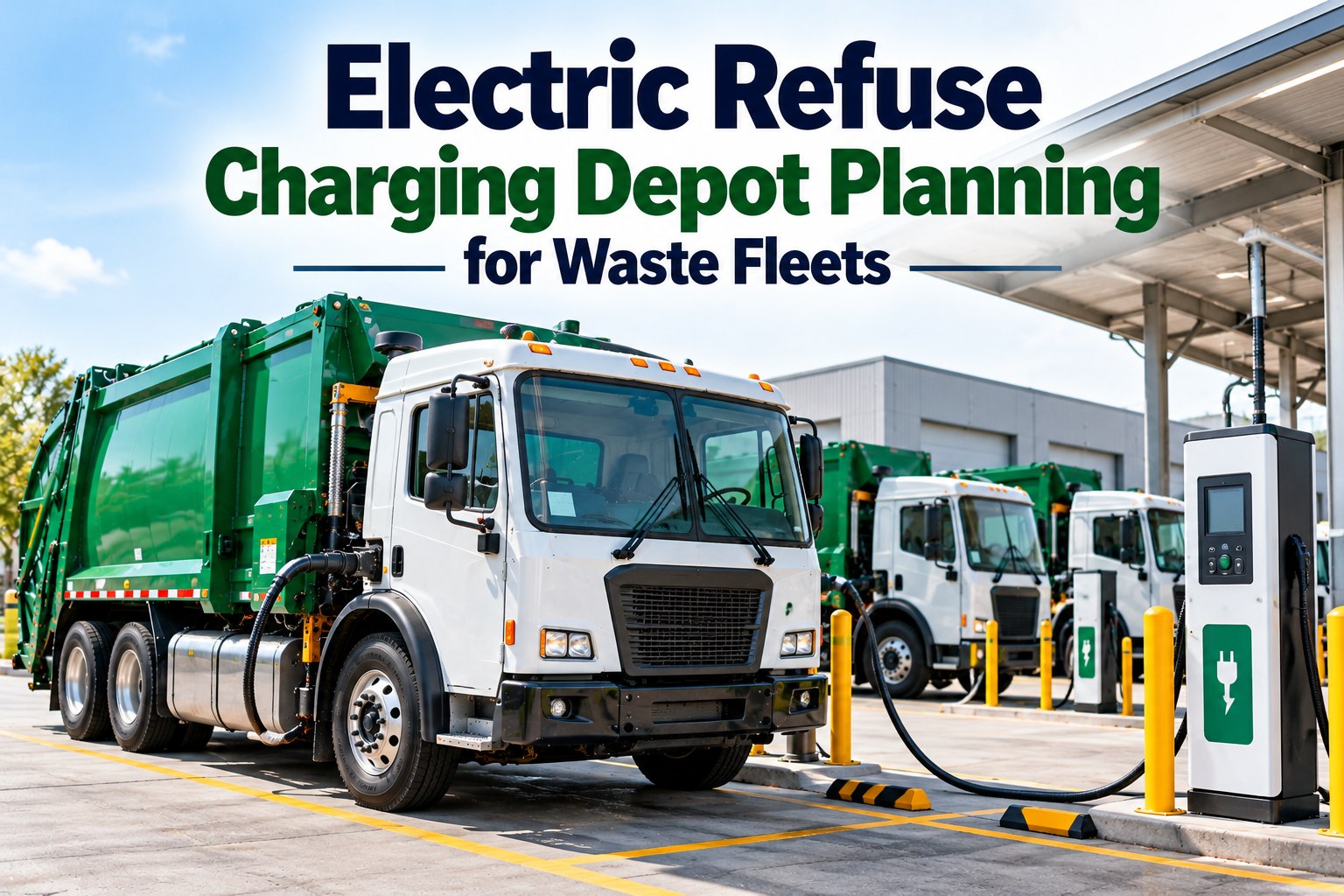
Electric refuse charging depot planning fails on sequencing far more often than on technology. Published planning guidance puts full deployment at one to four years — but the phases are wildly uneven. Integrating the trucks themselves takes one to three months. The electrical upgrades and construction behind them take six to forty-eight. A fleet that orders vehicles first has bought the fastest item in the project and will then wait, sometimes for years, on the part nobody scheduled. The planning has to run backwards from the utility’s timeline rather than forwards from a vehicle order, and the decision that determines whether that happens is taken in the first month of the programme, long before anybody is choosing chargers. Book a planning call before the trucks are specified.
Track the whole build — and every truck in it — on one record. First three vehicles free.
The Trucks Are the Fastest Part of the Project
Four phases, four very different durations, and only one of them is under your direct control. Seeing them side by side explains most of what goes wrong in depot programmes.
Where the Time Actually Goes
Durations from published truck charging infrastructure planning guidance. The spread between phases is the planning problem.
Cheap, slow, and the only phase you fully control
The phase with the widest range and the least control
Fast once power exists, impossible before
The part most fleets start with, and the shortest of the four
Starting a depot programme this year? The sequencing decision made in month one determines whether trucks arrive to working chargers or to a waiting list. Talk it through with us before the vehicle order goes in.
Charging Approach, Site Readiness and Rate Structure
The three decision sets that make up a depot plan. Most fleets resolve the first and discover the other two during construction. Swipe sideways on mobile.
Four Things to Settle With the Utility First
The utility owns the longest phase of the project. Everything here is a planning-phase activity, and all of it is cheaper to do before anything is ordered.
Engage the Utility Before the Trucks
The utility controls the longest phase of the project and cannot be accelerated by urgency later. Opening the conversation during planning, when you have load estimates rather than vehicles, is the single highest-value scheduling decision available.
Estimate Load by Truck Type
Published guidance is explicit about estimating energy needs per truck type rather than averaging. A rear-loader on a dense residential route and a roll-off on long hauls are different loads, and sizing to the average under-serves one and over-builds for the other.
Produce the Single-Line Diagram Early
It specifies service voltage and load, locates service drops and transformers, and is what the utility works from. Treating it as a construction-phase document rather than a planning one is a common cause of restarting step three.
Run the Depot Yard Analysis
Site and grid infrastructure, available space and future expansion. The yard decides trenching distance, and trenching distance frequently decides the budget.
Keep the Build Visible
A depot programme that runs for two years across a utility, a contractor and a charger supplier needs a state somebody can read at a glance — not a folder of email threads.
Four Failures That Cost the Most
Each of these is common, expensive, and entirely avoidable at the planning stage.
Trucks Ordered Before Power
Vehicles arrive in one to three months. The service upgrade behind them can take six to forty-eight. The result is paid-for assets parked against a wall waiting for a transformer.
Everything Charging at Once
Plugging the whole fleet in at shift end creates a single enormous peak. Demand charges are set by that peak, not by total consumption.
Sizing to Today's Fleet
Conduit and switchgear sized for the pilot means the second phase is a second excavation at full cost.
Ignoring the Rate Structure
Two fleets with identical consumption can see very different bills depending on tariff and when they draw power.
Sequencing Comparison: Trucks First vs Power First
The total project duration barely changes. What changes is whether you are paying for vehicles while you wait, and whether the daily inspection record on those trucks starts at delivery or at first use.
The Five-Step Planning Sequence
Published guidance sets these out in order, and the order is the point — step five is where most fleets would prefer to start.
Confirm Whether Upgrades Are Needed
Decide if facility upgrades are required at all, engage the utility and technical support, confirm charging requirements, estimate energy needs by truck type, and determine scaling potential.
Decide Charging Specifications
Define projected energy needs, the charger type — AC or DC, Level 2 or Level 3 — and the charging schedule that fits your route day.
Develop the Electric Service Plan
Specify service voltage and load, locate service drops and transformers, draft the single-line diagram, and estimate costs.
Conduct the Depot Yard Analysis
Assess site and grid infrastructure, available space, and future expansion needs before anything is committed to the ground.
Begin the Installation Process
Only now. Every earlier step exists to make this one predictable rather than exploratory.
Note: Guidance also recommends considering renewable generation and energy storage, and discussing electrical rates directly with the utility where power needs are significant — specifically for fleets planning more than five trucks.
What FleetRabbit Does Across a Depot Transition
A transition runs for years and spans two fleets at once. The job of the software is to keep both legible and keep the build’s state in one place.
Charger Uptime and Fault Logging
Chargers are equipment with a failure rate. Faults, resets and service visits sit on an asset record the same way a truck’s do, so a failing unit is visible before it strands a shift.
Per-Vehicle Charge Records
Which truck charged, when, and whether it reached the state of charge the next route needs — attached to the vehicle rather than living only in the charger vendor’s portal.
Depot Readiness Checklist
The five planning steps as an assignable checklist with owners and dates, so a multi-year build has a visible state rather than a folder of emails.
Driver Reports From the Yard
A charger that would not handshake, a cable that will not latch, a truck that did not take charge — reported from the cab and routed to whoever owns it.
Work Orders for Charging Equipment
A failed charger check becomes a job with an owner and a date, rather than a note that the unit on bay four has been odd lately.
Cost Per Vehicle Across Both Fleets
Diesel and electric units reported side by side on the same cost basis, which is what a transition business case actually needs to be argued from.
Running diesel and electric side by side? Cost per vehicle on one basis across both fleets is what a transition case is actually argued from. Set it up free for three trucks and see the comparison on your own data.
What to Do While the Electrical Work Runs
Six to forty-eight months is a long time to treat as dead space, and the fleets that use it well arrive at energisation ready rather than merely connected.
The useful work is almost entirely data. Establish what each route actually demands in energy terms before the trucks exist, using the duty-cycle information you already hold — that is what turns a charger specification from an estimate into a calculation. Get the diesel fleet’s cost per vehicle onto a basis you can compare against, because the moment the first electric unit runs you will be asked whether it is cheaper and a vague answer helps nobody. Decide now how charging state will be recorded and who owns a truck that did not reach the state of charge its next route needs, since that question arrives on day one and improvising it produces a process nobody trusts.
None of that needs power, hardware or budget approval, and all of it is far harder to do retrospectively. A maintenance record that already carries the diesel baseline is worth considerably more than one started the week the chargers are commissioned.
Where Refuse Routes Help, and Where They Do Not
Collection work suits depot charging better than most vocations, for a reason worth being explicit about: the route day usually begins and ends at the same yard, with a long parked overnight window. That is precisely the pattern depot charging is designed around, and it is why refuse appears early in most heavy-duty electrification programmes.
What it does not solve is the peak. A yard where every truck returns within the same hour and plugs in simultaneously produces a single large demand spike, and demand charges are set by that spike rather than by how much energy is used overall. Sequencing the fleet across the overnight window costs nothing in route time and is the main commercial lever available. It is also one of the few decisions that can be changed after the concrete is poured, which makes it worth getting the scheduling right rather than buying capacity to avoid the problem.
Frequently Asked Questions
How long does an electric refuse depot take to build?
Published planning guidance puts full deployment at one to four years depending on fleet size and the upgrades needed. Planning runs three to twelve months, electrical upgrades and construction six to forty-eight months, and integrating the trucks themselves only one to three. The electrical work is the long pole and it is the part you control least.
Should we order trucks or power first?
Power. Vehicles are the fastest element of the whole project at one to three months, so ordering them first simply means they arrive and wait. Start the utility conversation during planning and time the vehicle order against the energisation date.
Do we need a full depot build to run a pilot?
Often not, and checking is the cheapest step available. Existing service capacity is sometimes sufficient for a small number of trucks, which lets a pilot run while the main upgrade proceeds on its own timeline.
What actually drives the cost?
Trenching distance and service capacity far more than the chargers themselves. The depot yard analysis exists precisely because where the transformer sits relative to where the trucks park changes the budget substantially.
How do we avoid large demand charges?
Demand charges are set by peak draw rather than total consumption, so sequencing the fleet instead of plugging everything in at shift end is the main lever. Guidance also recommends evaluating EV-specific utility rates during planning, as a separate exercise from the connection itself.
At what fleet size does this get serious?
Planning guidance suggests discussing electrical rates with the utility for fleets planning more than five trucks. Below that, existing capacity more often suffices; above it, the conversation changes.
Does a refuse route suit depot charging?
Generally better than most vocations, because the route day typically starts and ends at the same yard with a long parked overnight window. That pattern is what depot charging is designed around.
Plan the Power, Then Order the Trucks
Keep the five planning steps, the utility milestones, the charger assets and every vehicle on one record — so a two-year build has a state anybody can read, and the trucks arrive to working chargers. First three vehicles free.