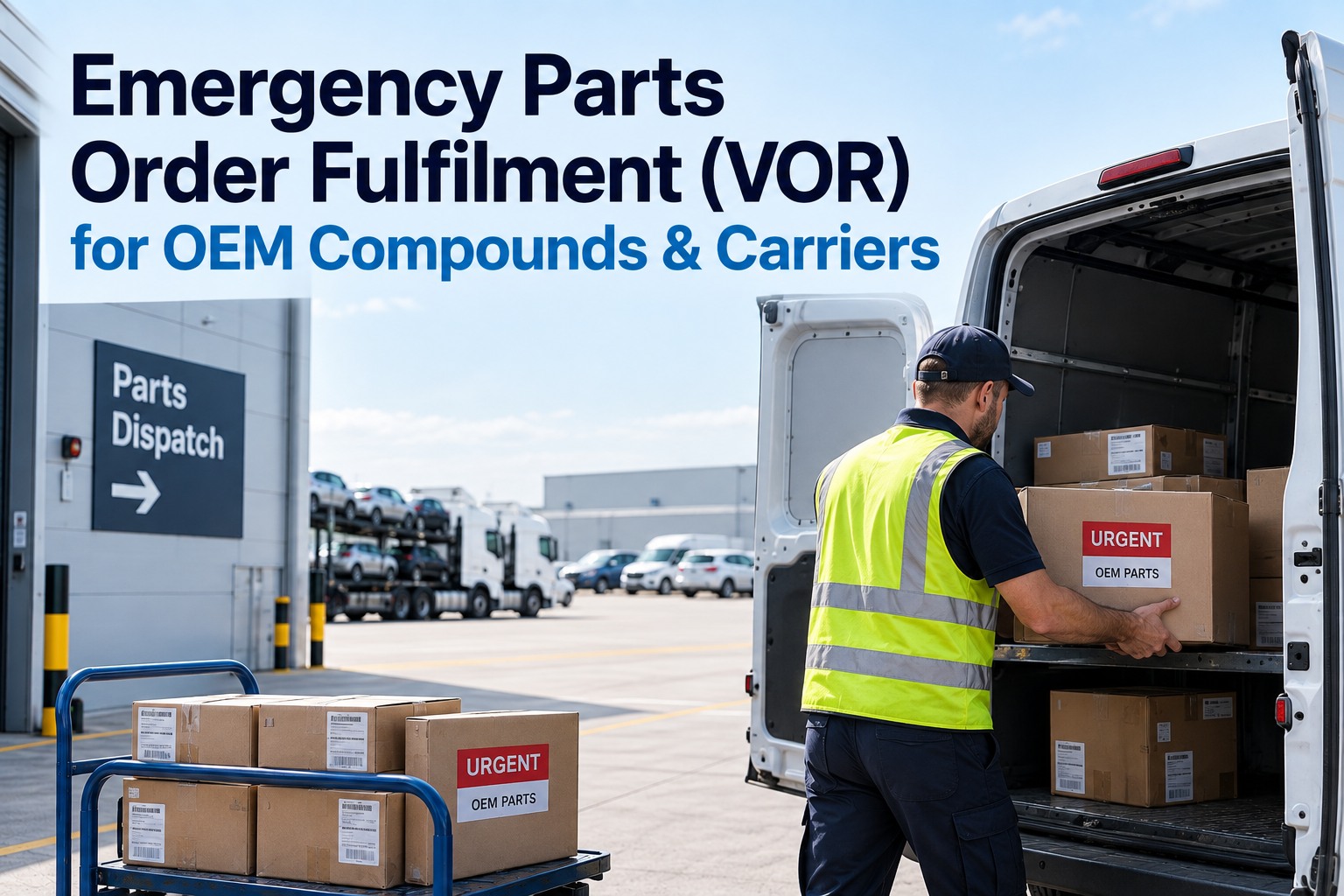
An emergency parts order is not a normal order with a flag on it. It has a different cut-off, a different pick path, frequently a different carrier, and a completely different clock — and networks that treat it as an expedited version of the standard flow fail it in the same three places every time. The clearest published models make this explicit by giving urgent lines their own class rather than their own priority score: a documented regional distribution operation runs three order classes, with stock orders at the bottom, workshop day orders in the middle, and vehicle-off-road orders as class one, each with its own cut-off and its own nominated transporter. That structure exists because the alternative is urgent lines quietly consuming the capacity that every scheduled delivery depends on. Book an architecture review to see where your urgent flow diverges from your standard one.
FVL · EMERGENCY PARTS FULFILMENT
Emergency Parts Order Fulfilment (VOR)
Urgent lines given their own class, cut-off, pick path and carrier — with the clock split four ways, so you can see which interval is actually costing the promise.
Before cut-off — picked, packed, dispatched today
CUT-OFF
After — the vehicle waits until tomorrow
One minute either side of that line is a different day for the customer
Give Urgency a Class, Not a Priority Score
The structural decision that makes everything else workable. A documented operation runs three, each with its own deadline and its own turnaround commitment.
← Swipe to see all columns →
Two things worth taking from that table. The classes have different deadlines rather than different queue positions, which means a dealer knows at the moment of ordering what they have bought. And the same operation maintains its top five hundred fast-moving parts at around 98% availability — because the fastest emergency process in the world cannot beat simply having the part where it was needed.
Reserve the Capacity or the Emergencies Eat the Plan
The single most actionable design decision on this page, and it is a number rather than a principle.
20–30%
Of daily delivery capacity held back for same-day emergency orders
Why the buffer exists
Without reserved capacity, urgent requests destroy the planned routes entirely — because the only way to serve them is to break a sequence that other dealers were relying on. The buffer is not slack; it is the thing that stops one emergency generating four late deliveries.
And what it protects
Scheduled window reliability. A network that absorbs emergencies by degrading its planned service teaches dealers that windows are unreliable, which drives more emergency ordering — the loop that makes the problem grow.
The speed benchmark worth knowing
Best-in-class distributors can accept an emergency order and have it out for delivery within thirty minutes. That figure is only reachable where the pick path, the staging area and the carrier handoff were designed in advance — it is an outcome of structure, not of urgency applied to a standard process.
Five Things Same-Day Actually Requires
Same-day is an operational promise rather than a carrier product. These five elements have to exist together, and most operations have three.
01
A defined cut-off, and a release
The latest time an order qualifies for same-day fulfilment, plus the mechanism that releases it into the warehouse and transport workflow. A cut-off without an automatic release is a deadline that still waits for someone to notice it.
02
A separate pick path
Orders flagged same-day routed to fast-pick zones or dedicated pickers, with simplified packing. Not the same walk as a stock order with a sticker on it — a different route through the building.
03
A staging area for urgent lines
A physical place where completed urgent orders wait for collection, separate from general outbound. This is the element most often missing, and its absence is why picked orders sit in a marshalling area losing the time the pick just saved.
04
A carrier that collects more than once a day
Express couriers, local carriers or an in-house fleet accepting pickups multiple times daily. A single daily collection converts every same-day promise into a next-day one, regardless of how fast the warehouse was.
05
Monitoring against the promised window
Not against a generic on-time figure. The emergency service level is its own commitment and needs its own measurement, or its failures disappear into an average dominated by stock orders.
14:58
order accepted
15:28
out for delivery
Thirty minutes is achievable. Can you evidence yours?
Most operations can state a target and cannot produce the distribution behind it. Bring a month of urgent order lines to a 30-minute review and we'll build the timeline in Fleet Rabbit — accepted to released, released to picked, picked to handed off, handed off to delivered — so you can see which of the four intervals is actually consuming your promise.
Different Class, Different Carrier
Emergency movement is described as a distinct discipline rather than fast routine routing, and the operational differences are specific.
Nominate transporters by class
The documented model appoints local transporters to handle each class of order, rather than pushing all classes through one arrangement. Different urgency, different commitment, different provider — negotiated separately.
Point to point, not routed
Emergency logistics is characterised as direct movement — no relays, no mixed freight, no unnecessary stops when the job is downtime-critical. The moment an urgent line joins a multi-stop run it inherits every risk on that run, and it will arrive behind whatever went wrong at stop three.
Cover the hours breakdowns happen
Emergency provision runs after hours, overnight and at weekends, because vehicles do not fail inside business hours as a courtesy. A same-day promise that expires at five o'clock is a business-hours promise.
The Handoff Is Where It Goes Wrong
Everything upstream can work perfectly and still deliver a part into an empty reception at seven in the evening. Four details prevent it.
Name the exact receiving pointThe shop bay or dock rather than the site address. A part delivered to the main entrance of a large dealer group is not a part in the technician's hands, and the last hundred metres can cost an hour.
Name the recipientA person with a phone, agreed at the point the order is raised. A handoff plan without a named contact is a delivery attempt rather than a delivery.
Confirm availability before dispatchAvailability of the part and the cleanest handoff plan, confirmed together before the movement starts. Dispatching an urgent part toward a site that closes before it arrives converts an emergency into an overnight delay plus a courier invoice.
Keep the repair team informed en routeUpdates so the technician knows when the part arrives, because a workshop can schedule around a known arrival and can do nothing at all with an unknown one. Communication failure between stakeholders is named among the causes of extended downtime.
Proof of delivery timing on an urgent line
On a stock order the record can settle later. On an emergency line the confirmation is operational information rather than paperwork — it is what tells the workshop the repair can start and what closes the service level. Capture it at the handoff with the time and the location, and route it back immediately rather than at end of shift, because a delivery nobody knows about is an asset sitting in a dock.
What Off-Road Time Actually Costs the Customer
Six consequences, and the last one is the reason fleet customers escalate faster than the parts organisation expects.
1Replacement transport and emergency rentalsDirect, immediate and usually at short-notice pricing.
2Administrative overheadThe coordination cost of managing a vehicle that is neither working nor fixed.
3Lost productivityDrivers and field workers left without a vehicle, whose time is spent regardless of whether the vehicle moves.
4Customer dissatisfaction downstreamLate deliveries and service disruption affecting their retention, not just yours.
5Waits measured in weeks on some componentsFleets are described as sometimes waiting weeks for a single part, particularly on specialist vehicles and electric ones — which is where an emergency channel earns its cost.
6Insurance premiumsSlow repair turnaround is linked to higher claims costs and, through them, to increased premiums. That converts your fulfilment speed into a line on their insurance renewal — which is why fleet customers treat off-road days as a commercial issue rather than a service one.
The Four Intervals to Measure
One overall figure hides everything useful. Split it where the responsibility changes.
Interval 1
Accepted to releasedHow long an urgent order waits before it exists in the warehouse workflow. Pure administrative delay, and the cheapest interval to eliminate.
Interval 2
Released to picked and packedThe measure of whether the separate pick path is real. If this matches your stock order pick time, it is not.
Interval 3
Packed to carrier handoffThe staging interval, and usually the largest hidden loss. A part completed at half past two and collected at six has spent longer waiting than it spent being picked.
Interval 4
Handoff to confirmed deliveryTransit plus the last hundred metres, closed by a timestamped confirmation rather than by an assumption that it arrived.
Report those four alongside two others: the share of urgent orders arriving before the cut-off, and the availability of your fastest-moving lines. A rising proportion of after-cut-off emergencies is a dealer communication problem, and falling availability on core lines is what generates the emergencies in the first place.
Twenty minutes on your urgent flow and you will know which interval owns the delay
On an architecture review we'll take a month of emergency order lines into Fleet Rabbit and split the clock four ways — accepted to released, released to picked, picked to handoff, handoff to confirmed. Then we'll show what share arrived after cut-off, how often urgent lines displaced scheduled deliveries, and where a reserved capacity band would have absorbed them. You keep the breakdown either way.
Frequently Asked Questions
What makes an order a vehicle-off-road order?
That the vehicle cannot be driven and a part is required to return it to service. In the documented three-class model these are raised only in genuine emergencies such as a breakdown requiring a part urgently, and they carry the highest priority in the system — above workshop day orders and well above dealer stock orders. The classification matters because each class carries its own cut-off, its own turnaround commitment and its own nominated transporter.
What cut-off should we set?
One documented operation places its emergency cut-off at 3pm with same-day turnaround — picked, packed and dispatched that day, with same-day delivery within the local market. Its stock order cut-off sits earlier, having been extended from 1pm to 2pm for some dealers. The principle matters more than either time: each class needs its own deadline, so a dealer knows at the moment of ordering exactly what service they have bought.
How do we stop emergencies wrecking the scheduled routes?
Reserve capacity for them — the published guidance is 20 to 30 per cent of daily delivery capacity held back for same-day emergency orders, specifically because without that buffer urgent requests destroy planned routes entirely. It is not slack. It is what prevents one emergency generating several late scheduled deliveries, and it breaks the loop where unreliable windows cause dealers to order more emergencies.
How fast can an emergency order realistically move?
Best-in-class distributors can accept an emergency order and have it out for delivery within thirty minutes. That is a product of structure rather than effort — a defined cut-off with automatic release, a separate fast-pick path with simplified packing, a dedicated staging area for urgent lines, and a carrier collecting several times a day. Missing any one of those four, and the other three cannot recover the time.
Should urgent lines go on the regular delivery run?
Generally no. Emergency movement is described as a distinct discipline rather than routine courier routing — direct point-to-point, without relays, mixed freight or unnecessary stops when the job is downtime-critical. The moment an urgent line joins a multi-stop run it inherits every risk on that run. Appointing transporters by order class, as the documented model does, keeps the two commitments separate.
Where do emergency deliveries usually fail?
At the handoff. Confirm the exact receiving point — the shop bay or dock rather than the site address — and a named recipient with a phone, agreed when the order is raised. Confirm part availability and the handoff plan together before dispatch, and keep the repair team updated en route, since poor communication between stakeholders is named among the causes of extended downtime. A part delivered to the wrong door of a large site is an hour lost after everything upstream went right.
Why do fleet customers escalate so hard on this?
Because off-road time costs them in six directions at once: replacement transport and emergency rentals, administrative overhead, lost productivity from drivers without vehicles, dissatisfaction among their own customers, and on some components waits measured in weeks. The one that surprises parts organisations is the last — slow repair turnaround is linked to higher claims costs and increased insurance premiums, which turns your fulfilment speed into a line on their renewal.
Book a review with a month of urgent lines and we'll show where your clock is going.
Class 1 · VOR
Class 2 · Day
Class 3 · Stock
Separate the Class, Then Separate the Clock
Give urgency its own cut-off, its own pick path, its own staging area and its own carrier — reserve the capacity that stops it consuming everyone else's service, and measure the four intervals separately, because a single average will never tell you which one is costing the promise.
Cut-off times, class structures and turnaround commitments vary by network and market — the figures here are drawn from published operator examples and are offered as reference points rather than standards
September 7, 2026By Emily Davis
All Blogs