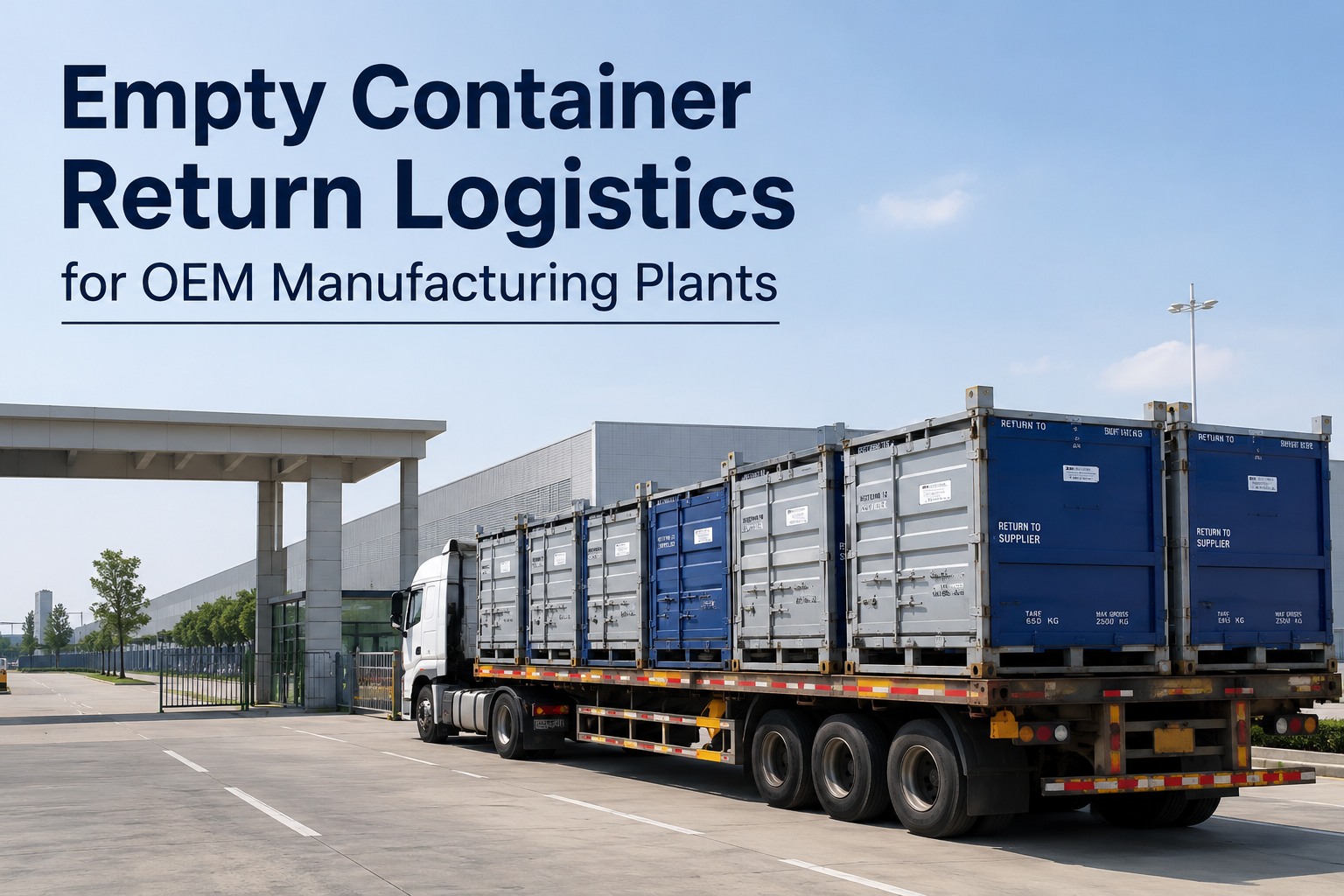
An empty return leg is the only movement in your network that has a guaranteed cost and no possible revenue. Everything else — a late inbound delivery, an oversized pool, a slow dock — costs money contingently, depending on what else goes wrong. An empty trailer running back from your plant to a supplier costs fuel, driver hours, tolls, vehicle wear and emissions with complete certainty, every time, and it does so in a budget line where it is almost never visible as a separate item. That invisibility is the whole problem. Nobody defends a cost they cannot see, so return legs get planned last, filled opportunistically if at all, and treated as an unavoidable consequence of geography rather than as a design decision. In practice they are highly designable, and in a plant network the flows that could fill them — returnable racks, rebalancing stock, supplier collections — are already moving in roughly the right direction. Request the integration datasheet to map the fillable legs on your own lanes.
2026 GUIDE · EMPTY RETURN LOGISTICS
Empty Container Return Logistics
Backhaul planned rather than hoped for, triangulation applied to returnable pools, carrier accountability written into the lane, and an emissions case that stands on its own.
What one empty return leg costs you
Fuel and vehicle wearCertain
Driver hours and tollsCertain
Capacity that could have carried freightOpportunity
Emissions against a Scope 3 targetReported
Four costs, zero revenue, and no line item. That combination is why the leg survives.
Why Empties Behave Differently
Return flows are not inbound freight in reverse. Four properties make them a distinct planning problem, and treating them as ordinary transport is why they get planned last.
No delivery deadlineNothing stops if an empty arrives a day late, so the flow has no natural advocate and loses every scheduling contest it enters.
Flexible timing, inflexible directionEmpties can wait but cannot go anywhere else. That combination makes them the ideal filler for legs that are running anyway.
Cost without revenueRepositioning is widely regarded as unprofitable, costly and undesirable — necessary work that generates nothing on its own.
Structurally imbalancedManufacturing networks consume in one direction and return in the other by design, so imbalance is permanent rather than seasonal.
The property that makes it solvable
Because imbalance is structural rather than random, the opportunity is predictable. You are not hunting for coincidental matches — the same lanes run loaded one way and empty the other, every week, in a pattern you can plan against months ahead rather than discover load by load.
Four Ways to Fill the Leg
In rough order of implementation effort. The first two need scheduling discipline rather than new relationships, which is why they should be exhausted before anything else is considered.
01Scheduled returnable backhaul
Empties and racks ride the leg that already exists, on a planned cadence rather than when someone notices a pile. The most reliable fill available in a plant network because the flow is already going the right way and its timing is flexible.
EffortScheduling only. No new partners, no new contracts.
02Supplier collection en route
Where a supplier sits on or near the return path, collecting inbound freight on the way back converts an empty leg into transport you would otherwise have bought separately. Effectively a milk run assembled backwards.
EffortRoute redesign plus a collection window agreement.
03Triangulation
Instead of returning the unit to its origin, match it directly to the next party who needs it — a container released at one location goes straight to the next point of origin rather than back to a depot. The intermodal industry calls this a street turn, and the logic transfers to returnable pools intact.
EffortMatching capability plus rapid multi-party communication.
04Consolidation depot
A shared empty depot positioned to minimise total repositioning distance across the network. Depot siting is itself an optimisation problem, and one worth solving on both cost and emissions rather than cost alone.
EffortCapital and a network-level model. Last resort, not first move.
Most plants can fill their first legs with flows they already run.
Triangulation, Honestly Assessed
It saves the most and is the hardest to run. The saving is real — eliminating the return-to-depot trip removes empty miles, reduces handling and retrieval, and cuts the emissions associated with moving units back and forth. The difficulty is equally real: the approach is known to be hard to implement in practice, and the reason is organisational rather than technical.
What it requires
A systematic and rapid communication network between all parties — the single most cited barrier
A matching capability that pairs available empties with the next demand point
Agreement on who holds custody between the two legs
Condition standards trusted by the receiving party without re-inspection
Identity that survives the handover, so the unit is traceable across parties
All five are governance. None of them is a vehicle.
What it returns
Fewer empty miles, since the unit never returns to a depot
Faster turnaround, which directly shortens container cycle time
Lower handling, storage and retrieval cost at the depot end
Reduced carbon from eliminating back-and-forth transport
Better asset velocity, which reduces the pool you need to own
The pool reduction is the benefit most often left out of the case.
Worth separating in your own analysis: triangulation improves cycle time, and cycle time determines pool size. So the transport saving is the visible benefit and the capital released from a smaller pool is frequently the larger one — but it only materialises if you actually resize the pool afterwards rather than leaving the surplus in circulation.
Carrier Accountability on the Return Leg
The return leg is where accountability quietly evaporates, because the load has no value, no deadline and no recipient waiting. Six terms that keep it owned.
← Swipe to see all columns →
The Emissions Case
Worth building separately rather than folding into the cost case, because it survives scrutiny on its own terms and it reaches a different approver. Transport is responsible for a substantial share of total carbon emissions, which makes repositioning an environmental question as well as an economic one — and empty running is the least defensible category of transport emissions there is, since no goods move at all.
1Empty miles are pure emitted carbonEvery other transport emission at least moves something. This category is the easiest to justify eliminating and the hardest to defend keeping.
2It lands in Scope 3Upstream and downstream transport sits in the reporting category most organisations find hardest to reduce, which makes a concrete lever unusually valuable.
3The saving is measurable per legUnlike most sustainability initiatives, a filled return leg produces an auditable reduction tied to a specific route and date.
4Depot siting is an emissions decisionOptimal depot location can be solved for economic cost and emissions together, and the two answers are not always the same location.
5Regulatory pressure is risingEmissions regulation is already reshaping repositioning strategy in several European markets, including shifting movements off congested road networks onto rail.
6It funds the cost caseWhere a transport saving alone is too small to prioritise, the combined argument frequently clears the bar that neither would alone.
Two cases, one project
Build the cost case for logistics and the emissions case for sustainability reporting, from the same route data, and present them together. They are the same intervention measured twice — and in most organisations they are approved by different people with different thresholds, so having both roughly doubles the chance of getting past one of them.
Sequencing the Work
Five steps. The first three cost nothing and typically deliver most of the available saving, which is the usual pattern in return-leg work.
1Make empty legs visibleCount them per lane per week. Almost no plant reports this, and the number alone usually changes the conversation.
2Map directional imbalanceVolume out against volume back per lane. Structural imbalance is where the fillable legs are, and it is stable enough to plan against.
3Schedule the returnable backhaulEmpties on a planned cadence rather than on complaint. Cheapest fill available and it also fixes empty dwell at the plant.
4Add supplier collections to the pathIdentify suppliers within a corridor of the return route and rebuild the leg as a reverse milk run.
5Then consider triangulation or a depotBoth need governance and capital respectively. Neither is worth starting before the first three are exhausted.
Zero
revenue on an empty leg, every time, on every lane
Map the fillable legs on your own lanes
The integration datasheet covers empty-leg visibility from your existing route data, directional imbalance mapping per lane, the matching logic behind triangulation and what it requires from partners, and how return-leg events feed container cycle time and pool sizing.
What to Measure
Six figures, per lane rather than per network. A network-level empty ratio is the number that lets every specific lane hide. Our analytics and reporting module carries them.
Empty legs per lane per weekThe base number. If you track nothing else, track this — it is the figure that makes the cost visible for the first time.
Loaded-leg ratioLegs carrying anything as a share of legs run. Include returnables as load, because they are.
Directional imbalance per laneVolume out against volume back. The stable, plannable signal that identifies where fill is available.
Empty dwell before collectionHow long units wait at the plant and at suppliers. Falls when backhaul becomes scheduled, and is an early proof point.
Return-leg emissionsModelled per lane from distance and vehicle type. Feeds Scope 3 reporting directly and funds the cost case.
Cycle time change per laneFaster returns shorten container cycle, which reduces required pool size — the saving most likely to be forgotten.
Frequently Asked Questions
Is triangulation realistic for returnable racks?
Yes in principle, and it is genuinely difficult in practice for the same reason it is in intermodal. The concept is identical: rather than returning a unit to its origin depot, release it directly to the next party who needs it, eliminating the repositioning trip entirely. The barrier is not the vehicle but the coordination — the approach demands a systematic and rapid communication network between the parties, plus agreement on custody, condition standards and identity across the handover. Start with two willing partners on one lane rather than attempting a network-wide scheme.
Where does the biggest saving usually come from?
Scheduled returnable backhaul, because the flow already exists and its timing is flexible. Empties can wait but cannot go anywhere else, which makes them the ideal filler for a leg that is running regardless. Most plants find their first material improvement in legs they are already paying for, using assets already sitting in their own yard — which is also why the first phase of this work rarely needs a business case beyond making the empty-leg count visible.
Why do empty legs persist when everyone knows they are wasteful?
Because they have no advocate. Nothing stops when an empty arrives late, so the flow loses every scheduling contest it enters, and the cost sits inside a blended transport line rather than as an identifiable item. Repositioning is widely described as unprofitable, costly and undesirable — necessary work that generates nothing on its own — and work of that description gets planned last by default. Making the count visible per lane is the intervention that changes the dynamic, before any routing work at all.
Should we build an empty depot?
Only after the cheaper levers are exhausted, and then model it properly. Depot siting is a genuine optimisation problem where the objective should include emissions alongside holding and travel cost, because the lowest-cost location and the lowest-emissions location are not always the same. It is capital and a network-level commitment, whereas scheduled backhaul and en-route supplier collection are configuration changes. Sequence accordingly rather than starting with the most visible option.
How do we hold carriers accountable for the return leg?
By specifying a loaded-leg expectation rather than only a rate per mile, and by naming who owns collection, custody and condition on the return. Where transport is subcontracted, accountability should stay with the contracting party — otherwise a gap opens exactly when a subcontracted carrier fails and you have no counterparty. Add a movement reporting obligation covering events rather than only exceptions, or the return half of your loop will have no data and therefore no measurement.
Is the emissions argument strong enough on its own?
Often, yes, and it is worth presenting separately. Empty running is the least defensible category of transport emissions because nothing moves, it falls in the Scope 3 category most organisations struggle to reduce, and the saving is auditable per route and date rather than estimated. Regulatory pressure is already reshaping repositioning strategy in several European markets, including shifting movements off congested road networks onto rail. Build both cases from the same route data and present them to their respective approvers.
What is the first week's work?
Count empty legs per lane per week from data you already hold, and put directional imbalance next to it. That is a spreadsheet exercise, it needs no system change, and it usually produces two or three lanes where a scheduled returnable backhaul is obviously available and simply nobody's job. Everything more sophisticated follows from having that number in front of people. Our
integrations overview covers the route and event data sources.
Design the Return Leg, Don't Inherit It
Empty legs counted per lane, structural imbalance used as a plan rather than discovered as a surprise, returnables scheduled onto legs already running, and the emissions case built alongside the cost case from the same data.