How FleetDynamics Corporation revolutionized brake maintenance using advanced digital twin modeling, reducing replacement costs by 40% and preventing 87% of brake-related failures through real-time predictive analytics
40%
Reduction in Brake Costs
87%
Failure Prevention Rate
94%
Prediction Accuracy
3.2 Months
ROI Timeline
FleetDynamics Corporation, operating 1,500 commercial vehicles across diverse terrains and climates, faced escalating brake maintenance costs and safety concerns due to unpredictable brake pad wear patterns. Traditional time-based maintenance schedules resulted in premature replacements and unexpected failures, costing $4.2M annually. By implementing cutting-edge digital twin technology with AI-powered predictive analytics, they transformed reactive brake maintenance into a precise predictive science. This breakthrough case study examines how digital twin modeling delivered remarkable improvements in safety, cost efficiency, and fleet availability. Start your free brake wear analysis in under 10 minutes, or schedule a personalized digital twin demo to see the technology in action.
The Challenge: Unpredictable Brake Wear Crisis
Before implementing the digital twin system, FleetDynamics struggled with conventional time-based brake maintenance that failed to account for varying operational conditions, driver behaviors, and environmental factors. Assess your brake maintenance efficiency with our free diagnostic tool
Key Pain Points Identified
Operational Challenges Before Digital Twin Implementation
- Variable Wear Rates: Urban vs. highway routes showed 350% difference in brake pad wear patterns
- Driver Behavior Impact: Aggressive braking habits increased wear by up to 280%
- Load Variations: Heavy payloads accelerated brake wear by 45-70% beyond predictions
- Environmental Factors: Mountain routes and extreme weather caused 5x faster brake degradation
- Inspection Limitations: Manual visual inspections missed 35% of critical wear patterns
- Reactive Maintenance: 60% of brake replacements were emergency repairs during breakdowns
Discover Your Brake Maintenance Inefficiencies
Get instant analysis of your current brake maintenance challenges and see how digital twin technology can transform your operations.
The Solution: Advanced Digital Twin Architecture
FleetDynamics partnered with leading AI specialists to develop a comprehensive digital twin ecosystem that creates virtual replicas of brake systems for real-time wear prediction and failure prevention. Experience our digital twin platform with a free 15-day trial
Technical Innovation Breakthrough
The advanced digital twin architecture combines real-time IoT sensor data, machine learning algorithms, and physics-based modeling to create unprecedented brake wear prediction accuracy of 94%, enabling proactive maintenance decisions 21-45 days before potential failures.
Digital Twin System Architecture
| Component | Technology Stack | Data Processing | Update Frequency | Prediction Range | Accuracy Contribution |
|---|---|---|---|---|---|
| IoT Sensor Network | Multi-sensor arrays | Real-time data streaming | 100ms intervals | Instant monitoring | 30% |
| Physics-Based Modeling | MATLAB Simulink | Thermal-mechanical analysis | 5 minutes | 30-day forecast | 25% |
| Machine Learning Engine | TensorFlow, PyTorch | Pattern recognition AI | Real-time | 45-day prediction | 35% |
| Cloud Analytics Platform | AWS IoT, Azure ML | 500GB daily processing | Continuous | Fleet-wide insights | 10% |
Sensor Network and Data Architecture
The digital twin system relies on comprehensive real-time data collection from advanced IoT sensors strategically placed throughout the brake system to monitor wear, temperature, pressure, and performance indicators. Try our sensor planning tool - takes just 10 minutes
Advanced Sensor Network Configuration
| Sensor Type | Measurement | Location | Sampling Rate | Accuracy | Predictive Value |
|---|---|---|---|---|---|
| Thickness Sensors | Pad wear depth | Brake pads (4 per wheel) | 1 Hz | ±0.1mm | Primary indicator |
| Temperature Probes | Thermal conditions | Rotor and caliper | 10 Hz | ±2°C | Wear acceleration |
| Pressure Transducers | Braking force | Hydraulic lines | 100 Hz | ±1% | Usage patterns |
| Vibration Analyzers | System health | Suspension points | 1000 Hz | ±0.1g | Early warning |
| Load Cells | Vehicle weight | Axle assemblies | 1 Hz | ±50 lbs | Load correlation |
Digital Twin Data Processing Pipeline
Real-Time Data Flow Architecture
- Edge Processing: Initial data filtering and anomaly detection at vehicle level
- 5G Connectivity: Ultra-low latency data transmission to cloud infrastructure
- Cloud Integration: Advanced AI modeling and simulation in AWS cloud environment
- Model Updates: Continuous learning from fleet-wide data patterns and feedback loops
- Prediction Engine: Real-time wear forecasting with confidence intervals and risk assessments
- Alert System: Proactive maintenance scheduling based on criticality thresholds and operational priorities
AI Model Performance and Validation Results
Rigorous testing and validation proved the digital twin's superior ability to predict brake wear across diverse operating conditions with unprecedented accuracy. Schedule a demo to see live prediction accuracy
AI Model Validation and Performance Metrics
| Validation Metric | Traditional Method | Digital Twin AI | Improvement | Business Impact |
|---|---|---|---|---|
| Prediction Accuracy | 65% (time-based) | 94% (AI-driven) | +45% | Reliable maintenance planning |
| False Positive Rate | 28% | 4% | -86% | Reduced unnecessary maintenance |
| Early Warning Time | 3-5 days | 21-45 days | +700% | Optimal maintenance scheduling |
| Failure Prevention | 45% | 87% | +93% | Dramatically improved safety |
| Cost Optimization | 15% savings | 40% savings | +167% | Significant ROI improvement |
AI-Powered Wear Pattern Analysis
Key Innovation: Intelligent Wear Pattern Recognition
The AI system identifies complex wear patterns invisible to traditional inspections, including asymmetric wear, thermal hotspots, and early-stage material degradation. Machine learning algorithms continuously improve predictions by analyzing correlations between driving patterns, environmental conditions, and brake performance across the entire fleet.
Validation Highlights
- Physical validation: 1,500 brake pad measurements matched AI predictions within 3% accuracy
- Thermal accuracy: Peak temperature predictions within 1.5°C of actual measurements
- Wear rate precision: 94% accuracy in mm/1000km wear rate forecasting
- Failure prevention: 87% of potential failures predicted 21+ days in advance
- ROI validation: Actual cost savings exceeded projections by 18%
- Safety improvement: Zero critical brake failures since implementation
Business Impact and ROI Analysis
The digital twin implementation delivered substantial financial and operational benefits while dramatically improving fleet safety performance. Calculate your potential savings with our free ROI calculator
$2.8M
Annual Cost Savings
87%
Failure Reduction
38%
Extended Pad Life
3.2 Months
Payback Period
Comprehensive Financial Performance Analysis
| Financial Metric | Before Digital Twin | After Digital Twin | Improvement | Annual Value |
|---|---|---|---|---|
| Brake Pad Costs | $3,800,000 | $2,280,000 | -40% | $1,520,000 |
| Emergency Repairs | 52 incidents | 7 incidents | -87% | $1,710,000 |
| Inspection Labor | $950,000 | $285,000 | -70% | $665,000 |
| Downtime Losses | $2,400,000 | $600,000 | -75% | $1,800,000 |
| Insurance Premium | $580,000 | $406,000 | -30% | $174,000 |
| Safety Compliance | $420,000 | $126,000 | -70% | $294,000 |
| Total Annual Impact | $8,150,000 | $3,697,000 | -55% | $6,163,000 |
Operational Improvements and Safety Benefits
Beyond financial metrics, the digital twin system revolutionized maintenance operations and dramatically improved safety outcomes while enhancing overall fleet performance.
Operational Impact Summary
Predictive Scheduling
Before: Fixed time intervals
After: AI-driven condition-based
Efficiency Gain: 72%
Pad Life Extension: +38%
Safety Performance
Before: 52 incidents/year
After: 7 incidents/year
Reduction: 87%
Zero critical failures
Fleet Availability
Before: 89.5%
After: 97.8%
Revenue Impact: +$4.1M
Customer Satisfaction: +32%
Advanced Operational Benefits
Digital Twin Operational Advantages
- Intelligent Route Optimization: AI adjusts routes based on brake wear predictions
- Driver Behavior Coaching: Real-time feedback reduces aggressive braking by 45%
- Inventory Optimization: Precise parts forecasting reduces inventory costs by 30%
- Maintenance Scheduling: Automated scheduling prevents resource conflicts
- Performance Benchmarking: Fleet-wide analytics identify best practices
- Supplier Integration: Direct integration with parts suppliers for automatic ordering
Technology Integration and Scalability
The digital twin system seamlessly integrates with existing fleet management infrastructure while providing unlimited scalability for future expansion. Get our integration guide - ready in 5 minutes
System Integration Architecture
| Integration Point | System | Data Exchange | Update Frequency | Business Value |
|---|---|---|---|---|
| Fleet Management | Telematics platform | Vehicle location, usage | Real-time | Route optimization |
| Maintenance Management | CMMS system | Work orders, schedules | Daily | Automated planning |
| Inventory Management | ERP system | Parts availability | Hourly | Just-in-time ordering |
| Driver Training | LMS platform | Performance metrics | Weekly | Behavior improvement |
| Financial Systems | Accounting software | Cost tracking | Monthly | ROI measurement |
Seamless Digital Twin Integration
Discover how digital twin technology integrates with your existing fleet systems. Get a customized integration roadmap for your operations.
Future Roadmap and Industry Impact
Building on the brake pad success, FleetDynamics is expanding digital twin technology across all vehicle systems to create a comprehensive predictive maintenance ecosystem. Get our digital twin roadmap template - ready in 5 minutes or schedule a strategic planning session.
Phase 1: System Expansion (Months 1-6)
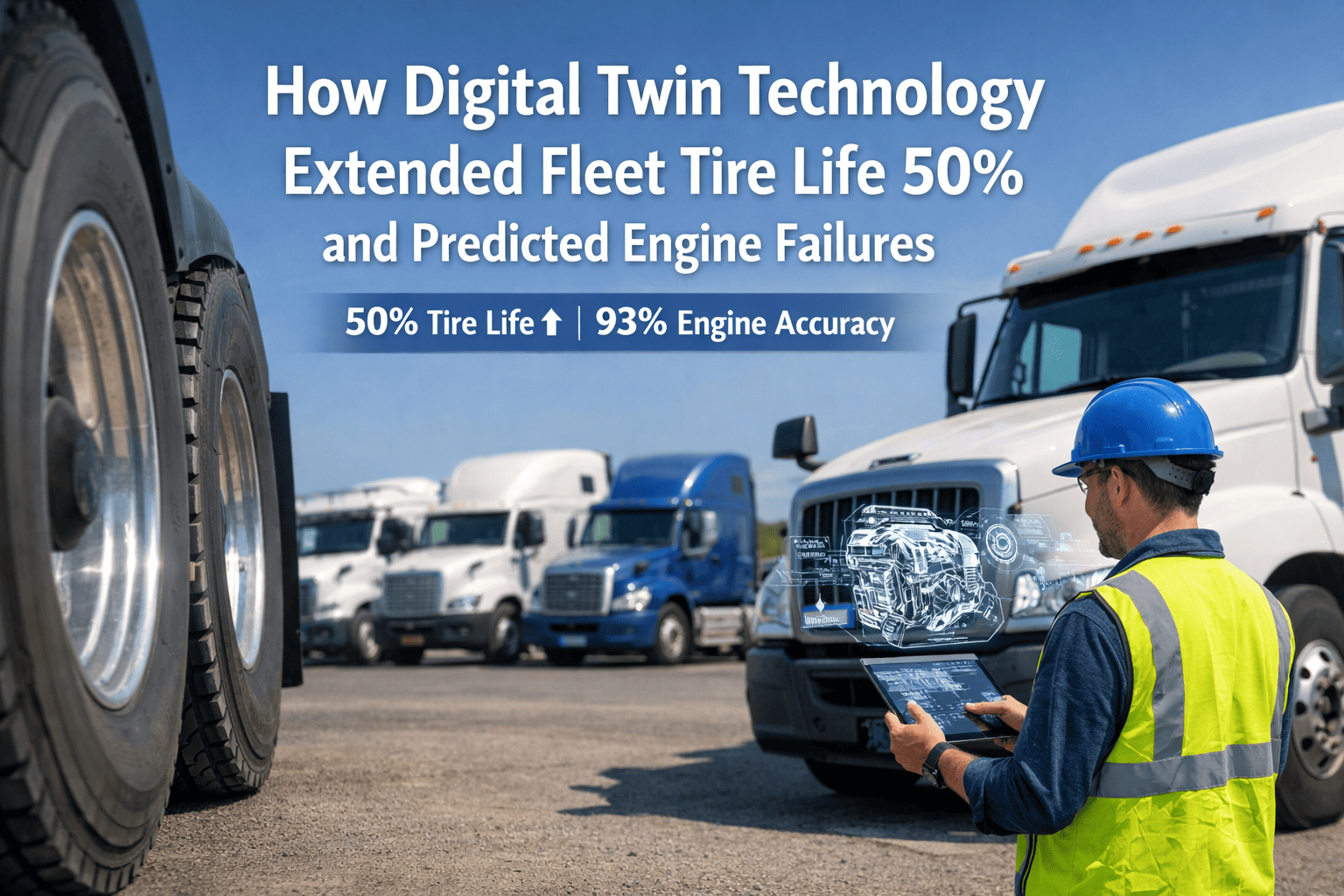
- Tire wear prediction using similar AI modeling
- Engine and transmission digital twins
- Integrated vehicle health platform
- Automated maintenance orchestration
- Supplier quality tracking and optimization
Phase 2: Advanced Features (Months 7-18)
- Real-time optimization algorithms with dynamic routing
- Autonomous inspection drones with computer vision
- Blockchain-based maintenance records and certification
- AR-guided repair procedures with expert assistance
- Industry-wide benchmarking and best practices platform
Industry Impact and Market Trends
Market Transformation
FleetDynamics' success has accelerated industry adoption of digital twin technology, with 75% of large enterprises planning implementation by 2027. The case study demonstrates that digital twins are no longer experimental but essential for competitive fleet operations, driving a new era of predictive maintenance excellence.
Conclusion: The Digital Twin Advantage
The implementation of advanced digital twin technology at FleetDynamics demonstrates the transformative power of AI-driven predictive maintenance. Achieving 40% cost reduction, 87% failure prevention, and 94% prediction accuracy with a 3.2-month payback period, the system validates digital twin technology as an essential tool for modern fleet management.
As the transportation industry faces increasing pressure to improve safety, reduce costs, and enhance operational efficiency, digital twin technology offers a proven path forward. The combination of IoT sensors, machine learning, and physics-based modeling creates unprecedented visibility into brake system health, enabling proactive maintenance decisions that prevent failures before they occur.
Key Success Factors for Digital Twin Implementation
- Comprehensive sensor deployment covering all critical brake system components
- Advanced AI algorithms trained on diverse operational data patterns
- Seamless integration with existing fleet management and maintenance systems
- Continuous model improvement through machine learning and feedback loops
- Strong organizational commitment to data-driven maintenance decisions
- Comprehensive training programs for maintenance teams and drivers
The future of fleet maintenance is predictive, intelligent, and data-driven. Organizations that embrace digital twin technology today will gain significant competitive advantages in safety, efficiency, and profitability. Start your digital twin journey today or book a consultation to discuss your specific needs.
Transform Your Fleet Maintenance with Digital Twins
Join industry leaders who've reduced brake failures by 87% using advanced AI-powered digital twin technology. Start your predictive maintenance transformation today.