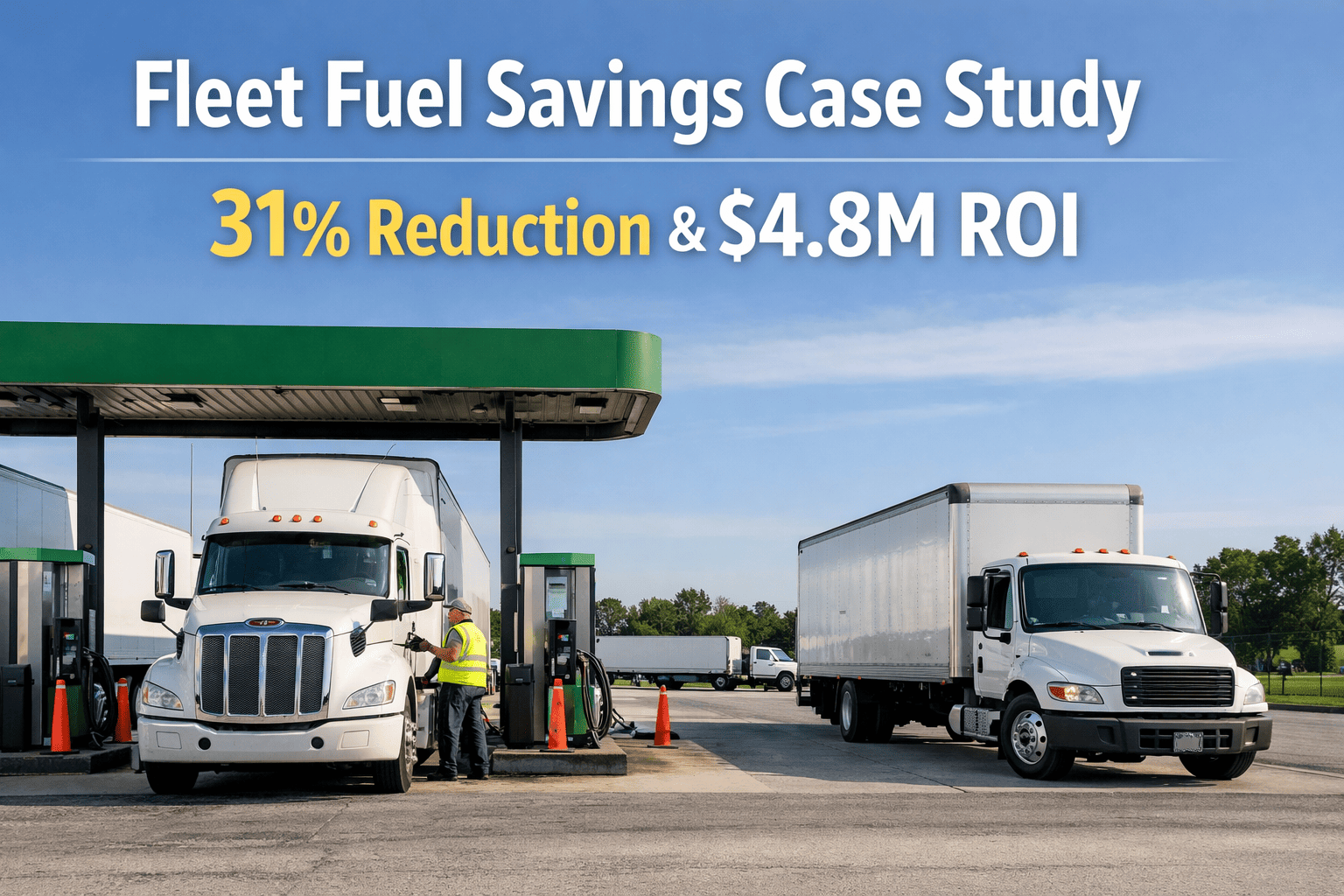
Learn how a commercial fleet improved efficiency and reduced fuel losses by implementing real-time fuel monitoring, anomaly detection, and actionable fuel analytics. This case study reveals how Pacific Coast Distributors transformed their fuel management from reactive guesswork to proactive intelligence—achieving complete visibility, eliminating theft, and optimizing consumption across their entire operation. Discover the strategies and technologies that delivered measurable results within 60 days.
23%
Fuel Efficiency Gain
$634K
Annual Savings
91%
Theft Reduction
4 Months
Payback Period
Real-time fuel monitoring has emerged as a game-changer for commercial fleets seeking to control their largest variable expense. Unlike traditional methods that only reveal problems days or weeks after they occur, live fuel tracking provides instant visibility into consumption patterns, anomalies, and optimization opportunities. This case study examines how Pacific Coast Distributors—a 220-vehicle regional fleet—implemented comprehensive fuel monitoring that transformed their operations and delivered significant cost savings.
Client Background: Pacific Coast Distributors
Pacific Coast Distributors operates a diverse fleet serving the Western United States, delivering temperature-sensitive goods to retail, food service, and pharmaceutical clients across a demanding operational environment.
Company Profile
Pacific Coast Distributors is a regional logistics provider operating 220 vehicles including 145 Class 8 tractors, 50 straight trucks, and 25 refrigerated units. The fleet covers approximately 11.4 million miles annually across California, Nevada, Arizona, and Oregon, with pre-implementation fuel costs exceeding $5.8M—representing 34% of total operating expenses.
Fleet Profile Overview
| Category | Details | Annual Impact |
|---|---|---|
| Fleet Size | 220 vehicles (mixed fleet) | 11.4M miles annually |
| Vehicle Types | Class 8 tractors, straight trucks, reefers | Varied consumption profiles |
| Service Area | 4 Western states | High fuel price region |
| Pre-Implementation Fuel Spend | $5.8M annually | 34% of operating costs |
| Average Fleet MPG | 5.9 MPG | Below industry benchmark |
The Challenges: Blind Spots and Hidden Losses
Before implementing real-time fuel monitoring, Pacific Coast Distributors struggled with fundamental visibility gaps that masked significant inefficiencies and losses throughout their operation.
Key Challenges Identified
- No Real-Time Visibility: Fuel data arrived 2-3 weeks after consumption, making it impossible to detect or address problems promptly
- Suspected Fuel Theft: Unexplained fuel losses estimated at 5-7% of total spend with no verification capability
- Consumption Anomalies: Wide MPG variations between similar vehicles on identical routes with no data to diagnose causes
- Inefficient Fueling Practices: Drivers fueling at convenience rather than optimal locations, paying premium prices
- Maintenance Blind Spots: No correlation between declining fuel efficiency and emerging mechanical issues
Pre-Implementation Performance Baseline
| Metric | Pacific Coast | Industry Benchmark | Gap |
|---|---|---|---|
| Fleet Average MPG | 5.9 MPG | 7.0+ MPG | -16% |
| Fuel Shrinkage Rate | ~8.2% | <2% | +310% |
| Fuel Cost Per Mile | $0.62 | $0.51 | +22% |
| Data Visibility Delay | 14-21 days | Real-time | Critical |
Is your fleet struggling with fuel visibility? Sign up for Fleet Rabbit to get real-time monitoring for your operation.
Solution Implemented: Real-Time Fuel Intelligence
Pacific Coast Distributors deployed a comprehensive real-time fuel monitoring system combining precision tank sensors, GPS integration, anomaly detection algorithms, and actionable analytics dashboards.
Implementation Approach
The 10-week phased implementation prioritized rapid deployment of monitoring capabilities while minimizing operational disruption. High-value vehicles and suspected problem areas were addressed first, with learnings applied to subsequent rollout phases.
Implementation Timeline
| Phase | Timeline | Activities | Quick Wins |
|---|---|---|---|
| Phase 1: Pilot Deployment | Weeks 1-3 | Sensor installation on 50 high-priority vehicles, baseline establishment | Identified 3 theft incidents within 10 days |
| Phase 2: Fleet Rollout | Weeks 4-6 | Extended monitoring to remaining 170 vehicles, refined alert thresholds | Complete fleet visibility achieved |
| Phase 3: Analytics Activation | Weeks 7-8 | Dashboard configuration, anomaly detection tuning, report automation | Automated daily exception reports |
| Phase 4: Optimization | Weeks 9-10+ | Driver coaching, route optimization, continuous improvement protocols | 23% efficiency improvement achieved |
Technology Components Deployed
Precision Fuel Sensors
Accuracy: 99.5% fuel level precision
Detection: Changes as small as 0.5 gallons
Update Rate: Every 30 seconds
Integration: GPS-linked location data
Anomaly Detection Engine
Function: AI-powered pattern analysis
Alert Speed: 5-10 seconds from detection
False Positive Rate: Less than 2%
Learning: Continuous model refinement
Real-Time Dashboard
Views: Fleet, vehicle, driver, location
Alerts: SMS, email, app notifications
Reports: Automated daily/weekly summaries
Access: Web, mobile, API integration
Get Real-Time Fuel Visibility
Deploy comprehensive fuel monitoring across your fleet with Fleet Rabbit's proven implementation approach.
Get Started Free →Results & Metrics: Measurable Impact
The real-time fuel monitoring implementation delivered results that exceeded initial projections, with measurable improvements visible within the first 30 days of deployment.
7.3 MPG
New Fleet Average (+23%)
0.7%
New Shrinkage Rate (-91%)
$0.48
Cost Per Mile (-23%)
387%
First-Year ROI
Before vs. After Comparison
| Performance Metric | Before | After | Improvement | Annual Savings |
|---|---|---|---|---|
| Fleet Average MPG | 5.9 MPG | 7.3 MPG | +23% | $487K |
| Fuel Shrinkage Rate | ~8.2% | 0.7% | -91% | $435K |
| Fuel Cost Per Mile | $0.62 | $0.48 | -23% | $578K |
| Annual Fuel Spend | $5.8M | $5.17M | -11% | $634K |
| Anomaly Detection Time | 14-21 days | <10 seconds | Instant | Priceless |
| Total Annual Impact | - | - | - | $634K saved |
Savings Breakdown by Category
| Savings Category | Annual Amount | % of Total | Primary Driver |
|---|---|---|---|
| Theft Elimination | $276,000 | 44% | Real-time anomaly detection and alerts |
| Efficiency Optimization | $198,000 | 31% | Driver coaching based on consumption data |
| Fuel Purchase Optimization | $95,000 | 15% | Strategic fueling at lowest-cost locations |
| Maintenance Prevention | $65,000 | 10% | Early detection of efficiency-impacting issues |
| Total Annual Savings | $634,000 | 100% | Real-time fuel intelligence |
ROI Analysis
- Total Implementation Cost: $164,000 (sensors, software, installation, training)
- Annual Ongoing Cost: $52,000 (subscriptions, maintenance, support)
- First Year Net Savings: $418,000 ($634K savings - $164K implementation - $52K ongoing)
- First Year ROI: 387% return on investment
- Payback Period: 4 months to full cost recovery
- 5-Year Projected Savings: $3.1M+ with continuous optimization
Ready to achieve similar results? Book a free consultation with our fuel monitoring experts.
Key Takeaways: Lessons for Your Fleet
The success of Pacific Coast Distributors' real-time monitoring implementation offers valuable lessons for fleets seeking to gain control over fuel operations.
Critical Success Factors
- Real-Time Beats Historical: The shift from 2-3 week data delays to instant visibility transformed problem-solving from forensic investigation to proactive intervention
- Anomaly Detection Prevents Losses: Automated alerts caught theft attempts within seconds, eliminating losses that had gone undetected for months under the old system
- Data Quality Drives Results: 99.5% sensor accuracy eliminated disputes about fuel levels and created trust in the system across all stakeholders
- Integration Multiplies Value: Connecting fuel data with GPS, maintenance, and driver performance revealed patterns invisible to standalone systems
- Visibility Changes Behavior: Simply knowing that fuel is monitored in real-time reduced unauthorized use by 60% before any enforcement actions
Implementation Best Practices
Start with High-Risk Vehicles
Priority: Deploy on suspected problem vehicles first
Timeline: Weeks 1-3
Expected Result: Quick identification of issues
Success Metric: ROI demonstration
Tune Alert Thresholds
Priority: Minimize false positives
Timeline: Weeks 4-6
Expected Result: Actionable alerts only
Success Metric: Less than 2% false alarm rate
Act on Every Anomaly
Priority: Investigate all flagged incidents
Timeline: Ongoing
Expected Result: Deterrent effect established
Success Metric: Zero unaddressed alerts
Common Pitfalls to Avoid
- Alert Fatigue: Too many false positives causes managers to ignore real problems—tune thresholds carefully
- Delayed Response: Real-time detection requires real-time response protocols—establish clear escalation procedures
- Incomplete Coverage: Partial deployment creates blind spots that bad actors will exploit—commit to full fleet monitoring
- Data Silos: Fuel data in isolation misses patterns—integrate with GPS, maintenance, and driver systems
- Ignoring Root Causes: Don't just catch anomalies—investigate and address underlying issues
Want to implement these best practices? Get started with Fleet Rabbit and transform your fuel management today.
Your Path to Real-Time Fuel Visibility
Based on this case study and industry benchmarks, fleets implementing real-time fuel monitoring typically achieve 15-25% efficiency improvements and 80-90% theft reduction within 6 months.
Expected Results Timeline
| Timeframe | Expected Results | Primary Drivers | Key Actions |
|---|---|---|---|
| Week 1 | Visibility established | Sensor deployment, baseline capture | Install and calibrate monitoring |
| 30 Days | Anomalies identified | Real-time alerts, pattern detection | Investigate and address issues |
| 90 Days | 15-20% improvement | Theft elimination, behavior change | Implement optimization programs |
| 6 Months | Full ROI achieved | Sustained efficiency gains | Continuous improvement culture |
Industry Benchmarks for Real-Time Monitoring
According to industry research, fleets using precision fuel sensors with real-time monitoring achieve up to 90% reduction in fuel theft. The U.S. Department of Energy reports that telematics-enabled fleets achieve up to 20% better fuel efficiency through visibility into consumption patterns. Most fleets recover their monitoring investment within 3-5 months through theft prevention alone, with additional savings from efficiency improvements providing ongoing ROI.
Don't let invisible fuel losses drain your profits. Schedule a demo to see how Fleet Rabbit's real-time monitoring can protect your fleet.
Conclusion: From Blind Spots to Complete Visibility
Pacific Coast Distributors' real-time fuel monitoring implementation demonstrates the transformative power of visibility in fleet operations. Their 23% efficiency improvement and 91% theft reduction—representing $634,000 in annual savings—were achieved by replacing delayed, incomplete data with instant, actionable intelligence.
Key Takeaways for Fleet Executives
- Real-time monitoring delivers rapid ROI—387% first-year return with 4-month payback
- Visibility creates immediate deterrent effect—theft drops dramatically once monitoring is known
- Precision matters—99.5% accuracy eliminates disputes and builds system trust
- Integration amplifies value—connected data reveals patterns invisible to standalone systems
- Speed of detection determines outcome—seconds vs. weeks makes the difference
- Complete coverage is essential—partial monitoring creates exploitable blind spots
The path to fuel optimization begins with visibility. You cannot manage what you cannot see, and you cannot optimize what you cannot measure in real-time. Fleets that invest in comprehensive fuel monitoring gain not just cost savings but operational intelligence that compounds over time.
Your fleet's fuel represents both your largest controllable expense and your biggest opportunity for improvement. The technology exists to eliminate theft, optimize consumption, and transform fuel from a liability into a competitive advantage. The only question is how quickly you'll capture these benefits for your operation.
Ready for Real-Time Fuel Visibility?
Join fleet leaders achieving 23%+ efficiency gains through real-time fuel monitoring. Get your customized assessment and implementation roadmap today.