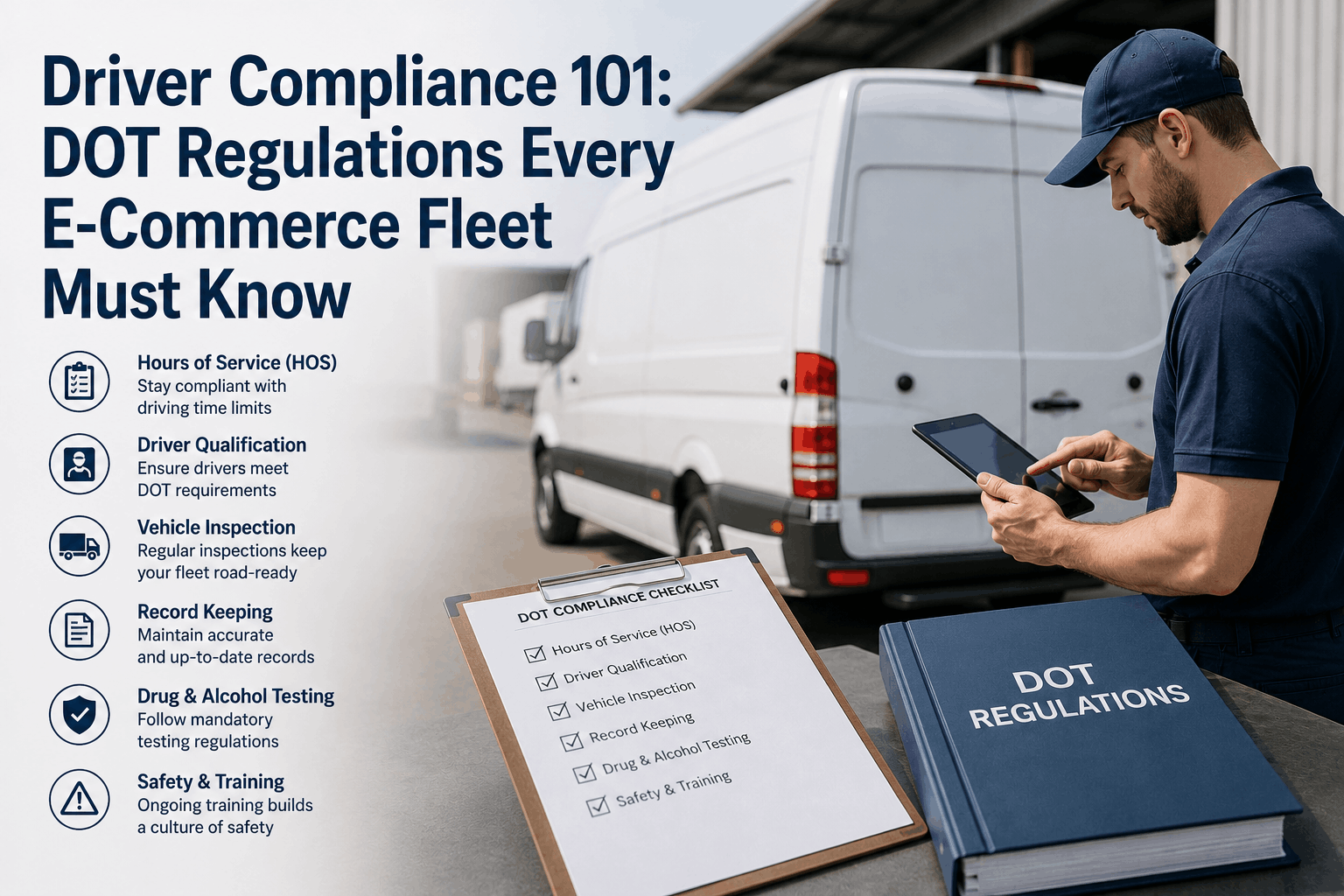
DOT compliance isn't optional — and for e-commerce delivery fleets across the western United States, the stakes have never been higher. The FMCSA reported over 35,000 commercial vehicle violations in California, Arizona, and Nevada in 2024, with e-commerce carriers accounting for a growing share. Non-compliance penalties, out-of-service orders, and liability exposure add 15–30% in hidden regulatory cost that never appears in a route efficiency report. Fleet Rabbit's compliance platform integrates DVIR workflows, HOS monitoring, and driver behavior scoring — giving e-commerce fleets the visibility to stay compliant and competitive simultaneously. Book a demo to see Fleet Rabbit's compliance tools applied to your delivery operation.
Quick Answer
DOT compliance for e-commerce delivery fleets in the western U.S. centers on five areas: Hours of Service (HOS) rules for CMV drivers, Driver Vehicle Inspection Reports (DVIR) required every shift, drug and alcohol testing under 49 CFR Part 382, driver qualification file maintenance, and vehicle maintenance recordkeeping. Fleets using Fleet Rabbit reduce compliance violations 40–55%, eliminate manual DVIR paperwork, and catch HOS violations before they become FMCSA enforcement events — protecting operating authority across every route.
Who Must Comply: CMV Thresholds and E-Commerce Applicability
Many e-commerce operators assume DOT regulations only apply to long-haul trucking. Federal Motor Carrier Safety Regulations apply to any CMV used in interstate commerce — and "interstate commerce" includes far more than crossing state lines. Delivering packages shipped from out of state, even within California or Arizona, constitutes interstate commerce. An Amazon DSP delivering in Phoenix is in interstate commerce because packages originated outside Arizona. Most e-commerce last-mile fleets in the western U.S. are subject to full FMCSA requirements regardless of whether drivers ever cross a state line.
GVWR Thresholds
Any vehicle over 10,001 lbs GVWR in interstate commerce is subject to FMCSA regulations. Most cargo vans (Ford Transit, Ram ProMaster) rate at 8,550–11,030 lbs GVWR. Vehicles over 26,001 lbs require CDL drivers. Check the door placard — not the loaded weight.
Western State Additions
California's BIT program requires independent CMV inspection every 25 months. Washington requires annual safety inspections. Oregon enforces weight-mile tax compliance over 26,000 lbs. Fleets across CA, WA, OR, NV, and AZ must comply with both federal FMCSRs and state-specific programs.
Enforcement Corridors
The western U.S. enforcement corridor (I-5, I-15, I-40) sees active roadside inspection activity year-round. A vehicle placed out-of-service cannot move until defects are corrected — each OOS event costs $1,800–$3,200 in recovery, redelivery, and productivity loss.
HOS Rules: Hours of Service for Last-Mile Delivery Drivers
HOS violations are among the most common enforcement findings for e-commerce fleets. Property-carrying CMV drivers may drive a maximum of 11 hours after 10 consecutive hours off duty. All driving must occur within a 14-hour on-duty window beginning the moment any work starts — including pre-trip inspection or loading. Once the window closes, the driver cannot operate regardless of remaining drive hours. E-commerce fleets scheduling 10-hour shifts with pre-shift prep routinely push drivers into 14-hour violations without realizing it.
1
The 14-Hour Window — Where Most Violations Occur
The 14-hour window begins at the first on-duty moment — not first drive time. A driver clocking in at 7:00 AM for a 30-minute pre-trip inspection begins driving at 7:30 AM, but the 14-hour window closes at 9:00 PM. Dispatchers scheduling routes ending at 9:30 PM are scheduling HOS violations on every such shift.
Pacific Northwest DSP example: Driver in at 7:00 AM → pre-trip complete 7:30 AM → 14-hour window closes 9:00 PM. Routes planned to finish at 9:30 PM = systematic violation.
2
The 30-Minute Break and Short-Haul Exemption
Drivers must take a 30-minute off-duty break after 8 cumulative hours of driving — on-duty waiting time does not qualify. The 150 air-mile short-haul exemption eliminates the ELD mandate for drivers who return to their home terminal within 14 hours and don't exceed the radius. Most urban last-mile drivers qualify, but the exemption is voided the moment any condition is exceeded.
Break: 30 min off-duty after 8 hrsShort-haul: 150 air-mile radiusELD exemption if short-haul applies
3
Fleet Rabbit HOS Integration
Fleet Rabbit integrates HOS rule sets into route planning — flagging potential window violations before dispatch, scheduling required breaks at logical route points, and tracking short-haul exemption eligibility per driver per shift. Dispatchers see compliance status before vehicles leave the depot.
HOS-compliant routes built at dispatch — not discovered during an enforcement stop on I-15 or I-5.
HOS Compliance + Route Intelligence
Build Compliant Routes From Dispatch — Not After an Enforcement Stop
Fleet Rabbit flags HOS window violations before dispatch, schedules required breaks into routes, and tracks short-haul exemption eligibility automatically across every driver and shift.
40–55%
Violation Reduction
DVIR Requirements: Pre-Trip and Post-Trip Inspections
Driver Vehicle Inspection Reports are the most frequently cited compliance gap in e-commerce audits. FMCSA 49 CFR 396.11 mandates a written DVIR after every day of operation. 49 CFR 396.13 requires the next driver to review and sign the previous DVIR before operating the vehicle.
7 Required Inspection Systems
Before operating any CMV, drivers must inspect: (1) Service brakes, (2) Parking brake, (3) Steering, (4) Lights and reflectors, (5) Tires, (6) Horn, (7) Windshield wipers. The DVIR must list any defects found. Verbal walk-arounds without documentation don't satisfy 396.11 — undocumented defects found at roadside become violations against both driver and carrier.
Post-Trip Documentation and Retention
Post-trip DVIRs must be completed at the end of every driving day and signed by the driver. The carrier must certify defects were repaired before the vehicle returns to service and retain DVIRs for 3 months. For a 50-vehicle fleet, one month of missing DVIRs equals 1,000 potential violation instances during an audit. Fleet Rabbit maintains searchable, vehicle-tagged DVIR archives accessible in seconds.
Electronic DVIR Acceptance
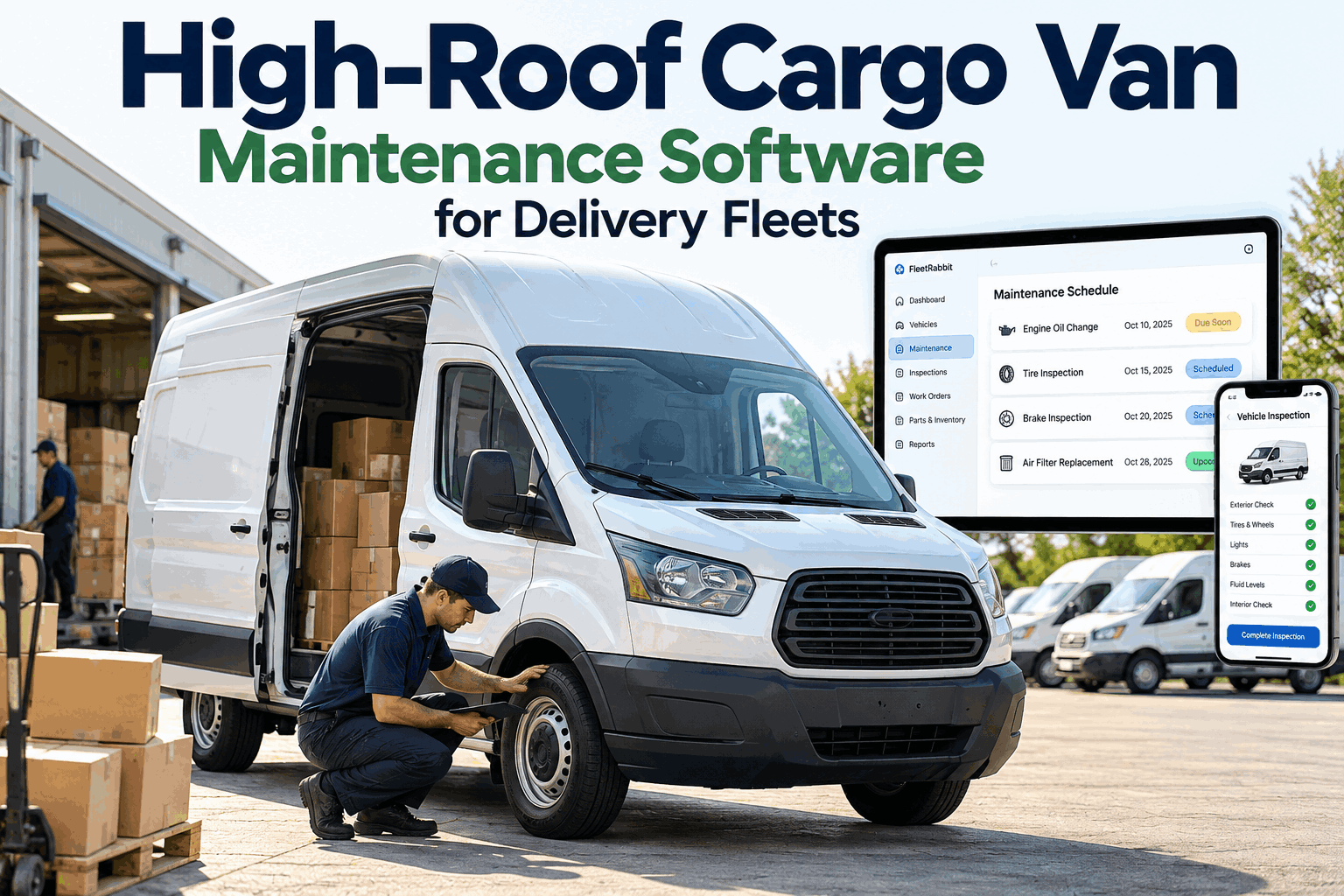
FMCSA accepts electronic DVIRs under 49 CFR 396.11(c), provided the system uniquely identifies driver and vehicle, captures all required items, and retains records 3 months. Fleet Rabbit's mobile DVIR walks drivers through every required item, captures digital signatures, and automatically blocks uncleared vehicles from dispatch.
Vehicle Maintenance Recordkeeping
Beyond DVIRs, Part 396 requires a systematic inspection and maintenance schedule — not "fix things when they break." California's BIT program requires independent terminal inspections every 25 months. Fleet Rabbit monitors fault codes and service intervals automatically, scheduling maintenance before vehicles reach violation thresholds and creating an audit-ready history.
Driver Qualification Files: 49 CFR Part 391
Every CMV driver in interstate commerce must have a complete Driver Qualification file on file with the carrier. DQ file deficiencies are the second most common finding in FMCSA compliance reviews of e-commerce fleets — often because seasonal hiring creates documentation backlogs that never get resolved.
CDL Copy
Current valid CDL on file
MVR Annual
Motor Vehicle Record every 12 months
Medical Card
DOT physical — max 24 months
Employment App
Application + 3-year work history
Road Test
Signed certificate or equivalent
3-Yr Retention
Post-termination file requirement
Drug and Alcohol Testing: 49 CFR Part 382
Any CDL driver operating a vehicle over 26,001 lbs GVWR must participate in a DOT-mandated drug and alcohol testing program. The FMCSA Drug and Alcohol Clearinghouse query is required before every driver's first trip — no exceptions for volume spikes or driver shortages. FMCSA sets annual random testing minimums at 50% of average driver count for drugs and 10% for alcohol, with selections made by a scientifically valid random method.
Pre-Employment and Clearinghouse Query
Every CDL driver must receive a negative pre-employment drug test before operating a CMV. Carriers must also query the FMCSA Drug and Alcohol Clearinghouse for unresolved violations before first operation. Hiring without a Clearinghouse query is a per-driver violation regardless of test results — a common gap in high-turnover e-commerce last-mile hiring across California, Arizona, and Nevada.
Post-Accident Testing — Timing is Everything
Post-accident testing is required when a fatality occurs, or when the driver receives a citation AND either a vehicle requires towing OR someone needs off-scene medical treatment. Testing must occur within 8 hours (alcohol) and 32 hours (drugs). Missing the window is treated as a refusal — equivalent to a positive result. Fleets in California and Arizona face elevated post-accident scrutiny along I-10 and I-15 delivery corridors.
Frequently Asked Questions: DOT Compliance for E-Commerce Fleets
QDo delivery drivers in cargo vans need ELDs?
Most e-commerce last-mile drivers in cargo vans qualify for the 150 air-mile short-haul exemption, which eliminates ELD and paper log requirements. But the exemption must be actively managed — drivers who exceed the radius even occasionally are subject to HOS logging for those days. Fleet Rabbit tracks short-haul eligibility per driver per shift, alerting dispatchers when a route would void the exemption before departure.
QWhat are the penalties for FMCSA violations in the western U.S.?
FMCSA civil penalties range from $1,782 to $19,787 per violation per day under 2025 schedules. HOS violations run $1,782–$17,360 per offense. Recordkeeping violations are assessed per missing document. California CHP adds state penalties on top of federal fines. Beyond fines, carriers with Unsatisfactory safety ratings lose operating authority — a business-ending outcome for e-commerce DSPs dependent on their MC number.
QHow does Fleet Rabbit help with FMCSA compliance review preparation?
Fleet Rabbit centralizes all compliance documentation — DVIRs, maintenance records, driver activity data, and inspection history — in searchable, exportable formats. Complete records for any vehicle, driver, or date range are produced in minutes. The compliance dashboard shows open items across DVIR completion, maintenance intervals, and DQ file expirations daily, so operations managers see gaps before auditors do.
Related Fleet Rabbit Resources
The four AI capabilities transforming e-commerce fleet operations — real-time GPS visibility, predictive vehicle health monitoring, dynamic route optimization, and delivery performance analytics.
AI-driven fault prediction and maintenance scheduling that prevents mid-route breakdowns — keeping fleets out of OOS status and compliant with Part 396 maintenance requirements.
How real-time utilization tracking reduces fleet operating cost across western U.S. delivery corridors while supporting compliance documentation requirements.
How GPS hardware, IoT vehicle data, and cloud analytics combine to deliver real-time fleet visibility and compliance documentation across every route.
Stay DOT-Compliant and Cut Last-Mile Cost — See Fleet Rabbit in Action
Fleet Rabbit integrates digital DVIR workflows, HOS monitoring, predictive maintenance recordkeeping, and driver behavior scoring in one system — giving e-commerce fleets across California, Arizona, Nevada, Washington, and Oregon the compliance infrastructure to pass any FMCSA review while reducing total last-mile operating cost.
Digital DVIR Workflows
HOS Compliance Monitoring
Audit-Ready Recordkeeping
40–55% Fewer Violations
Predictive Maintenance
May 25, 2026
By John Mark
All Posts