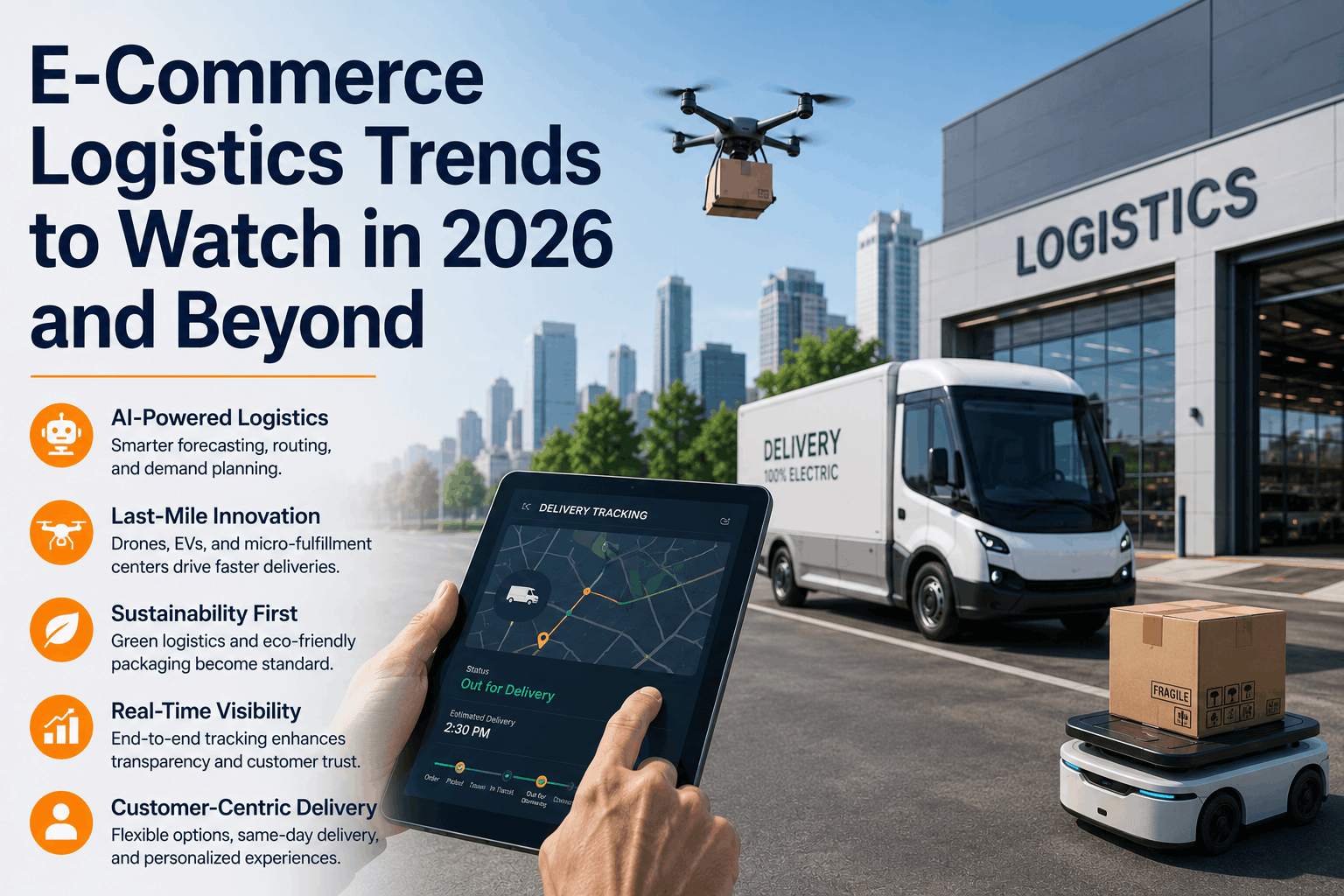
The e-commerce logistics landscape in 2026 looks fundamentally different from what western U.S. fleets were navigating just three years ago. Drone corridors are live above Phoenix and Dallas. Autonomous delivery vehicles are running permitted routes in San Francisco and Austin. AI dispatch systems are making routing decisions in milliseconds that used to take a dispatcher 45 minutes every morning. And California's zero-emission freight mandates are forcing fleet electrification on a timeline that isn't optional. The fleets that will own western U.S. last-mile logistics in 2028 are making infrastructure decisions right now. Book a demo to see how Fleet Rabbit prepares your operation for what's coming.
2026 Outlook
Six trends are reshaping e-commerce logistics across the western U.S. in 2026: AI-native dispatch replacing legacy routing software, electric fleet mandates accelerating in CA, WA, and OR, autonomous last-mile pilots expanding beyond gated communities, drone delivery gaining commercial altitude in sunbelt markets, hyper-local micro-fulfillment cutting urban TAT, and real-time carbon tracking becoming a merchant contract requirement. Fleets that instrument these shifts now gain compounding operational advantage over those that wait for the market to force their hand.
Where Western U.S. E-Commerce Logistics Stands Entering 2026
Before unpacking what's coming, it's worth anchoring to where western U.S. fleets are today. Consumer expectations in California, Washington, and Oregon now lead the nation — and in many cases, set the global benchmark for same-day and next-day delivery speed, reliability, and sustainability visibility.
68%
of western U.S. consumers expect same-day or next-day by default
$0.41
average cost reduction per stop from AI dispatch vs. manual routing
2027
California CARB deadline for medium-duty electric fleet compliance
3.2×
higher retention for customers receiving accurate live ETAs vs. static updates
Trend 1 — AI-Native Dispatch: The End of Morning Route Planning
The single biggest operational shift hitting western U.S. fleets in 2026 isn't autonomous vehicles or drones — it's the quiet replacement of legacy route planning software with AI-native dispatch systems that operate continuously, not in morning batches.
AI DISPATCH
Continuous Route Intelligence vs. Static Morning Plans
Legacy dispatch: a route planner builds all routes at 5 a.m. and drivers run them regardless of what changes by noon. AI-native dispatch: routes are continuously rebuilt as orders arrive, traffic shifts, and driver capacity changes — every 4–8 minutes, all day. For Bay Area and LA fleets where afternoon traffic can add 40+ minutes to a static route, continuous recalculation isn't a luxury feature. It's the difference between 91% on-time and 76% on-time on the same day, with the same drivers.
Legacy Dispatch (2023)
⏰ Routes built once at 5–6 AM
?️ Static traffic assumptions
? Manual stop sequence adjustments
? Phone-based driver communication
? End-of-day reporting
AI-Native Dispatch (2026)
⚡ Routes rebuilt every 4–8 minutes
? Live traffic + incident rerouting
? Automatic stop reassignment
? In-app driver guidance updates
? Real-time ops dashboard
On-Time Delivery Rate: Legacy vs. AI Dispatch — Western U.S. Metro Routes
Trend 2 — Electric Fleet Mandates: California Leads, Others Follow
California's Advanced Clean Fleets regulation isn't a distant future scenario — it's an active compliance deadline. Medium-duty delivery vehicles registered in California face zero-emission requirements beginning in 2025 for high-priority fleets, with broader compliance phases rolling through 2027. Washington and Oregon are following California's framework within 12–18 months.
2024–2025
California high-priority fleet ZEV requirements active. Fleets operating 50+ vehicles in CA face immediate compliance scrutiny.
2026 ← NOW
Washington and Oregon ZEV framework deadlines align with CA. Bay Area and LA fleets running gas-powered vans face increasing per-vehicle surcharge exposure.
2027
CARB medium-duty fleet deadline. All new delivery vehicle purchases in CA must be zero-emission. Mixed fleet management — routing EVs within charge range — becomes a critical dispatch capability.
2028–2030
Full ZEV fleet transition required for CA, WA, OR commercial fleets. Operators who began transition in 2025–2026 will have route-proven EV operations. Late movers face compressed transition timelines and higher vehicle acquisition costs.
⚡
EV Fleet Dispatch Requires Different Software Logic
Gas-powered route planning ignores energy constraints. EV dispatch must factor battery state, charging station locations, and range-per-route into every optimization decision. A route that's optimal for a gas van may strand an EV 8 miles from its depot. Fleet Rabbit's EV-aware routing engine treats battery range as a first-class constraint alongside traffic, delivery windows, and vehicle capacity.
Trend 3 — Autonomous Last-Mile: Pilots Become Operations
2026 marks the inflection point where autonomous delivery transitions from pilot headlines to operational reality in western U.S. markets. Nuro, Serve Robotics, and Starship Technologies have moved from proof-of-concept to permitted commercial operations in specific California and Texas geographies.
?
Sidewalk Robots
~$1.80/delivery
SF, LA, San Diego — dense residential
Sidewalk robots handle sub-3 mile last-mile in high-density residential zones. Serve Robotics operates commercial routes in LA with per-delivery costs below $2. Human driver equivalent: $6–$9. Not yet scalable for mixed-density suburbs.
?
Autonomous Vans
~$3.20/delivery
Phoenix, Austin, suburban CA corridors
Level 4 autonomous vans from Nuro and Gatik run fixed suburban routes with high delivery predictability. Cost per delivery in permitted zones tracks 45–55% below human driver equivalent on identical routes. Currently limited to geo-fenced corridors.
?
Drone Delivery
~$4.10/delivery
Phoenix metro, Dallas suburbs, Reno
Wing (Google) and Zipline have commercial drone delivery corridors live in Phoenix and Dallas suburbs. Coverage is geography-constrained (no high-rise, no dense urban), but within permitted zones, sub-30-minute delivery at competitive cost is operational today.
?
The Near-Term Reality for Western U.S. Fleet Operators
Autonomous delivery doesn't replace human-driven fleets in 2026 — it creates hybrid operations where specific route segments (dense residential, fixed suburban corridors) are candidates for autonomous handoff. The operational requirement is a dispatch platform that can assign stops to autonomous assets and human drivers from a single routing interface, switching between them based on availability, cost, and route type. Human drivers remain essential for the 70–80% of deliveries outside autonomous-capable geographies.
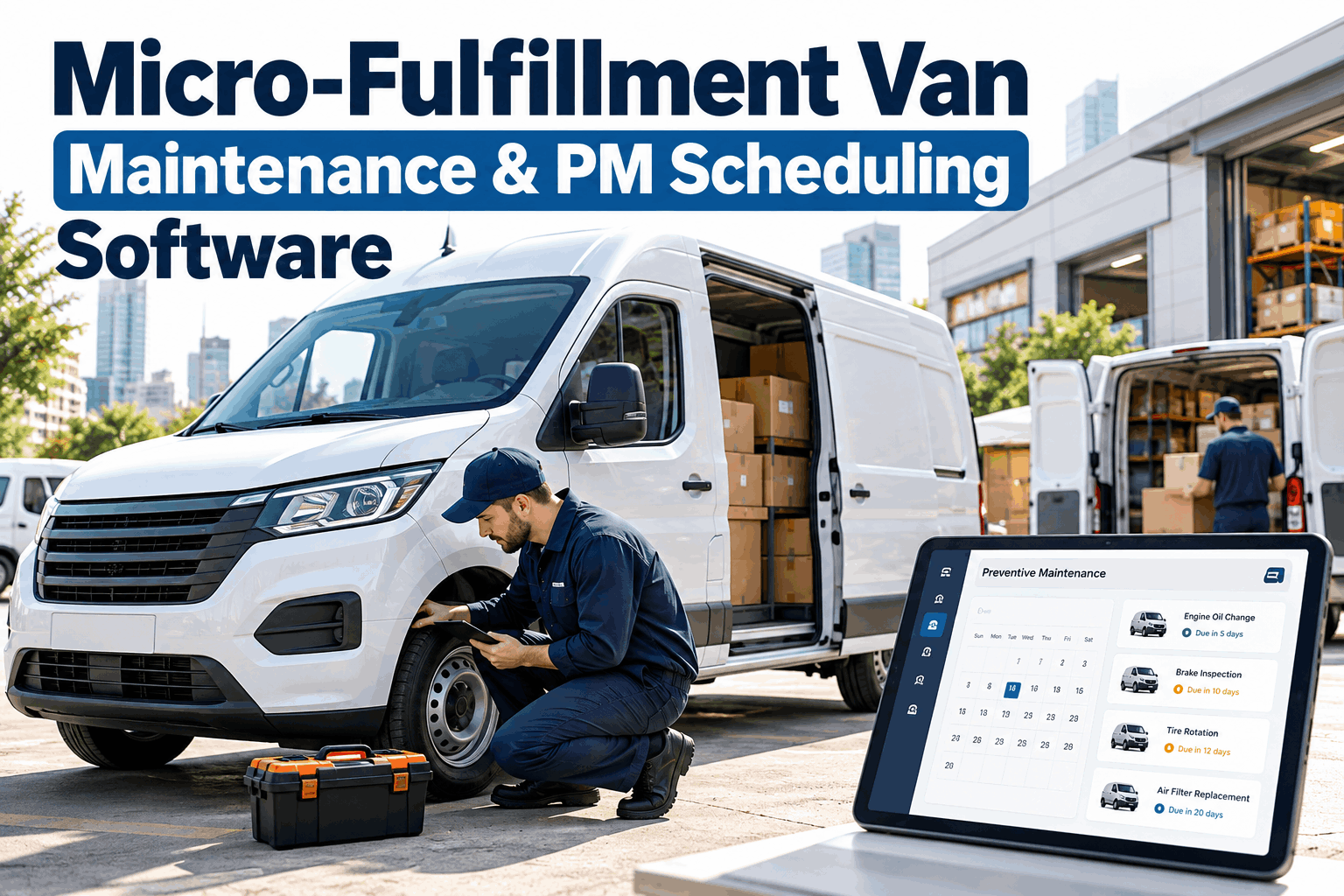
Trend 4 — Micro-Fulfillment: The Urban TAT Race Goes Hyper-Local
Same-day delivery at 2–4 hour TAT isn't achievable from a regional distribution center 35 miles outside the city. Western U.S. markets are seeing rapid expansion of micro-fulfillment nodes — small urban warehouses within 5–10 miles of delivery density — that make sub-4-hour TAT economically viable without heroic last-mile effort.
5–10 mi
Micro-fulfillment node radius for 2–4hr TAT in western U.S. dense markets
3,200+
Micro-fulfillment locations operating across CA, WA, OR, AZ as of early 2026
$0.28
Avg per-stop cost reduction vs. regional DC when micro-node is within 8 miles
58%
of LA Basin same-day volume now originates from micro-fulfillment vs. regional DCs
For fleet operators, micro-fulfillment expansion changes the pickup pattern: instead of loading from one regional DC at 6 a.m., drivers may run multi-origin routes that pick up from 2–3 micro-nodes throughout the day. Routing software that handles multi-origin pickup sequences — not just single-depot hub-and-spoke — becomes a prerequisite for operating in micro-fulfillment networks.
Trend 5 — Green Fleet Visibility: Carbon Tracking Enters Merchant Contracts
Sustainability reporting has moved from marketing to contract requirement for western U.S. e-commerce logistics operators. Major California-based merchants — particularly in apparel, consumer electronics, and grocery — are now including per-shipment carbon emissions in carrier RFPs, with some requiring real-time emissions data via API integration.
Merchant Carbon Requirement Adoption — Western U.S. E-Commerce, 2023–2026
2023 — Requires emissions reporting
2024 — Requires emissions reporting
2025 — Requires emissions reporting
2026 — Requires emissions reporting
?
Route Optimization Is Your Fastest Carbon Reduction Lever
Before electrification timelines, route distance reduction is the single fastest way to reduce per-delivery emissions on existing fleets. A 15–20% route distance reduction from AI optimization translates directly to a 15–20% emissions reduction — measurable, reportable, and achievable within weeks of deployment. For fleets facing merchant carbon requirements on a 2026 contract renewal cycle, route optimization is the bridge to compliance while EV transition proceeds.
Trend 6 — Real-Time Customer Visibility: The New Table Stakes
In 2024, live tracking was a differentiator. In 2026, it's a minimum requirement. Western U.S. consumers — particularly in tech-dense markets like the Bay Area, Seattle, and LA's Westside — benchmark delivery visibility against Uber Eats and Amazon, both of which offer driver-on-map live tracking with minute-accurate ETAs.
?
Live Driver Tracking
Driver-on-map tracking with 30–60 second refresh. Not order-status updates — actual driver GPS location visible to customer from dispatch through delivery.
Reduces WISMO calls 38–52%
⏱️
Dynamic ETA Updates
ETAs recalculated from real route progress and live traffic — not static schedule windows. Customers get a 25–40 minute accurate arrival window, not "between 2–6 PM."
3.2× higher at-home rate
?
Proactive Delay Alerts
When a route delay is detected, customers receive an updated ETA before they notice the window has passed — converting a frustration event into a managed expectation.
44% lower negative reviews
Built for What's Coming
Future-Ready Fleet Operations — Starting With What Works Today
Fleet Rabbit's AI dispatch, EV-aware routing, real-time customer visibility, and carbon analytics give western U.S. fleets the operational foundation for every trend reshaping e-commerce logistics in 2026 and beyond.
The 2026 Readiness Scorecard: Is Your Fleet Positioned?
The trends above aren't equally urgent for every western U.S. fleet. The readiness scorecard below maps each trend to its operational urgency by market and fleet type.
Trend
CA Fleets
WA / OR
AZ / NV
Urgency
AI-Native Dispatch
Critical
Critical
High
Deploy now
EV Fleet Transition
Mandatory
2027
2028+
Plan now, buy 2026
Carbon Reporting
Contract req.
Emerging
Voluntary
Instrument now
Autonomous Integration
Pilot ready
Watch
Pilot ready
Evaluate 2026–27
Micro-Fulfillment Routing
Active now
Growing
Emerging
Upgrade routing stack
Live Customer Visibility
Table stakes
Table stakes
Expected
Deploy now
Frequently Asked Questions: 2026 Logistics Trends
QHow soon do California fleets need to start EV transition planning?
California fleets should have an EV transition roadmap in place now. CARB's Advanced Clean Fleets regulation requires high-priority fleets (state and local government, drayage, and high-mileage operators) to meet ZEV requirements on a rolling schedule beginning in 2024–2025. For broader commercial delivery fleets, new vehicle purchase ZEV requirements begin in 2025–2026 depending on fleet size. The constraint isn't regulatory awareness — it's vehicle lead times. Electric delivery van delivery windows from Rivian, Ford, and GM are running 9–18 months out, meaning 2027 compliance requires 2025–2026 order placement.
QWill autonomous delivery replace human drivers in western U.S. markets by 2028?
No — not at meaningful scale in 2028. Autonomous delivery in western U.S. markets will handle specific route types (dense residential corridors, fixed suburban routes, drone-accessible low-density areas) within geo-fenced operating domains. The 70–80% of delivery volume that falls outside current autonomous-capable geographies — dense urban apartment buildings, mixed commercial/residential, non-standard access addresses — will continue to require human drivers through at least 2030. The near-term operational reality is hybrid fleets: dispatch systems that route human drivers and autonomous assets from a single interface, assigning each stop to the most cost-effective fulfillment option.
QWhat should western U.S. fleet operators prioritize first in 2026?
AI-native dispatch and live customer visibility are the two highest-ROI investments for western U.S. fleets in 2026 — both because they deliver measurable improvement immediately and because they create the data infrastructure that every other trend (EV routing, autonomous integration, carbon reporting) builds on. Fleets without real-time route intelligence can't optimize EV range constraints, can't integrate autonomous assets, and can't generate the per-delivery emissions data that merchant carbon requirements are starting to mandate. The routing and dispatch stack is the foundation. Everything else layers on top of it.
Position Your Fleet for 2026 and Beyond — See Fleet Rabbit in Action
AI dispatch, EV-aware routing, real-time customer visibility, and carbon analytics — Fleet Rabbit gives western U.S. e-commerce fleets the operational platform for every trend reshaping last-mile logistics in 2026. Most operations achieve full ROI within 45–60 days.
AI-Native Dispatch
EV Fleet Routing
Carbon Analytics
Live Customer Tracking
Micro-Fulfillment Ready
June 3, 2026
By Michael Finn
All Posts