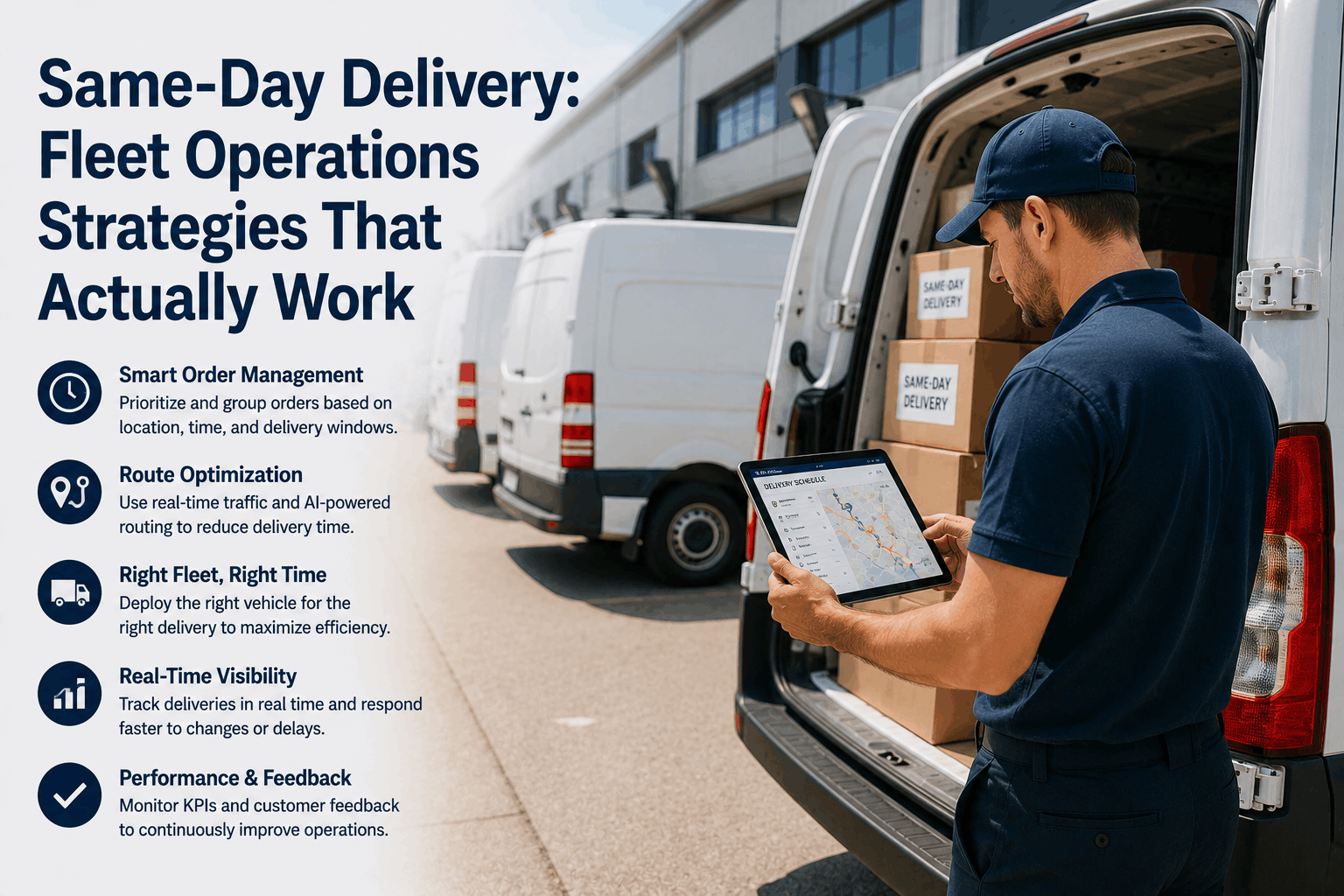
Same-day delivery has shifted from premium differentiator to baseline expectation across western U.S. metro markets. In Seattle, the Bay Area, and Los Angeles, customers expect their package before dinner — trained by Amazon, DoorDash, and Instacart to accept nothing less. The question for independent e-commerce fleets isn't whether to offer same-day. It's whether they can do it without destroying margins. Fleet Rabbit's route optimization and real-time dispatch platform gives western U.S. fleets the operational infrastructure to fulfill same-day promises profitably. Book a demo to see Fleet Rabbit's same-day delivery tools applied to your operation.
Quick Answer
Same-day delivery profitability in western U.S. markets depends on three pillars: dynamic route batching that clusters orders by geography in real time, staffing models that flex with intraday order volume, and a software stack connecting dispatch, drivers, and customers in a single live view. Fleets using Fleet Rabbit achieve same-day delivery at 22–31% lower cost-per-stop than manual dispatch equivalents, with on-time rates above 94% across Bay Area, LA, and Pacific Northwest operations.
Why Same-Day Is Harder Than Next-Day — And Where Western Fleets Break
Next-day delivery is a planning problem. Same-day delivery is a real-time execution problem. Western U.S. metro areas compound the challenge: Bay Area traffic is among the most unpredictable in the country, LA's geographic spread makes zone clustering critical, and Seattle's density creates last-mile access friction that burns time at every stop.
The Same-Day Execution Window
An 11 a.m. same-day order with a 6 p.m. promise leaves roughly 4.5–5.5 hours of delivery window after pick/pack and carrier handoff. In LA or Bay Area congestion, every minute of routing inefficiency eats directly into that promise.
Where Western Fleets Lose Margin
Same-day margin destruction comes from underloaded vehicles dispatched urgently before enough orders accumulate, failed delivery attempts requiring same-day re-dispatch at 2–3x base cost, and overtime labor from poor shift alignment with intraday order patterns.
The Profitability Threshold
Same-day becomes profitable when route density crosses a market-specific threshold. In LA and Bay Area dense zones: 4.5–6 stops/hour. In Seattle and Portland: 3.5–5 stops/hour. Fleets operating below threshold are burning fuel and labor on a service their pricing can't support.
Same-Day Benchmarks: Western U.S. Market Standards (2025)
Western U.S. consumers benchmark same-day delivery against the fastest operators in their market. Amazon's same-day infrastructure in California and Washington sets expectations every e-commerce fleet must compete against, regardless of size.
Market
Order Cutoff
Delivery Window
On-Time Target
Cost/Stop
Bay Area (SF, Oakland, San Jose)
12 PM
3–7 PM
93%+
$6.80–$9.20
Los Angeles Metro
1 PM
5–9 PM
91%+
$7.40–$10.50
Seattle / Puget Sound
11 AM
3–7 PM
94%+
$6.20–$8.80
Portland Metro
12 PM
4–8 PM
92%+
$5.90–$8.10
San Diego / Sacramento
1 PM
5–8 PM
90%+
$5.50–$7.80
5 Fleet Planning Decisions That Determine Same-Day Profitability
Same-day profitability is set before a single package is loaded. Zone structure, wave timing, staffing model, vehicle mix, and cutoff policy determine whether same-day is a growth lever or a margin drain.
1
Dynamic Zone Clustering — Not Fixed Territories
Fixed delivery zones can't adapt to volatile same-day order patterns. Dynamic clustering groups orders by real-time geographic density, adjusting zone boundaries as orders accumulate throughout the day.
Fleet Rabbit on a Los Angeles same-day operation: fixed zones produced avg 3.1 stops/hr. Dynamic clustering produced 5.4 stops/hr on equivalent volume — moving the route from margin-negative to profitable.
2
Wave Dispatch — Hold Orders to Build Density
Dispatching the moment same-day orders arrive produces underloaded routes with high cost-per-delivery. Wave dispatch holds orders 45–90 minutes to accumulate geographic density before releasing routes.
Immediate dispatch: 3.2 stops/hrWave dispatch: 5.1 stops/hrCost reduction: 28–34%
3
Flex Staffing Aligned to Intraday Order Patterns
Bay Area tech-corridor orders peak 9–11 a.m. and 1–3 p.m. LA consumer orders peak 11 a.m.–2 p.m. Fixed 8-hour shifts misalign driver availability with these peaks — paying overtime for coverage that doesn't match volume.
Bay Area fleets running split shifts (6–11 a.m. and 12–7 p.m.) consistently outperform full-day shifts on cost-per-delivery by 18–24%.
4
Hard Cutoff Enforcement with Feasibility Checking
Soft cutoffs — accepting same-day orders "as long as possible" — are the most common source of SLA breach in western U.S. fleets. Real-time feasibility checking calculates whether each incoming order can be fulfilled within window given current driver positions, traffic, and route capacity.
Fleet Rabbit feasibility checking reduces same-day SLA breach rate 44–62% in Bay Area and LA operations by catching infeasible orders before they enter the dispatch queue.
Same-Day Delivery Optimization
Fulfill Same-Day Profitably — 22–31% Lower Cost Per Stop
Fleet Rabbit gives western U.S. fleets the dynamic clustering, wave dispatch, real-time feasibility, and live rerouting tools to make same-day a margin-positive service line — not just a customer promise that costs more than it earns.
The Software Stack That Makes Same-Day Work
Same-day at scale requires a connected stack built for real-time decision-making — not morning-dispatch planning tools repurposed for intraday execution.
Real-Time Order Batching and Route Generation
Fleet Rabbit's dispatch engine re-evaluates route assignments every 4–8 minutes, inserting new same-day orders into active routes where they can be fulfilled within window, or triggering new wave dispatch when density thresholds are met.
Live Traffic Integration and Mid-Route Rerouting
Bay Area I-880, LA freeways, and Seattle bridges create daily congestion that static plans can't handle. Real-time rerouting redirects vehicles around emerging delays before they cascade into missed same-day windows.
Live ETA Notifications — Reduce Failed Attempts 28–35%
Same-day delivery fails most often because the customer isn't home. Live ETA alerts calculated from real route progress give customers a 30–60 minute accurate arrival window — making them 3.1x more likely to be available at delivery.
Supervisor Dashboard — Fleet-Wide Same-Day Visibility
Fleet Rabbit's ops dashboard shows every active driver's position, current stop status, and projected on-time rate in real time. Routes at risk of window breach get flagged with specific recommended interventions before the SLA breaks.
Driver Mobile App — Eliminate Stop-Level Friction
Best-in-class western U.S. same-day stops average 2.8 minutes. App friction adds 45–90 seconds per stop — compounding into 15–30 minutes of lost time per route. One-tap access to codes, locker options, and POD capture keeps dwell time at target.
Same-Day Performance Analytics — Weekly Improvement Loop
Fleet Rabbit analytics surface which zones, drivers, time windows, and order types drive cost variance week over week — enabling targeted weekly intervention rather than expensive fleet-wide policy changes.
Same-Day Delivery Results: Western U.S. Fleet Outcomes
22–31%
Lower Cost Per Stop
74%
Stop Density Improvement
28–35%
Fewer Failed Attempts
44–62%
SLA Breach Reduction
14–22%
Labor Cost Reduction
45–60 days
Typical Full ROI Timeline
Frequently Asked Questions: Same-Day Delivery for Western U.S. Fleets
QWhat stop density is needed to make same-day delivery profitable in LA or the Bay Area?
In dense urban zones (inner LA, SF, downtown Seattle), same-day profitability typically requires 4.5–6 stops per vehicle per hour. In suburban zones (outer LA County, East Bay, Eastside Seattle), the threshold is 3.5–4.5 stops per hour. Fleets consistently below threshold should use wave dispatch to build density before releasing routes rather than dispatching immediately with insufficient stop concentration.
QHow does real-time rerouting affect same-day on-time rates in Bay Area traffic?
Bay Area traffic can shift significantly within 20–30 minutes around I-880, US-101, and Bay Bridge corridors during afternoon peak. Fleets using static morning routes typically see 12–18% of same-day deliveries miss their window due to afternoon congestion. Real-time rerouting reduces this breach rate to 3–7% — without adding vehicles or drivers.
QWhat order cutoff time should western U.S. fleets use for same-day delivery?
For Bay Area and Seattle operations targeting a 3–7 p.m. delivery window, a 12 p.m. cutoff allows adequate wave accumulation and pick/pack time. For LA targeting 5–9 p.m., cutoffs can extend to 1–2 p.m. The critical requirement is hard cutoff enforcement with real-time feasibility checking — soft cutoffs produce SLA breach rates 3–5x higher than enforced cutoffs backed by routing feasibility validation.
Build a Profitable Same-Day Operation — See Fleet Rabbit in Action
Fleet Rabbit gives western U.S. e-commerce fleets the dynamic clustering, wave dispatch, real-time rerouting, and feasibility checking tools to make same-day delivery profitable from pilot zone through full-market scale.
22–31% Lower Cost/Stop
Dynamic Zone Clustering
Real-Time Rerouting
Wave Dispatch Optimization
94%+ On-Time Rate
May 26, 2026
By Lebron
All Posts