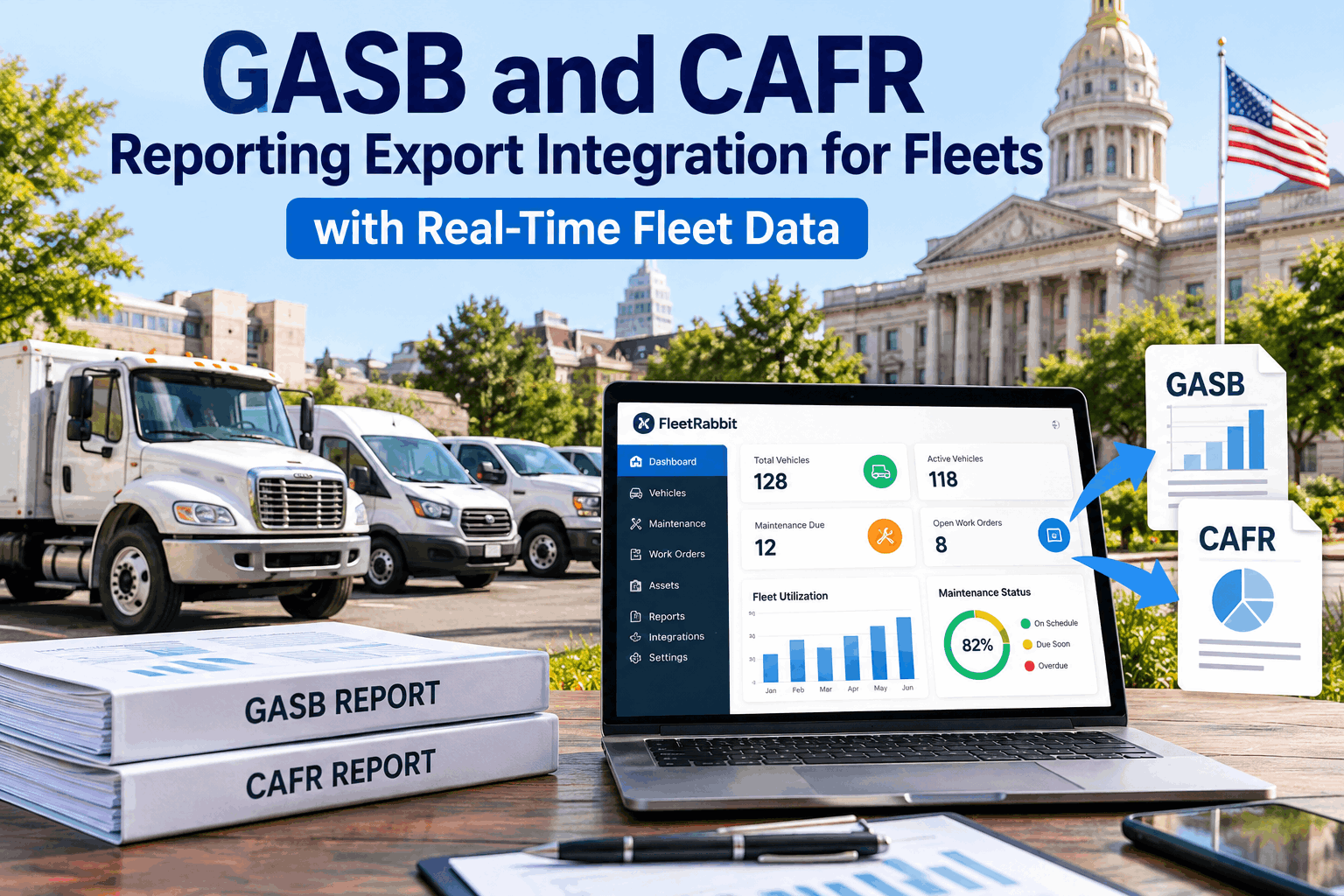
Public works directors, municipal finance officers, town treasurers, and county budget analysts face a relentless fiscal deadline every fiscal year-end: compiling the Annual Comprehensive Financial Report (ACFR, historically known as CAFR) and demonstrating capital asset compliance under Governmental Accounting Standards Board (GASB) Statement 34 and Statement 96 mandates. In municipal governance, public sector rolling stock—from heavy tandem snowplows and fire apparatus to police pursuit cruisers and water department utility service vans—represents millions of dollars in capital infrastructure. Yet, when finance departments attempt to audit asset book values, accumulated depreciation, capitalized overhaul expenditures, and deferred maintenance liabilities, they run into a wall of fragmented shop records. Municipal mechanics track brake jobs, transmission rebuilds, and hydraulic pump overhauls on garage whiteboards, paper work orders, or standalone garage databases that never communicate with central accounting ERP systems like Tyler Munis, CentralSquare, or BS&A. Without real-time telematics integration, finance officers are forced to estimate asset degradation using simplistic straight-line calendar schedules that ignore true operational stress. A police interceptor that accumulated 3,500 idle hours during stationary traffic details or a public works dump truck running heavy hydraulic snowplow gear has incurred severe mechanical wear far beyond its odometer mileage. Under GASB 34 rules, failing to accurately document condition-assessment ratings, capitalized life-extension repairs, and true asset salvage values leads to audit findings, restatements, and potential municipal bond rating downgrades. FleetRabbit delivers dedicated GASB and CAFR/ACFR reporting export integration software designed specifically for government fleets. By combining J1939 and OBD-II CAN-bus engine-hour telemetry, automated repair capitalization ledgers, condition assessment scoring, and mobile driver pre-trip eDVIR records under DOT 49 CFR Part 396 into a unified platform priced at a flat $5 per asset per month, FleetRabbit converts daily garage maintenance data into audit-ready financial schedules. Export clean municipal asset schedules in minutes, substantiate capital replacement requests before town councils, and capture maintenance records completely offline inside steel public works barns, concrete parking depots, and rural salt sheds with zero cellular reception. Discover how our financial export engine streamlines your annual audit when you book a demo or start automating your municipal asset ledgers immediately when you sign up for our platform.
The 4 Pillars of GASB 34 and ACFR Capital Asset Fleet Reporting
Satisfying state and local government accounting directives requires transforming raw garage maintenance transactions into standardized capital balance sheets; FleetRabbit automates these four core financial pillars.
Accrual Capital Asset Accounting
Bridges the gap between fund-level modified accrual expenditures (when vehicles are purchased) and government-wide full accrual financial statements, tracking historical capitalized costs and multi-year depreciation schedules.
Capitalized vs. Expensed Maintenance
Automatically categorizes garage shop work orders based on statutory capital thresholds: routine PM oil changes are expensed immediately, while major engine or transmission overhauls that extend useful asset life are capitalized.
Modified Approach & Condition Scoring
Maintains updated physical condition-assessment ratings (Good, Fair, Poor) derived from daily driver eDVIR walkarounds, satisfying the GASB 34 modified approach option for public infrastructure assets.
Terminal Disposal & Salvage Reconciliation
Calculates exact gain or loss upon municipal vehicle auction disposal, netting terminal salvage proceeds against remaining book value to ensure error-free Statement of Activities reporting.
The Severe Risks of Managing Municipal Capital Assets on Disconnected Spreadsheets
Compiling annual comprehensive financial reports using disconnected desktop spreadsheets and paper garage receipts exposes public agencies to audit findings, budget delays, and bond rating downgrades. Review our public sector financial risk models when you book a demo or start testing our cloud tools directly when you sign up for immediate platform access.
External Audit Findings & Restatements
State auditors examine fixed asset depreciation ledgers and capital addition records. When finance teams cannot produce verified work orders supporting capitalized life-extension repairs or reconcile asset disposals against general ledger debits, auditors issue material weakness findings that damage government transparency.
Credit Rating Downgrades & Higher Borrowing Costs
Credit rating agencies (Moody's, S&P, Fitch) inspect a municipality's Annual Comprehensive Financial Report to evaluate long-term financial health. Delays in filing financial statements or unquantified deferred maintenance liabilities can trigger credit outlook downgrades, increasing municipal bond interest rates.
Failed Capital Replacement Requests at Town Council
Requesting $250,000 for a new municipal dump truck or backhoe without defensible fixed asset accounting creates fierce budget battles. Lacking verified maintenance-to-depreciation ratios, town select boards routinely defer replacements, forcing shops to pour operating tax funds into failing machinery.
Reinforced Steel DPW Barns and Remote Storage Dead Zones
Municipal public works garages, salt sheds, and water treatment compounds are constructed with reinforced steel and concrete, creating cellular dead zones. Cloud-only accounting tools crash, causing operators to abandon digital pre-trip inspection logs and leaving municipal equipment undocumented.
Built Specifically for Municipal Fixed Asset Accounting & Reporting
FleetRabbit connects CAN-bus telematics gateways, garage work orders, parts inventory, and municipal ERP general ledgers into an automated financial reporting pipeline. Discover how our software simplifies municipal audit season when you book a demo with our public sector specialists.
1-Click GASB 34 / ACFR Data Exporter
Generates pre-formatted CSV and Excel financial schedules for Statement of Net Position asset disclosures, tracking historical cost, accumulated depreciation, and net book value across all municipal funds.
Automated Capitalization Threshold Engine
Automatically flags major component overhauls (engine rebuilds, transmission replacements, hydraulic retrofits) that exceed municipal dollar thresholds, tagging them as capitalized life-extensions rather than expensed repairs.
Engine-Hour Usage Depreciation Modeling
Calculates asset consumption using real CAN-bus engine run-hours alongside odometer miles, providing accurate usage-based depreciation curves for high-idle police and public works equipment.
DPW Garage Offline Mobile Sync
Shop mechanics sign off work orders and equipment operators complete pre-trips inside reinforced steel DPW sheds with zero cellular reception; all diagnostic records auto-sync upon departure.
eDVIR Defect Dispatch Lockout
Vehicles tagged with critical mechanical defects on morning walkarounds—such as leaking hydraulic lines, worn tires, or steering play—are automatically blocked from service dispatch.
1-Click Town Council Budget Dossiers
Generate clear, professional fleet lifecycle reports, maintenance histories, and capital justification sheets formatted for town managers, select boards, and municipal auditors in under 60 seconds.
Direct Mapping to Federal, State & Municipal Financial Standards
Operating a municipal fleet under automated fixed asset governance ensures strict compliance with public accounting guidelines, commercial motor carrier safety standards, and municipal audit directives.
Mandates that local governments report capital assets—including heavy equipment, rolling stock, and specialized vehicles—along with annual depreciation and cumulative maintenance expenditures in annual financial reports.
Standardizes the accounting and financial reporting for subscription-based software contracts, recognizing software subscriptions as right-to-use intangible assets with corresponding liabilities on municipal financial statements.
Standardizes daily pre-trip and post-trip driver walkarounds (§ 396.11), qualified mechanic corrective action signatures (§ 396.13), and statutory 90-day electronic maintenance record retention across heavy municipal assets.
Enforces statutory public access and retention guidelines for municipal expenditures: work orders, purchasing records, and vehicle disposal documentation must remain accessible for official public records inquiries.
Municipal Fleet Capital Accounting Software Benchmark Comparison
A feature-level comparison evaluating GASB reporting capabilities, general ledger connectivity, and offline resilience as of 2026. Schedule a personalized walkthrough when you book a demo with our team.
| Reporting Dimension | FleetRabbit | Legacy Enterprise Municipal CAD | Basic Telematics Portals | Manual Excel & Paper Receipts |
|---|---|---|---|---|
| Pricing (per asset/month) | $5/month flat | $35–$75/month | $15–$30/month | High administrative payroll drag |
| 1-Click GASB 34 / ACFR Export | Native automated financial schedules | Requires custom SQL queries | Not supported | Weeks of manual spreadsheet assembly |
| Capitalization vs. Expense Rules | Automated work order thresholds | Manual accounting review | Not available | Prone to auditor classification errors |
| Engine-Hour Usage Depreciation | Real CAN-bus run-hour sync | Straight-line calendar only | Raw sensor ping only | Straight-line calendar only (Inaccurate) |
| DPW Barn Offline Mobile Sync | Full store-and-forward | Network dependent | Data dropped offline | Paper logs only |
| Free Trial Access | 14 days, up to 3 assets | Sales demonstration only | Limited sandbox demo | None |
| Contract Terms & Procurement | Monthly or annual (No lock-in) | 3 to 5-year mandatory contract | 2 to 3-year contract | None |
5-Step GASB & ACFR Fleet Integration Pathway
FleetRabbit embeds cleanly into your municipal public works garage, administrative offices, and operator mobile devices in under two weeks without operational disruptions. Begin testing immediately when you sign up for our free trial.
Municipal Asset Master & Historical Ledger Ingestion
Import municipal trucks, police cruisers, snowplows, backhoes, acquisition dates, department general ledger codes, and historical depreciation ledgers via automated CSV tools.
Capitalization Thresholds & Fund Mapping
Configure municipal capitalization rules (e.g., $5,000 threshold and 2-year life extension) and map asset classes directly to municipal accounting funds (General, Highway, Water, Enterprise).
Telematics Gateway & Meter Synchronization
Connect factory OEM telematics or plug-and-play diagnostic dongles to establish continuous J1939 engine-hour and odometer tracking for usage-based depreciation modeling.
Shop Mechanics & Operators Mobile Rollout
Equip municipal equipment operators, police officers, and town mechanics with the offline-first mobile app on standard smartphones or rugged tablets for rapid pre-trips.
Audit-Ready Financial Command Go-Live
Activate live general ledger expense posting, automated shop work order queues, parts inventory replenishment triggers, and 1-click town council budget reporting archives.
2-Week Deployment Plan & Milestones
A structured timeline designed to transition local government fleet operations from paper binders to audit-ready financial governance with zero disruption to daily public services. Review our full onboarding plan when you book a demo today.
Week 1: Chart of Accounts & Fixed Asset Setup
- Audit municipal general ledger account trees, department fund allocations, and parts catalogs
- Connect municipal ERP API endpoints or establish automated SFTP batch export directories
- Configure vehicle profiles by department: Police, Fire, DPW, Parks, and Water
- Assign user access roles for Finance Directors, Town Managers, and Garage Superintendents
Week 2: Garage Rollout & Live Verification
- Distribute mobile app to municipal operators and conduct 15-minute training on digital pre-trips
- Validate store-and-forward offline syncing inside concrete maintenance garages and utility yards
- Simulate a completed mechanic work order to verify instant general ledger expense posting
- Launch live fleet management dashboard and town council replacement budget reporting
Documented Municipal GASB & ACFR Financial Results
Operational improvements documented by local government agencies that transitioned from manual spreadsheets to automated fixed asset fleet software. Review the complete municipal case study when you book a demo with our team.
3 Weeks Trimmed from Annual Audit Cycle Across 50 Vehicles
A regional township managing 50 vehicles previously spent three weeks every autumn manually assembling fixed asset schedules and depreciation tables for independent auditors. FleetRabbit deployed automated GASB 34 export integration, eliminating 120 hours of administrative data consolidation and achieving zero audit exceptions on capital asset disclosures in year one.
$480,000 Capital Replacement Approved Unanimously
A county road department operating 65 heavy trucks struggled to convince county commissioners to fund replacement snowplows based on mileage alone. FleetRabbit's integrated lifecycle reports demonstrated that maintenance expenditures on five aging dump trucks exceeded their amortized capital replacement cost by 135%, securing unanimous board approval for new vehicles.
Every year when audit season rolled around, our town finance department and our public works garage turned into a war room. The auditors would ask for documentation on our capital additions, our accumulated depreciation schedules, and our vehicle disposal records under GASB 34, and we would spend weeks digging through shoeboxes of garage invoices, trying to figure out which repairs were capitalized and which were expensed. Inevitably, our numbers didn't match the general ledger, and our town received a management letter comment from the state. FleetRabbit solved our reporting nightmare completely. It connects our garage work orders and live engine-hour meters directly to our capital asset ledgers, categorizes our major overhauls automatically, and lets us export clean, audit-ready GASB 34 and ACFR schedules in literally two clicks. Our independent auditors were amazed by the transparency, our audit finished three weeks early, and our town council finally has total confidence in our fleet budget requests.
Frequently Asked Questions
Automate Your Municipal Fleet's GASB 34 & ACFR Reporting in Less Than 2 Weeks
Eliminate audit stress, track true capital asset depreciation, and produce transparent public records at $5/asset/month with a 14-day free trial.