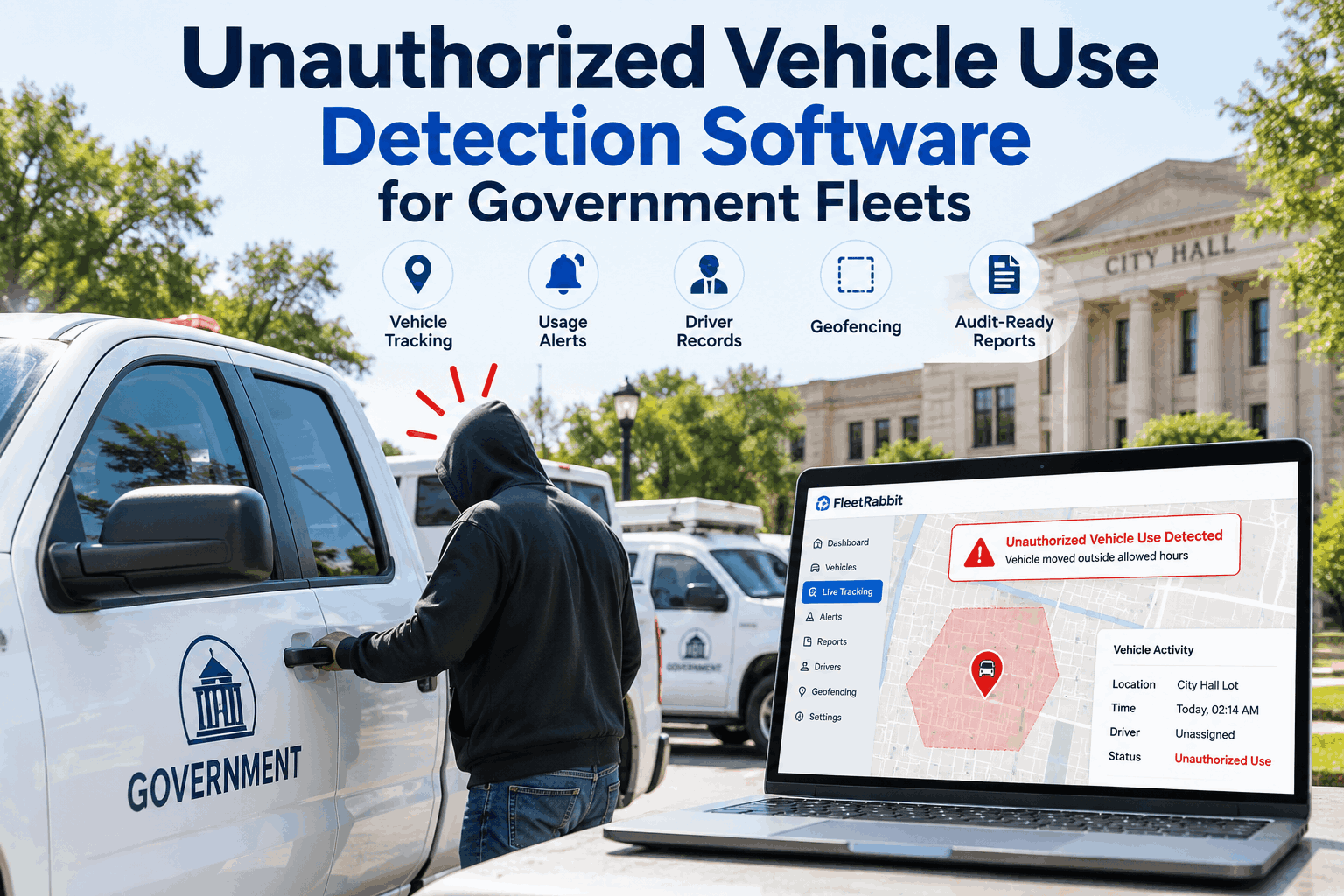
Municipal administrations, county authorities, and state government agencies operate public vehicle fleets under strict statutory mandates that require complete fiscal stewardship and accountability to taxpayers. Under federal regulations, IRS fringe benefit rules, and state ethics statutes, government-owned vehicles—ranging from code enforcement compacts and public health utility vans to heavy public works dump trucks—are restricted exclusively to official public business. However, public fleet managers face persistent compliance challenges when assets are operated outside authorized shifts, driven beyond municipal geographic boundaries, or used for personal errands, unauthorized home-to-work commuting, and weekend side jobs. When agencies rely on self-reported paper logbooks, uncalibrated odometer entries, or passive after-the-fact citizen complaints, unauthorized vehicle use quietly drains operating budgets. Every off-hours mile wastes taxpayer fuel, accelerates engine depreciation, increases the risk of uninsured municipal liability collisions, and risks severe media scandals that damage public trust. Implementing automated unauthorized vehicle use detection software pairs high-precision GPS telematics, time-windowed geofencing, digital driver ID fobs, and after-hours ignition alerts into an audit-ready compliance engine. By enforcing usage boundaries and monitoring vehicle trips, government fleet directors eliminate unauthorized asset drift and protect public funds. To examine how automated geofence rules safeguard your agency's assets, book an executive compliance consultation demo with our public fleet specialists or configure after-hours alerts right away through our free platform sign up.
Unauthorized Vehicle Use Detection Software for Government Fleets
An executive compliance and asset integrity blueprint for city managers, fleet directors, and municipal auditors. Prevent vehicle misuse, enforce shift-based geofences, intercept unauthorized take-home commuting, and maintain an audit-ready ledger for council oversight.
Ignition event recorded Saturday at 10:14 PM. Asset departed municipal public works yard boundary and traveled 18.4 miles south to a retail commercial strip without an active dispatch ticket.
Ignition event logged Sunday at 02:40 AM. RFID badge matched on-call supervisor (Tech: K. Vance) responding to documented water main fracture #WM-4091 on Maple Ave.
Protect Taxpayer Assets from Unauthorized Use and Fraud
Eliminate off-hours vehicle misuse, automate geofenced jurisdictional boundaries, link digital driver ID fobs, and maintain an audit-ready compliance trail starting from $3/vehicle/month with no hardware lock-in.
The Legal, Fiscal, and Public Trust Risks of Government Vehicle Misuse
Operating a government vehicle fleet without automated tracking exposes municipal and county administrations to severe legal liabilities. Under federal guidelines, IRS taxable fringe benefit standards, and local administrative codes, government-owned vehicles cannot be used for personal errands, family transport, or unapproved commuting. If an employee takes a city-owned vehicle home without authorization and causes a severe collision while running personal weekend errands, the municipality's sovereign immunity defenses can be undermined. Claimants' attorneys can argue the municipality failed to exercise reasonable care over public assets, exposing municipal self-insurance pools to significant liability verdicts. Furthermore, unmonitored off-hours use accelerates mechanical wear: personal driving adds thousands of unbudgeted miles, drives up scheduled maintenance frequency, and leads to excessive idling that damages diesel particulate filters (DPFs). The public trust consequences are equally severe: news reports detailing public works trucks parked outside retail centers or vacation spots during off-hours damage public confidence and disrupt budget approvals. Automated unauthorized use detection software prevents these exposures by enforcing operational rules through software. City administrators can examine active tracking models by scheduling a tailored government fleet compliance demo or establish custom geographic boundaries via our quick platform sign up.
Time-Windowed Shift & Weekend Geofencing
Configure virtual perimeters around municipal yards, district zones, and service limits. Fleet managers set time-sensitive rules that become active during high-risk windows (such as between 6:00 PM and 6:00 AM on weekdays and all weekend hours), generating instant alerts if a vehicle leaves the yard.
After-Hours Ignition & Movement Interception
Telematics modems detect CAN-bus ignition-on events during scheduled off-hours. If a vehicle's engine starts on a Sunday afternoon without an active work order, the system flags the trip and sends notifications to the on-call supervisor.
Driver Identification & Key Fob Verification
Integrates with RFID security badges and Bluetooth driver fobs. A buzzer alerts operators until an authorized employee scans their badge, linking every mile directly to an employee record for complete trip transparency.
Audit-Ready IRS & Public Records Compliance
Generates certified vehicle usage logs separating official business miles from authorized take-home commutes. The system produces pre-formatted documentation satisfying IRS fringe benefit reporting and public information audits.
Direct Technical Matrix: Manual Paper Logs vs. FleetRabbit Unauthorized Use Detection
Relying on manual paper logbooks, trust-based sign-outs, and after-the-fact odometer audits leaves public agencies exposed to unchecked vehicle misuse. Paper records are easily misstated, forgotten, or lost, leaving fleet managers unable to verify where a vehicle was driven over the weekend. Review how manual tracking compares directly against FleetRabbit's automated, real-time unauthorized use detection platform. City managers and municipal auditors can evaluate custom geofence alerting rules by booking an executive municipal fleet software demo or explore our driver verification tools through our self-service sign up.
| Fleet Compliance Dimension | Paper Mileage Logs & Static Inspections | FleetRabbit Automated Detection Engine | Public Sector Advantage |
|---|---|---|---|
| Misuse Detection Velocity | Weeks or months later during manual audits; often missed | Immediate real-time alerts via SMS, push, & email | Intercepts unauthorized trips while in progress |
| Geographic Boundary Enforcement | None; relies entirely on employee compliance | Automated multi-polygon jurisdictional geofencing | Flags boundary breaches outside authorized zones |
| Off-Hours Engine Ignition Tracking | Completely unmonitored during nights and weekends | Instant CAN-bus alerts on after-hours starts | Eliminates unauthorized weekend personal use |
| Driver Identification Verification | Self-signed paper logs; easily misattributed | RFID employee badge & Bluetooth fob required | 100% indisputable accountability for every mile |
| IRS Commuting Fringe Benefit Audit | Manual spreadsheet estimation; high audit risk | Cryptographic trip records separating official from commute | Maintains audit-ready records for tax compliance |
4-Stage Closed-Loop Unauthorized Use Interception Workflow
FleetRabbit standardizes public fleet oversight into an automated, four-stage workflow that connects vehicle sensor telemetry to real-time supervisor escalation, disciplinary defense, and permanent audit records. To examine how our software protects public vehicles, schedule an operational compliance demonstration with our team.
Boundary & Shift Policy Definition
Fleet administrators set municipal operating zones, assign shift schedules (e.g., 07:00 - 15:30), define authorized home-to-work corridors for take-home units, and configure off-hours alert thresholds.
Real-Time Sensor & Telematics Ingestion
Onboard telematics modems poll GPS location, ignition state, and CAN-bus telemetry. Drivers scan their municipal RFID badge upon entry, pairing their employee profile to the vehicle trip.
Automated Exception Interception & Alerts
If an ignition occurs outside operating hours, or if a vehicle exits authorized boundaries without a dispatch ticket, the system logs an exception and notifies supervisors immediately.
Supervisory Review & Audit Reconciliation
Department supervisors review the flagged trip, linking it to an emergency callout or verifying an unapproved detour. Resolved exceptions are archived in permanent compliance ledgers.
Financial Capital Stewardship: Eliminating Unbudgeted Municipal Fleet Waste
Operating a municipal fleet without automated vehicle tracking creates compounding financial losses across unmonitored fuel consumption, off-hours vehicle wear, and unbudgeted maintenance. A single public works pickup truck used for unauthorized weekend errands or side jobs adds thousands of unapproved miles each year. Beyond fuel costs, excessive idling and personal travel accelerate brake and tire degradation, trigger premature oil service intervals, and consume vehicle warranty miles. In the event of an off-hours collision during personal use, the municipality faces potential legal and financial liabilities that can drain self-insurance funds. Identifying these cost drivers helps fleet directors and city managers build a strong business case for automated detection software. Calculate your agency's exact cost recovery by booking an operational fleet assessment demo or get started directly via our rapid platform sign up.
Top Causes of Public Fleet Budget Waste from Unmonitored Use
Compliance Platform Capabilities
Draw precise virtual boundaries around municipal service areas, specific project sites, or approved take-home travel routes.
Requires an RFID badge scan or mobile check-in before trip authorization, pairing every operating minute to a specific driver.
Connects via standard OBD-II ports, J1939 CAN-bus adapters, or factory OEM telematics with zero restrictive hardware commitments.
ROI & Public Accountability Framework for Municipal Leaders
When municipal leadership evaluates fleet monitoring software, elected officials must measure financial return across fuel savings, asset preservation, risk mitigation, and public transparency. FleetRabbit delivers quantifiable financial return across all primary public sector fleet operating categories. To review your customized municipal compliance model, schedule an executive briefing demo with our government fleet team or start configuring your municipal fleet boundary rules today with a free account.
Fuel & Operating Savings
Eliminating unauthorized weekend personal travel and off-route personal errands cuts fuel waste and extends vehicle lifecycle service by months.
Tort & Sovereign Protection
Providing verifiable, time-stamped proof of authorized municipal business shields cities from catastrophic off-hours civil litigation verdicts.
Audit & Media Defensibility
Maintaining complete, exportable electronic trip records ensures total transparency during municipal audits and public records inquiries.
Frequently Asked Questions: Unauthorized Vehicle Use Detection
What qualifies as unauthorized vehicle use in a government or municipal fleet?
Unauthorized use refers to operating a government-owned vehicle for purposes outside official public business. Examples include personal errands, unauthorized home-to-work commuting, off-hours weekend trips, transporting unauthorized non-employee passengers, or driving outside defined municipal boundaries without an active assignment.
How does the software detect unauthorized trips in real time?
FleetRabbit monitors vehicle location, ignition events, and driver identification fobs. If an ignition occurs outside operating hours, or if a vehicle exits authorized geofenced boundaries, the system automatically flags an exception and sends immediate alerts to department supervisors.
How does the system distinguish between an unauthorized trip and a legitimate emergency callout?
Municipal employees responding to emergency callouts scan their assigned RFID security badge. The platform cross-references the driver badge and trip timestamp against open emergency dispatch tickets or on-call rosters, clearing the trip and populating the audit log with the matching work order ID.
Does monitoring vehicle use comply with public employee union agreements?
Yes. FleetRabbit provides objective, transparent logging focused on vehicle asset integrity, safety, and official policy compliance. Clear operational parameters, automated shift gating, and transparent reporting workflows support consistent policy enforcement across all departments.
Upgrade Your Municipal Fleet Asset Oversight Today
Eliminate unauthorized vehicle misuse, protect public taxpayer funds, enforce shift-based geofences, and maintain complete audit-ready records. Experience FleetRabbit today with zero proprietary hardware lock-in.
Share This Story, Choose Your Platform!
From our blog

Snowplow Operator Safety Software for Municipal Fleets

Government Fleet Safety Analytics and Incident Software

Public Works Near-Miss and Hazard Reporting Software Across Every Department

Electric Delivery Van Proof-of-Delivery Software Guide

What Is Apparatus Readiness? NFPA Fire Fleet Compliance Guide

What Is Fleet Chargeback? Municipal Fleet Cost Guide 2026

What Is a Government Motor Pool? Fleet Management Guide