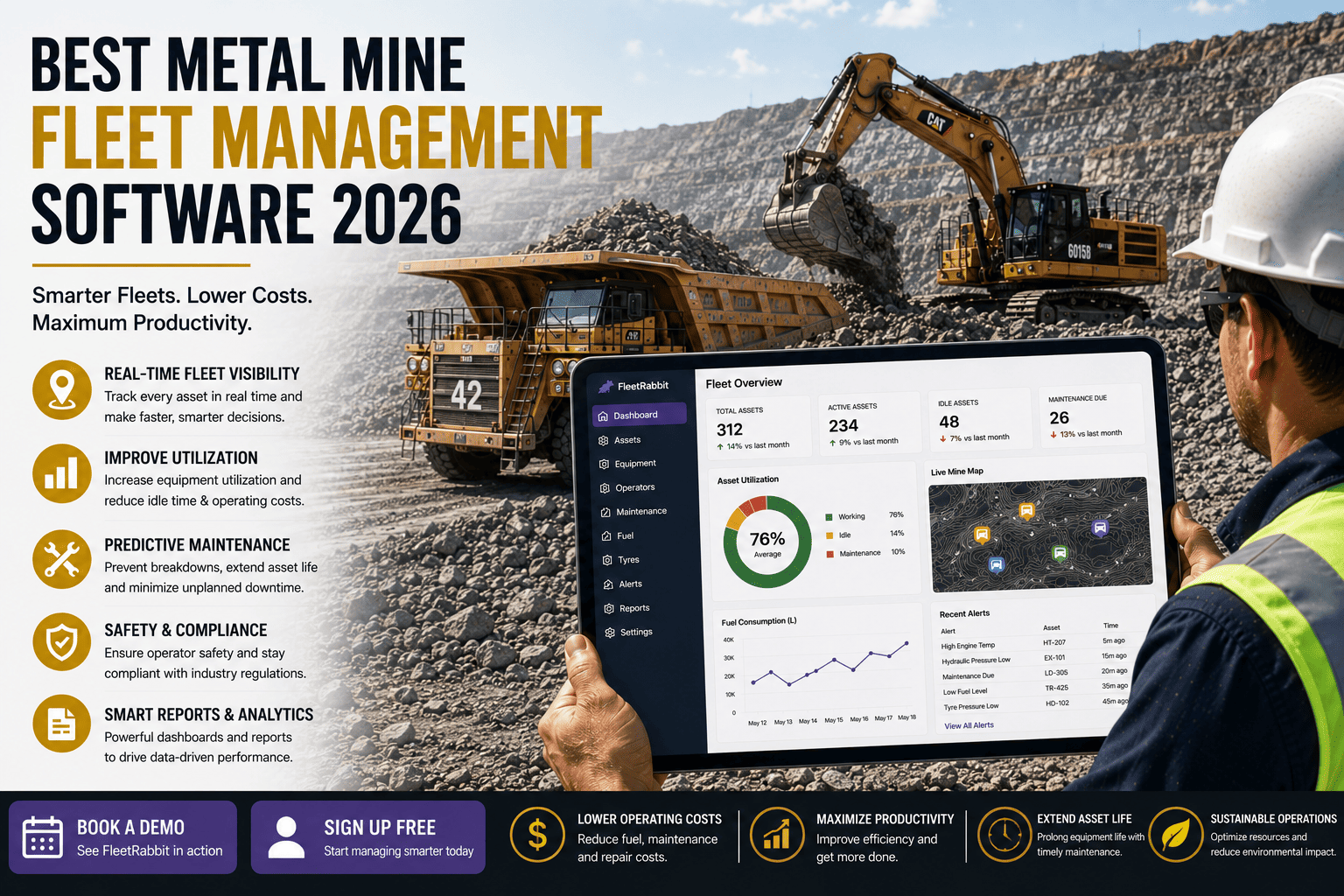
Best Metal Mine Fleet Management Software in 2026

best-metal-mine-fleet-management-software-2026

A single haul truck sitting idle at a metal mine can cost between 5,000 and 20,000 dollars an hour in lost production, and when the primary shovel goes down the losses ripple through the entire truck queue. Copper, gold, and iron ore operations run on tight margins per tonne, and the gap between a mine that hits its production target and one that consistently misses it almost never comes down to the equipment itself. It comes down to the fleet management software running behind that equipment. Choosing the right platform is one of the highest-leverage decisions a mine manager makes in 2026, and this guide breaks down exactly what to look for before you commit.

Quick Answer

The best metal mine fleet management software combines real-time haul truck dispatch, predictive maintenance built around engine hours rather than mileage, ore-grade and production tracking, and MSHA-ready digital compliance. Metal mines implementing purpose-built platforms report 30 to 40 percent reductions in unplanned downtime and utilization gains of 8 to 15 percent within the first year of use.

Why Metal Mines Can't Run on Generic Fleet Software

Most fleet management tools on the market were built for highway trucking or general construction, then retrofitted for mining as an afterthought. That approach breaks down fast at a copper, gold, or iron ore operation, where duty cycles are extreme, ore bodies shift underground and pit walls move week to week, and equipment costs run into the hundreds of thousands per unit. A metal mine needs software designed around the realities of the pit, not a highway route.

01
Engine Hours, Not Mileage
Haul trucks, shovels, and loaders never touch a public road. Maintenance intervals, warranty tracking, and lifecycle costs must be built around engine hours and load cycles, not odometer readings.
02
Shifting Haul Profiles
As a pit deepens or a stope advances, haul distances, grades, and cycle times change constantly. Dispatch logic has to re-optimize routes and truck-shovel matching in near real time, not once a quarter.
03
MSHA, Not DOT
Pre-shift inspections, defect reporting, and compliance recordkeeping at a metal mine follow MSHA rules, not highway regulations. Software built for trucking fleets simply doesn't map to those requirements.

Core Capabilities the Best Platforms Deliver

Once you strip away the marketing language, every strong metal mine fleet management platform in 2026 is judged on the same five capability areas. Each one maps to a documented cost driver at the pit, and weak performance in any single area quietly erodes cost-per-tonne over the life of the mine.

Capability What It Solves Typical Impact
Dynamic Dispatch Assigns trucks to shovels and crushers based on live queue length, grade targets, and cycle time 8 to 15 percent utilization gain
Predictive Maintenance Flags engine, hydraulic, and drivetrain wear before a failure stops the haul cycle 30 to 40 percent unplanned downtime cut
Production & Grade Tracking Reconciles tonnes moved against block model grade to catch dilution early Improved ore recovery accuracy
Digital MSHA Inspections Replaces paper pre-shift logs with mobile defect capture and audit trails PM completion rates above 95 percent
OEM & Telematics Integration Pulls fault codes and health data from Cat, Komatsu, and Volvo equipment automatically Fewer manual data entry errors
Built For Copper, Gold & Iron Ore Fleets
See Your Pit Data Live

FleetRabbit brings haul truck dispatch, predictive maintenance, and MSHA-ready inspections into one dashboard built for metal mining duty cycles. If you want to try it on your own fleet first, you can sign up free with 3 machines before rolling it out site-wide.

30-40%
Downtime Reduction
8-15%
Utilization Gain

What Changes by Commodity

Metal mine fleet management software has to flex around the specific economics of what's coming out of the ground, because a copper pit, a gold operation, and an iron ore mine each stress the fleet differently.

Copper Mines: Tonnage and Grade Reconciliation

Copper operations move enormous waste-to-ore ratios to reach economic grade, so haul fleets spend most of their cycles on waste rather than ore. The software needs strong grade reconciliation, comparing what the block model predicted against what the crusher actually receives, so dilution gets caught before it erodes concentrate value.

Why This Matters

A copper mine losing even half a percent of head grade to undetected dilution across a multi-million-tonne annual plan can represent a meaningful swing in revenue, which is why production tracking tied to fleet dispatch is non-negotiable for copper operators.

Gold Mines: Ore Control and Blending Precision

Gold operations depend on precise ore control, routing specific truckloads to specific stockpiles based on assay results rather than simple ore-versus-waste classification. Fleet software here needs destination logic sophisticated enough to blend feed grade for the mill and prevent high-grade material from being misrouted to a low-grade pad.

Why This Matters

Misrouted high-grade ore at a gold mine is one of the costliest and most common software failures, and it is nearly always solved by tighter integration between the dispatch system and the geology block model.

Iron Ore Mines: Volume, Speed, and Rail Coordination

Iron ore operations run at enormous scale with high-capacity trucks feeding crushers and, often, rail loadout on a strict schedule. Fleet software for iron ore needs to optimize raw throughput and keep haul cycles synchronized with crusher and rail capacity so trucks aren't queuing and burning cycle time waiting on a bottleneck downstream.

Why This Matters

Iron ore economics reward volume and consistency more than grade precision, so the software's dispatch algorithm and real-time queue visibility carry more weight than the ore-control features that matter most at a gold or copper site.

How to Evaluate Your Options

With a clear picture of what the software needs to do, evaluating vendors comes down to a short, disciplined checklist rather than a long feature comparison spreadsheet.

Confirm Real-Time Dispatch, Not Batch Reporting

Ask vendors to show live dispatch decisions responding to a changed shovel or crusher status within seconds, not a report that updates once a shift.

Check OEM Compatibility Across Your Mixed Fleet

Most metal mines run mixed fleets of Cat, Komatsu, and Volvo equipment. Confirm the platform pulls telematics and fault codes from all of them without manual workarounds.

Verify MSHA-Ready Documentation

Pre-shift inspections, defect reporting, and audit trails should be built for MSHA from day one, not adapted from a DOT-focused trucking product.

Ask About Implementation Timeline

A realistic rollout, including telematics integration and staff training, should take weeks rather than a full year. Most operations see measurable downtime reduction within 60 to 90 days of going live.

The Return on Investment

Fleet management software pays for itself faster at a metal mine than in almost any other equipment-heavy industry, simply because the cost of a single major failure is so high. Preventing even one unplanned haul truck or shovel failure typically covers the annual software cost outright, and the compounding gains from better utilization and dispatch accuracy continue every single shift after that.

From Reactive To Predictive
Put a Number on Your Downtime

FleetRabbit's predictive maintenance engine watches engine hours, hydraulic pressure, and drivetrain trends across your haul fleet so failures get caught before they stop production. Ready to see it against your own equipment list? Book a 30-minute demo and we'll walk through your specific fleet mix.

$5K-$20K
Cost Per Idle Hour
60-90 Days
To Measurable Results
Metal Mine Fleet Software Copper Mining Technology Gold Mine Dispatch Iron Ore Haulage Predictive Maintenance MSHA Compliance

Frequently Asked Questions

QWhat makes fleet software for metal mines different from general fleet software?
Metal mine software is built around engine hours instead of mileage, MSHA compliance instead of DOT rules, and dispatch logic that reacts to shifting pit conditions and ore grade rather than fixed highway routes.
QHow much does haul truck downtime actually cost?
A single large haul truck sitting idle costs between 5,000 and 20,000 dollars per hour depending on truck class and commodity price. When a primary shovel goes down, cascading losses across the queued trucks can climb far higher.
QDoes the software work with mixed OEM equipment?
The strongest platforms integrate with Cat, Komatsu, and Volvo telematics through direct API connections, pulling engine hours and fault codes automatically regardless of which brands make up your fleet.
QCan this software help with ore grade control?
Yes. Production tracking modules reconcile actual tonnes and grade delivered against the block model, helping copper and gold operations catch dilution and misrouted ore before it affects concentrate or mill feed value.
QHow long does implementation take at an active mine?
Most metal mines complete telematics integration and staff training within a few weeks and see measurable downtime reduction within 60 to 90 days of going live. You can sign up free to start with a small subset of machines first.
QIs this suitable for underground metal mines as well as open pit?
Underground metal mines need the same engine-hour maintenance tracking and MSHA documentation, though dispatch logic shifts toward loader and truck coordination in confined haulage drifts rather than open-pit route optimization.
QWhat is a realistic return on investment timeline?
Preventing a single major unplanned failure typically covers the annual software cost. Book a demo and our team will walk through ROI projections based on your fleet size and commodity.

Fleet management software has become the difference between mines that consistently hit production targets and mines that fight downtime every shift. Whether you're running a copper operation focused on grade reconciliation, a gold mine that lives or dies on ore control precision, or an iron ore site chasing raw throughput, the right platform pays for itself by preventing just one major unplanned failure. The mines moving first on purpose-built fleet software are already widening the gap on uptime, safety, and cost-per-tonne over those still running paper logs and radio check-ins.

Ready to Run Your Fleet on Real-Time Data?

FleetRabbit gives metal mining operations the dispatch optimization, predictive maintenance, and MSHA-ready compliance tools that used to be reserved for six-figure enterprise systems. Start free with 3 machines, no credit card required, and see the difference within your first few shifts.
Haul Truck Dispatch Predictive Maintenance Ore Grade Tracking MSHA Compliance Mixed Fleet Integration

July 22, 2026 By John
All Posts

Best Metal Mine Fleet Management Software in 2026

best-metal-mine-fleet-management-software-2026

A metal mine's fleet is built around a small number of extremely expensive machines doing an enormous amount of work. An ultra-class haul truck hauling copper ore, gold-bearing rock, or iron ore out of a deep open pit can cost more than a house just in tires, and a single shovel sitting idle because trucks are backed up in the queue can cascade into six-figure losses within a single shift. Metal mine fleet management software has to handle that scale, matching haul trucks to shovels, tracking ore versus waste movement, and catching mechanical problems on machines that are too expensive to run to failure.

Metal Mine Fleet Snapshot

A single ultra-class haul truck tire costs 40000 to 70000 dollars and typically lasts 4000 to 6000 hours, making tire management one of the largest controllable costs on any metal mine site. Unplanned haul truck downtime costs 5000 to 20000 dollars per hour, and when a primary shovel goes down the cascading cost across the truck queue can reach 180000 dollars per hour at large operations. Mines running predictive maintenance and fleet analytics report 30 to 42 percent reductions in unplanned downtime.

Why Ultra-Class Fleets Change The Economics

Metal mining, whether it's copper, gold, iron ore, or nickel, tends to run some of the largest and most expensive mobile equipment in any industry. A 190 to 400 ton haul truck represents millions of dollars in capital investment, and every hour it sits idle or in the shop is an hour that was already budgeted into the mine plan's tonnage target. Because these fleets are smaller in unit count than a construction or aggregate fleet but far higher in per-unit value, the cost of getting maintenance and dispatch wrong is proportionally much larger.

Tire Program
Ultra-Class Tire Cost
A single ultra-class haul truck tire costs 40000 to 70000 dollars, and with six tires per truck across a fleet of 20 or more units, tire lifecycle management becomes one of the largest line items on the maintenance budget.
Shovel-Truck Match
Cascading Downtime Risk
When a primary shovel goes down, every truck in its queue sits idle waiting, and cascading losses across a large truck-shovel match can reach 180000 dollars per hour at major operations.
Prevention
Predictive Maintenance Payoff
Mines shifting from reactive to predictive maintenance report 30 to 42 percent reductions in unplanned downtime, with the majority of savings coming from fewer emergency repairs and lower parts inventory costs.

How Fleet Needs Shift Across Copper, Gold, And Iron Ore

While the core haul truck, shovel, and drill fleet looks similar across metal commodities, the operational priorities differ enough that a one-size approach to fleet management leaves value on the table.

Copper Operations And Ore-Waste Ratios

Copper mines typically move far more waste rock than ore to reach payable grade, which means fleet software needs to separate ore haul cycles from waste haul cycles clearly so tonnage and cost reporting reflect true grade economics rather than a blended total that hides which trucks are actually moving payable material.

Gold Operations And Grade Control Sensitivity

Gold mining often runs tighter grade control zones, where a haul truck misrouting ore to the wrong stockpile can quietly cost more in blending losses than a mechanical breakdown would. Dispatch accuracy and GPS-verified dump locations matter as much as maintenance uptime in these operations.

Iron Ore Operations And Sustained Tonnage Targets

Iron ore operations typically run at higher sustained tonnage volumes with tighter rail or port shipping schedules downstream, which makes haul truck availability and cycle time consistency the dominant priority, since a shipping window missed at the port has consequences far beyond the pit.

Built For Copper, Gold, And Iron Ore Fleets
See Every Haul Truck, Shovel, And Drill In One View

FleetRabbit tracks ultra-class haul trucks, shovels, drills, and dozers with condition-based maintenance triggers, tire program tracking, and real-time utilization data across ore and waste haul cycles. Start free with 3 assets today.

30-42%
Downtime Reduction
$40K-70K
Per Ultra-Class Tire

Core Fleet Assets And Where Software Needs To Focus

A metal mine's mobile fleet spans a wide range of asset types, each with a different failure mode and a different cost of getting maintenance wrong. The table below breaks down where fleet management software delivers the most value across a typical open-pit metal operation.

Equipment Type Primary Cost Driver Downtime Cost Range Software Priority
Ultra-Class Haul Truck Tire wear, engine hours, brake system stress on ramp grades 5000 to 20000 dollars per hour Telematics integration with OEM systems and tire program tracking
Electric Or Hydraulic Shovel Bucket and dipper wear, hydraulic system failure Up to 180000 dollars per hour cascading Condition-based alerts tied to shovel-truck match scheduling
Drill Rig Bit wear, mast alignment, hydraulic leaks 4000 to 10000 dollars per incident Drilling hour tracking with escalated defect work orders
Dozer And Grader Undercarriage wear from abrasive haul road conditions 3000 to 8000 dollars per incident Undercarriage wear tracking tied to haul road maintenance schedule
Underground LHD And Jumbo Confined-space wear, diesel particulate system stress 6000 to 15000 dollars per incident Offline mobile inspections for low-connectivity underground sections

Optimizing The Deep Pit Haul Cycle

As open pits get deeper, haul cycle times get longer and the cost of every inefficiency multiplies across every truck making that trip dozens of times per shift. A haul road with poor grading adds unnecessary strain on brakes and tires with every pass, and a queue imbalance at the crusher or shovel means trucks burn fuel and engine hours sitting idle rather than hauling. Fleet software that tracks cycle time by route segment can flag exactly where a haul road is costing the fleet time, rather than leaving that discovery to a driver complaint or a slow month-end report.

Utilization data also reveals which trucks are running below fleet average and why, whether that's a mechanical issue, a routing inefficiency, or an operator pattern worth addressing through coaching. Sites that want to see this kind of cycle-level visibility applied to their own pit layout can book a demo and bring their current haul road map to the conversation.

Metal Mine Fleet Software Copper Mining Software Gold Mine Fleet Management Iron Ore Fleet Software Ultra-Class Haul Trucks Tire Program Management

Return On Investment For Metal Mine Fleets

Return on investment for metal mine fleet software tends to scale with the size of the individual assets involved rather than the total unit count. A mid-size operation running 20 ultra-class haul trucks and supporting shovels, drills, and dozers that invests 80000 to 150000 dollars annually in a platform like FleetRabbit typically prevents 10 to 18 unplanned equipment failures per year. At an average of 12000 dollars in combined downtime and repair cost per incident, that is 120000 to 216000 dollars in direct annual savings, before counting extended tire life and reduced parts inventory costs.

Where Additional Savings Compound

Beyond direct downtime prevention, mines tracking utilization and tire wear data typically extend average tire life by 15 to 25 percent through better rotation scheduling and haul road maintenance, which on a 40000 to 70000 dollar tire represents meaningful savings across a full fleet replacement cycle.

Frequently Asked Questions

QWhat makes metal mine fleet software different from other mining software
Metal mine fleets run fewer, far more expensive machines than aggregate or coal fleets, so the software needs to prioritize tire program management, OEM telematics integration, and shovel-truck match scheduling rather than just tracking a large unit count.
QHow much does an ultra-class haul truck tire actually cost
A single ultra-class haul truck tire typically costs 40000 to 70000 dollars and lasts 4000 to 6000 hours, making tire lifecycle tracking one of the highest-value features fleet software can offer a metal mine.
QDoes fleet software need to differentiate ore and waste haulage
Yes, especially for copper and other operations with high waste-to-ore ratios. Separating ore and waste haul cycles in reporting gives a far more accurate picture of true grade economics than a blended tonnage total.
QCan fleet software integrate with Cat MineStar or Komatsu KOMTRAX
Yes. The strongest metal mine fleet platforms ingest OEM telematics feeds from systems like Cat MineStar and Komatsu KOMTRAX so diagnostic data from the most expensive assets on site feeds directly into maintenance scheduling.
QHow fast does metal mine fleet software pay for itself
Most operations see payback within three to five months. Preventing 10 to 18 unplanned failures a year on ultra-class equipment typically saves 120000 to 216000 dollars against a much smaller software investment. Book a demo to calculate your specific fleet numbers.
QDoes this work for underground metal mining equipment too
Yes. LHDs, jumpers, and underground haul trucks need offline-capable mobile inspection tools since underground sections often have no cellular connectivity, and the platform should sync data automatically once a device resurfaces.

The Bottom Line For Metal Mine Operators

Metal mining fleets run some of the most expensive mobile equipment on earth, and the margin for error on maintenance timing, tire management, and shovel-truck matching is thinner than most other industries face. A single missed brake inspection or a shovel that goes down mid-shift doesn't just cost a repair bill, it cascades through the entire haul cycle and shows up directly in the mine's tonnage numbers. Purpose-built fleet management software turns that risk into a visible, manageable system instead of a recurring surprise.

If your pit is still running maintenance schedules off a spreadsheet or relying on radio calls to know which truck is down, it's worth seeing what a connected dashboard looks like against your own haul fleet. You can start a free trial with a few units, or book a demo to walk through your specific pit, fleet mix, and commodity with the FleetRabbit team.

Protect Your Most Expensive Equipment On Site

FleetRabbit connects ultra-class haul trucks, shovels, drills, and support equipment into one dashboard with predictive maintenance, tire program tracking, and real-time utilization data. See downtime start dropping within your first few weeks. No credit card required to start.

Metal Mine Fleet Management Ultra-Class Haul Trucks Tire Program Tracking Predictive Maintenance Mining Fleet Analytics

July 23, 2026 By John
All Posts

Best Metal Mine Fleet Management Software in 2026

best-metal-mine-fleet-management-software-2026

A metal mine's fleet is built around a small number of extremely expensive machines doing an enormous amount of work. An ultra-class haul truck hauling copper ore, gold-bearing rock, or iron ore out of a deep open pit can cost more than a house just in tires, and a single shovel sitting idle because trucks are backed up in the queue can cascade into six-figure losses within a single shift. Metal mine fleet management software has to handle that scale, matching haul trucks to shovels, tracking ore versus waste movement, and catching mechanical problems on machines that are too expensive to run to failure.

Metal Mine Fleet Snapshot

A single ultra-class haul truck tire costs 40000 to 70000 dollars and typically lasts 4000 to 6000 hours, making tire management one of the largest controllable costs on any metal mine site. Unplanned haul truck downtime costs 5000 to 20000 dollars per hour, and when a primary shovel goes down the cascading cost across the truck queue can reach 180000 dollars per hour at large operations. Mines running predictive maintenance and fleet analytics report 30 to 42 percent reductions in unplanned downtime.

Why Ultra-Class Fleets Change The Economics

Metal mining, whether it's copper, gold, iron ore, or nickel, tends to run some of the largest and most expensive mobile equipment in any industry. A 190 to 400 ton haul truck represents millions of dollars in capital investment, and every hour it sits idle or in the shop is an hour that was already budgeted into the mine plan's tonnage target. Because these fleets are smaller in unit count than a construction or aggregate fleet but far higher in per-unit value, the cost of getting maintenance and dispatch wrong is proportionally much larger.

Tire Program
Ultra-Class Tire Cost
A single ultra-class haul truck tire costs 40000 to 70000 dollars, and with six tires per truck across a fleet of 20 or more units, tire lifecycle management becomes one of the largest line items on the maintenance budget.
Shovel-Truck Match
Cascading Downtime Risk
When a primary shovel goes down, every truck in its queue sits idle waiting, and cascading losses across a large truck-shovel match can reach 180000 dollars per hour at major operations.
Prevention
Predictive Maintenance Payoff
Mines shifting from reactive to predictive maintenance report 30 to 42 percent reductions in unplanned downtime, with the majority of savings coming from fewer emergency repairs and lower parts inventory costs.

How Fleet Needs Shift Across Copper, Gold, And Iron Ore

While the core haul truck, shovel, and drill fleet looks similar across metal commodities, the operational priorities differ enough that a one-size approach to fleet management leaves value on the table.

Copper Operations And Ore-Waste Ratios

Copper mines typically move far more waste rock than ore to reach payable grade, which means fleet software needs to separate ore haul cycles from waste haul cycles clearly so tonnage and cost reporting reflect true grade economics rather than a blended total that hides which trucks are actually moving payable material.

Gold Operations And Grade Control Sensitivity

Gold mining often runs tighter grade control zones, where a haul truck misrouting ore to the wrong stockpile can quietly cost more in blending losses than a mechanical breakdown would. Dispatch accuracy and GPS-verified dump locations matter as much as maintenance uptime in these operations.

Iron Ore Operations And Sustained Tonnage Targets

Iron ore operations typically run at higher sustained tonnage volumes with tighter rail or port shipping schedules downstream, which makes haul truck availability and cycle time consistency the dominant priority, since a shipping window missed at the port has consequences far beyond the pit.

Built For Copper, Gold, And Iron Ore Fleets
See Every Haul Truck, Shovel, And Drill In One View

FleetRabbit tracks ultra-class haul trucks, shovels, drills, and dozers with condition-based maintenance triggers, tire program tracking, and real-time utilization data across ore and waste haul cycles. Start free with 3 assets today.

30-42%
Downtime Reduction
$40K-70K
Per Ultra-Class Tire

Core Fleet Assets And Where Software Needs To Focus

A metal mine's mobile fleet spans a wide range of asset types, each with a different failure mode and a different cost of getting maintenance wrong. The table below breaks down where fleet management software delivers the most value across a typical open-pit metal operation.

Equipment Type Primary Cost Driver Downtime Cost Range Software Priority
Ultra-Class Haul Truck Tire wear, engine hours, brake system stress on ramp grades 5000 to 20000 dollars per hour Telematics integration with OEM systems and tire program tracking
Electric Or Hydraulic Shovel Bucket and dipper wear, hydraulic system failure Up to 180000 dollars per hour cascading Condition-based alerts tied to shovel-truck match scheduling
Drill Rig Bit wear, mast alignment, hydraulic leaks 4000 to 10000 dollars per incident Drilling hour tracking with escalated defect work orders
Dozer And Grader Undercarriage wear from abrasive haul road conditions 3000 to 8000 dollars per incident Undercarriage wear tracking tied to haul road maintenance schedule
Underground LHD And Jumbo Confined-space wear, diesel particulate system stress 6000 to 15000 dollars per incident Offline mobile inspections for low-connectivity underground sections

Optimizing The Deep Pit Haul Cycle

As open pits get deeper, haul cycle times get longer and the cost of every inefficiency multiplies across every truck making that trip dozens of times per shift. A haul road with poor grading adds unnecessary strain on brakes and tires with every pass, and a queue imbalance at the crusher or shovel means trucks burn fuel and engine hours sitting idle rather than hauling. Fleet software that tracks cycle time by route segment can flag exactly where a haul road is costing the fleet time, rather than leaving that discovery to a driver complaint or a slow month-end report.

Utilization data also reveals which trucks are running below fleet average and why, whether that's a mechanical issue, a routing inefficiency, or an operator pattern worth addressing through coaching. Sites that want to see this kind of cycle-level visibility applied to their own pit layout can book a demo and bring their current haul road map to the conversation.

Metal Mine Fleet Software Copper Mining Software Gold Mine Fleet Management Iron Ore Fleet Software Ultra-Class Haul Trucks Tire Program Management

Return On Investment For Metal Mine Fleets

Return on investment for metal mine fleet software tends to scale with the size of the individual assets involved rather than the total unit count. A mid-size operation running 20 ultra-class haul trucks and supporting shovels, drills, and dozers that invests 80000 to 150000 dollars annually in a platform like FleetRabbit typically prevents 10 to 18 unplanned equipment failures per year. At an average of 12000 dollars in combined downtime and repair cost per incident, that is 120000 to 216000 dollars in direct annual savings, before counting extended tire life and reduced parts inventory costs.

Where Additional Savings Compound

Beyond direct downtime prevention, mines tracking utilization and tire wear data typically extend average tire life by 15 to 25 percent through better rotation scheduling and haul road maintenance, which on a 40000 to 70000 dollar tire represents meaningful savings across a full fleet replacement cycle.

Frequently Asked Questions

QWhat makes metal mine fleet software different from other mining software
Metal mine fleets run fewer, far more expensive machines than aggregate or coal fleets, so the software needs to prioritize tire program management, OEM telematics integration, and shovel-truck match scheduling rather than just tracking a large unit count.
QHow much does an ultra-class haul truck tire actually cost
A single ultra-class haul truck tire typically costs 40000 to 70000 dollars and lasts 4000 to 6000 hours, making tire lifecycle tracking one of the highest-value features fleet software can offer a metal mine.
QDoes fleet software need to differentiate ore and waste haulage
Yes, especially for copper and other operations with high waste-to-ore ratios. Separating ore and waste haul cycles in reporting gives a far more accurate picture of true grade economics than a blended tonnage total.
QCan fleet software integrate with Cat MineStar or Komatsu KOMTRAX
Yes. The strongest metal mine fleet platforms ingest OEM telematics feeds from systems like Cat MineStar and Komatsu KOMTRAX so diagnostic data from the most expensive assets on site feeds directly into maintenance scheduling.
QHow fast does metal mine fleet software pay for itself
Most operations see payback within three to five months. Preventing 10 to 18 unplanned failures a year on ultra-class equipment typically saves 120000 to 216000 dollars against a much smaller software investment. Book a demo to calculate your specific fleet numbers.
QDoes this work for underground metal mining equipment too
Yes. LHDs, jumpers, and underground haul trucks need offline-capable mobile inspection tools since underground sections often have no cellular connectivity, and the platform should sync data automatically once a device resurfaces.

The Bottom Line For Metal Mine Operators

Metal mining fleets run some of the most expensive mobile equipment on earth, and the margin for error on maintenance timing, tire management, and shovel-truck matching is thinner than most other industries face. A single missed brake inspection or a shovel that goes down mid-shift doesn't just cost a repair bill, it cascades through the entire haul cycle and shows up directly in the mine's tonnage numbers. Purpose-built fleet management software turns that risk into a visible, manageable system instead of a recurring surprise.

If your pit is still running maintenance schedules off a spreadsheet or relying on radio calls to know which truck is down, it's worth seeing what a connected dashboard looks like against your own haul fleet. You can start a free trial with a few units, or book a demo to walk through your specific pit, fleet mix, and commodity with the FleetRabbit team.

Protect Your Most Expensive Equipment On Site

FleetRabbit connects ultra-class haul trucks, shovels, drills, and support equipment into one dashboard with predictive maintenance, tire program tracking, and real-time utilization data. See downtime start dropping within your first few weeks. No credit card required to start.

Metal Mine Fleet Management Ultra-Class Haul Trucks Tire Program Tracking Predictive Maintenance Mining Fleet Analytics

July 23, 2026 By John
All Posts

Share This Story, Choose Your Platform!

Latest Posts

Scroll