The purchase price on a new haul truck or excavator is the number everyone remembers, the one that gets approved in a capital meeting and shows up on a balance sheet. It is also, by a wide margin, the smallest piece of what that machine will actually cost over its working life. Acquisition price typically accounts for less than a fifth of total lifetime cost, with the remaining majority decided entirely by how well the asset is operated, maintained, and eventually retired. Lifecycle management software exists to give fleet managers control over that much larger, much less visible side of the equation.
Why the Purchase Decision Is Only the Beginning
Most mine sites track equipment well during the buying process and well during a breakdown, and very little in between. Purchase price, warranty terms, and vendor comparisons get scrutinized closely at acquisition. Years later, a catastrophic failure gets the same level of attention. The long middle stretch, where an asset quietly accumulates maintenance cost, declining reliability, and shifting total value, often goes almost entirely unmanaged.
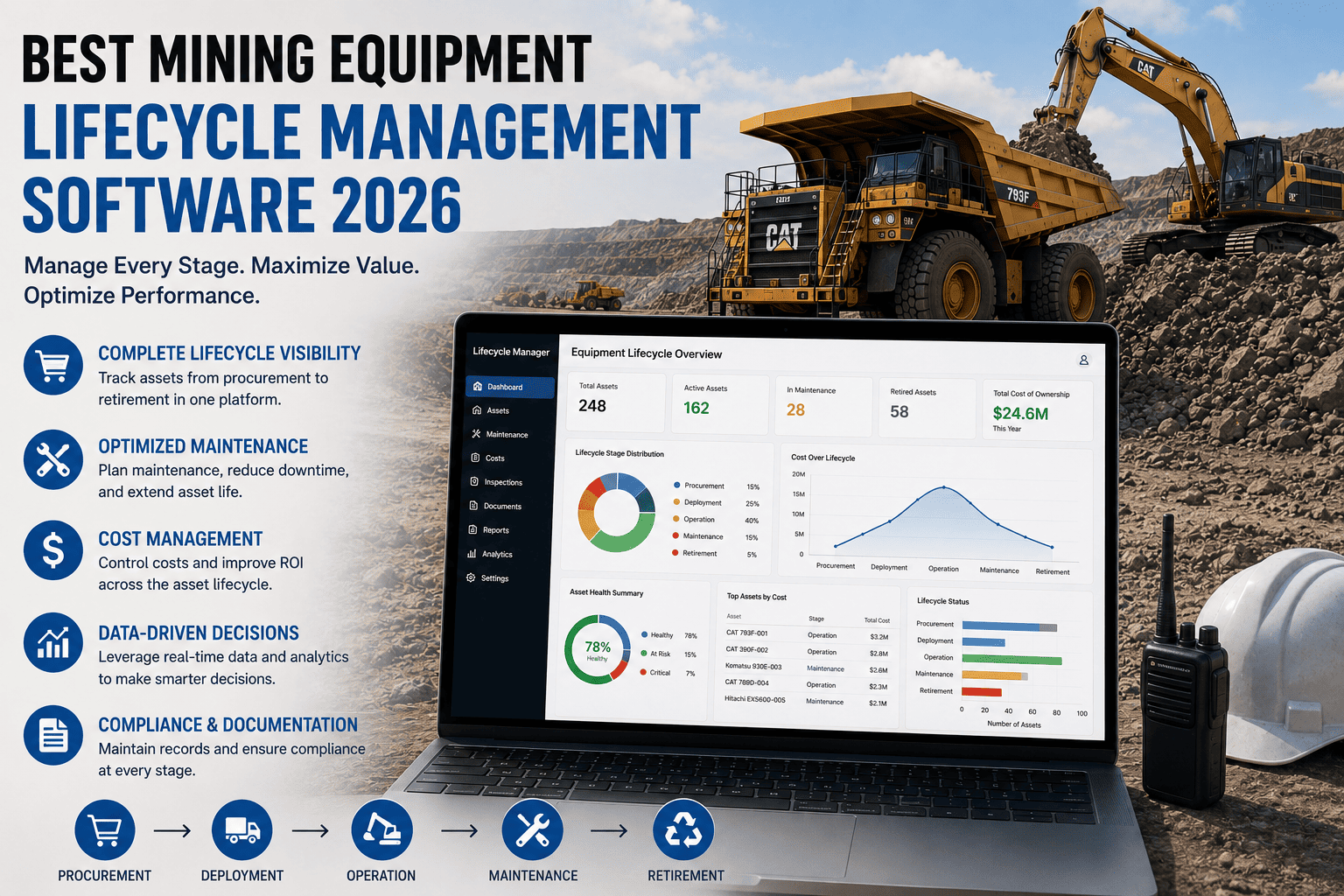
The Six Stages Every Mining Asset Moves Through
A mining asset's life is not a single event. It is a sequence of distinct stages, each with its own decisions and its own data requirements, and a weakness in any one stage tends to compound costs in every stage that follows it.
Planning
Defining the workload an asset actually needs to handle, since over-specifying or under-specifying at this stage locks in cost problems before the machine even arrives on site.
Acquisition
Evaluating vendors, warranty terms, and total cost of ownership projections, not just the headline price tag on the purchase order.
Operation and Maintenance
The longest phase of the lifecycle, where scheduled service, condition monitoring, and parts tracking determine how much value the asset actually delivers per dollar spent.
Performance Optimization
Analyzing accumulated operating data to catch the point where an asset shifts from a productive contributor into a cost center quietly eating the budget.
Repair or Replace Evaluation
Comparing cumulative repair cost against current replacement value to decide whether continued investment still makes financial sense.
Disposal
Planned retirement with documented service history protects resale value, while delayed or reactive disposal decisions lock up capital in an asset already past its useful economic life.
The Moment an Asset Becomes a Liability
Every machine eventually crosses an invisible line where it shifts from generating value to consuming it. A widely used screening threshold treats annual repair and maintenance cost exceeding half of an asset's current replacement value as the signal that a replacement evaluation should become the default, not the exception. Without lifecycle data tracked consistently, that line is nearly impossible to see until well after it has already been crossed.
Why This Decision Is Usually Made Too Late
Repair and replace decisions made reactively, after an asset has already become unreliable, almost always cost more than the same decision made proactively. By the time frequent breakdowns and rising maintenance costs are obvious to everyone on the team, the asset has typically already been a financial drain for months, sometimes years, without anyone tracking the cumulative number that would have flagged it earlier.
What to Look for in a Lifecycle Management Platform
A spreadsheet can hold purchase dates. It cannot connect those dates to cumulative repair cost, current replacement value, and a clear recommendation about whether an asset is still worth keeping. That gap is exactly what dedicated lifecycle software is built to close.
Full History From Day One
Purchase price, warranty terms, and baseline performance data captured at acquisition, creating the reference point every future comparison depends on.
Cumulative Cost Tracking Per Asset
Every maintenance dollar tied to the specific machine, building the running total that reveals exactly when repair spend is approaching replacement value.
Automatic Repair-vs-Replace Flagging
Assets crossing the cost threshold surfaced automatically instead of relying on someone noticing the pattern by memory.
Documented Service History for Resale
A complete, verifiable maintenance record that increases buyer confidence and protects the asset's resale value at disposal.
The clearest way to see where your own fleet sits on this curve is to put real numbers behind it. You can sign up for a free trial and see your assets' lifetime cost data laid out within a day.
How FleetRabbit Manages the Full Equipment Lifecycle
FleetRabbit was built to follow every asset from the day it arrives on site to the day it leaves, keeping acquisition data, maintenance history, and cost trends connected in one record instead of scattered across procurement files and shop floor notes.
Every Asset Starts With a Complete Baseline
Purchase details, warranty terms, and initial performance data are captured at intake, giving every future maintenance decision a reference point to compare against.
Cumulative Cost Visible at Every Stage
FleetRabbit tracks total maintenance spend per asset against its current replacement value continuously, so the repair-versus-replace conversation happens with real numbers instead of gut feeling.
A Clear Signal When Retirement Planning Should Begin
Assets approaching the cost threshold that typically signals declining economic viability are flagged automatically, giving fleet managers time to plan a replacement instead of reacting to a sudden, expensive failure.
Stop Managing Equipment in Two Moments Instead of One Lifecycle
FleetRabbit connects acquisition data, ongoing maintenance cost, and replacement value into one continuous record for every asset, so repair-or-replace decisions are made with evidence instead of memory. Sign up for a free trial and load your fleet's lifecycle data today, or book a demo to see your specific assets modeled on the call.
What Proper Lifecycle Management Is Actually Worth
The case for lifecycle visibility is not abstract. Operations that track cumulative cost per asset consistently catch the repair-versus-replace inflection point years earlier than operations relying on memory and intuition, avoiding the years of declining reliability and rising emergency repair spend that come from holding onto an asset well past its economic life.
Protecting Value on Both Ends of the Lifecycle
Better lifecycle management does not just control mid-life maintenance spend. A well-documented service history meaningfully increases resale value at disposal, while better acquisition decisions, grounded in total cost of ownership rather than purchase price alone, prevent the next asset from repeating the same expensive pattern.
Frequently Asked Questions
Every Asset Is Already Writing Its Own Cost Story
The question is whether anyone is reading it before the replacement decision becomes urgent instead of planned. FleetRabbit tracks every asset from acquisition through disposal, turning scattered records into a clear, continuous lifecycle view your team can actually act on. Get started with a free trial or talk through your specific fleet and asset ages with our team first.