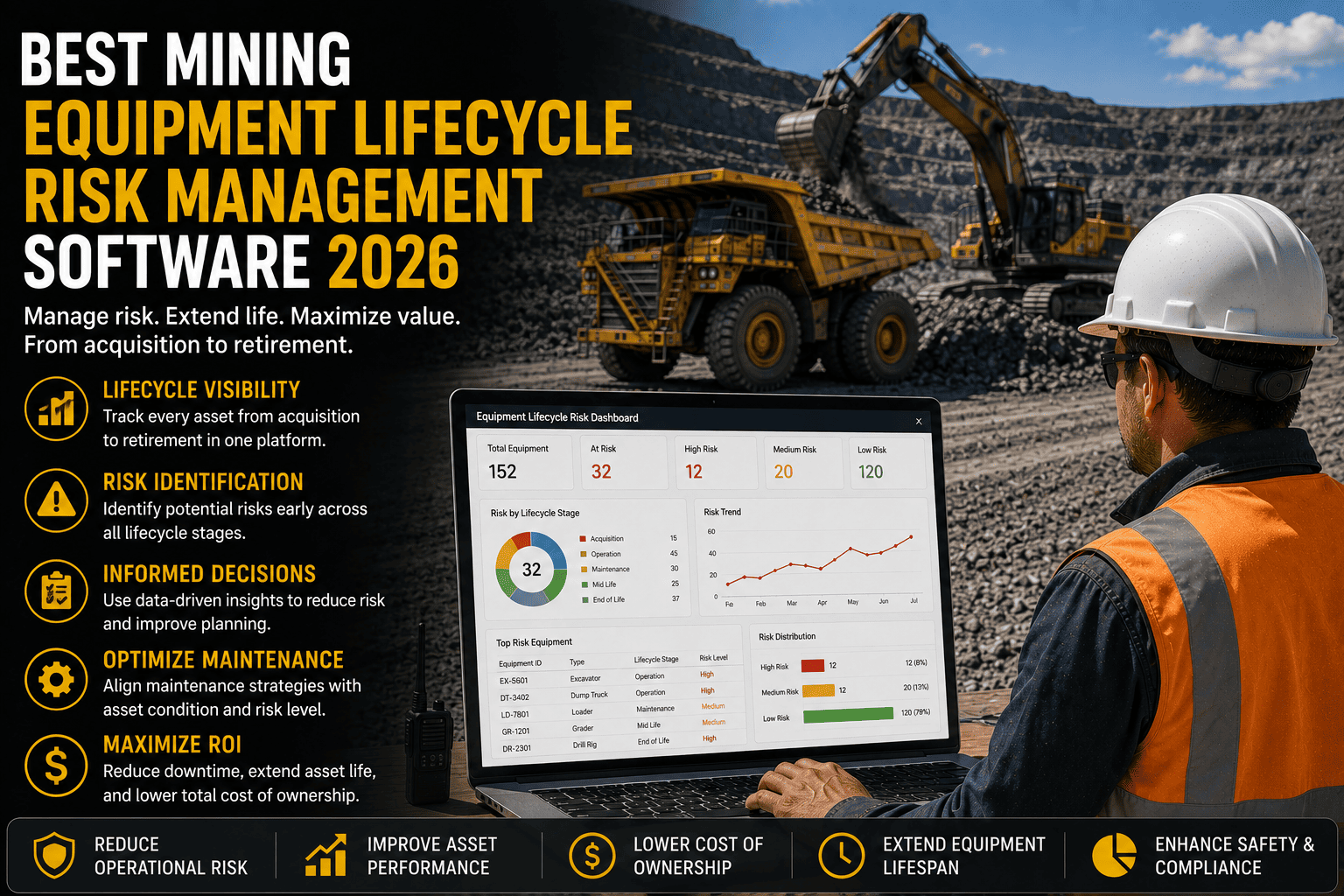
A haul truck doesn't fail the day it turns ten years old. It fails on an ordinary Tuesday, months after the signs were already visible in the maintenance history, if anyone had been looking at the whole picture instead of the last work order. Ultra-class haul trucks can weigh more than 600 tonnes fully loaded, cost tens of millions of dollars, and a single breakdown can cost a mining operation up to $2 million in lost productivity in a single day. Lifecycle risk management software exists to answer one question before that Tuesday arrives: which asset in your fleet is quietly becoming the next expensive surprise.
The best mining equipment lifecycle risk management software tracks every haul truck and loader against its actual wear curve, not just its age, combining runtime hours, component condition, and failure history into a live risk score. Operations using predictive, condition-based tools are reducing unplanned downtime by roughly 50 percent and extending equipment life by 20 to 30 percent, while the rebuild-versus-replace decision becomes a data-backed calculation instead of a guess made under pressure.
Every Machine Follows the Same Risk Curve
Equipment risk doesn't rise in a straight line. It follows a predictable curve, and the mines that manage it well are the ones tracking exactly where each asset sits on that curve, not just its calendar age. Mining equipment runs 5,000 to 7,000 operating hours a year in extreme conditions, dust, vibration, temperature swings from negative 50 to positive 50 degrees, which pushes components through that curve faster than almost any other industry.
Most sites track equipment closely at two moments: during the purchase, when warranty terms and vendor comparisons get scrutinized, and during a catastrophic failure, when it's too late to do anything but react. The stretch in between, where an asset quietly moves from Zone 2 into Zone 3, is exactly where lifecycle risk software earns its keep. You can see where your own fleet sits on that curve by choosing to sign up for a free trial and importing your current asset records.
What Lifecycle Risk Software Actually Tracks
A calendar date tells you almost nothing about how close a haul truck is to failure. Real risk management software builds its score from the conditions the machine has actually experienced, not the year it rolled off the line.
FleetRabbit scores every haul truck and loader using real runtime, component condition, and failure history, so your team knows which asset needs attention before it becomes the next breakdown.
The Rebuild-Versus-Replace Decision
Every haul truck eventually reaches a point where the question shifts from how to fix it to whether fixing it still makes sense. That decision is one of the most expensive calls a mining operation makes, and it's usually made with far less data than the original purchase decision received.
Reading The Signals Before The Decision Gets Forced
| Signal | Favors Rebuild | Favors Replace |
|---|---|---|
| Maintenance Cost Trend | Costs stable or rising slowly year over year | Costs accelerating faster than production value delivered |
| Failure Frequency | Isolated failures on distinct components | Repeat failures clustering on the same subsystem |
| Parts Availability | Parts readily available at standard cost | Parts scarce, discontinued, or on long lead times |
| Operating Hours vs. Design Life | Well within the manufacturer's expected service life | Approaching or past design life with wear-out signals present |
| Resale Or Trade Value | Rebuild investment protects a still-meaningful asset value | Asset value has declined enough that a rebuild rarely pays back |
Why This Decision Needs Live Data, Not a Yearly Review
Static intervals and generic assumptions no longer hold up against fleets operating under different haul road profiles, loading behaviors, and duty cycles. A forecast that recalculates automatically as machines actually operate gives planners a decision that behaves like the equipment itself, not a spreadsheet built once and forgotten.
What Happens Without Lifecycle Risk Visibility
Acquisition price typically accounts for less than a fifth of an asset's total lifetime cost. The rest gets decided by how well the machine is operated, maintained, and eventually retired, which means the biggest financial risk in your fleet is usually invisible on the balance sheet.
Getting Started With Lifecycle Risk Management
Bringing this level of visibility to a mining fleet doesn't require ripping out existing telematics or maintenance systems. Most operations follow the same three-step path to get their first risk rankings live.
Operations moving to predictive, condition-based tracking are seeing fleet availability above 98 percent without spending more on maintenance overall, simply by acting on risk signals earlier. If you'd like to see how this looks against your own fleet's ages and hours, you're welcome to book a demo and bring your current asset list to the call.
FleetRabbit tracks every haul truck and loader from acquisition through disposal, giving your team a clear, continuous lifecycle view instead of scattered records that only get read after a breakdown.
Ready To See Your Fleet's Risk Curve
The most expensive breakdowns are rarely the ones nobody could have predicted. They're the ones where the warning signs were sitting in a maintenance log nobody had time to connect to the bigger picture. When you're ready to see that picture for your own fleet, you can sign up and start a free trial, or if you'd rather walk through your asset ages and risk profile live first, book a 30-minute demo with our team.
Every aging haul truck and loader is telling you something through its maintenance history. FleetRabbit turns that scattered data into a live risk score, so rebuild and replacement decisions happen on your schedule, not the equipment's.