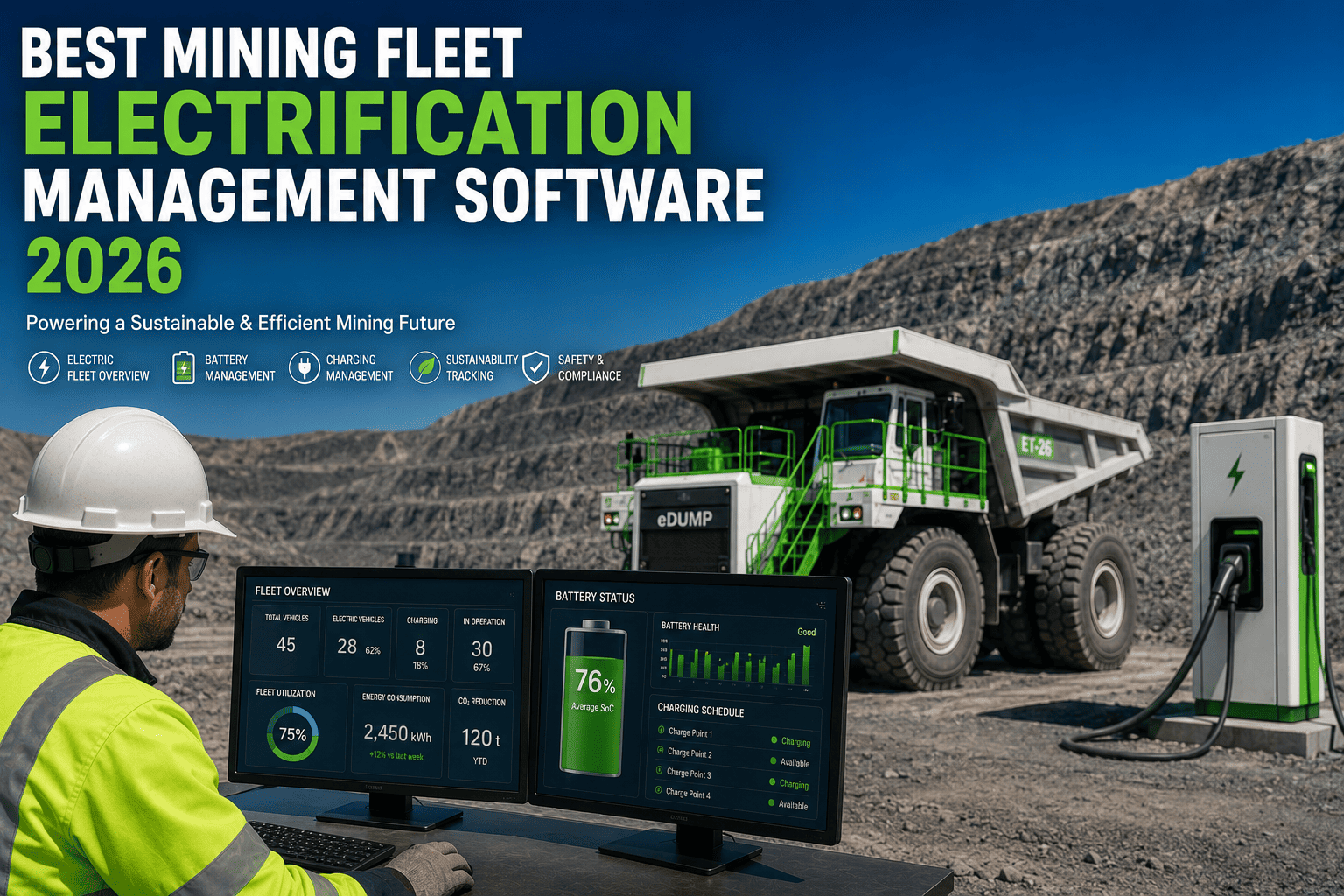
Mining is electrifying — and the operations that plan now will lead the decade. Diesel-powered mobile equipment is responsible for up to 80% of a mine's direct Scope 1 emissions, making fleet electrification the single highest-leverage intervention available to any operator serious about measurable decarbonisation. But the shift from diesel to electric is not just a vehicle decision — it is a complete operational transformation that touches charging infrastructure, energy management, battery health monitoring, maintenance protocols, and workforce readiness all at once. The right mining fleet electrification management software turns this complexity into a clear, staged roadmap — and makes every phase of the transition trackable, measurable, and manageable. Book a FleetRabbit demo to see how leading mine operations are managing their electrification journey in 2026.
Why Mining Fleet Electrification Software Is Now Essential
Traditional fleet management platforms were built for diesel. They have no concept of battery state-of-charge, no charging schedule optimizer, no energy cost tracking, and no way to manage the distinct maintenance cycle of electric equipment — fewer moving parts but entirely new critical systems like high-voltage battery packs, thermal management units, and regenerative braking. Mining operations running mixed diesel and electric fleets on diesel-era software are flying blind on the assets that matter most.
Three forces are now acting simultaneously on mine operators. First, institutional investors and ESG rating agencies apply formal scoring penalties to operators without credible decarbonisation plans. Second, regulatory pressure from advanced clean fleet mandates is tightening timelines across North America, Europe, and Australia. Third, the operational economics are compelling — electric mining equipment achieves 90% energy efficiency versus diesel's 30%, and smart charging management reduces electricity costs by up to 40%. Sign up for FleetRabbit and start mapping your electrification readiness today.
ESG & Investor Pressure
ESG rating agencies are now applying formal scoring penalties to mining operators without credible decarbonisation roadmaps. Institutional investors and climate disclosure frameworks including TCFD and CDP require granular Scope 1 and Scope 2 emissions tracking — not estimates.
Regulatory Mandates
Advanced Clean Fleet regulations in California, Canada, and across the EU are tightening zero-emission requirements for heavy equipment. Operations that begin software-supported transition planning in 2026 avoid the compliance risk of rushed adoption later.
Operational Economics
Electric mining equipment delivers 90% energy efficiency vs diesel's 30%. Renewable energy integration reduces charging costs by 30–50%. Underground operations eliminate ventilation energy costs when diesel exhaust is removed. The financial case for electrification is no longer theoretical.
What Mining Fleet Electrification Software Must Do
Electrification management is not a single feature — it is a platform capability that must span the entire transition lifecycle, from readiness assessment and charging infrastructure planning through battery health monitoring and mixed-fleet operations. Book a demo to see how FleetRabbit handles every stage in one unified dashboard.
The 6 Must-Have Capabilities
Mixed Fleet Management — Diesel + Electric on One Dashboard
Most mines will run diesel and electric equipment together for the next decade. Your platform must manage both powertrains in a unified dashboard — fuel consumption and maintenance intervals for diesel, state-of-charge, charging schedule, and battery health for EVs — without forcing operators to switch between systems. Platforms that silo EV and diesel data create blind spots that cost uptime and money.
Battery Health Monitoring & Lifecycle Tracking
Mining battery packs cost $150,000 or more to replace. Battery management systems must monitor cell balancing, thermal regulation, depth-of-discharge patterns, and degradation curves to predict when packs approach end-of-life. Modern mining batteries retain 75–85% of original capacity after 8–10 years under proper management — poor monitoring cuts that lifespan significantly. Cycling between 20–80% state-of-charge rather than full 0–100% cycles is the standard protocol that software must enforce and track automatically.
Smart Charging Infrastructure Management
Unmanaged charging is expensive. Plugging in 10 machines simultaneously after a shift creates demand charge spikes that account for 50–70% of the monthly electricity bill. Smart charging software staggers loads, shifts charging to off-peak time-of-use rate windows, and balances electrical loads across the site. Fleets using smart charging management report up to 40% reduction in electricity costs and 38% improvement in charger utilization. Battery energy storage integration further buffers peaks, reducing demand charges by an additional 30–50%.
EV-Specific Inspection & Maintenance Workflows
Electric mining equipment requires entirely new inspection protocols covering 400–800V high-voltage systems, battery thermal management checks, regenerative braking calibration, and cooling system verification — none of which appear in diesel inspection templates. Maintenance intervals differ too: 50% fewer moving parts means longer mechanical intervals, but new critical system checks at different frequencies. Software must support equipment-specific digital inspection checklists that evolve as your EV fleet grows.
Energy Consumption & Carbon Emissions Reporting
Electrification without emissions tracking defeats the purpose. Fleet management software must capture per-vehicle and per-route energy consumption, calculate carbon reduction versus diesel baseline, track renewable vs grid energy sourcing for charging, and format outputs for ESG reporting frameworks including TCFD, CDP, and corporate sustainability disclosure requirements. Automated carbon reporting transforms electrification from an operational project into a documented sustainability asset.
Fleet Transition Planning & Readiness Assessment
No fleet goes 100% electric overnight. Effective transition management requires duty cycle analysis, daily energy demand mapping, route suitability scoring for electrification, and phased replacement scheduling aligned with infrastructure build-out timelines. Operations that begin software-supported planning now — even for deployments 2–3 years away — arrive at transition with infrastructure ready, teams trained, and business cases validated by real operational data rather than manufacturer projections.
Mining Electrification by Application Type
Electrification feasibility and optimal software requirements vary significantly based on where and how equipment operates. Understanding these differences is essential for prioritizing which assets to electrify first and what software capabilities matter most for your specific operation.
Underground Mining
Best FitUnderground operations present the strongest immediate electrification case. Removing diesel exhaust eliminates ventilation energy requirements — a major operating cost — while reducing fire and explosion risks associated with combustion engines. Load-haul-dump (LHD) vehicles represent the most successful EV implementation in underground mining to date.
Surface Mining — Short Haul
Good FitShort haul cycles of 2–4 km from pit to crusher are well-suited for current battery technology. Consistent, predictable routes allow accurate energy demand forecasting. Opportunity charging during shift changes maintains utilization without long downtime windows. Solar-powered charging infrastructure pairs naturally with surface operations in high-irradiance regions.
Large Haul Trucks — Open Cut
Planning PhaseLarge-scale haul truck electrification (200+ tonne class) remains in development with Caterpillar and BYD prototyping. Commercial deployment at scale extends into the early 2030s. A 220-tonne haul truck carries a 1.4 MWh+ battery pack requiring serious infrastructure investment — one site spent $4M on electrical upgrades before deploying six electric trucks. Start planning now; infrastructure timelines demand 12–18 months lead time.
Manage Your Entire Fleet Transition From One Platform
FleetRabbit gives mining operations a unified dashboard for diesel and electric equipment — battery health monitoring, smart charging scheduling, EV-specific inspection workflows, carbon emissions reporting, and phased transition planning all in one place. No enterprise contracts. Set up in under a day.
The Mining Fleet Electrification Transition Roadmap
Successful electrification follows a proven implementation sequence that minimizes operational disruption while building organizational confidence in electric technologies. The strategic approach typically spans 3–7 years for complete fleet transition. Operations that rush into 1–2 year aggressive timelines often encounter operational failures and program abandonment. Sign up for FleetRabbit to get your fleet readiness assessment started today.
Battery Management: The Make-or-Break Factor
A mining battery pack is one of the most expensive assets on site — and the most sensitive to management quality. Poor thermal management, incorrect depth-of-discharge cycling, or inadequate cell balancing can cut a battery's service life from 10 years to 4. Fleet electrification software that tracks battery health as a primary metric — not an afterthought — protects millions in capital investment and prevents the most expensive surprises in EV fleet operations.
Battery Management Metrics Every Mining Operation Must Track
Charging Infrastructure: The Hidden Cost That Decides Everything
The #1 barrier to mining fleet electrification is not the machines — it is charging infrastructure. A depot charging 10 machines simultaneously may require 1–3.5 MW of power, equivalent to a small industrial facility. Utility engagement and grid capacity assessment must happen 12–18 months before your first EV arrives. Operations that treat infrastructure as an afterthought to vehicle purchasing discover the hard way that chargers cannot deliver power the grid cannot supply.
Infrastructure Planning Checklist
Electrical Capacity
Smart Charging Management
Renewable Integration
Compliance & OEM Integration
Frequently Asked Questions
Start Your Mining Electrification Journey with FleetRabbit
Mining fleet electrification in 2026 is not a distant ambition — it is an active operational challenge for the companies that will lead the next decade. Diesel-powered equipment drives 80% of mine Scope 1 emissions. Electric systems achieve 90% energy efficiency. Smart charging software reduces electricity costs by 40%. And the mines that begin building software-supported electrification plans now will arrive at each transition phase with infrastructure ready, teams prepared, and data-backed business cases that make investor and regulatory conversations straightforward.
FleetRabbit is built for exactly this transition — managing diesel and electric assets on one unified dashboard, monitoring battery health in real time, optimizing charging schedules to minimize energy costs, and automating the ESG carbon reporting that modern mining sustainability requires. Sign up for a free FleetRabbit trial or book a 30-minute demo to see how your operation can manage every stage of electrification from one platform.
Manage Your Mining Fleet Electrification From Day One
FleetRabbit gives you a unified platform for diesel and electric mining assets — battery monitoring, smart charging optimization, EV inspections, carbon reporting, and phased transition planning. Get started in under a day and see your first electrification insight before your next shift.