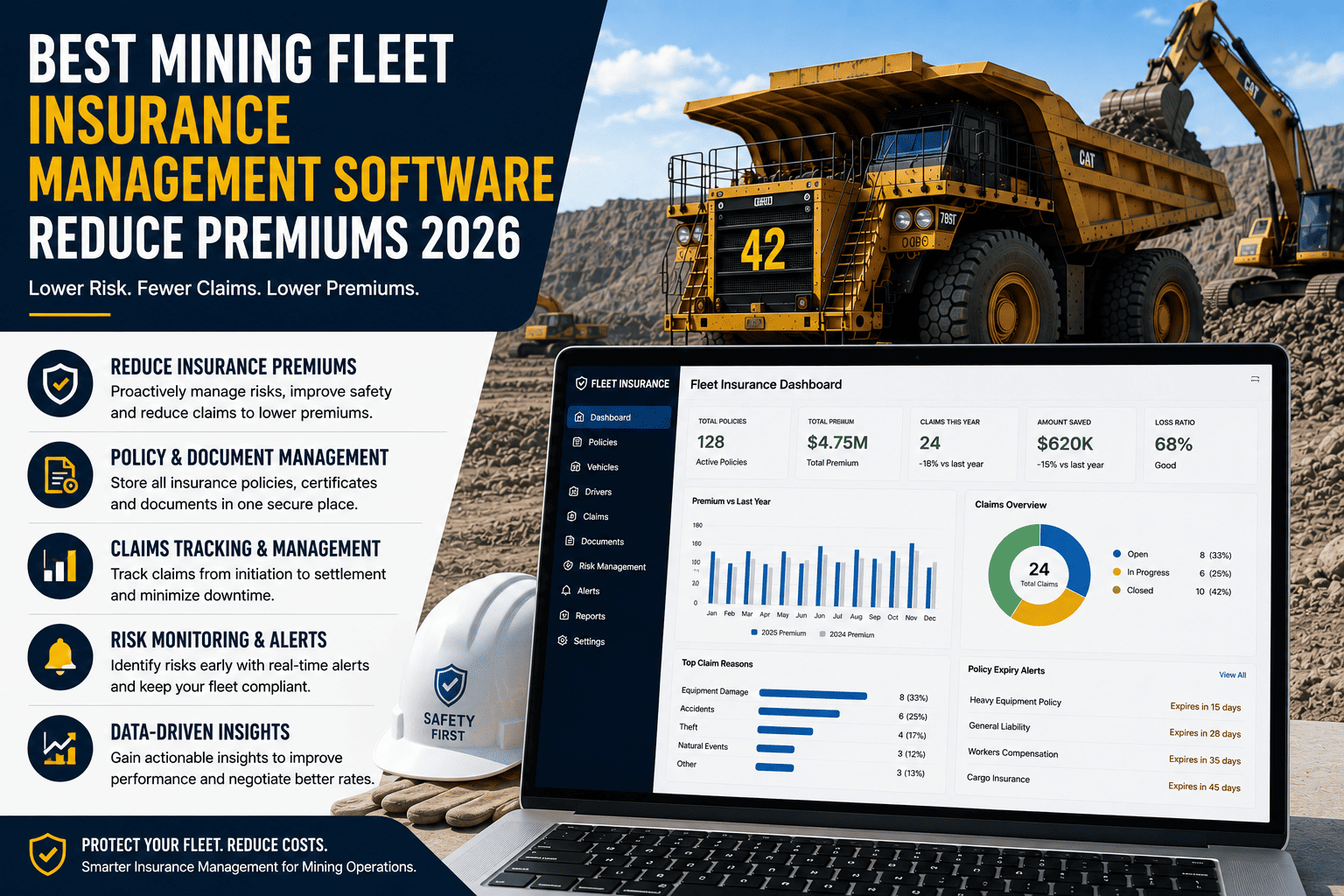
Insurance renewal season used to be a paperwork exercise. In 2026 it is closer to a negotiation, and the mines walking in with proof of how safely their fleet actually operates are the ones getting favorable terms while everyone else absorbs another double-digit increase. Underwriters are no longer pricing mining fleets off zip code, vehicle count, and five-year loss history alone. They want documented safety data, maintenance compliance, and claims history in a format they can actually verify, and mining fleet insurance management software is what turns scattered records into exactly that.
Mining fleet insurance management software centralizes safety documentation, maintenance compliance records, telematics-verified operator behavior, and claims history so it can be presented to underwriters at renewal. Fleets that document their safety performance this way are seeing premium reductions in the range of 10 to 30 percent, while fleets without that documentation continue to face steady annual increases. The discount typically stacks in layers: a credit simply for having active monitoring, a further credit for verified performance, and additional savings as claims frequency declines over time.
Why Mining Fleet Premiums Keep Climbing
Commercial fleet insurance costs have risen steadily for years, with many operators reporting annual premium increases of 8 to 20 percent even in years without a major claim. Rising repair costs, higher litigation exposure, and parts inflation are pushing underwriters to price risk more conservatively across the board, and mining fleets carry an additional layer of exposure through heavy equipment values, remote-site claims complexity, and the safety-critical nature of haul truck and loader operations. Without hard data proving your fleet's actual risk profile, an underwriter defaults to pricing you at the industry average, which in a rising-rate environment means you absorb the full brunt of the market's worst years even if your own site has an excellent record.
What Underwriters Actually Want to See at Renewal
Telematics-Verified Behavior Data
Twelve months of hard braking, speeding, and operator behavior trends by vehicle and shift, showing a documented pattern rather than a single good quarter.
Maintenance Compliance Records
Preventive maintenance completion rates and inspection history tied to each asset, proving equipment is not being run past its safe service intervals.
Claims and Incident History
A clear, documented account of every claim with context on what changed operationally afterward, not just a raw frequency count.
Formal Safety Program Evidence
Coaching records, training completion, and a documented safety program that shows systemic risk management rather than reactive incident response.
How the Insurance Discount Actually Stacks
Telematics-driven discounts are rarely a single flat number. They build in layers, and mining fleets that understand the structure can target their safety program at the layer that moves the number the most.
FleetRabbit compiles your fleet's safety data, maintenance compliance, and claims history into a renewal-ready report your broker can hand straight to underwriters. Sign up for free to see your fleet's current safety profile, or book a demo before your next renewal conversation.
Documented Safety vs. Undocumented Safety
Two mine sites can operate with equally safe fleets and still walk away from renewal with very different premiums, purely because one of them can prove it. The comparison below shows what changes when safety performance is actually documented and presented at renewal.
| Renewal Factor | Undocumented Safety Record | Documented Safety Record |
|---|---|---|
| Underwriter's Default Pricing | Industry average risk assumption | Fleet-specific verified risk pricing |
| Claims Dispute Resolution | Slower, larger vehicle often assumed at fault | Faster, timeline-backed liability review |
| Maintenance Proof | Informal, hard to produce on request | Compliance certificate generated per asset |
| Rate Trend Over Renewals | Tracks the broader market's annual increases | Can improve as documented loss ratio declines |
Turning Claims Into Faster, Cheaper Resolutions
Timestamped Records Change the Liability Conversation
When an incident happens, adjusters resolve liability far faster when they have an inspectable, timestamped record of vehicle location, condition, and operator activity leading up to the event, instead of relying on conflicting verbal accounts weeks later. That speed alone reduces legal exposure and claims administration cost.
Maintenance History Defends Against Inflated Liability
If a mechanical failure is involved in a claim, the inability to produce a documented inspection and maintenance program dramatically increases liability exposure, since the absence of proof is treated the same as the absence of a program. A maintenance compliance record tied to the specific asset removes that ambiguity entirely.
A Clean Claims Trend Compounds at Every Renewal
Insurers price heavily on rolling multi-year claims frequency, so every additional claim-free year documented in your system extends your low-loss experience period and strengthens your negotiating position at the next renewal, not just the current one.
Getting Your Fleet Renewal-Ready
Establish Your Data Baseline
Connect telematics, maintenance, and claims data into one platform so a true safety picture exists before you approach a carrier.
Run an Internal Review Period
Benchmark your safety scores against industry averages for 60 to 90 days before sharing data externally, so you know your positioning going in.
Build the Renewal Package
Compile behavior trends, maintenance compliance, and a written narrative for any claims into a single documentation package for your broker.
Present Proactively, Not Reactively
Hand the package to your broker ahead of the renewal quote request so underwriters price you against your documented risk from the start.
If your fleet is safer than the number on your renewal notice suggests, the problem is documentation, not performance. FleetRabbit turns your telematics, maintenance, and claims data into the proof underwriters are actually asking for. Sign up for free and start building your safety record today, or book a demo to prepare for your next renewal.