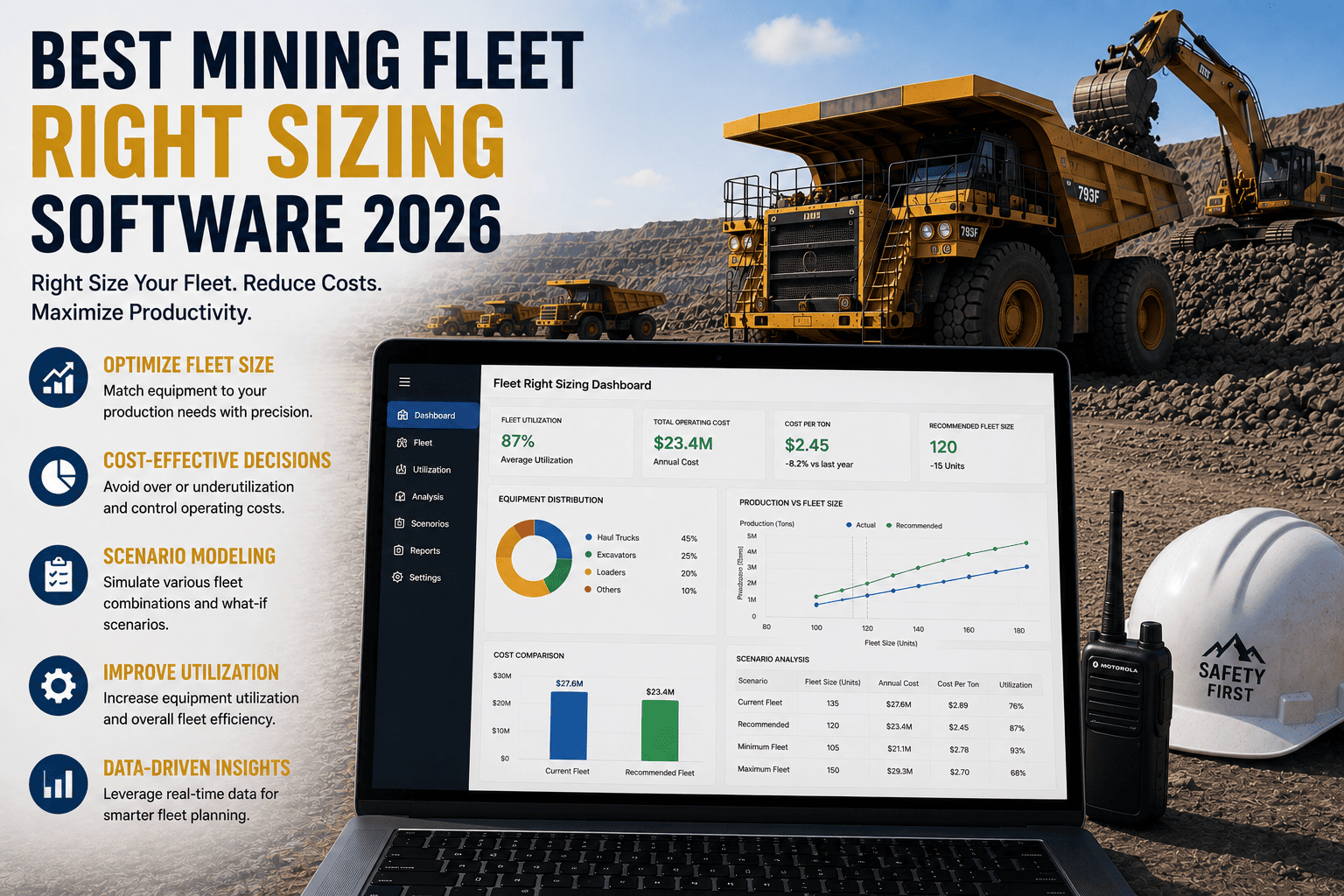
Most mine managers assume their fleet size is roughly correct. They built it over years, replacing trucks when production demanded and retiring machines when repair bills became impossible to justify. The problem with that approach is that it is entirely reactive — the fleet grows and shrinks in response to events rather than in response to data. Industry analysis consistently shows that the average mining operation runs 14 to 22 percent more equipment than its actual production demand requires, carrying insurance, depreciation, and maintenance costs on assets that are not earning their capital investment. Fleet right-sizing software changes this by replacing intuition with utilization data, giving mine managers the evidence to align fleet size precisely with operational demand — and the confidence to defend that alignment in a capital review.
Too few machines. Production targets missed. Trucks overworked beyond duty cycles. Safety and maintenance risk compounds.
Every asset earns its place. Utilization 80–90%. Capital deployed efficiently. Costs minimised without compromising output.
Too many machines. Capital tied up in idle assets. Insurance, depreciation, and maintenance drain budget with no matching production return.
The Two Failure Modes That Cost Mines the Most
Fleet sizing errors come in two directions and both are expensive — but they fail in very different ways. Understanding which failure mode your operation is experiencing is the starting point for a right-sizing program. Sign up for a free FleetRabbit trial to see your per-asset utilization data within 24 hours and identify which mode applies to your fleet.
Over-Fleeting
Machines were added during peak production cycles and never removed when demand stabilised. Every idle asset carries full fixed costs: depreciation, insurance, licensing, storage, and scheduled maintenance. A single idle haul truck costs $80,000 to $150,000 per year in fixed ownership expense before it moves a single tonne.
- Multiple trucks consistently sitting at low utilisation across shifts
- Maintenance team servicing assets that rarely operate
- Fleet roster growing without corresponding production increase
- Capital budget requests rejected but operational performance unchanged
Under-Fleeting
The fleet is too small for the work assigned, but the shortfall is invisible in daily reports because assets run at or beyond their rated duty cycles. The problem shows up as missed production targets, elevated breakdown frequency from overuse, accelerated component wear, and safety incidents driven by operator pressure to compensate for equipment that simply is not there.
- Equipment consistently running at maximum utilisation with no buffer
- Maintenance intervals compressed by high engine-hour accumulation
- Production plans revised downward regularly without clear explanation
- Operators reporting pressure to skip rest periods or pre-shift checks
The Three Questions Every Right-Sizing Assessment Must Answer
Fleet right-sizing is not simply counting trucks and comparing against production targets. It requires three specific data questions answered at the asset level — not as fleet-wide averages that mask individual outliers. A fleet averaging 75 percent utilisation can easily contain machines running at 95 percent and machines running at 40 percent simultaneously. Average data hides both problems.
Which Assets Are Below the Productive Threshold
World-class mining operations target haul truck utilisation above 80 percent of available hours. Any machine consistently operating below 65 percent should be evaluated for redeployment, disposal, or transfer to a different site or shift. Per-asset weekly utilisation trends — not fleet averages — surface these machines unambiguously.
What the data looks like:
What Is the Real Carrying Cost of Each Underutilised Asset
Underutilised assets are not free. Every machine on the roster carries depreciation, insurance, licensing, maintenance, and operator allocation costs regardless of how much it works. Quantifying the annual carrying cost of each below-threshold asset converts the right-sizing conversation from operational to financial — which is where capital decisions actually get approved.
What the data looks like:
Is the Problem Over-Fleet or Operational Inefficiency
A truck that appears underutilised because it spends three hours per shift waiting in a crusher queue is not an excess asset — it is a dispatch problem. Distinguishing between structural over-fleeting and operational inefficiency (idle time, queue time, shift change gaps) is essential before recommending disposal. Disposing of a truck that is actually needed but poorly dispatched makes the under-fleet problem worse.
What the data looks like:
FleetRabbit AI reads utilisation, idle time, and cost-per-hour for every asset in your fleet — automatically, from existing telematics. Connect your fleet and see which machines are earning their place and which are draining budget, before your next capital review.
From Over-Fleetted to Right-Sized: A Four-Stage Transformation
Right-sizing a mining fleet is not a one-time exercise. It is a continuous management discipline that becomes reliable only when it is built on live, per-asset utilisation data rather than periodic manual audits. Here is how operations move from excess assets and capital waste to a precisely calibrated fleet that earns its investment. Book a demo to see how FleetRabbit maps this process to your specific fleet and site profile.
Stage 1 — Baseline Measurement
Connect your fleet to a utilisation tracking platform and let it run for four weeks without making any operational changes. Collect engine hours, idle hours, cycle counts, and cost-per-hour data for every asset individually. This baseline is the foundation for every subsequent right-sizing decision — without it, you are still guessing.
Stage 2 — Asset Classification
Sort every machine into three tiers based on four-week utilisation data. High-utilisation machines above 80 percent stay and potentially justify additional resourcing. Mid-range machines between 65 and 80 percent get operational review. Below-65-percent machines enter a deeper investigation to distinguish over-fleet from process inefficiency.
Stage 3 — Decision and Redeployment
For each below-threshold machine, select the appropriate action based on the idle classification data. Process-inefficiency assets get dispatch optimisation and are reassigned to higher-demand zones or shifts. Genuine excess assets are evaluated for redeployment to another site, short-term lease back, or disposal — each decision backed by a financial case built from the asset's carrying cost data.
Stage 4 — Continuous Monitoring
Right-sizing is not a one-off audit. As production zones shift, seasonal demand changes, and mining plans evolve, the correct fleet size changes with them. A live utilisation dashboard means right-sizing decisions are made continuously — as data changes, not in a once-a-year capital planning session that is already six months out of date by the time it runs.
What to Look for in Fleet Right-Sizing Software in 2026
The right-sizing analytics category includes everything from basic GPS trackers that show location to purpose-built platforms that surface utilisation, cost-per-hour, and capital recommendations in one workflow. Here is what separates tools that genuinely support right-sizing decisions from those that only add complexity.
The Financial Case for Right-Sizing Your Mining Fleet
What Every Idle Asset Actually Costs Per Year
An idle haul truck is not a zero-cost asset sitting in a yard. It is an asset actively consuming budget across multiple line items simultaneously. Understanding the true annual carrying cost of an idle machine makes the business case for disposal or redeployment self-evident.
The Productivity Gain on the Other Side
Right-sizing is not only about eliminating waste from excess assets. Addressing chronic underutilisation in assets that are needed but poorly deployed typically delivers a 10 to 20 percent improvement in effective equipment productivity without adding a single machine to the fleet. Better dispatch, optimised shift allocation, and idle reduction on retained assets compound the savings beyond what disposal alone achieves. Start your free trial and see where your utilisation gains are hiding.
Frequently Asked Questions
FleetRabbit AI surfaces per-asset utilisation rates, idle classification, and cost-per-hour for every machine in your fleet — automatically, within 24 hours of connecting. Stop carrying $112,000 to $190,000 in annual fixed costs on machines that are not producing. Start your free trial today, no credit card required.