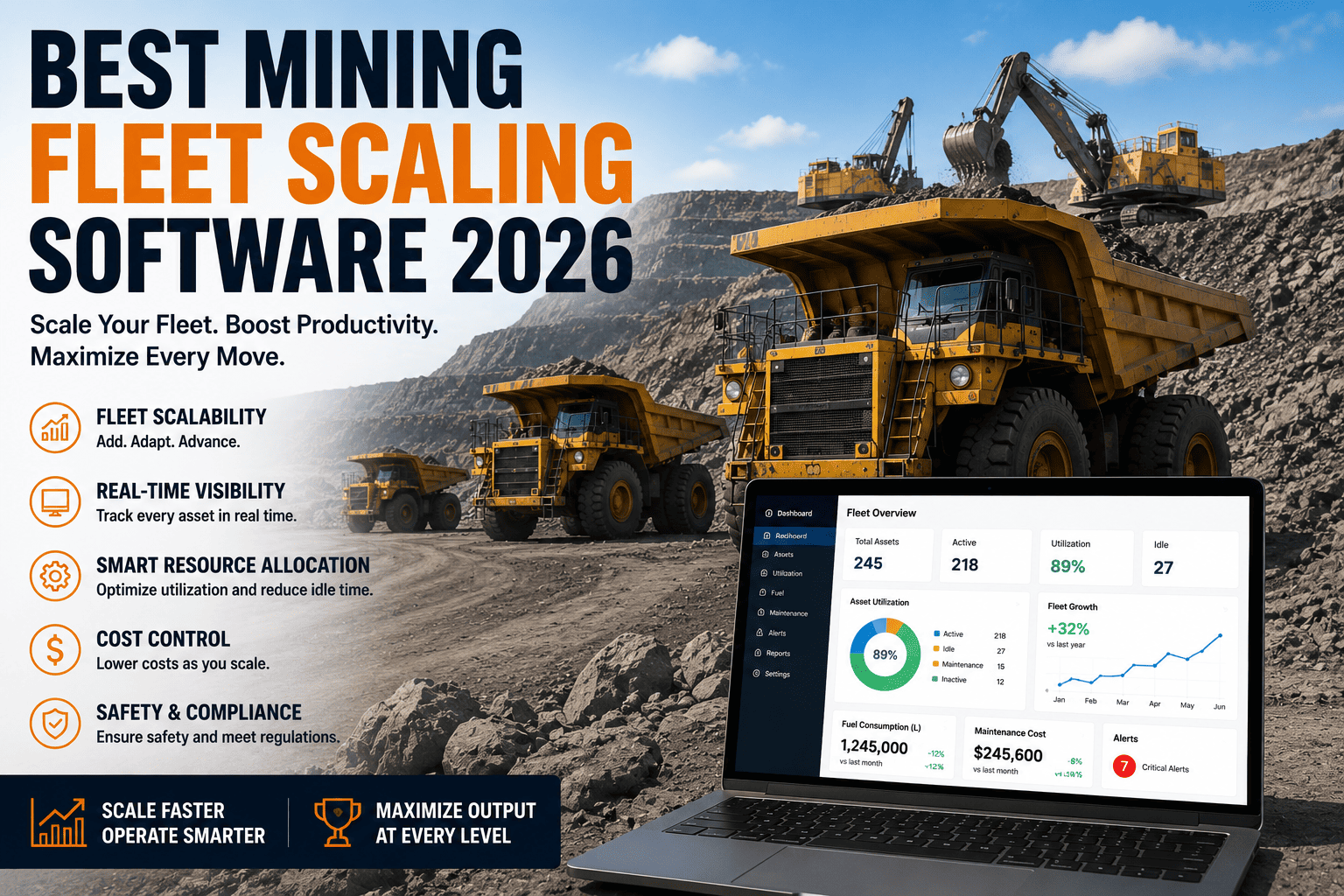
Growth is supposed to feel good. But for most mining operations, adding a new pit, opening a bench, or winning a bigger haul contract creates a quieter problem nobody budgets for: the fleet plan that worked for 12 trucks starts falling apart at 20. Spreadsheets can't tell you which machines to redeploy, rental costs creep up because nobody tracked utilization, and expansion decisions get made on gut feel instead of data. Mining fleet scaling software fixes exactly this gap, giving operators a live, data-backed picture of every asset so growth doesn't outrun control.
Mining fleet scaling software helps operations plan equipment expansion, track utilization across sites, manage owned versus rented assets, and forecast fleet needs before a new pit, bench, or contract goes live. The best platforms combine real-time utilization data, predictive maintenance, and rental cost tracking so every scaling decision is backed by numbers instead of guesswork. Sign up free or book a demo to see how it applies to your fleet.
What Mining Fleet Scaling Software Actually Does
At its core, mining fleet scaling software answers one question before any equipment decision is made: what do we already have, and is it enough? Instead of treating every new pit or contract as a reason to buy trucks, the platform pulls utilization, engine hours, maintenance status, and location data from every asset across every site into a single view. That view turns fleet expansion from a guessing game into a calculation.
Fleet Visibility Across Every Site
A growing mining operation rarely runs from one location. Scaling software consolidates haul trucks, loaders, excavators, drills, and support vehicles from every pit and site into one dashboard, so a manager evaluating a new bench can see immediately whether a underused loader two sites away can be redeployed instead of ordered new.
Utilization Benchmarking
Each asset gets a utilization score based on active hours versus available hours. Equipment running below 60 percent utilization becomes the first candidate for reassignment when a new project starts, rather than sitting idle while a rental truck arrives at the new site.
Equipment Allocation Modeling
Before committing capital, teams can model different scaling scenarios: redeploy three existing haul trucks and rent two more, or purchase four new units outright. The software calculates cost, downtime risk, and payback period for each scenario side by side.
Rental Versus Purchase Analysis
Scaling decisions almost always involve a rent-or-buy question. The platform tracks rental agreement end dates, daily rental rates, and comparable purchase costs, flagging when a rental has crossed the point where buying would have been cheaper.
FleetRabbit shows you exactly which equipment to redeploy, rent, or buy before your next pit or bench goes live. Model scaling scenarios, track rentals, and forecast maintenance load in one platform. Sign up free and see your fleet's true capacity in minutes, or book a demo to walk through your specific expansion plan.
Signs Your Operation Has Outgrown Manual Fleet Planning
Manual planning works fine at a small scale, but certain signals mean it is actively costing money. Recognizing these early prevents a scaling project from turning into a budget overrun.
| Warning Sign | What It Usually Means | What Scaling Software Fixes |
|---|---|---|
| Renting equipment every quarter | Existing fleet utilization is unknown, so rentals fill a gap that may not exist | Surfaces idle assets first, reducing unnecessary rental spend |
| Spreadsheet fleet tracking across sites | No single view of equipment location, hours, or condition | Centralized dashboard across every pit and site |
| New pit delayed waiting on equipment | No forecast of maintenance load or asset availability ahead of launch | Predictive scheduling flags availability weeks in advance |
| Maintenance backlog after expansion | More equipment added without scaling maintenance capacity | Maintenance load forecasting tied to fleet growth plans |
| Rental invoices exceed budget repeatedly | No tracking of rental return dates or cost-versus-purchase breakeven | Automated rental cost alerts and buy-versus-rent breakeven analysis |
Core Capabilities to Look For
Not every fleet platform is built for scaling decisions. Some are designed purely for maintenance tracking, which leaves the expansion-planning problem unsolved. Here is what matters most when evaluating options.
Real-Time Cross-Site Utilization Data
Look for a platform that pulls live engine hours, GPS location, and duty-cycle data from every site, not just the one currently expanding. This is what makes redeployment possible instead of default new purchases.
Predictive Maintenance Forecasting
Scaling a fleet without forecasting maintenance load creates a second problem right behind the first: more breakdowns on more machines. Strong platforms model expected service demand as the fleet grows, so maintenance teams aren't caught understaffed.
Rental Fleet Management
Since most scaling projects involve at least some rented equipment, the software should track rental contracts, return dates, and daily costs automatically, with alerts before a rental quietly becomes more expensive than ownership.
Scenario Modeling and Reporting
The ability to model two or three expansion scenarios side by side, comparing capital cost, downtime risk, and payback timeline, turns fleet scaling from a reactive scramble into a planned rollout.
FleetRabbit connects every site into one live dashboard so you know exactly what equipment is available before you rent or buy for the next project. Book a demo and we'll map your current utilization against your next expansion, or sign up now and start free with your existing fleet data.
Benchmarks Worth Tracking as You Scale
A handful of metrics tell you whether your scaling plan is actually working once new equipment or a new site is live.
Fleet Utilization Rate
Track the percentage of available hours each machine is actually working. A healthy scaling operation keeps utilization above 70 percent across the combined fleet, including newly added units.
Rental-to-Owned Ratio
Monitor what share of your active fleet is rented versus owned. A ratio creeping consistently upward without a corresponding purchase decision usually signals rentals have quietly become permanent.
Maintenance Capacity Per Machine
As fleet size grows, maintenance staffing and parts inventory need to grow with it. Tracking maintenance hours available per active machine catches understaffing before it causes downtime.
Frequently Asked Questions
Scale With Confidence, Not Guesswork
Expanding a mining fleet will always involve some uncertainty, but it doesn't have to involve blind spending. When every asset across every site is visible in one place, redeployment becomes the default option, rentals get tracked instead of forgotten, and new equipment gets purchased only when the data actually supports it. That is the difference between fleet growth that strains a budget and fleet growth that strengthens one.
FleetRabbit gives mining operations one live view of every asset across every site, so scaling decisions are backed by utilization data instead of guesswork. Start free today or book a short demo to see how it fits your next pit, bench, or contract.