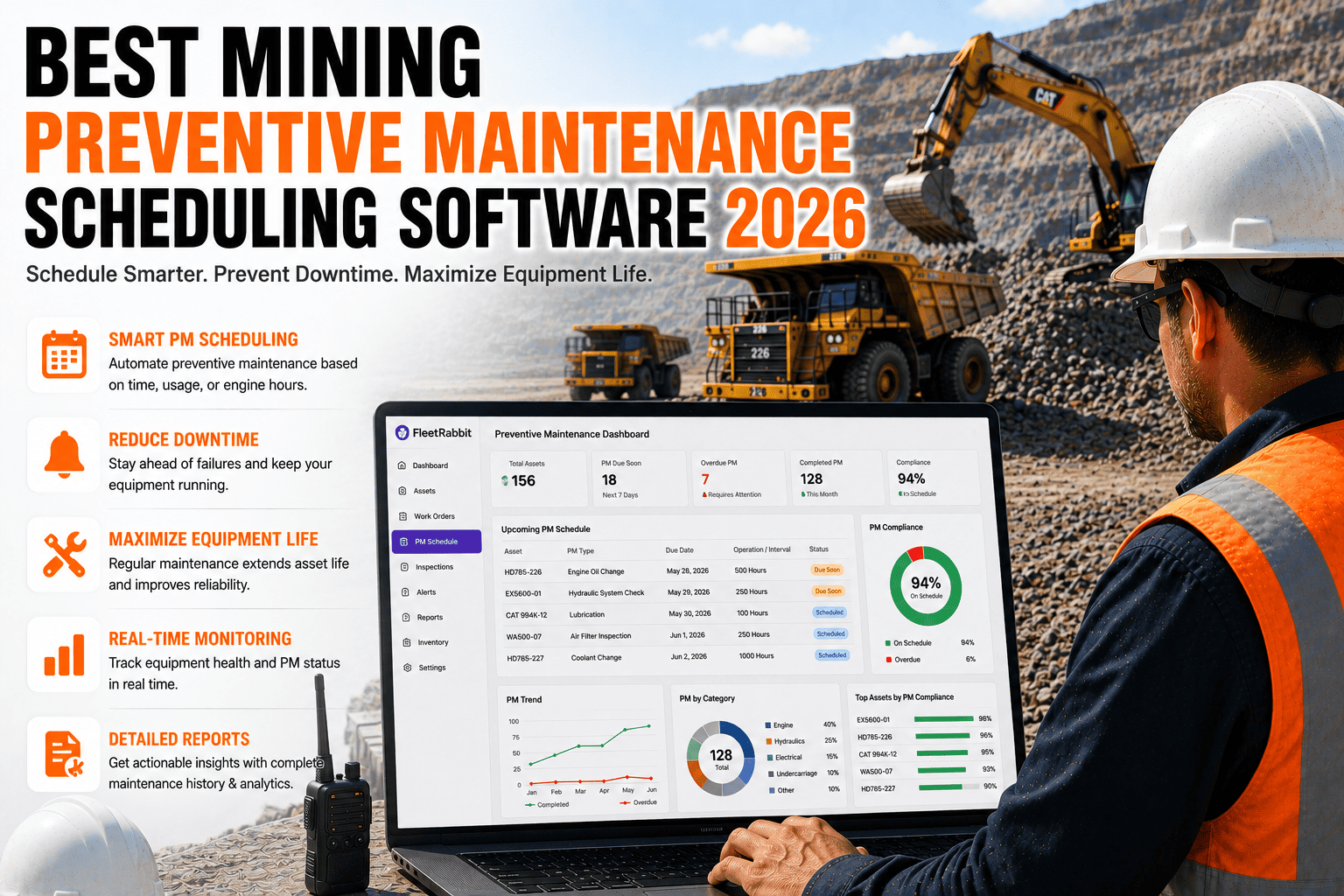
Best Mining Preventive Maintenance Scheduling Software in 2026

best-mining-preventive-maintenance-scheduling-software-2026

An excavator crosses 4,800 engine hours on a Tuesday during the busiest week of the quarter. The service interval says it was due at 4,750. Nobody catches it because the maintenance calendar only gets checked every other Friday, and the machine keeps running under full load for another 300 hours before a bearing finally gives out mid-shift. The interval wasn't a mystery. It was sitting in a logbook the whole time. Preventive maintenance scheduling only works when it's tied to the actual number on the meter, not to whichever day someone remembers to look.

PM Scheduling Reality

Manual, calendar-based maintenance scheduling on active mine sites typically achieves only 60 to 70 percent PM compliance, meaning 30 to 40 percent of scheduled services get missed, delayed, or completed late. Roughly 70 percent of mining equipment failures are preventable with a structured PM program, and unplanned downtime on major assets can cost 100000 dollars or more per hour once lost production is factored in. Software that schedules by engine hours, mileage, and service interval automatically, rather than by calendar reminder, is what pushes compliance above 95 percent.

What A Missed PM Interval Actually Costs

A single overdue service rarely causes a failure by itself. It's the accumulation of small delays, a filter change pushed back a week, a hydraulic service run 200 hours late, that compounds into major component failure. Understanding where that cost concentrates helps explain why scheduling precision matters more in mining than almost any other industry.

Interval Drift
Hours Pass Faster Than Calendars Track
A haul truck running double shifts can blow past a 250-hour service interval in days, not weeks. A calendar-based reminder has no way to catch that pace, so the machine keeps working well past its due point.
Cascading Failure
One Small Delay Becomes A Major Repair
A minor service pushed back repeatedly lets small wear turn into component failure. A skipped oil analysis can mean a crusher bearing runs hot for days before it seizes, turning a routine task into a six-figure repair.
Compliance Gap
The 30 Percent Nobody Notices
Manual scheduling on active sites typically completes only 60 to 70 percent of PM tasks on time. The remaining 30 to 40 percent aren't skipped on purpose, they simply fall through the gap between a whiteboard and a busy shift.
Schedule By The Meter, Not The Calendar
Close The 30 Percent Compliance Gap

FleetRabbit tracks engine hours, mileage, and service intervals per asset automatically, generating work orders the moment a machine approaches its due point instead of waiting for someone to check a calendar. Start your free trial and see your fleet's real PM compliance rate today.

60-70%
Typical Manual PM Compliance
95%+
Compliance With Automated Scheduling

How PM Scheduling Should Differ By Asset Class

Not every piece of mining equipment should be scheduled the same way. Haul trucks accumulate engine hours fast under continuous load, support vehicles rack up mileage on haul roads, and fixed plant equipment like crushers runs on a mix of operating hours and condition checks. Good scheduling software applies the right trigger to each asset class instead of forcing everything onto one calendar.

Asset Class Primary Scheduling Trigger Typical Interval Basis Risk If Missed
Haul Trucks Engine hours Service every 250 hours regardless of calendar date Engine or drivetrain failure mid-haul, stalling downstream crushers and conveyors
Support Vehicles Mileage Service intervals tied to odometer readings, similar to on-road fleets Brake or suspension failure on haul roads, creating safety and delivery risk
Excavators And Loaders Engine hours plus condition checks Fixed hour intervals combined with hydraulic and undercarriage inspection Hydraulic system failure or accelerated undercarriage wear
Fixed Plant (Crushers, Conveyors) Operating hours plus condition monitoring Scheduled bearing and belt inspection alongside vibration or temperature checks Bearing seizure or belt failure halting an entire processing line
Drills Engine hours and cycle counts Component-specific intervals based on drilling cycles completed Downhole tooling damage or lost drilling time on an active pattern

Engine-Hour Scheduling Is The Backbone For Mobile Equipment

Fixed calendar intervals assume every machine works the same pace, which is rarely true on an active mine site. Engine-hour based scheduling ties the next service directly to actual usage, so a truck running double shifts gets flagged sooner than one running a single shift, exactly as it should.

Mileage And Cycle-Based Triggers Round Out The Picture

Support vehicles and drills don't always fit neatly into an hour-based model. Mileage works better for haul road vehicles, while cycle counts capture wear on equipment like drills where the number of operations matters more than time running. The right software applies whichever trigger actually reflects wear for that asset type.

Why Combining Triggers Beats Picking Just One

Many mines get the best results by combining a primary trigger, engine hours for example, with a secondary condition check like oil analysis or vibration monitoring on critical components. This catches assets that hit their scheduled service point in good shape and lets you extend the interval safely, while flagging ones showing early wear before the fixed interval would have caught it.

Manual Scheduling Versus Automated PM Compliance

The gap between calendar-based and automated scheduling isn't a small efficiency gain, it's the difference between reactive and predictive maintenance as an operating model. Manual scheduling depends on someone manually tracking hours across a fleet that may span dozens of machines and multiple sites. Automated scheduling removes that dependency entirely by generating the work order the moment a threshold is reached.


Five Capabilities The Best Mining PM Scheduling Software Needs


A generic maintenance calendar isn't built for the scale or complexity of a mining fleet. When evaluating scheduling software, look for these five capabilities specifically, since each one addresses a failure point common to mining operations.

One
Automatic Work Order Generation
The system should create the work order itself the moment an asset crosses its threshold, rather than requiring someone to notice and manually schedule it.
Two
Multiple Trigger Types Per Asset
Engine hours, mileage, cycle counts, and calendar time should all be available and combinable, since different asset classes wear differently.
Three
Fleet-Wide Compliance Visibility
Supervisors need one view showing PM compliance across the entire fleet, not just individual work orders scattered across separate logs.
Four
Mobile Data Entry From The Field
Engine hour and mileage readings need to feed into the system directly from operators and technicians on site, not get transcribed later from a paper log.
Five
Historical Interval Analysis
The ability to look back at how intervals performed for a specific machine reveals whether a schedule needs adjusting or a particular asset needs closer attention.
Every Asset Class, One Scheduling Engine
See Your Fleet's Real PM Compliance

FleetRabbit combines engine-hour, mileage, and cycle-based scheduling with automatic work order generation and fleet-wide compliance visibility, built specifically for mining-scale operations. Book a demo to see your current compliance rate and where the gaps are.

70%
Of Failures Preventable With A PM Program
$100K+
Per Hour Cost Of Major Downtime

Metrics That Show Your PM Program Is Actually Working

PM compliance rate measures the percentage of scheduled services completed on time against their engine-hour, mileage, or calendar threshold. Mean time between failures reveals whether preventive work is actually extending the life of major components, with a rising trend signaling the program is working. Cost per operating hour tracks total maintenance spend against actual asset usage, making it possible to compare efficiency across machines and sites on equal footing.

Reading These Numbers Together

A high PM compliance rate paired with a flat or declining mean time between failures usually means services are happening on schedule but aren't addressing the actual wear pattern, a signal to review interval length or add condition-based checks rather than just completing more work orders.

QWhat is PM scheduling software for mining equipment
It's a system that automatically triggers maintenance work orders based on engine hours, mileage, cycle counts, or calendar intervals for each specific asset, replacing manual tracking on whiteboards, spreadsheets, or paper logs.
QWhy does calendar-based scheduling fail on mining sites
Mining equipment usage varies dramatically by shift pattern and workload, so a fixed calendar date has no way to account for a machine that accumulates engine hours much faster than another. This gap is a major reason manual scheduling typically achieves only 60 to 70 percent compliance.
QShould every asset use engine hours as the scheduling trigger
No. Engine hours work well for haul trucks and excavators, but support vehicles are often better tracked by mileage, and drills may need cycle-count based intervals tied to the number of operations performed rather than time running.
QHow much does automated scheduling improve PM compliance
Automated engine-hour and mileage-based scheduling with automatic work order generation typically pushes PM compliance above 95 percent, compared to the 60 to 70 percent common with manual, calendar-based tracking. Start a free trial to see this on your own fleet.
QWhat percentage of mining equipment failures are actually preventable
Roughly 70 percent of mining equipment failures are considered preventable through a structured, well-followed preventive maintenance program, which is why scheduling precision has such a direct impact on downtime and repair costs.
QCan PM scheduling software work across multiple mine sites
Yes. A strong platform tracks engine hours, mileage, and service intervals independently for every asset regardless of site, giving operations with multiple pits or plants one consolidated compliance view. Book a demo to see multi-site scheduling in action.
QDoes preventive maintenance replace predictive maintenance
No, most mines combine both. Preventive maintenance handles routine, interval-based servicing across the whole fleet, while predictive maintenance using condition monitoring is typically reserved for the highest-criticality components where sensor data can catch failure earlier than a fixed interval would.
Stop Letting Engine Hours Outrun Your Calendar

A missed PM interval rarely announces itself until the repair bill does. FleetRabbit schedules maintenance by engine hours, mileage, and cycle counts automatically across every asset class in your mining fleet, turning a 60 to 70 percent manual compliance rate into a number you can actually count on.


PM Scheduling Software Engine Hour Maintenance Mining Fleet Compliance Automated Work Orders Downtime Reduction

July 8, 2026 By John
All Posts

Best Mining Preventive Maintenance Scheduling Software in 2026

best-mining-preventive-maintenance-scheduling-software-2026

Every maintenance plan looks solid on paper. Then the season gets busy, a truck that was due for service keeps running because pulling it off the line feels like the wrong call in the moment, and three weeks later that same truck is the one sitting in the shop with a failure that could have been caught early. Preventive maintenance rarely fails because nobody planned it. It fails because a plan sitting in a spreadsheet or a wall calendar has no way of insisting that anyone actually follow it.

Quick Answer

Mining preventive maintenance scheduling software tracks every asset's service intervals automatically and sends alerts before maintenance becomes overdue, instead of relying on someone remembering to check a calendar. A field study of 118 off-road mining trucks found only 607 of 783 scheduled preventive services were actually completed on time, and that shortfall alone was linked to over 819 additional failures and an 8.16 percent drop in fleet availability. FleetRabbit closes that adherence gap with automated scheduling, service alerts, and a full maintenance history for every asset in one place.

Why It Slips 01
Schedules Live Outside The Workday
A maintenance calendar kept in a spreadsheet only gets checked when someone remembers to open it, which is easy to skip during a busy production week.
Why It Slips 02
Pulling A Truck Feels Like The Wrong Call
When production is under pressure, taking a working asset offline for scheduled service is an easy decision to postpone, right up until it breaks down instead.
Why It Slips 03
Nobody Sees The Pattern Until It's Big
A single missed service looks harmless in isolation, but a pattern of missed intervals across the fleet is invisible without a system tracking adherence over time.

What Happens When Preventive Maintenance Schedules Slip

The gap between a maintenance plan and a maintenance plan that actually gets followed is larger than most fleets assume. A documented study of 118 off-road mining trucks tracked 783 scheduled preventive maintenance procedures over a year and found only 607 were actually performed as planned. That shortfall in adherence was linked to more than 819 additional failures, roughly 9,723 hours of unavailability, and a production loss exceeding five million tons on the fleet studied. None of that started with a single dramatic breakdown. It started with individual services that felt safe to postpone.

Why "We Have A Schedule" Isn't The Same As "We Follow It"

Almost every mining maintenance program is time-driven, built around fixed intervals of hours or mileage. That structure works well on paper, but it depends entirely on someone consistently checking it, flagging it, and acting on it before the interval passes, which is exactly the step that manual tracking tends to lose under day-to-day pressure.

Never Miss A Service Interval Again
Let The System Track Adherence For You

FleetRabbit tracks every asset's service intervals automatically and alerts your team before maintenance becomes overdue, closing the gap between the plan and what actually happens. Sign up for a free trial and see your fleet's schedule mapped out today, or book a demo to see automated alerts in action.

77.5%
Typical Manual PM Adherence
8.16%
Availability Lost To Gaps

Manual PM Tracking vs Automated Scheduling Software

The core difference is not whether a schedule exists. Almost every fleet has one. The difference is whether the schedule enforces itself or depends on someone remembering to look at it.

Scheduling Task Manual Tracking Automated PM Scheduling Software
Tracking Service Intervals Spreadsheet or wall calendar checked manually Tracked continuously against hours, mileage, or condition
Alerting The Team Relies on someone remembering to check Automated alerts sent before service becomes overdue
Parts And Labor Prep Ordered reactively once the service is already due Flagged in advance so parts and technicians are ready
Fleet-Wide Adherence Hard to see without manually cross-checking every asset Visible instantly across the entire fleet in one view
Maintenance History Scattered across files, notebooks, and memory Complete, searchable record for every asset in one place

What To Look For In Mining PM Scheduling Software

Not every maintenance tool actually solves the adherence problem. These are the capabilities that make the real difference on a mine site.

Automated Service Alerts

Alerts should reach the right person before a service window closes, not after, giving maintenance teams enough lead time to plan the downtime instead of reacting to it.

Hour, Mileage, And Condition-Based Triggers

Different components wear at different rates, so scheduling needs to combine fixed intervals with condition data, catching issues that a purely time-based plan would miss entirely.

Why fixed intervals alone fall short

A truck running double shifts reaches its service interval far sooner than one running light duty, and a schedule based only on the calendar treats both the same way until something breaks.

Parts And Labor Preparation

Knowing a service is coming a week ahead means parts can be ordered and technicians scheduled in advance, which is the difference between a four-hour planned service and a twelve-hour scramble.

Fleet-Wide Adherence Visibility

A single dashboard showing every asset's maintenance status at a glance lets a manager catch a slipping pattern before it turns into a string of failures, rather than discovering it one breakdown at a time.

Digital Maintenance History And Compliance Records

Every completed service, part replaced, and technician sign-off should be stored automatically, creating a record that is ready for an audit without anyone having to dig through old paperwork.

Built To Close The Adherence Gap
Turn Your Maintenance Plan Into A Habit

FleetRabbit combines automated alerts, condition-based triggers, and a complete maintenance history so preventive maintenance actually gets done on schedule. Start your free trial and set up your first service schedule today, or book a demo to see it configured for your fleet.

Auto
Service Alerts
100%
Fleet-Wide Visibility

Who Benefits Most From Automated PM Scheduling

Some fleets feel the cost of missed maintenance intervals more sharply than others, and these are the operations where automated scheduling pays off fastest.

Fleets Running Mixed Duty Cycles

When some trucks run double shifts and others run light duty, a single fixed calendar cannot keep up, but condition-based automated scheduling adjusts to each asset's actual usage.

Small Maintenance Teams Covering A Large Fleet

A lean crew responsible for dozens of assets cannot manually track every interval reliably, which makes automated alerts less of a convenience and more of a necessity.

Sites Preparing For Compliance Audits

Operations that need to show a clean maintenance history on demand benefit from digital records that are already organized, instead of assembling documentation under deadline pressure.

Frequently Asked Questions

QHow much does missed preventive maintenance actually cost a mining fleet
A documented study of off-road mining trucks found that gaps in preventive maintenance adherence were linked to over 819 additional failures and an 8.16 percent drop in fleet availability across the fleet studied.
QWhy do maintenance schedules slip even when a plan exists
Most plans depend on someone manually checking a calendar or spreadsheet, and under production pressure that check is one of the easiest steps to postpone or forget.
QDoes automated scheduling account for different usage rates across assets
Yes. Hour, mileage, and condition-based triggers adjust each asset's schedule to its actual usage, rather than applying one fixed calendar to every machine regardless of duty cycle.
QCan this software help with parts and labor planning
Yes. Advance alerts flag upcoming services early enough for parts to be ordered and technicians scheduled ahead of time, avoiding the scramble of reactive repairs.
QWill this help during a compliance audit
Yes. Every completed service and sign-off is stored digitally, creating an organized, searchable maintenance history that is ready to present without last-minute paperwork.
QIs this practical for a small maintenance team
Yes, and often the benefit is largest here. A small crew covering many assets cannot manually track every interval reliably, which is exactly what automated alerts are built to solve.
Stop Losing The Gap Between Planned And Done

A maintenance plan only protects your fleet if it actually gets followed. FleetRabbit automates service alerts, tracks adherence across every asset, and keeps a complete maintenance history, so preventive maintenance stops depending on someone remembering to check a calendar.

Automated PM Scheduling Service Alerts Condition-Based Triggers Maintenance History Fleet-Wide Visibility

July 18, 2026 By John
All Posts

Share This Story, Choose Your Platform!

Latest Posts

Scroll