Regulatory violations in commercial trucking do not arrive as single, isolated events — they accumulate progressively from documentation gaps, maintenance deferrals, and monitoring failures that go undetected until a roadside inspection, compliance audit, or accident investigation reveals a pattern of systemic non-compliance. The consequences of that accumulation extend far beyond the specific violation fine: FMCSA safety ratings that affect insurance premiums and shipper relationships, out-of-service orders that remove revenue-generating vehicles from service, and Compliance Safety Accountability (CSA) scores that compound over 24 months to define a carrier's regulatory risk profile with lasting financial impact. The fundamental problem for most carrier operations is not that their vehicles, drivers, or maintenance programs are non-compliant by design — it is that violations occur because the monitoring and alert infrastructure required to catch compliance deviations before they become recorded violations does not exist in a timely, automated form. Book a demo to see how FleetRabbit's compliance monitoring, automated violation alerts, and corrective action workflows protect your fleet's safety rating and CSA score.
Compliance Safety Guide — Transportation and Logistics
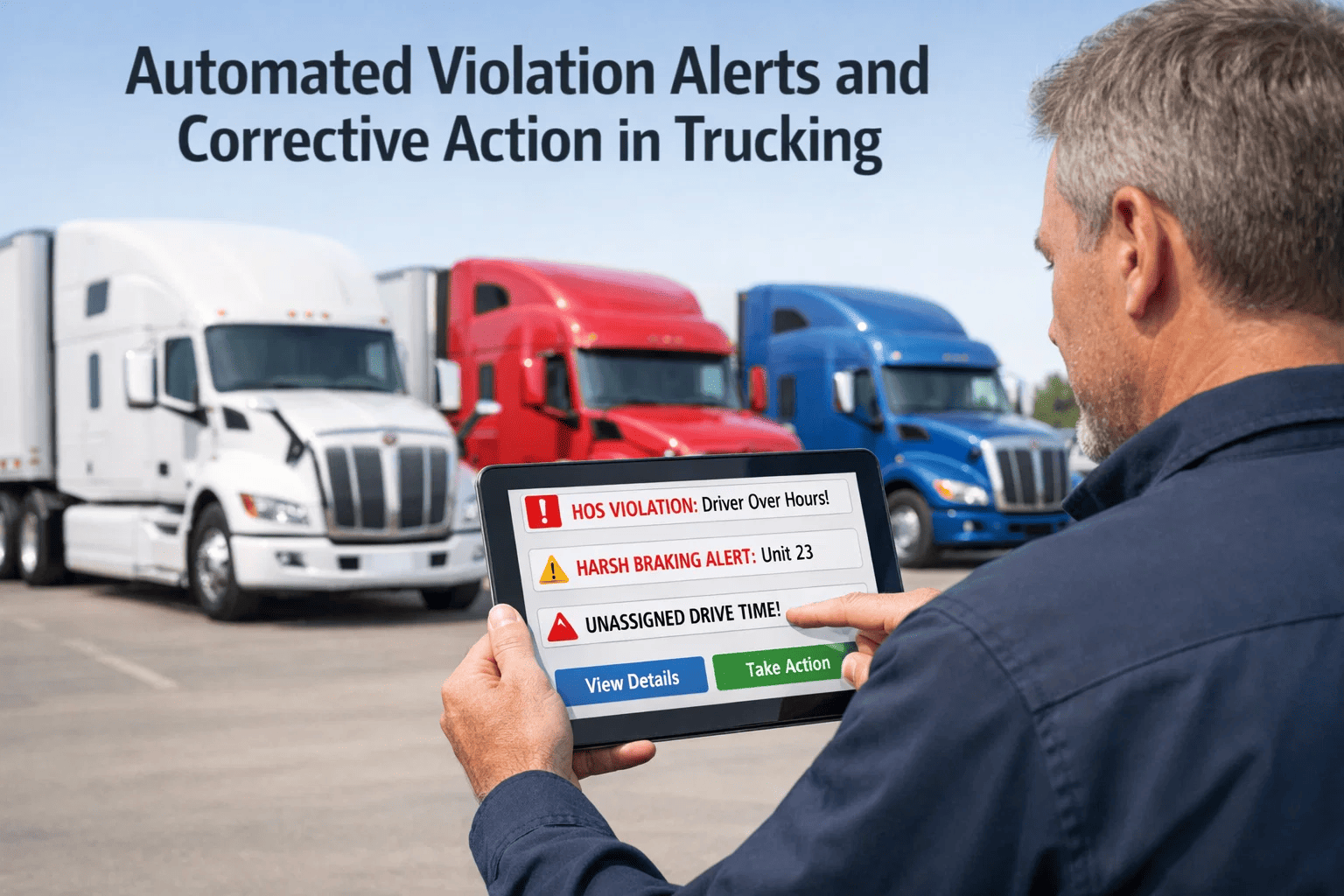
Automated Violation Alerts and Corrective Action in Trucking
How FleetRabbit's compliance monitoring system catches violations before they become CSA score events and structures corrective action documentation to satisfy FMCSA audit requirements
$15,000
average annual CSA score impact cost per percentage point decline in carrier safety rating
68%
of FMCSA violations cited during roadside inspections involve conditions detectable by pre-trip DVIR
24 months
CSA violation data retention window — each citation compounds rating impact for two years
-71%
violation reduction achieved by carriers with automated pre-violation alert systems versus manual compliance programs
Guide Summary
Automated violation alerts in commercial trucking refer to technology-driven monitoring systems that identify compliance deviations — HOS limit approaches, DVIR deficiency patterns, vehicle inspection overdue status, driver credential expirations — and generate actionable notifications before these conditions produce formal FMCSA violations. This guide covers the primary violation categories that automated alert systems address, the FMCSA regulatory framework governing each violation type, the structure of effective corrective action programs that satisfy audit requirements, and how FleetRabbit's compliance module implements automated monitoring, alert generation, and corrective action documentation for transportation carriers.
The CSA Score Framework: Why Violation Prevention Is More Valuable Than Violation Remediation
The FMCSA's Compliance Safety Accountability (CSA) program scores motor carriers and drivers across seven Behavior Analysis and Safety Improvement Categories (BASICs): Unsafe Driving, Hours-of-Service Compliance, Driver Fitness, Controlled Substances and Alcohol, Vehicle Maintenance, Hazardous Materials Compliance, and Crash Indicator. Violations recorded during roadside inspections and crash reporting contribute points to a carrier's score in the relevant BASIC, weighted by severity and recency — more recent violations count more heavily than older ones within the 24-month retention window.
When a carrier's BASIC score in any category crosses the FMCSA's intervention threshold, the carrier enters a compliance intervention process that includes warning letters, targeted roadside inspection campaigns, compliance reviews, and ultimately — for carriers with persistent elevated scores — safety fitness determinations that can affect operating authority. The financial consequences of elevated CSA scores materialize before formal FMCSA intervention: major shippers and brokers actively screen carrier CSA scores as part of their carrier selection and rate-setting processes, and carriers with elevated Vehicle Maintenance or HOS Compliance scores consistently lose freight to lower-scoring competitors.
The economic argument for automated violation prevention rather than reactive violation management is therefore compelling. A system that prevents ten violations from becoming CSA score events in a given 12-month period does not just eliminate the fines associated with those citations — it protects the carrier's BASIC scores from the cumulative 24-month consequences of a violation pattern that would affect insurance premiums, shipper relationships, and inspection burden for two years after the violations occurred. Book a demo to review your fleet's current CSA BASIC profile and identify the violation categories where FleetRabbit monitoring has the highest prevention value.
Primary Violation Categories and the Alert Systems That Address Them
Hours-of-Service Violations
BASIC: Hours-of-Service Compliance
HOS violations occur when drivers exceed the regulatory limits for driving hours, on-duty hours, or consecutive hours without the required rest periods under 49 CFR Part 395. The most common preventable HOS violations are property-carrying drivers exceeding the 11-hour driving limit (single severity point), drivers exceeding the 14-hour on-duty window (two severity points), and drivers with insufficient off-duty time before beginning a new duty period (four severity points for the most serious category).
FleetRabbit Alert Mechanism
Real-time HOS monitoring with automated alerts at configurable thresholds — typically 90% and 95% of limit — allowing dispatchers to adjust assignments and driving plans before the limit is reached. All driver HOS status visible in the portfolio dashboard without requiring dispatcher-initiated status requests.
DVIR Deficiency Violations
BASIC: Vehicle Maintenance
DVIR violations occur when drivers fail to complete pre-trip and post-trip inspection reports as required by 49 CFR 396.11, or when defects identified in DVIR reports are not corrected before the vehicle is returned to service. Missing DVIR reports (failure to prepare) typically receive two severity points. Operating a vehicle with a known defect that was not repaired receives higher severity scoring depending on the safety criticality of the defect category.
FleetRabbit Alert Mechanism
Automated DVIR completion tracking shows outstanding inspection reports in real time. If a driver has not completed their pre-trip DVIR before the vehicle departs, the system flags the vehicle as non-compliant and alerts the dispatch supervisor. Defect findings in completed DVIRs automatically generate linked work orders with priority assignment.
Vehicle Maintenance Violations
BASIC: Vehicle Maintenance
Vehicle maintenance violations recorded during roadside inspections typically involve brake system deficiencies, lighting equipment failures, tire condition violations, steering system issues, and cargo securement defects — the majority attributable to conditions that a systematic preventive maintenance program and daily DVIR would identify before the vehicle is presented for inspection. Carriers with Vehicle Maintenance BASIC scores above the intervention threshold consistently have PM compliance rates below 70 percent and DVIR completion rates below 85 percent.
FleetRabbit Alert Mechanism
PM due date and mileage trigger alerts notify maintenance managers when vehicles approach overdue PM status. Inspection finding work orders are automatically prioritized by defect severity. Vehicles with outstanding safety-critical maintenance items can be flagged out-of-service in FleetRabbit to prevent dispatch assignment until the corrective action is completed.
Driver Credential Violations
BASIC: Driver Fitness
Driver Fitness violations include operating with an expired commercial driver's license, expired or invalid medical certificate, invalid endorsements for the cargo type being transported, or violations of CDL license restrictions. These violations are entirely preventable with proactive credential tracking — they occur only when the carrier fails to monitor driver qualification document expiration dates and removes drivers from service when renewal is not completed.
FleetRabbit Alert Mechanism
FleetRabbit's team management module maintains driver qualification file records including CDL expiration, medical certificate expiration, and endorsement records. Automatic alerts at 90, 60, and 30 days before expiration allow fleet managers to require renewal completion before the credential lapses, preventing driver fitness violations from occurring.
Recall-Related Violations
BASIC: Vehicle Maintenance
Operating a vehicle with an open safety recall that has not been remediated can result in violation citations if the roadside inspector identifies the outstanding recall status. NHTSA recall tracking across a large fleet is difficult to manage manually — individual recall notifications apply to specific VINs based on manufacturer and campaign, requiring cross-referencing of recall databases against the carrier's entire vehicle registry to identify affected units and ensure timely remediation.
FleetRabbit Alert Mechanism
FleetRabbit's recall tracking feature monitors NHTSA recall databases against the carrier's vehicle registry and alerts maintenance managers when a vehicle in the fleet is subject to a new recall campaign. Recall remediation tracking allows carriers to document completion for each affected VIN, maintaining audit-ready evidence of recall management.
How FleetRabbit Structures the Automated Alert System
FleetRabbit's compliance alert architecture operates on three levels that correspond to the urgency and consequences of different alert types. Understanding the alert level structure is important for fleet managers configuring the system, because alerts that are over-urgent in severity cause dispatcher and manager fatigue — routine notifications handled with the same urgency as genuine pre-violation alerts create a noise level that degrades response quality across all alert types. FleetRabbit allows alert sensitivity, distribution, and escalation rules to be configured per alert category, ensuring that the alert management burden is proportionate to the compliance risk each alert type represents.
Level 1 — Information
Early-warning notifications that require awareness but not immediate action. Examples include PM services due in 7 to 14 days, driver credentials expiring in 60 to 90 days, DVIR completion pending with more than 2 hours remaining in the shift window.
Recipients: Fleet Manager dashboard — visible in daily review, no active notification push
Level 2 — Warning
Compliance deviation conditions that require action within the current operational period. Examples include HOS at 85 percent of limit, PM service overdue by 5 days or 500 miles, DVIR not yet completed with less than 1 hour in shift window, driver credential expiring in 30 days.
Recipients: Fleet Manager and Dispatcher — active notification to responsible parties, response required
Level 3 — Critical
Imminent violation conditions where action in the next operational period is the only way to prevent a compliance event. Examples include HOS at 95 percent of limit, vehicle with safety-critical DVIR defect operating without recorded corrective action, expired driver credential with active assignment.
Recipients: Fleet Manager, Dispatcher, and Designated Supervisor — immediate notification, escalation required, corrective action documented
Corrective Action Documentation: What FMCSA Auditors Require
When violations do occur — or when compliance monitoring identifies a systemic pattern that requires investigation and remediation — the corrective action documentation that satisfies FMCSA compliance audit requirements must meet specific standards. A corrective action program that is real but not documented is functionally equivalent to no corrective action program from the perspective of an FMCSA compliance reviewer. The documentation requirements for a satisfactory corrective action program include identification of the root cause of the violation, specific corrective actions taken to address the root cause, responsible party assignment for each corrective action, completion documentation with timestamps, and monitoring plan to verify that the corrective action has produced the intended improvement.
FleetRabbit structures corrective action documentation within the work order system — each inspected deficiency, driver violation finding, or compliance gap generates a work order or action record that contains all required fields for FMCSA-satisfactory documentation. The workflow from violation identification to corrective action completion is linear and auditable: inspection finding creates work order, work order is assigned to responsible party with due date, responsible party completes the corrective action and documents completion in FleetRabbit, maintenance manager reviews and closes the work order, and the complete chain is preserved in the vehicle's or driver's record with full timestamp and attribution. When an FMCSA compliance auditor requests evidence of corrective action for a specific violation category, FleetRabbit can produce the complete documentation trail without manual compilation from multiple record systems.
01
Violation or Deficiency Identified
Inspection finding, HOS alert, DVIR defect report, credential expiration alert, or roadside violation citation creates a compliance event in FleetRabbit. All events are timestamped and attributed to the specific vehicle, driver, and location at event creation.
02
Root Cause Assessment
Fleet manager or maintenance supervisor reviews the event and documents the root cause assessment in the FleetRabbit compliance record — distinguishing between one-time operational anomalies (driver error, equipment failure) and systemic patterns (PM schedule gap, driver training deficiency) that require different corrective approaches.
03
Corrective Action Assignment
Specific corrective actions are created as work orders or action items in FleetRabbit, each assigned to the responsible party — maintenance technician, dispatcher, driver training coordinator, or fleet manager — with a required completion date and priority designation. Multi-step corrective plans include all individual action items in a linked sequence.
04
Corrective Action Execution
Assigned responsible parties complete corrective actions and document completion in FleetRabbit with timestamp, work performed description, and any relevant supporting information (parts replaced, training completed, procedure revised). Completion of each action updates the compliance event status automatically.
05
Supervisor Review and Closure
Fleet manager or compliance officer reviews completed corrective actions for adequacy and closes the compliance event in FleetRabbit. Closure requires confirmation that all individual action items are complete and that the root cause has been addressed. Closure is timestamped and attributed to the reviewing manager.
06
Monitoring and Verification
FleetRabbit analytics tracks recurrence — if the same violation category appears again within the monitoring period following corrective action closure, the system flags the recurrence as a potential systemic issue requiring escalated response and updated corrective action. FMCSA auditors can see the complete closed-loop documentation cycle.
HOS Monitoring: FleetRabbit's Real-Time Compliance Framework
Hours-of-service compliance is the BASIC category that generates the most frequent carrier compliance interventions and the most consistent operational pressure on fleet management teams. The complexity of HOS rules — different limits for property-carrying versus passenger-carrying vehicles, split sleeper berth provisions, agricultural exemptions, short-haul exemptions, and the adverse driving conditions extension — creates a regulation environment where even well-intentioned drivers and dispatchers can make compliance errors without real-time monitoring and alert infrastructure.
FleetRabbit's HOS monitoring module provides fleet managers and dispatchers with a real-time view of every driver's current duty status, cumulative driving hours, remaining on-duty time, and next required rest period across the entire fleet. The dashboard presentation is designed for operational use — dispatchers can see at a glance which drivers have sufficient hours for new assignments, which drivers are approaching limit thresholds that will constrain their available assignment window, and which drivers are in required rest periods that cannot be interrupted. Alert notifications are generated automatically when the configurable threshold levels are approached, giving dispatchers time to adjust load assignments proactively rather than learning about HOS constraints after a driver has already exceeded a limit during an existing assignment.
11-Hour Driving Limit
49 CFR 395.3(a)(1)
Maximum driving time per day for property-carrying CMV drivers after 10 consecutive hours off duty. FleetRabbit tracks cumulative driving time from the start of the duty period and alerts at configurable thresholds — typically at 9.5 hours (86%) and 10.5 hours (95%).
Violation Severity: 1-3 points depending on extent of excess
14-Hour On-Duty Window
49 CFR 395.3(a)(2)
Drivers may not drive after being on duty for 14 consecutive hours following 10 hours off duty. The 14-hour clock runs from the first moment of on-duty status regardless of time spent off-duty within the window. FleetRabbit tracks window start time and alerts dispatchers with remaining window time per driver.
Violation Severity: 2-5 points depending on extent of excess
70-Hour / 8-Day Limit
49 CFR 395.3(b)(2)
Drivers may not drive after accumulating 70 on-duty hours in any consecutive 8-day period. This rolling limit requires continuous tracking across 8 days of records and is frequently underestimated by dispatchers who only track daily limits. FleetRabbit calculates rolling 8-day totals automatically and provides remaining on-duty hours available within the 70-hour budget.
Violation Severity: 3-6 points depending on extent of excess
30-Minute Break Requirement
49 CFR 395.3(a)(3)(ii)
Drivers must take a 30-minute break before driving after 8 cumulative hours of driving time since last off-duty or sleeper-berth period of at least 30 minutes. Break timing coordination with delivery appointments and dispatch assignments creates the most common operational source of 30-minute break violations. FleetRabbit alerts at 7.5 cumulative driving hours.
Violation Severity: 1-2 points
10-Hour Off-Duty Requirement
49 CFR 395.3(a)
Drivers must take at least 10 consecutive hours off duty before beginning a new duty period. Early departures — drivers dispatched before completing the required 10-hour rest period — are a frequent source of HOS violations in operations with early morning dispatch cycles. FleetRabbit enforces the rest requirement in the dispatch scheduling interface.
Violation Severity: 3-7 points as most serious HOS category
Short-Haul Exemption Compliance
49 CFR 395.1(e)
Short-haul drivers operating within 150 air miles of their reporting location may be exempt from ELD requirements and the 30-minute break rule, but must meet specific conditions on duty hours, radius, and shift start-end at the same location. FleetRabbit tracks short-haul exemption eligibility per driver and flags when conditions that invalidate the exemption occur.
Violation Severity: Depends on underlying rule violated when exemption lapses
DVIR Compliance: Turning Daily Inspections into Compliance Infrastructure
The Driver Vehicle Inspection Report is the most consistent daily compliance document in commercial trucking — required before every trip by the driver, reviewed and certified by the motor carrier, and retained for a minimum of three months (12 months for defect reports requiring repair certification). It is also the compliance document most frequently compromised by time pressure, driver familiarity bias (assuming the vehicle is fine without actually inspecting), and documentation systems that make completion cumbersome enough that drivers find ways around the requirement.
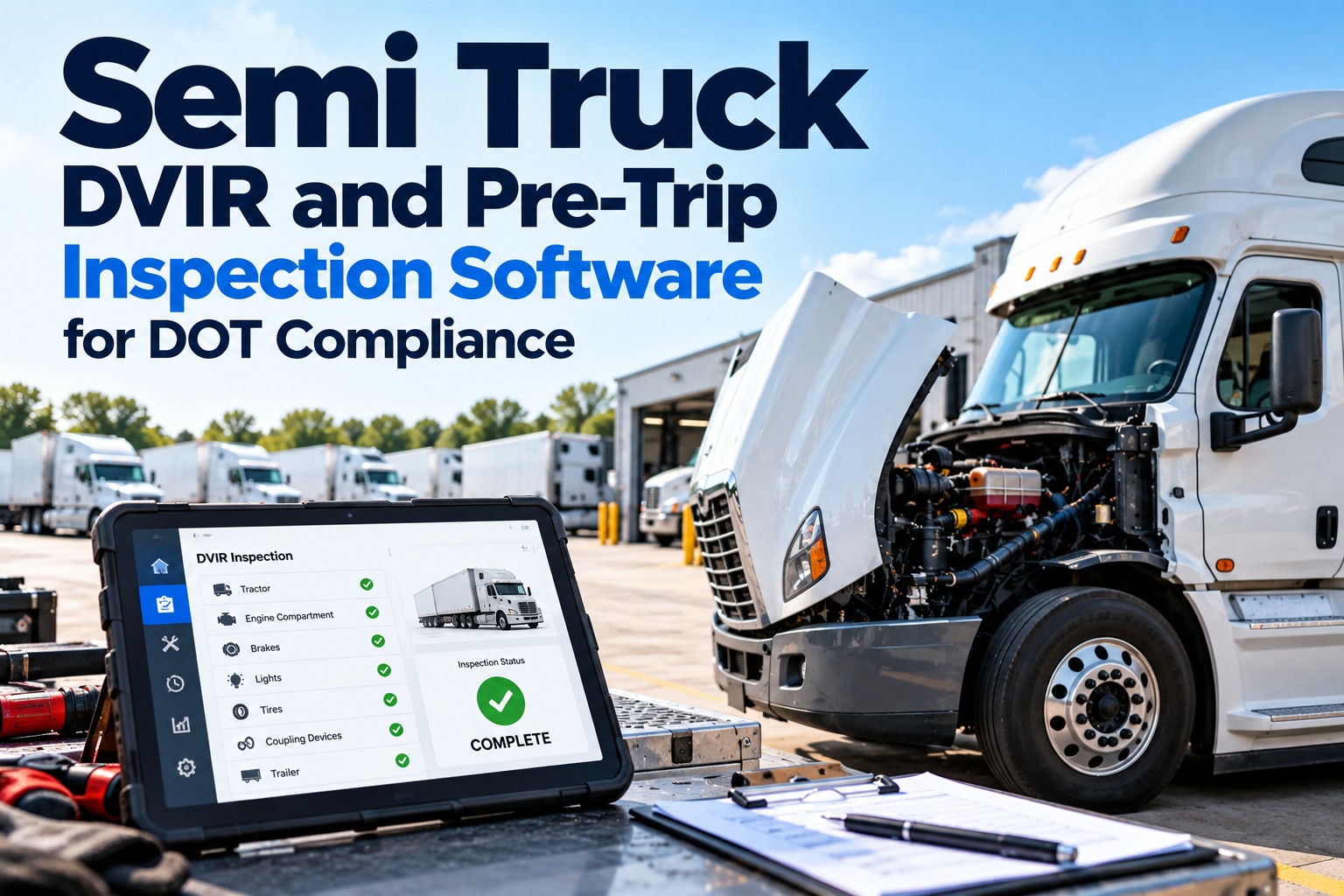
FleetRabbit's digital DVIR module transforms the DVIR from a compliance burden into a compliance asset. Drivers complete pre-trip and post-trip inspections on the FleetRabbit mobile app — following the structured inspection checklist that covers all items listed in 49 CFR 396.11. The completed inspection is timestamped and driver-attributed automatically, eliminating the signature compliance question. Defect items marked in the inspection create linked work order requests in the maintenance module immediately — the driver's DVIR finding goes directly to the maintenance team without requiring any manual handoff. When the defect is corrected, the maintenance technician closes the work order in FleetRabbit with completion documentation, creating the certifying mechanic's record that the regulation requires before the vehicle can return to service with drivers.
Paper DVIR forms completed or skipped at driver discretion — no automated tracking
Defect reports physically delivered to maintenance — handoff delays, lost notifications
Vehicle sometimes dispatched before defect corrective action is confirmed
Monthly DVIR completion rate unknown until manual count of filed forms
Compliance audit requires physical file retrieval across 3-month period
Repeat defects at same vehicle not visible without manual record cross-reference
Digital DVIR required before dispatch assignment activated — completion tracked automatically
Defect findings create maintenance work orders instantly — no handoff delay or notification gaps
Safety-critical defects flag vehicle out-of-service in FleetRabbit until corrective action confirmed
Real-time DVIR completion rate visible by driver, vehicle, terminal, and fleet
All DVIR records available with date and vehicle filters for immediate auditor access
Pattern analysis identifies vehicles with repeated defect categories requiring investigation
Building a Compliance Culture: Alert Systems and Accountability Structures
Technology alone does not produce compliance improvement — it produces compliance data. Converting compliance data into sustained behavioral and operational improvement requires an organizational structure that uses the data in regular accountability processes. Carriers that deploy automated alert systems and compliance dashboards without establishing a regular compliance review cadence at the management level typically see short-term improvement followed by regression as the novelty of the technology dissipates and the operational pressures that created compliance gaps in the first place reassert themselves.
An effective compliance accountability structure using FleetRabbit involves three recurring management processes: daily dispatch manager review of outstanding alerts and pending corrective actions (15 minutes at the start of each dispatch shift), weekly fleet manager review of BASIC score trends, violation counts, and corrective action completion rates by driver and terminal (60-minute weekly operations meeting with standard agenda), and monthly executive review of CSA score trajectory, compliance-related cost (fines, out-of-service incidents, increased insurance attributable to score decline), and investment in compliance improvement measures (30-minute monthly report to COO or VP of Operations). This three-tier review structure uses FleetRabbit's dashboard and reporting outputs as the data source, maintaining accountability without requiring manual report preparation by compliance staff.
Daily
Dispatch Manager Review
Outstanding Level 2 and 3 alerts — action required or in progress
DVIR completion status — all vehicles dispatched today with pending or missing DVIR
HOS status — any drivers approaching limit threshold for current duty period
Vehicles flagged out-of-service — maintenance status and expected return to service
Review Duration: 15-20 minutes
Weekly
Fleet Manager Operations Review
BASIC score trend by category — week-over-week change and 30-day trajectory
Violation count by category and responsible party — driver, terminal, or operational pattern
Corrective action completion rate — all open corrective actions with due date status
PM compliance rate — overdue services and at-risk vehicles by priority
DVIR completion rate by driver — identification of drivers with below-threshold rates
Review Duration: 45-60 minutes
Monthly
Executive Compliance Report
CSA score status across all BASIC categories versus intervention thresholds
Month-over-month violation trend — improvement or deterioration versus 90-day baseline
Compliance cost summary — fines, OOS incidents, insurance attribution
Corrective action program status — completion rates and systemic issues identified
Review Duration: 30 minutes
Handling Roadside Inspection Findings and DataQ Challenges
Even carriers with strong automated monitoring programs will occasionally receive violation citations during roadside inspections. Not all violations cited at roadside are accurately recorded — inspection officer error, ambiguous regulatory interpretation, and documentation misunderstandings can result in citations that do not accurately reflect the carrier's operational practices. The FMCSA's DataQ challenge process provides a mechanism for carriers to contest inaccurate violations before they compound the carrier's CSA score for 24 months.
FleetRabbit's documentation capabilities provide the evidence base required for successful DataQ challenges. When a driver receives a violation citation during a roadside inspection, the fleet manager can immediately pull the relevant records from FleetRabbit: DVIR for the inspection date showing the vehicle's reported condition, maintenance records showing that the cited defect was addressed or was not present based on the most recent PM and inspection documentation, HOS records showing the driver's duty status at the time of the inspection, and driver credential records showing valid license and medical certification status. This documentation, produced promptly in a well-organized format, significantly improves the success rate of DataQ challenges for violations that were inaccurately cited. Book a demo to see how FleetRabbit's record retrieval capabilities support your DataQ challenge process.
Frequently Asked Questions
QWhat is the relationship between FleetRabbit's HOS monitoring and ELD hardware? Does FleetRabbit replace the ELD mandate requirement?
FleetRabbit's HOS monitoring uses duty status data from connected ELD systems — it does not replace the ELD hardware requirement under the FMCSA ELD mandate. Carriers subject to the ELD mandate (commercial drivers operating under property-carrying HOS rules for vehicles above 10,001 lbs GVWR without an applicable exemption) must still have FMCSA-registered ELD hardware in the vehicle. FleetRabbit integrates with ELD and telematics data from major providers — Samsara, Motive, Geotab, Verizon Connect, and others — to pull driver duty status information into the FleetRabbit fleet management dashboard where it can be monitored alongside vehicle maintenance, DVIR, and credential records in a unified compliance view. Short-haul operators exempt from the ELD mandate can use FleetRabbit's driver logging features for manual HOS record keeping within the platform.
QHow does FleetRabbit handle violation alert notification to ensure alerts reach the right person without creating notification overload?
FleetRabbit uses a role-based notification routing system where each alert category is assigned to the appropriate responsible party based on the alert type and the organizational hierarchy. HOS approaching-limit alerts go to the driver's assigned dispatcher. DVIR missing reports go to the terminal's dispatch supervisor. PM overdue alerts go to the maintenance manager at the relevant terminal. Credential expiration alerts go to both the fleet manager and the driver's operations supervisor. The notification routing configuration is set during deployment and can be updated without IT involvement when staff changes occur. Alert threshold sensitivity is configurable by category — carriers with dispatch managers who find the default thresholds generating too many low-urgency notifications can raise the threshold before they generate active notifications, moving early-warning items to the information-level dashboard view only.
QCan FleetRabbit produce compliance records in the format required for FMCSA compliance reviews and targeted investigations?
Yes. FleetRabbit's records are structured to satisfy FMCSA compliance review documentation requests. Vehicle maintenance records include all required elements: date of service, service performed, nature of any defect found, method of correction, and signature of certifying mechanic (through the technician attribution system). DVIR records include driver name, date, vehicle identification, pre-trip and post-trip findings, defect items, driver signature (electronic), and certifying mechanic documentation for repaired items. HOS records integrate with ELD records where applicable. Driver qualification files include all required credential documents with expiration dates and renewal history. When a carrier receives an FMCSA compliance review request, FleetRabbit can produce all relevant records for the review period with date range and vehicle or driver filters that make the production process significantly faster than manual retrieval from paper or disparate digital files.
QWhat happens in FleetRabbit when a DVIR records a safety-critical defect? How is the corrective action managed?
When a driver marks a defect item in a FleetRabbit DVIR, the system automatically creates a maintenance work order linked to that inspection record. The work order is categorized by the safety criticality of the defect — items in safety-critical categories (braking, steering, lighting, tires) are automatically assigned a high-priority designation and trigger an immediate notification to the maintenance supervisor. Safety-critical defect work orders also flag the vehicle as "service required" in the FleetRabbit asset registry, which the dispatch module uses to prevent the vehicle from appearing in available vehicle lists for assignment until the work order is closed. When the maintenance technician completes the repair and closes the work order, the close documentation includes repair description, parts used, and technician attribution — creating the certifying mechanic record required by 49 CFR 396.11 before the vehicle returns to service. The vehicle status automatically updates from "service required" to "available" when the defect work order is closed.
Book a demo to walk through the complete DVIR defect-to-corrective action workflow in FleetRabbit's platform.
QHow do FleetRabbit's violation alert capabilities help with DOT audit preparation specifically?
DOT compliance auditors (also known as compliance examiners for FMCSA compliance reviews) request specific record types during a compliance review: driver qualification files, hours-of-service records, vehicle maintenance records, DVIR records, and evidence of corrective action for any violations in the review period. FleetRabbit maintains all of these record categories in a single platform with audit-ready retrieval capabilities. When a compliance review is announced, the fleet manager can immediately pull all records for the review period without initiating a manual collection process across multiple locations and formats. The corrective action documentation trail for any compliance events during the review period is available from the alert system — showing each alert that was generated, the corrective action that was taken, and the documentation of completion. This comprehensive, organized record presentation significantly accelerates the compliance review process and demonstrates an active, functioning compliance management program to the reviewing examiner.
Stop Managing Violations. Start Preventing Them.
FleetRabbit's automated compliance monitoring, violation alert system, and corrective action documentation give your fleet management team the tools to protect your CSA score, satisfy FMCSA audit requirements, and build a compliance program that functions consistently — not just when an audit is approaching.
HOS Real-Time Monitoring
Digital DVIR
Automated Violation Alerts
CSA Score Protection
Corrective Action Trails
DOT Audit Readiness
April 21, 2026
By Jason Smith
All Posts