When a plaintiff's attorney sits down after a crash involving a commercial truck, the first document they request is rarely the police report. It is the driver's training and qualification file. Courts and juries increasingly treat thin, disorganized training records as evidence of a carrier that never really checked whether the person behind the wheel was prepared to be there, and that assumption alone has fueled settlements running into eight and nine figures. Building a defensible training record in 2026 is no longer just a compliance chore. It is one of the most important risk-management decisions a fleet makes.
Driver qualification file issues account for roughly 17 percent of all FMCSA violations, with more than 62,000 DQ-related citations issued over the past five years. A single missing or expired document typically carries a fine between 1,000 and 6,875 dollars, and repeated gaps can trigger a full compliance review. Beyond regulatory exposure, incomplete training documentation has been cited directly in nuclear verdict litigation, including cases where settlements exceeded 300 million dollars.
Why Training Records Carry More Weight Than Ever
A driver training record used to be treated as a box-checking exercise: a signed certificate, a folder, a filing cabinet. That approach no longer holds up under either regulatory or legal scrutiny. Entry-level driver training rules now require a certificate from an FMCSA-registered Training Provider Registry provider for any CDL issued or upgraded on or after February 7, 2022, and auditors verify that certificate against the registry directly. Litigation has moved even further, with plaintiff attorneys building entire arguments around what a carrier did or did not document about a driver's ongoing coaching and skill development.
The Difference Between a File and a Defense
A stack of signed forms proves a training session happened. It does not prove the driver understood the material, corrected the behavior being coached, or improved over time. A defensible record captures all three: what was taught, how competency was verified, and what happened afterward. That third piece, the follow-through, is exactly what is missing from most fleet files and exactly what attorneys look for first.
What "Defensible" Actually Means
A defensible record can answer three questions instantly, months or years after the fact: who delivered the training, what specific skill or behavior it addressed, and what evidence exists that the driver retained it. If any one of those three is missing, the record supports a story of negligence just as easily as it supports a story of diligence.
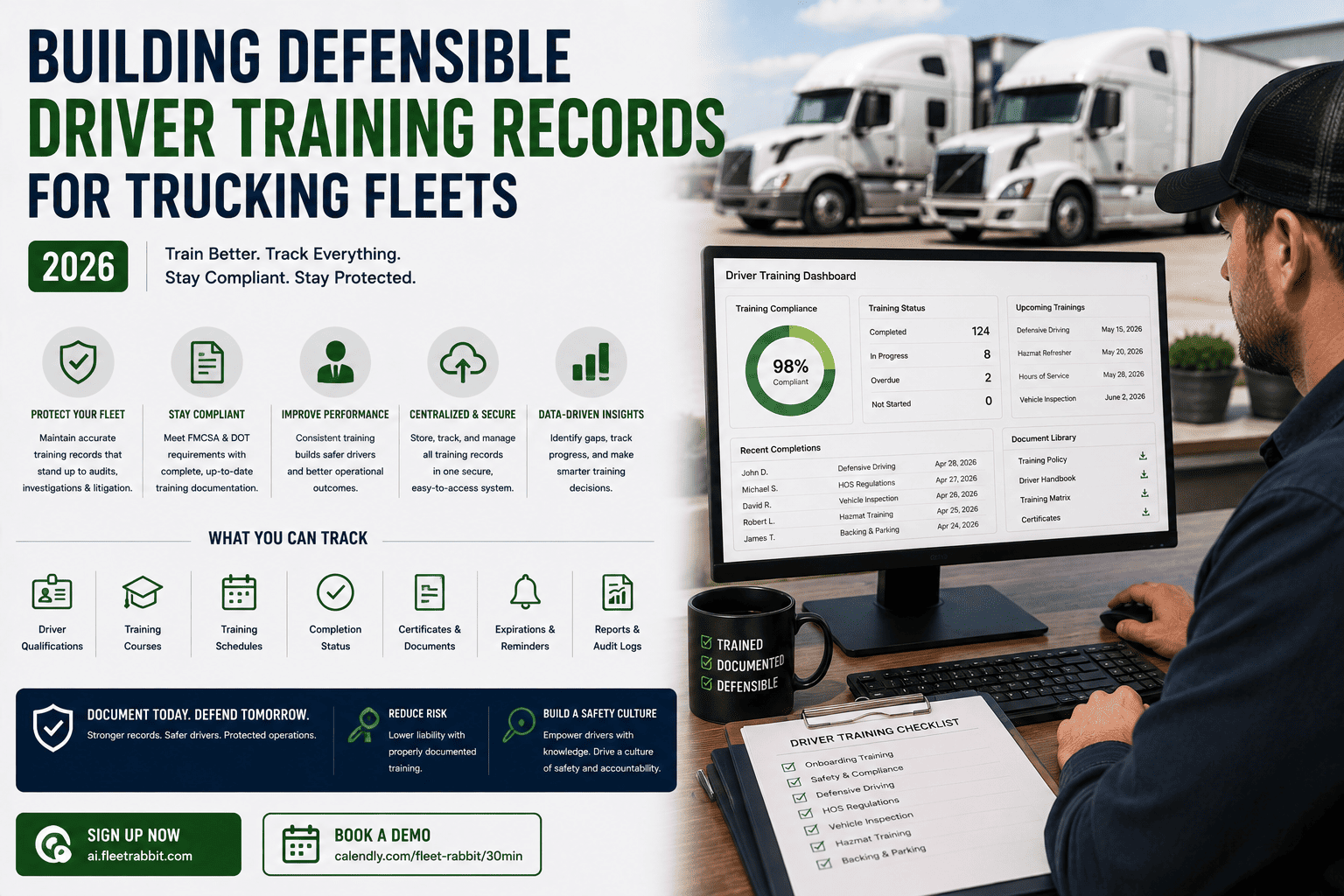
FleetRabbit centralizes ELDT certificates, coaching notes, and skill reviews for every driver in one searchable, timestamped file. You can sign up for FleetRabbit and digitize your training files today, or book a demo to see how audit-ready reporting works before you commit.
What Belongs in a Complete Training Record
A defensible training file is built in layers, starting before the driver's first day and continuing for as long as they operate a commercial motor vehicle. Each layer has its own retention clock, and missing any single layer weakens the whole file.
| Record Type | What It Proves | Retention Guidance | Common Gap |
|---|---|---|---|
| ELDT Completion Certificate | Driver met federal theory and behind-the-wheel training standards | Duration of employment plus 3 years | Certificate never verified against the training provider registry |
| Road Test or CDL Equivalent | Driver demonstrated practical skill matching vehicle class and endorsements | Duration of employment plus 3 years | Equivalent CDL not properly cross-referenced in the file |
| Coaching and Counseling Logs | Ongoing performance monitoring and corrective action | Retained alongside the driver qualification file | Sessions logged informally with no date, reviewer, or outcome |
| Annual Review of Driving Record | Continued fitness to drive, reviewed at least once per year | Duration of employment plus 3 years | Review completed but never signed or dated by a supervisor |
| Post-Incident Retraining | Corrective response following a violation, complaint, or crash | Duration of employment plus 3 years | Retraining discussed verbally but never documented |
Turning a Filing Cabinet Into a System
Most fleets do not lose training records on purpose. They lose them because the process depends on someone remembering to save a form, someone else remembering to file it, and a third person remembering to check it before an audit. Every handoff is a place the record can disappear or lose its timestamp.
Centralize Before You Digitize
Scanning paper into folders is not the same as building a system. A defensible record needs structure: every entry tied to a specific driver, a specific date, a specific reviewer, and a specific outcome. Without that structure, a digital file is just a paper file with worse lighting.
Make Follow-Through Visible
The single biggest gap in most training files is proof that coaching actually changed behavior. A record that shows a driver was coached on hard braking in March and shows no follow-up review in April tells its own story. Building a habit of scheduled follow-up checks closes that gap and turns a one-time note into a documented improvement trend.
A Habit Worth Building Quarterly
Run an internal audit of training files every quarter, not just before a scheduled review. Fleets that catch a missing signature or an expired certificate on their own timeline fix it quietly. Fleets that find it during an FMCSA compliance review or a deposition do not get that choice.
FleetRabbit tracks certification expirations, logs coaching outcomes, and generates audit-ready reports automatically, so nothing depends on someone remembering to file a form. Book a free demo to see a sample audit report, or sign up now to start building defensible records today.
Frequently Asked Questions
Every coaching note, certificate, and annual review either strengthens your compliance posture or leaves a gap someone else will find first. FleetRabbit keeps every driver's training history complete, timestamped, and ready the moment it is requested. Explore the platform with a free sign-up or walk through an audit-ready file with our team.