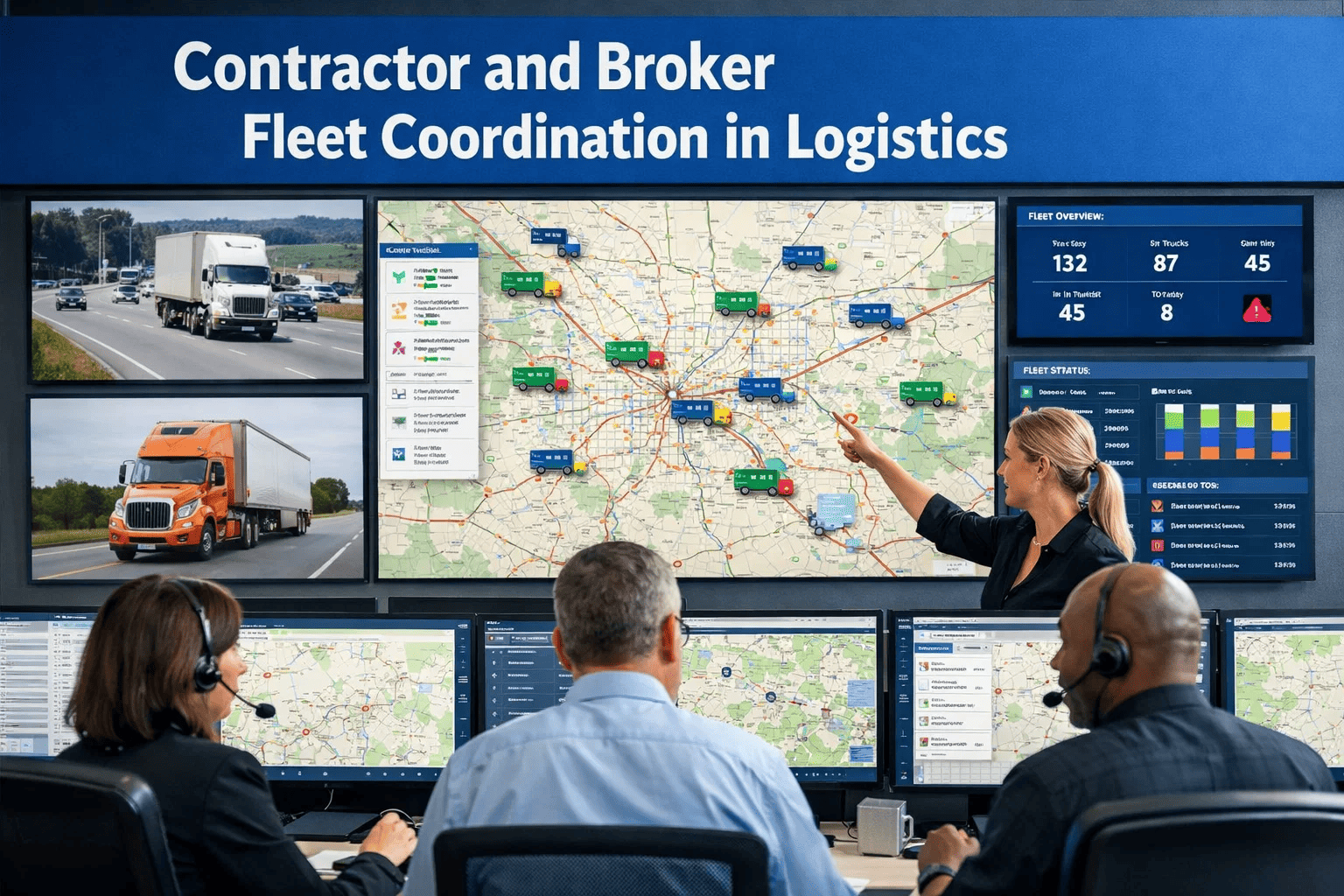
Modern logistics operations rarely run on owned assets alone. Most transportation companies now rely on owner-operators, independent contractors, freight brokers, and third-party carriers to fill capacity gaps. This network model creates flexibility — but introduces coordination failures that erode efficiency, inflate costs, and reduce service reliability when managed through fragmented tools.
FleetRabbit gives logistics executives and fleet managers the visibility and coordination infrastructure to manage contractor and broker fleets with the same operational precision as owned equipment. End-to-end load tracking, contractor performance analytics, compliance verification, and centralized communication eliminate the delays and capacity gaps that define manually coordinated outsourced fleets.
Contractor and Broker Fleet Coordination in Logistics
Gain Unified Visibility, Optimize Third-Party Carrier Performance, and Eliminate Coordination Delays
The Core Coordination Challenges Costing Your Fleet Margin
Transportation and logistics executives managing contractor and broker networks face a consistent set of challenges that multiply as carrier count and lane complexity grow. These four failures drive most of the hidden costs in outsourced fleet operations.
Fragmented Real-Time Visibility
Company-owned trucks transmit GPS through your telematics platform. Owner-operators use their own apps. Broker-managed loads disappear into carrier systems with only periodic check-calls. Operations teams cannot accurately answer basic status questions — forcing reactive firefighting instead of proactive management.
Inconsistent Compliance Verification
Every contractor and broker-tendered carrier must maintain current FMCSA registration, active insurance, DOT safety ratings, and driver qualification files. Verifying compliance across dozens of active contractors requires repetitive manual checking — and outdated certificates slip through, creating liability that appears only when accidents trigger coverage disputes.
Performance Data Silos
When contractor performance records scatter across dispatch notes, complaint logs, and billing disputes, systematic management becomes impossible. Operations leaders cannot identify which contractors deliver consistently, which generate recurring delay patterns, or which broker relationships produce the highest reliability — preventing data-driven carrier selection.
Communication Lag Creates Cascade Failures
When loads need rerouting, pickup times shift, or emergencies require immediate action — logistics teams relying on phone chains and email chains experience critical information lag. In time-sensitive freight, 30-minute communication delays between broker, carrier, and shipper cascade into multi-hour delivery failures and accessorial charges.
Your Outsourced Fleet Ecosystem: Four Carrier Tiers
Effective coordination begins with understanding the management requirements of each carrier category. Each tier demands different visibility tools, compliance requirements, and performance management approaches.
Owner-Operators and Independent Contractors
Owner-operators under direct lease or contract typically provide the most favorable rate structure and highest service reliability. They operate as fleet extensions with direct dispatch relationships — but using their own equipment and telematics tools, creating visibility gaps without integration.
- Direct dispatch via FleetRabbit contractor portal
- Individual compliance monitoring with document expiration alerts
- Performance scorecards for on-time delivery and load acceptance
- Automated settlement based on delivery confirmation
Regional Carriers with Recurring Lane Assignments
Regional and national carriers operating under contract rates on recurring lanes represent the reliable middle tier. These relationships require formal compliance verification, rate management, and performance tracking to maintain service standards and contract compliance.
- FMCSA compliance monitoring with certificate tracking
- Lane-level on-time performance measurement and trending
- Claims ratio monitoring for early service quality signals
- Rate sheet management with carrier document storage
Broker-Tendered Spot and Overflow Capacity
Freight brokers provide surge and overflow capacity at spot market rates. Broker-tendered loads require systematic tracking to prevent complete visibility loss once handed off — the most common source of service failures on time-sensitive shipments in mixed-fleet operations.
- Load status tracking across broker-tendered shipments
- Broker performance analytics comparing reliability versus spot cost
- Automated delivery confirmation for invoice verification
- Broker dependency metrics to identify lane conversion opportunities
Drop-and-Hook and Pool Trailer Networks
Drop-and-hook operations using pooled equipment create a fourth tier where trailer assignment tracking, equipment availability, and pickup confirmation gaps cause hidden delays. Without automated tracking, detention charges accumulate invisibly and empty trailer locations become operational guesswork.
- Trailer pool location tracking with availability status
- Automated detention clock start on confirmed arrival timestamps
- Empty return coordination with nearest contractor availability
- Equipment utilization reporting by customer location and lane
FleetRabbit Contractor Coordination: Core Platform Capabilities
FleetRabbit provides logistics teams with an integrated platform that extends fleet management beyond owned assets to the full contractor and broker network. These capabilities transform fragmented outsourced operations into managed network performance.
Unified Load Tracking Across Owned and Contractor Assets
FleetRabbit consolidates real-time load visibility across company-owned trucks, owner-operators, and broker-managed carriers into a single operational dashboard. Dispatchers, customer service, and logistics managers see all active loads regardless of carrier type through one interface — eliminating the need to check multiple tracking portals or make status phone calls.
40% fewer status call interruptions after unified tracking deploymentAutomated Contractor Compliance Monitoring
FleetRabbit maintains a contractor compliance database covering FMCSA operating authority, insurance certificate expiration, safety rating monitoring, and driver qualification documents for every active carrier. Automated alerts notify compliance staff before documents expire — preventing the operational shock of discovering gaps only when insurance certificates are requested under pressure.
Certificate expiration alerts eliminate 94% of manual compliance checking timeContractor Performance Scorecards and Analytics
Every load tendered to a contractor generates performance data — on-time pickup and delivery rates, load acceptance ratios, communication responsiveness, and claims frequency. FleetRabbit aggregates this into scorecards allowing data-driven carrier selection decisions and rate negotiations backed by documented performance history.
Data-driven carrier selection improves on-time delivery rates by 18% year oneDigital Load Tendering and Capacity Planning
FleetRabbit's load tendering workflow offers loads to preferred contractors, sets acceptance windows, and automatically falls to secondary options on expiration — with every assignment documented digitally. Demand forecasting and contractor availability analytics surface mismatches before they create operational crises, reducing emergency broker procurement by 31%.
Digital tendering reduces load assignment errors by 76% versus phone-based dispatchKey Performance Metrics for Contractor Network Management
Systematic contractor management requires consistent measurement against defined benchmarks. These eight metrics form the operational intelligence foundation that enables data-driven carrier selection and network optimization.
On-Time Pickup and Delivery Rate
Percentage of loads picked up and delivered within agreed windows. Industry benchmark: 94%+ for top-tier contractors. Trailing performance triggers carrier review conversations before service failures reach shippers.
Primary KPILoad Acceptance Rate
Percentage of tendered loads accepted on first offer. Low acceptance rates signal rate misalignment or capacity constraints requiring relationship adjustment before peak periods create emergency broker dependency.
Capacity SignalBroker vs. Contract Rate Premium
Average cost differential between contract-rate carrier loads and spot broker-tendered loads on the same lanes. Quantifies the capital cost of broker dependency and builds the business case for carrier network expansion.
Cost LeverCompliance Expiration Rate
Percentage of active contractors with documents expiring within 30 days. This leading indicator prevents the compliance gaps that create liability exposure and operational disruptions in carrier relationships.
Risk MonitorClaims Frequency by Carrier
Cargo claims, property damage, and service failure events per 100 loads by contractor. High claims frequency indicates service quality issues that rate negotiations alone do not resolve — requiring structured improvement plans.
Quality MetricContractor Network Utilization
Percentage of available contractor capacity deployed against load demand across lanes and time periods. Low utilization indicates relationship maintenance needs. High rates signal capacity expansion requirements before seasonal demand peaks.
Network HealthCommunication Response Time
Average time from dispatch contact to contractor acknowledgment per carrier. Poor response metrics create operational risk on time-sensitive loads and identify relationships needing structured improvement plans before critical freight is at stake.
ReliabilityInvoice Dispute Rate
Percentage of contractor invoices requiring dispute resolution before payment. High dispute rates indicate documentation capture gaps that FleetRabbit's load documentation workflow systematically eliminates — reducing AP workload significantly.
Financial HealthReduction in coordination-related delivery delays within 90 days
Decrease in emergency broker procurement costs through proactive capacity planning
Reduction in compliance disruptions from expired contractor documents
Return on platform investment through operational savings in year one
Frequently Asked Questions
Yes. FleetRabbit integrates with major freight broker and third-party carrier tracking platforms to maintain load visibility even when the hauling carrier operates their own telematics infrastructure. For broker-managed loads where direct integration is not available, FleetRabbit provides structured check-call workflows that capture location and status updates at configurable intervals — maintaining a consistent load history record regardless of the carrier's technology stack.
FleetRabbit is designed with flexibility for contractor onboarding. Owner-operators can share location and load status through the FleetRabbit driver mobile app, which is free to download and requires no specialized hardware. For contractors already using ELD systems, FleetRabbit integrates with major ELD providers to pull location and hours-of-service data without requiring any change to the contractor's existing setup — significantly reducing the adoption friction that prevents smaller contractors from participating in digital coordination programs.
FleetRabbit's lane analytics identify which routes are systematically fulfilled through broker-tendered spot capacity based on historical tendering frequency, spot rate premiums versus contract benchmarks, and delivery volume consistency. When a lane shows recurring broker utilization at significant premium to contract rates, FleetRabbit's data provides the volume and pricing evidence needed to recruit committed contractors — quantifying potential savings and providing the volume commitments that attract quality carrier partners.
FleetRabbit's compliance monitoring scales linearly with contractor count. The platform maintains a structured compliance record for each contractor covering FMCSA authority, insurance certificate expiration, safety rating status, and driver qualification files. Automated alerts notify compliance staff at configurable advance warning windows — typically 30 and 7 days before expiration. Compliance dashboard views surface all at-risk contractors simultaneously, allowing prioritized renewal outreach without manual database checking across multiple carrier portals.
Unify Visibility Across Your Entire Carrier Network
Most logistics operations are losing margin every week through invisible coordination costs — broker premiums that could have been avoided, compliance gaps that create liability exposure, and service failures that reach shippers before your operations team even knows a load is at risk. FleetRabbit replaces the fragmented phone chains, scattered spreadsheets, and disconnected tracking portals with a unified coordination platform purpose-built for mixed fleet operations.
Logistics operations consistently achieve measurable coordination improvements within 60 days of FleetRabbit deployment — with immediate reduction in status call volume, compliance surprises, and emergency broker capacity costs. The ROI case builds itself.
Free trial: 3 vehicles | $3/vehicle/month | No contracts | Full feature access