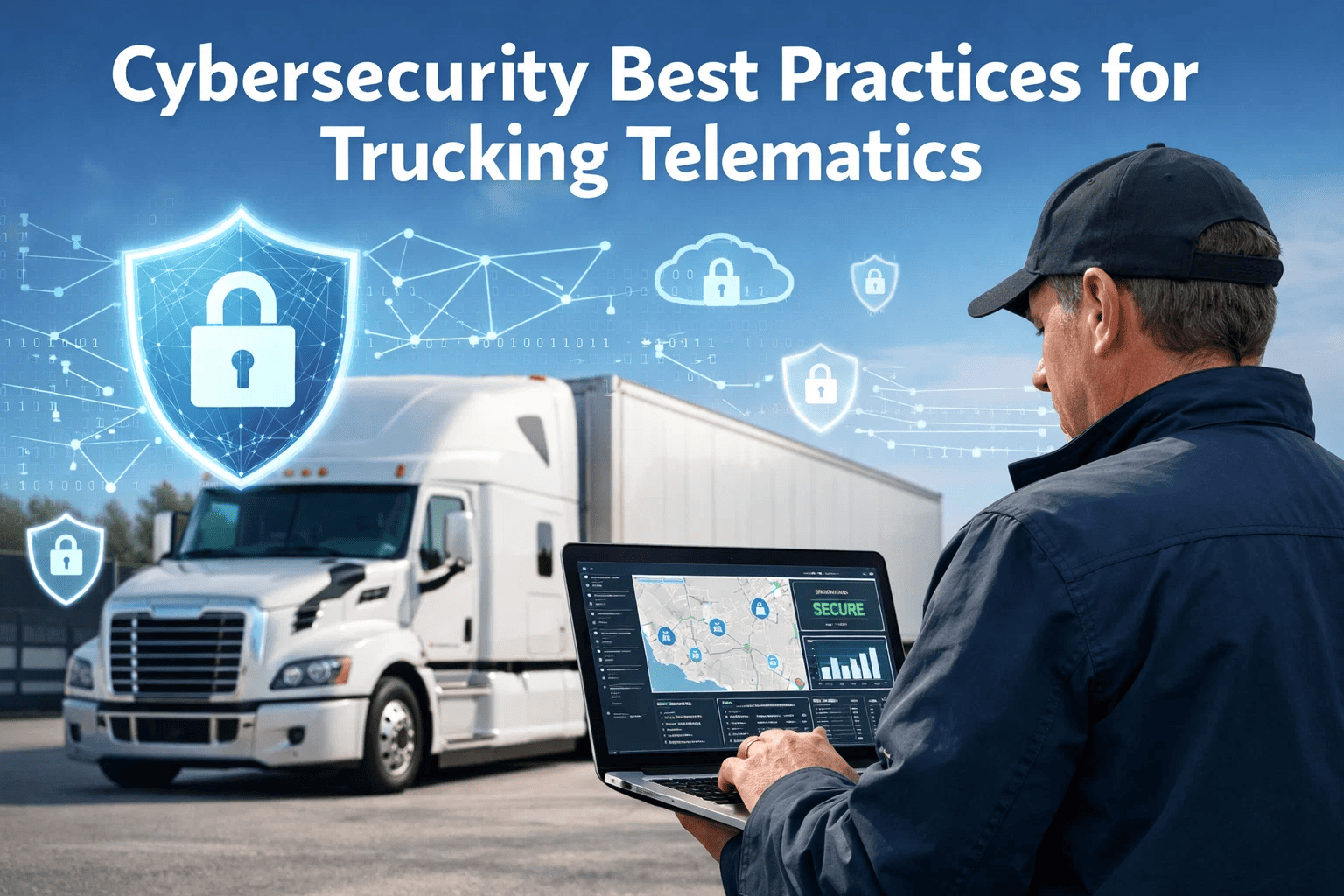
Connected fleet telematics has transformed how transportation companies manage vehicles, drivers, and operations. Real-time GPS tracking, engine diagnostics streaming to cloud platforms, driver behavior monitoring, and electronic logging device data create unprecedented operational visibility across trucking fleets. They also create an unprecedented cybersecurity attack surface. Every device that connects to the internet is a potential entry point for threat actors. Every data flow that leaves a vehicle or enters a fleet management platform represents a security boundary that must be actively defended. Transportation companies that deploy telematics without implementing proportionate cybersecurity controls are building glass houses in a landscape where industrial cyber threats are accelerating. Book a demo to see how FleetRabbit's platform protects your fleet data with enterprise-grade security architecture.
Compliance Guide
Cybersecurity Best Practices for Trucking Telematics: Data Protection, Connected Fleet Security, and Risk Management for Transportation Operations
FLEET SECURITY & DATA PROTECTION GUIDE
Protecting Your Connected Fleet: Cybersecurity Best Practices for Trucking Telematics and Fleet Data Security
The same telematics connectivity that gives fleet managers real-time operational visibility also creates digital access points that sophisticated threat actors actively seek to exploit. Transportation companies managing connected fleets must understand the specific threat landscape they operate in, implement layered cybersecurity controls across their technology environment, and choose fleet management software vendors with demonstrable security maturity. FleetRabbit is built with security-first architecture to protect your fleet data and operational continuity.
The Telematics Threat Landscape: Why Transportation Is a High-Value Target
Transportation and logistics companies are high-value targets for cyber threat actors for several compounding reasons. They operate business-critical infrastructure where operational disruptions translate directly and immediately into financial losses — making them candidates for ransomware extortion where payment calculus is straightforward. They handle sensitive customer data including shipping manifests, customer addresses, and contract pricing information that holds value for commercial espionage. They operate increasingly complex digital environments where legacy operational technology systems coexist with modern cloud platforms, creating heterogeneous attack surfaces that are difficult to defend uniformly.
The proliferation of connected telematics devices specifically amplifies these risks. ELD mandates have pushed cellular-connected devices into virtually every commercial truck. GPS tracking units, dashcams, tire pressure monitoring systems, and trailer tracking devices add additional connected endpoints to the fleet's digital perimeter. Each of these device categories represents a potential attack vector if not properly secured — and most fleet operators have not systematically evaluated or addressed the security posture of their telematics estate.
Ransomware attacks against transportation companies encrypt operational data — dispatch records, driver information, maintenance records, route data — and demand payment for decryption keys. When fleet management systems are compromised, operational continuity is immediately disrupted. Companies without adequate backup and recovery architecture can face days of operational paralysis while systems are restored. Average ransomware recovery cost for mid-size transportation companies exceeded $1.4 million in 2024.
GPS spoofing attacks transmit false location signals to GPS receivers in telematics devices, creating phantom vehicle positions that appear legitimate in fleet tracking platforms. Attackers can use spoofing to conceal vehicle movements, misdirect theft investigations, manipulate route verification for cargo diversion schemes, or disrupt navigation systems. High-value cargo routes targeting organized cargo theft operations represent the primary practical threat vector for GPS manipulation attacks against trucking fleets.
Electronic Logging Devices connect directly to vehicle CAN bus systems to read engine data, odometer information, and diagnostic parameters. If an ELD device is compromised through its cellular or Bluetooth interface, the attacker gains a potential pathway into the vehicle's onboard network. Academic research has demonstrated that insufficiently isolated ELD implementations could theoretically allow remote manipulation of vehicle systems — a threat category that FMCSA and DHS Cybersecurity and Infrastructure Security Agency (CISA) have formally identified as an emerging transportation sector risk.
Fleet management platforms store significant volumes of personal data about drivers: social security numbers for background check records, license information, medical certificate data, home address information, and earnings data. Driver data sets are valuable targets for identity theft operations. Credential theft attacks targeting fleet management platform login credentials can expose this data if access controls rely solely on password authentication without multi-factor verification requirements.
Transportation companies operate within complex logistics ecosystems that include shippers, receivers, freight brokers, fuel card networks, and technology vendors. Each digital interface between your fleet management environment and external parties represents a potential supply chain attack vector. Compromised vendor systems can be used as launching points for attacks against your operational infrastructure — a threat pattern demonstrated across multiple high-profile supply chain attacks in recent years against transportation sector organizations.
Sophisticated cargo theft operations no longer rely solely on physical surveillance. Cyber intrusion into fleet management systems, dispatch platforms, or shipper customer portals provides advance knowledge of high-value shipment routes, timing, and cargo contents that enables precisely targeted theft operations. The intersection of cyber intelligence gathering and physical cargo theft represents a growing threat to high-value load transportation categories including electronics, pharmaceuticals, and perishable food shipments.
Cybersecurity Best Practices for Connected Trucking Fleets
Identity and Access Management
Enforce Multi-Factor Authentication
All fleet management platform access should require multi-factor authentication — not just username and password. MFA eliminates the risk of credential theft attacks granting unauthorized access to fleet data and operational systems. SMS-based MFA is acceptable; authenticator app or hardware token MFA is preferred for executive and administrator accounts.
Implement Role-Based Access Controls
Different users require different levels of access to fleet management data. Drivers need access to their own inspection and duty status features. Dispatchers need load management visibility. Maintenance technicians need work order access. Executives need analytics and reporting. Granting all users administrator-level access creates unnecessary exposure — role-based controls limit breach impact by ensuring compromised credentials cannot access data beyond what the role requires.
Conduct Regular Access Reviews
Driver and employee turnover in transportation creates persistent orphaned account risk. Former employees whose fleet management platform credentials are not promptly deactivated retain access to operational data after separation. Conduct quarterly access reviews to identify and remove credentials belonging to drivers, mechanics, and administrative staff who are no longer with the organization. Automated deprovisioning tied to HR system offboarding workflows is the best practice standard.
Device and Endpoint Security
Establish Telematics Device Inventory and Baseline
Security management begins with a complete, accurate inventory of every connected device in your fleet telematics environment — ELDs, GPS trackers, dashcams, TPMS sensors, and any other cellular or Bluetooth-connected device. Document the manufacturer, model, firmware version, and network connectivity method for each device type. An unknown device cannot be secured. Unmanaged firmware is a persistent vulnerability vector.
Maintain Current Firmware on All Telematics Devices
Telematics device manufacturers release firmware updates that address security vulnerabilities in addition to functional improvements. Fleets that deploy ELDs, GPS units, and dashcam systems and then leave firmware unchanged for extended periods accumulate known vulnerability exposure that adversaries actively scan for. Establish a quarterly firmware review process with your telematics device vendors and apply security updates within 30 days of availability.
Configure Device Network Segmentation
Telematics devices that communicate over fleet-provided WiFi or cellular infrastructure should be segmented from corporate administrative networks. A compromised telematics device should not have network connectivity to back-office systems, accounting platforms, or driver HR data. Network segmentation — where telematics traffic flows through isolated network segments with restricted routing — limits the blast radius of device-level compromises.
Data Protection and Backup
Verify Vendor Data Encryption Standards
Fleet management software vendors transmit and store significant volumes of sensitive operational and personal data. Before selecting or renewing a fleet management platform contract, verify that the vendor encrypts data in transit using TLS 1.2 or higher and encrypts data at rest using AES-256 or equivalent. Request the vendor's SOC 2 Type II attestation or equivalent security certification. Vendors unable to provide security documentation represent elevated third-party risk.
Implement Tested Backup and Recovery Procedures
Ransomware defense ultimately rests on the organization's ability to restore operations from clean backups without paying extortion demands. For fleet management data — maintenance records, driver compliance documentation, inspection history, and route data — backup procedures must ensure regular snapshots are stored in isolated environments inaccessible from the primary operational environment. Backup recovery procedures must be tested, not assumed, through periodic tabletop exercises that simulate ransomware scenarios.
Enforce Data Minimization Principles
Fleet management platforms should collect and retain only the data required for operational and compliance purposes. Extended retention of personal data beyond regulatory minimum requirements increases your exposure in the event of a breach. Review your fleet platform data retention configurations to ensure personal data is purged on an appropriate schedule, and confirm that access to historical data is limited to users with a documented operational need.
Choose a Fleet Management Platform Built With Security-First Architecture
FleetRabbit is designed with enterprise-grade security controls — role-based access management, data encryption in transit and at rest, and secure API integrations — protecting your fleet data and operational continuity. Book a demo to review FleetRabbit's security architecture for your fleet.
How FleetRabbit's Security Architecture Protects Fleet Operations
Role-Based Access Control Framework
FleetRabbit's platform enforces granular role-based access controls that limit each user's data visibility and action permissions to what their operational role requires. Driver profiles, maintenance records, financial data, and executive analytics are accessible only to users with the appropriate role-based permissions — limiting the data exposure potential of any single compromised credential.
Encrypted Data Transmission and Storage
All data transmitted between the FleetRabbit mobile application, telematics integrations, and cloud platform is encrypted using current TLS standards. Fleet maintenance records, driver information, inspection documentation, and operational data stored in the FleetRabbit platform are encrypted at rest. Data in transit between FleetRabbit and integrated third-party systems — GPS telematics providers, fuel card networks, lab systems — is secured through authenticated API connections with encryption requirements.
Secure API Integration Architecture
FleetRabbit's integrations with GPS telematics providers, fuel card systems, and third-party data sources are implemented through authenticated API connections with least-privilege data access scoping. Integration credentials are managed separately from user credentials and are configured with the minimum data access permissions required to support the integration function — limiting the potential impact of compromised integration credentials on the broader fleet data environment.
Audit Logging for Compliance and Investigation
FleetRabbit maintains comprehensive audit logs of user access, data modifications, and system configuration changes. Audit logs support both compliance requirements and security incident investigation. When anomalous activity occurs — unusual access timing, unexpected data export volumes, configuration changes outside authorized maintenance windows — audit log data enables rapid investigation to determine scope and impact.
Offline Data Security for Remote Connectivity
When FleetRabbit's mobile application operates in offline mode — in remote yards, low-connectivity corridors, or rural areas — inspection data and operational records cached locally on driver devices are stored with appropriate security controls. Local data is protected from unauthorized access on lost or stolen devices through device-level security configuration guidance provided to fleet operators during platform onboarding.
Availability and Business Continuity
FleetRabbit's cloud infrastructure is designed for high availability with redundant systems and geographic distribution. Platform availability directly impacts fleet operational continuity — when fleet management systems are unavailable, dispatch, maintenance authorization, and compliance documentation processes are disrupted. FleetRabbit's architecture and SLA commitments provide the operational reliability that transportation companies require for business-critical fleet management functions.
Evaluating Fleet Software Vendors on Cybersecurity Maturity
Choosing a fleet management software vendor is also a cybersecurity decision. The vendor you select becomes a custodian of your fleet's operational data, driver personal information, and potentially a connected component of your vehicle telematics infrastructure. The security practices of your vendor directly determine your exposure to data breach, ransomware via third-party compromise, and operational disruption from platform unavailability.
Does the vendor hold SOC 2 Type II or equivalent certification?
SOC 2 Type II attestation from an independent CPA firm verifies that the vendor's security controls are not only designed appropriately but are operating effectively over time. Vendors without SOC 2 or equivalent independent certification have not subjected their security controls to third-party validation.
What are the vendor's data breach notification procedures and timelines?
Your vendor contract should specify the vendor's obligations in the event of a data breach affecting your fleet data — notification timelines, the scope of information provided in breach notifications, and the vendor's responsibility for breach remediation costs. Vendors who resist clear contractual breach notification commitments represent elevated risk during security incidents.
How does the vendor handle data residency and cross-border data transfers?
Transportation companies operating in multiple regulatory jurisdictions may have data residency obligations affecting where driver personal data can be stored and processed. Verify that your fleet management vendor's data storage infrastructure is compatible with your regulatory obligations. Vendors with global data center footprints should be able to provide documentation of their data residency controls and cross-border transfer mechanisms.
What is the vendor's vulnerability disclosure and patch timeline commitment?
Security vulnerabilities will be discovered in any sufficiently complex software platform. The quality of a vendor's security posture is measured not by the absence of vulnerabilities but by how quickly and effectively they are identified, disclosed, and remediated. Ask prospective vendors for their vulnerability disclosure policy and their historical track record for critical security patch issuance timelines.
Does the vendor support multi-factor authentication for all users?
Fleet management platform vendors that do not support MFA for all user accounts are providing inadequate protection against credential-based attacks. Verify that MFA is available, and preferably enforced by default, for all user account types — not only administrator accounts. Driver and technician accounts are frequent targets for credential stuffing attacks due to the large volume of these accounts across the fleet.
Building a Fleet Telematics Cybersecurity Program
1
Asset Inventory and Risk Assessment
Catalog every connected device, software platform, and data integration in your fleet telematics environment. Assess the security posture of each component — firmware currency, authentication controls, encryption status, and network segmentation. Identify the highest-risk exposures based on potential business impact and current control maturity.
2
Policy and Procedure Development
Formalize cybersecurity policies governing fleet telematics device management, fleet software access control, incident response procedures, and vendor security requirements. Written policies create organizational clarity about security expectations and provide the documented framework required for insurance and regulatory compliance purposes. Policies should be reviewed and updated annually.
3
Technical Control Implementation
Implement the technical controls identified as priority during risk assessment — MFA enforcement, access control review and remediation, network segmentation for telematics devices, firmware update procedures, and backup and recovery testing. Prioritize controls that address the highest-impact risks first. Technical control implementation should be documented and controls should be verified through periodic testing rather than assumed as continuously effective.
4
Workforce Awareness Training
Human factors are the leading cause of cybersecurity breaches across all industry sectors. Drivers, dispatchers, maintenance technicians, and administrative staff who interact with fleet management systems represent the human perimeter of your telematics security environment. Annual security awareness training covering phishing recognition, password management, safe mobile device practices, and incident reporting procedures reduces the risk of human-factor security incidents across the fleet operation.
5
Continuous Monitoring and Incident Response
Cybersecurity is not a one-time project — it is a continuous operational function. Implement security monitoring appropriate to your organization's size and risk profile. Maintain a documented incident response plan that defines roles, procedures, and communication protocols for security incidents affecting fleet operations. Test incident response procedures annually through tabletop exercises. Ensure that cybersecurity incidents are covered under your business interruption insurance policy with adequate coverage limits.
Common Questions About Fleet Telematics Cybersecurity
QAre there specific cybersecurity regulations that apply to transportation companies?
While no single comprehensive cybersecurity regulation applies universally to trucking operators, several regulatory frameworks create relevant obligations. The TSA cybersecurity directives for surface transportation cover certain pipeline-connected transportation operations. CISA's transportation sector guidance provides best practice frameworks. Companies handling ELD data are subject to FMCSA data privacy requirements. Those operating under certain surface transportation designations may be subject to NERC CIP-style requirements. Companies operating internationally must also address GDPR for driver personal data or equivalent regional privacy regulations. Legal counsel with transportation sector regulatory expertise should review your specific compliance posture.
QHow significant is the GPS spoofing threat for typical trucking operations?
GPS spoofing represents an elevated threat for high-value cargo carriers — electronics, pharmaceuticals, and premium consumer goods shipments where cargo theft economics justify sophisticated attack investment. For dry freight general commodity carriers, the immediate spoofing threat is lower, but the general principle of GPS data integrity monitoring — watching for anomalous position jumps, unexpected speed readings, or geofence events inconsistent with planned routes — is a good operational practice regardless of cargo value profile. Your telematics vendor should be able to describe their GPS signal validation and anomaly detection capabilities.
QWhat should a fleet's incident response plan include specifically for telematics-related incidents?
A fleet telematics incident response plan should include: identification criteria for security events versus operational failures; roles and escalation procedures for both IT and operations leadership; communication protocols for notifying affected drivers, customers, and regulatory bodies; procedures for isolating affected systems while maintaining operational continuity; forensic evidence preservation guidance; recovery prioritization for critical operational functions; and post-incident review procedures. Consulting with a cybersecurity firm with transportation sector experience to review or develop your incident response plan is strongly recommended.
QDoes cyber insurance cover telematics-related security incidents in trucking fleets?
Most commercial cyber insurance policies can cover losses from telematics-related security incidents including ransomware attacks on fleet management systems, data breach response costs for driver personal data exposures, and business interruption losses from operational disruptions caused by cybersecurity events. However, policy terms vary significantly — particularly around coverage for operational technology systems versus IT systems. Review your cyber insurance policy with your broker to confirm coverage scope for fleet telematics incidents and verify that your coverage limits are adequate given your fleet's digital footprint and operational revenue exposure.
Conclusion: Cybersecurity Is an Operational Imperative for Connected Fleets
The connectivity that makes modern fleet telematics so operationally powerful also creates security obligations that responsible fleet operators cannot afford to ignore. Cyber threats against transportation sector organizations are not theoretical — they are occurring at increasing frequency and sophistication, with financial and operational consequences that can be catastrophic for mid-size trucking companies that lack the organizational resilience of enterprise carriers.
The good news is that effective telematics cybersecurity does not require extraordinary investment — it requires systematic discipline. Completing a technology inventory, enforcing multi-factor authentication, maintaining current device firmware, selecting security-mature platform vendors, and training personnel on security awareness delivers substantially improved security posture at costs calibrated to any fleet size. FleetRabbit's security-designed platform gives transportation operators a fleet management foundation that is built to protect, not expose, their operational data and connected infrastructure.
Protect Your Connected Fleet With Security-First Fleet Management
FleetRabbit's platform is built from the ground up with enterprise-grade security architecture — role-based access controls, data encryption, secure API integrations, and comprehensive audit logging — giving transportation operators the security foundation their connected fleet management environment requires. See how FleetRabbit protects your fleet data and operational continuity.
Telematics Security
Fleet Data Protection
Connected Fleet Risk
ELD Security
Cybersecurity Best Practices
April 16, 2026
By Jason Smith
All Posts