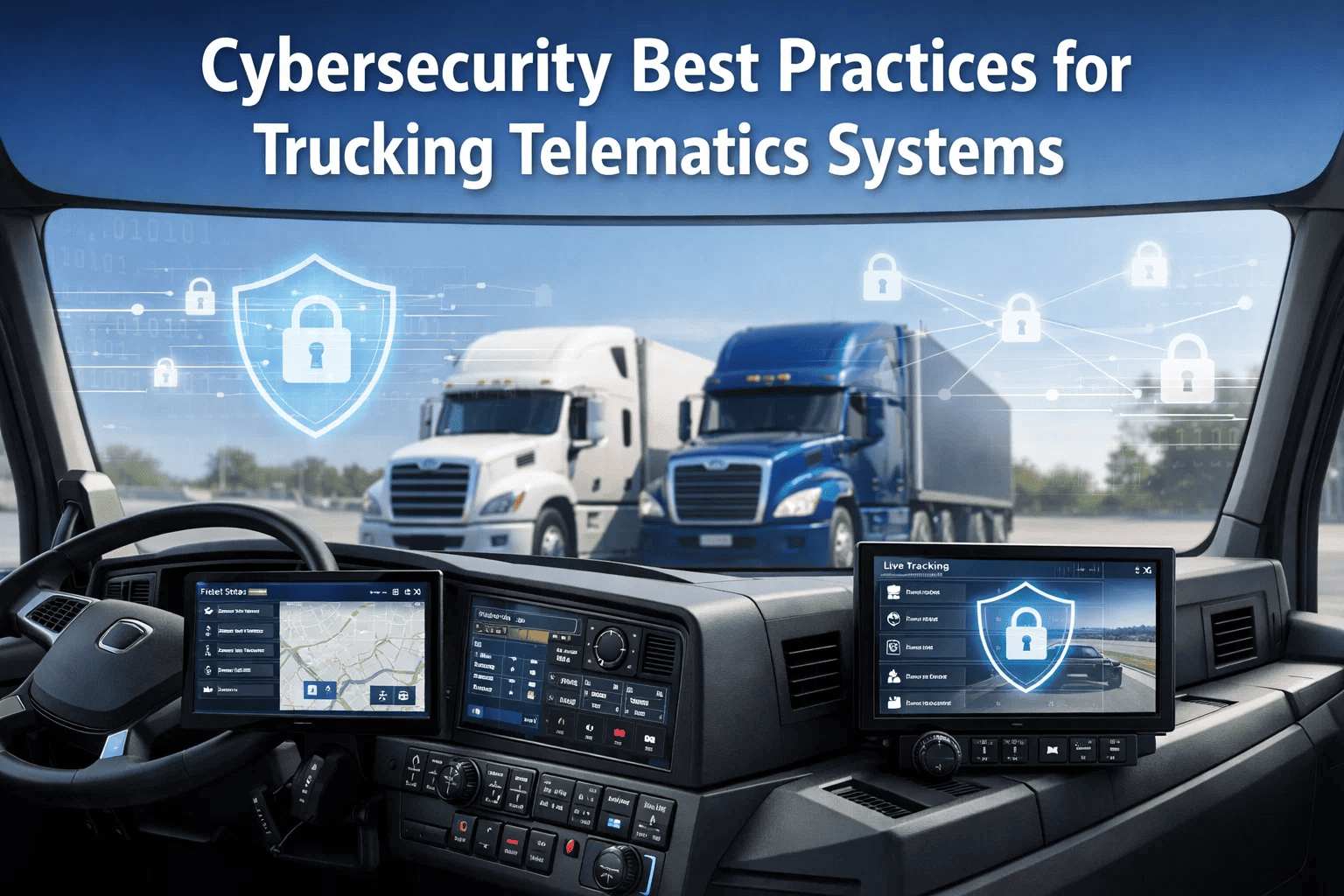
Commercial trucking telematics systems — the GPS tracking hardware, ELD devices, onboard diagnostics interfaces, fuel card integrations, and fleet management software platforms that modern carriers depend on for operations and compliance — have become high-value targets for cybersecurity threats. The attack surface of a contemporary national carrier's technology infrastructure is substantially larger than it was a decade ago: a 200-truck fleet now has 200 ELD endpoints, 200 driver-facing mobile devices, fuel card API connections, telematics hardware transmitting vehicle data continuously, cloud-based fleet management platforms accessible via web browsers from dozens of user devices, and integrations with shipper TMS systems, accounting software, and maintenance databases. Each integration, each device endpoint, and each user credential represents a potential entry point for malicious actors whose motivations range from data theft and ransomware deployment to competitive intelligence gathering and GPS spoofing attacks that disrupt carrier operations. Book a demo to review FleetRabbit's security architecture and data protection practices for your fleet management environment.
Trucking telematics cybersecurity encompasses the policies, technical controls, and operational practices required to protect fleet GPS and ELD hardware, telematics data transmission pipelines, fleet management software platforms, driver identity systems, and third-party integrations from unauthorized access, data theft, ransomware, and operational disruption. This guide covers the primary threat categories facing trucking operators, the security architecture principles that reduce exposure across the telematics stack, the operational security practices fleet managers can implement without dedicated IT security teams, and how FleetRabbit's platform security features support a carrier's overall cybersecurity posture.
The Expanding Cybersecurity Attack Surface in Modern Trucking Operations
A decade ago, a trucking company's technology infrastructure consisted primarily of a dispatch computer, a fuel card account, and perhaps a basic GPS tracking subscription. The cybersecurity risk profile was minimal — the systems were largely isolated, the data they contained had limited value to external actors, and the operational consequence of a system compromise was manageable without significant incident response investment. The technology infrastructure of a modern carrier is fundamentally different, and the cybersecurity risk profile has changed in proportion to the expansion of the attack surface.
Today's carrier fleet technology stack typically includes cloud-based fleet management software accessed by 20 to 200 users across multiple organizational roles, ELD hardware at every vehicle endpoint transmitting duty status data via cellular networks, GPS telematics systems feeding location and vehicle diagnostic data to fleet management platforms, fuel card API integrations connecting fuel transaction data from card networks to fleet analytics, driver mobile applications handling personal information and compliance records, maintenance management systems containing parts vendor payment information and vehicle specification data, and customer-facing portals and EDI connections that link the carrier's systems to shipper and 3PL technology environments. The aggregated data value of this infrastructure — driver personal information, vehicle operational data, lane and customer pricing, compliance records, and financial transaction history — is substantial, and its operational criticality means that a successful ransomware attack can halt operations within hours of deployment.
Primary Threat Categories for Trucking Telematics Operations
Understanding the specific threat categories that are most relevant to trucking operations enables fleet managers and technology leaders to prioritize security investments and operational controls in proportion to actual risk — rather than attempting to implement broad security programs without clear understanding of which threats are most likely to materialize in a carrier's specific operational environment. The five primary threat categories for trucking telematics operators are ransomware and operational disruption attacks, data theft targeting driver and compliance records, GPS spoofing and location data manipulation, credential compromise through phishing and password attacks, and supply chain compromises via third-party integrations.
Security Control Layer One: User Access and Identity Management
The largest single category of confirmed cybersecurity incidents affecting trucking operators — accounting for more than 60 percent of successful cloud platform compromises — involves unauthorized access through compromised user credentials. Attackers who obtain a valid fleet manager or dispatcher username and password gain the same system access as the legitimate user without triggering most automated security controls. The attacker can then access driver records, compliance documentation, customer lane data, and financial transaction history at their leisure — often without detection until the data theft or damage has already been completed.
Preventing credential-based compromises requires a three-component identity security program: strong password policy enforcement, multi-factor authentication (MFA) for all cloud platform access, and role-based access controls that limit each user's access to only the specific functions and data their role requires. Fleet managers overseeing the entire portfolio need different access rights than terminal dispatchers or maintenance technicians — and the damage from a compromised dispatcher account is significantly contained by role-based controls that prevent the dispatcher from accessing driver financial records, company accounting data, or compliance report generation functions that are outside their operational scope.
FleetRabbit implements role-based access controls as a core feature of its multi-terminal architecture — the same permission structure that allows terminal managers to see only their location's data also ensures that a compromised terminal manager credential cannot access fleet-wide compliance records, financial data, or other terminals' operational information. This access containment principle — least-privilege access for every user role — is one of the most effective available controls against the consequences of a credential compromise event. Book a demo to review FleetRabbit's role-based access control architecture and how it maps to your carrier's organizational structure.
Security Control Layer Two: Device and Endpoint Security
Fleet telematics hardware — ELD devices, GPS tracking units, driver tablets, and diagnostic interface hardware — represents a distributed network of physical endpoints that must be secured against both physical tampering and remote exploitation. Unlike enterprise office endpoints where physical security is maintained by building access controls, telematics hardware is deployed in vehicles that operate across the entire country, are parked at uncontrolled locations, and are accessible to any person who can access the vehicle cab. The physical security of telematics endpoints is inherently challenging, but logical security — firmware integrity, secure data transmission, and remote management capabilities — can be maintained regardless of physical location.
The primary endpoint security concerns for trucking telematics hardware are unauthorized firmware modification (particularly relevant to ELD devices where firmware manipulation could alter HOS records), unauthorized hardware insertion at OBD-II diagnostic ports (a documented cargo theft enablement technique where thieves insert GPS tracking devices to monitor vehicle location for theft planning), and data interception from cellular data transmissions between hardware and cloud platforms. Addressing these concerns requires a combination of hardware selection criteria, device management policy, and driver education about physical security risks.
Security Control Layer Three: Data Protection and Encryption
Fleet telematics data contains multiple categories of sensitive information whose unauthorized exposure creates legal, regulatory, and operational consequences. Driver personal information — names, CDL numbers, Social Security numbers for background checks, medical information from DOT physical records, and residential address information — is protected under federal privacy laws and numerous state privacy statutes. Its unauthorized disclosure triggers notification requirements, potential regulatory scrutiny, and civil liability exposure. Vehicle operational data — GPS location history, route patterns, customer delivery timing, and lane-specific performance data — has competitive sensitivity that makes it valuable to competitors and to criminal actors planning cargo theft operations. Financial data in integrated accounting systems contains rate information, customer payment terms, and vendor relationships that are core to carrier competitive positioning.
Data protection requires both technical encryption controls and data classification governance — understanding which data categories exist across the carrier's technology infrastructure, where they are stored, who has access, and how they are transmitted. Many trucking companies have not conducted formal data mapping exercises and therefore cannot answer basic questions about what personal data they hold, where it resides, and whether it is adequately encrypted at rest and in transit. The inability to answer these questions is itself a security risk: you cannot protect what you have not identified and mapped.
Evaluate Your Fleet's Technology Security Posture with FleetRabbit
FleetRabbit's platform implements role-based access controls, encrypted data transmission, and audit logging as core platform features — not optional add-ons. Book a demo to review the platform security features relevant to your carrier's compliance and data protection requirements.
Ransomware Preparedness: Detection, Response, and Recovery Planning
Ransomware remains the highest-consequence cybersecurity threat for trucking operators because of the operational dependency on digital systems for dispatch, compliance, and maintenance management. A carrier whose fleet management software, dispatch system, and ELD management portal are encrypted by ransomware cannot dispatch trucks with current load assignments, cannot verify driver HOS status for compliance, cannot complete DVIR submission workflows, and cannot access maintenance records required for breakdown response coordination. The operational impact is immediate and compounding — unlike a hardware failure that affects a single vehicle, ransomware can simultaneously disable operations across every terminal in the carrier's network.
Ransomware preparedness requires three distinct programs: prevention controls that reduce the probability of successful deployment, detection capabilities that identify ransomware activity before encryption completes, and recovery capabilities that allow operations to resume from offline backups without paying the ransom demand. The recovery capability is the most critical and most frequently neglected component — carriers that invest in prevention but not recovery consistently face the worst outcomes when prevention fails, because they have no viable alternative to ransom payment to restore operations.
GPS Spoofing: The Emerging Threat to Fleet Location Data Integrity
GPS spoofing — the transmission of false GPS signals that cause receiving devices to report an incorrect location — has evolved from a sophisticated military technology to a commercially accessible attack tool available to motivated criminals with modest technical resources. For trucking operations, GPS spoofing presents two categories of operational risk: cargo theft enablement (where cargo thieves spoof the GPS location of a high-value shipment to delay detection of vehicle diversion while the actual truck is redirected to an unmonitored location) and compliance record corruption (where false location data corrupts HOS records with incorrect route information that creates discrepancies during carrier audits).
The primary operational control against GPS spoofing is cross-source location validation — verifying GPS position data against at least one independent position signal source. Modern telematics systems that combine cellular triangulation with GPS provide a basic level of spoofing detection because significant divergence between GPS-reported location and cell tower triangulation location indicates a potential spoofing event. FleetRabbit's GPS integration uses telematics provider data that includes both position sources where available, and anomalous location changes — sudden jumps in reported position inconsistent with vehicle speed or route progression — are flaggable as potential data integrity issues for dispatcher review. Book a demo to review the GPS data validation capabilities in FleetRabbit's telematics integration framework.
Vendor Security Assessment: Evaluating Your Telematics Providers
The cybersecurity posture of a carrier's fleet technology stack is only as strong as the weakest link in its vendor chain. When a carrier's fleet management software provider, telematics hardware vendor, or ELD platform provider experiences a security breach, the carrier's data may be compromised without any failure of the carrier's own security controls. Supply chain and vendor security risk is one of the most challenging categories for fleet operators to manage because it requires evaluating the security practices of external organizations with limited transparency into their internal security programs.
A practical vendor security assessment framework for fleet technology procurement evaluates four dimensions: data handling and encryption practices, access control and authentication requirements, incident response and breach notification commitments, and compliance certifications and audit results. FleetRabbit maintains SOC 2 documentation and encrypts all data at rest and in transit as baseline platform capabilities, recognizing that fleet operators cannot satisfy their own data protection obligations with a software platform that does not meet foundational security standards.
Security Awareness Training for Fleet Operations Staff
Technical security controls — encryption, MFA, endpoint protection — address the mechanical dimensions of cybersecurity risk. Human behavior remains the most significant variable in a carrier's security posture. Social engineering attacks (phishing emails targeting dispatchers and fleet managers, phone-based pretexting calls seeking credentials) succeed not because technical controls fail but because human targets are deceived into bypassing those controls. Sustained security awareness education for fleet operations staff is therefore an essential complement to the technical controls described in this guide.
Fleet operations staff need security training that is relevant to their specific roles and the threats they are most likely to encounter — not generic IT security training designed for office workers in unrelated industries. Dispatchers need to understand the phishing tactics used to steal fleet software credentials (urgency-framed emails requesting password verification, fake load assignment notifications with malicious links). Fleet managers need to understand the social engineering risks of verbal credential requests — calls from individuals claiming to be telematics vendor support staff requesting remote access to dispatch systems. Maintenance technicians need to understand the physical security risks of unauthorized hardware connections to shop diagnostic equipment and vehicle OBD ports.
Compliance and Regulatory Dimensions of Fleet Cybersecurity
Cybersecurity is increasingly a regulatory compliance dimension for commercial carriers, not solely an operational risk management concern. The FMCSA's emerging guidance on ELD security requirements, state privacy laws that apply to driver personal data (California Consumer Privacy Act, Virginia Consumer Data Protection Act, and similar statutes in multiple states), and federal data breach notification requirements all create compliance obligations that fleet operators must address alongside their operational cybersecurity programs. Carriers who experience a data breach involving driver personal information face notification obligations to affected drivers, potential regulatory scrutiny, and civil liability exposure — consequences that extend far beyond the operational disruption of the breach event itself.
FleetRabbit's data architecture is designed to support carrier compliance with applicable privacy regulations by providing data access controls, audit logs, and data retention management capabilities that allow fleet operators to demonstrate responsible data stewardship to regulators and affected individuals. Book a demo to discuss how FleetRabbit's platform security and data governance features support your carrier's regulatory compliance obligations.
Frequently Asked Questions
Protect Your Fleet Data. Secure Your Telematics Infrastructure. Maintain Operational Continuity.
FleetRabbit's platform security features — role-based access controls, encrypted data transmission, detailed audit logging, and secure API integration architecture — provide the technical foundation for a carrier's fleet technology cybersecurity program.