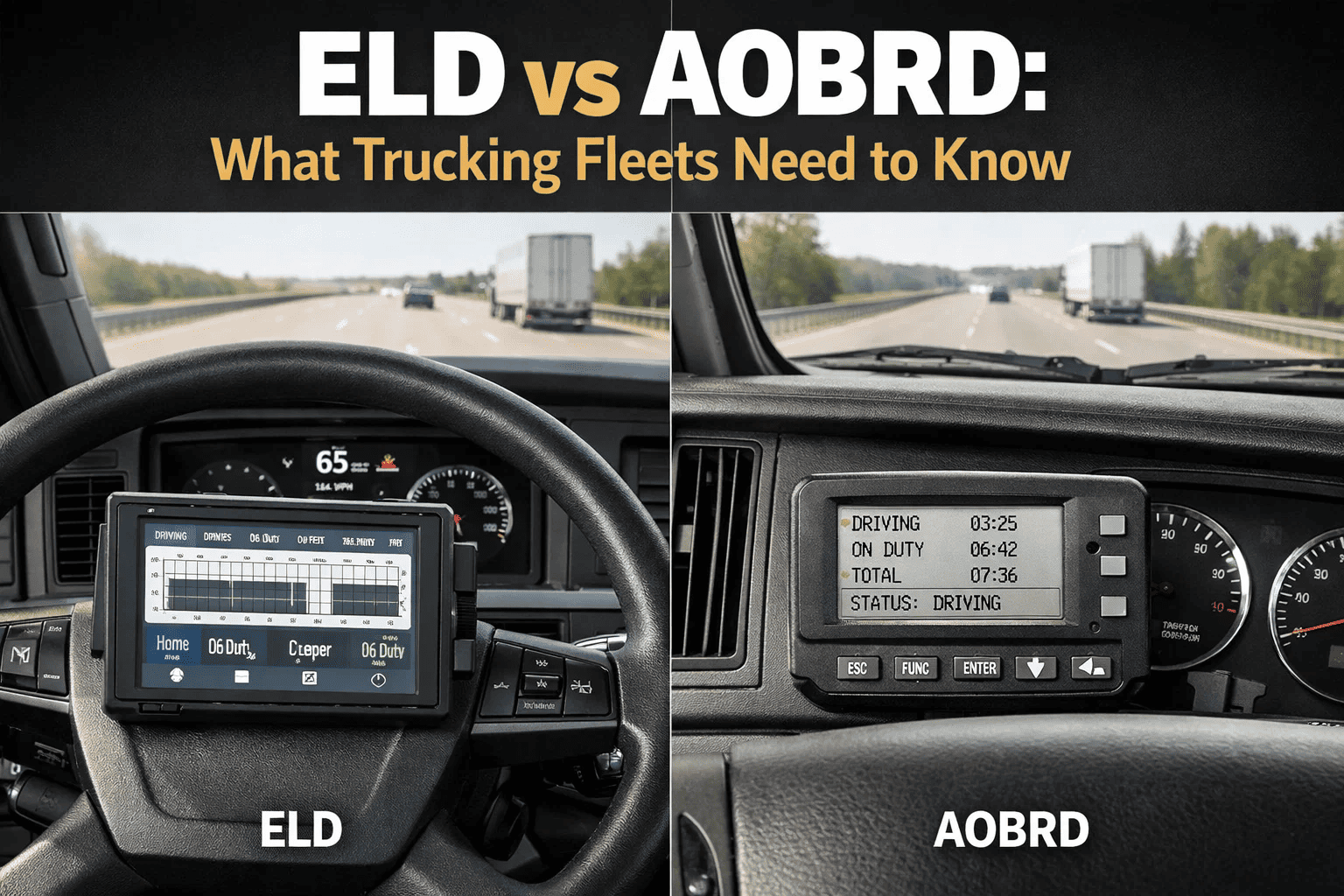
For nearly a decade, the commercial trucking industry operated under two overlapping electronic logging frameworks — Automatic On-Board Recording Devices, known as AOBRDs, and Electronic Logging Devices, defined under the FMCSA's final ELD rule published in December 2015. That coexistence period ended on December 16, 2019, when the AOBRD grandfather provision expired and full ELD compliance became mandatory for all commercial motor vehicle operators subject to the federal Hours of Service recording requirements. Today, every fleet operating in the United States under CDL hours of service rules must use an ELD that meets the technical and functional specifications of 49 CFR Part 395. Understanding the precise differences between what AOBRD systems provided and what ELD systems are required to provide is not merely historical context — it is operationally relevant for fleet managers who are evaluating ELD provider upgrades, conducting FMCSA compliance audits of their driver qualification and HOS records, or training new compliance staff on why the current regulatory framework was structured the way it is. This guide provides a complete technical and operational comparison of ELD and AOBRD systems, the compliance obligations that distinguish them, what the transition from AOBRD to ELD required of carriers, and how FleetRabbit's integrated fleet management and HOS monitoring platform supports the full compliance obligations of the current ELD mandate alongside the broader compliance, maintenance, and driver management functions that fleet managers need from a single operational platform. Book a demo to see how FleetRabbit supports ELD compliance monitoring alongside fleet management for your operation.
Legacy Standard
AOBRD
Automatic On-Board Recording Device
Expired December 16, 2019
Electronic recording of driver duty status
Basic HOS data capture without tamper-evident architecture
No requirement for automatic engine synchronization
Paper grid log transfer at roadside permitted
Carrier-controlled annotation and edit capability
VS
Current Mandate
ELD
Electronic Logging Device — 49 CFR Part 395
Mandatory Since December 16, 2019
Tamper-resistant automatic duty status recording with engine sync
Mandatory ECM synchronization to vehicle speed, engine RPM, odometer, and location
Standardized data transfer format — Bluetooth, USB, Wi-Fi, or telematics
Driver annotation required for any edit or modification with original record preserved
Certified device registration on FMCSA ELD registry mandatory
In This Comparison Guide
AOBRD Technical Specifications and Why They Were Insufficient
ELD Mandate Requirements Under 49 CFR Part 395
The 11 Technical Differences That Distinguished ELD from AOBRD
What the AOBRD-to-ELD Transition Required of Carriers
ELD Exceptions and Exemptions Still in Effect
Roadside Inspection Protocols Under the ELD Mandate
How FleetRabbit Supports ELD Compliance Monitoring
FAQ — ELD Compliance Questions from Fleet Managers
What AOBRD Systems Were and Why They Were Replaced
AOBRDs were the first generation of mandatory electronic logging technology in commercial trucking, required under regulations that predated the 2015 ELD rule by several decades. The original AOBRD requirements, codified at 49 CFR 395.15, required commercial motor vehicle operators subject to the HOS recording requirements to use an automatic on-board recording device that produced a contemporaneous, accurate, and retrievable record of driver duty status — but the technical specifications of the required device were significantly less prescriptive than the ELD rule that replaced them.
AOBRD systems were required to record driver duty status — off duty, sleeper berth, driving, on-duty not driving — along with vehicle location, distance driven, and engine use. However, AOBRDs were not required to synchronize electronically with the vehicle's engine control module, meaning that the tampering vulnerability inherent in manually controlled duty status switching was not structurally eliminated by the AOBRD architecture. A driver could, in theory, manually adjust their duty status record in ways that AOBRD hardware could not technically prevent — making the records less tamper-resistant than the FMCSA determined was adequate for effective HOS enforcement.
Why AOBRD Systems Were Insufficient for Modern HOS Enforcement
01
No Mandatory ECM Integration
AOBRDs were not required to synchronize driving status with actual vehicle movement from the engine control module. A vehicle in motion could theoretically have a non-driving duty status on the AOBRD record without the device automatically correcting the discrepancy — creating a structural enforcement gap that ELD's mandatory ECM synchronization closes.
02
Paper Transfer at Roadside Permitted
When a driver was stopped at a scale or checkpoint, AOBRD regulations permitted the display of a printed or written reproduction of the ELD data — which could then be subject to the same tampering vulnerabilities as paper logs, defeating a significant portion of the enforcement value the electronic system was supposed to provide.
03
Carrier-Controlled Edit Access
AOBRD systems allowed carrier administrators to edit driver records with fewer restrictions than the ELD rule imposes. The original record was not necessarily preserved alongside the edited version, creating audit trail gaps in the HOS record that investigators could not reliably detect or evaluate for accuracy.
04
No Standardized Transfer Protocol
AOBRD systems used proprietary data formats that varied by manufacturer, creating inconsistency in how FMCSA investigators and roadside officers accessed and interpreted electronic HOS records across different carriers and device brands. Standardized data transfer protocols under the ELD mandate resolved this inconsistency.
ELD Mandate Technical Requirements Under 49 CFR Part 395
The ELD mandate published in December 2015 — and fully enforced following the elimination of the AOBRD grandfather provision in December 2019 — establishes specific technical requirements that certified Electronic Logging Devices must meet. These requirements reflect the FMCSA's determination that effective HOS enforcement requires a device architecture that is structurally resistant to tampering, standardized in its data output format, and integrated with the vehicle's propulsion system in a way that ensures driving status is recorded contemporaneously with actual vehicle movement rather than at the driver's manual discretion.
Engine Control Module Synchronization
Mandatory — ELD must synchronize with vehicle ECM to capture engine power status, vehicle motion, VIN, and total engine hours
Not required — manual duty status entry permitted without ECM correlation
Eliminates ability to record non-driving status during actual vehicle movement
Automatic Driving Status Detection
Driving duty status must be automatically set when the vehicle exceeds 5 mph — no manual trigger required or permitted
Driver could manually enter driving status — no automatic vehicle-based trigger required
Prevents under-recording of driving time by ensuring all movement is captured
Data Transfer Format
Standardized ELD — output via Bluetooth 2.0+, USB 2.0+, Wi-Fi, or telematic transfer in FMCSA-specified format
Proprietary format — no standard specified, paper reproduction permitted at roadside
Enables consistent roadside inspection review across all device brands and carriers
Driver Edit and Annotation
Drivers may propose edits with mandatory annotation explaining the change — original record preserved and visible alongside edited version
Edit capability requirements less prescriptive — original record not necessarily preserved
Creates full audit trail of all record changes with driver and carrier accountability
FMCSA Device Registry
Device must be registered on FMCSA's published ELD registry — self-certification required by manufacturer
No registry or formal certification requirement — carrier responsible for confirming regulatory compliance
Provides law enforcement with verifiable confirmed-compliant device list for roadside reference
Malfunction Detection and Reporting
ELD must detect and record malfunctions — driver must note malfunction in record book and notify carrier within 24 hours
Malfunction detection and reporting requirements not specifically defined
Eliminates exploitation of equipment malfunction claims to avoid HOS record scrutiny
Supporting Documents
Supporting documents — bills of lading, receipts, dispatch records — limited to 8 per day maximum with ELD matching requirement
Supporting document requirements not modified to account for electronic recording
Correlates ELD driving record with load documentation for audit consistency
The 11 Technical Differences Between ELD and AOBRD That Changed Fleet Operations
When fleet managers and safety directors prepared for the December 2019 AOBRD-to-ELD transition, the operational changes required were more extensive than simply replacing hardware. The ELD technical specifications introduce structural changes to how driving time is recorded, how records are accessed at roadside, how edits are managed, and how carriers retain and produce records for FMCSA review — all of which required changes to operational procedures, driver training, and back-office compliance management processes.
01
Engine Synchronization
ELD: Continuous ECM data link — speed, RPM, odometer, location, VIN, engine hours all synchronized
AOBRD: No mandatory ECM connection — speed and position could be sourced separately or manually
02
Automatic Motion Detection
ELD: Driving status automatically applied at 5 mph — driver cannot suppress or delay the automatic duty status change
AOBRD: Manual duty status entry permitted — driver initiated duty status changes without automatic vehicle trigger
03
Roadside Data Transfer Method
ELD: Electronic transfer only via Bluetooth, USB, Wi-Fi, or telematics — no paper reproduction at roadside for primary compliance
AOBRD: Paper reproduction of electronic record was acceptable at roadside inspection — effectively similar to paper log presentation
04
Location Recording Frequency
ELD: Position must be recorded at each duty status change, every hour during on-duty driving, and at interval changes — with 1-mile precision
AOBRD: Position recorded with less prescriptive frequency requirements — compliance gap was possible
05
Edit Annotation and Original Record Preservation
ELD: Any edit must include a driver annotation explaining the reason — original unedited record preserved alongside the edited version permanently
AOBRD: Original record not required to be preserved after editing — creating audit trail gaps
06
Carrier Edit Restriction
ELD: Carrier can propose, but driver must accept or reject any edit to their record — driver is the authoritative record owner
AOBRD: Carrier administrator edit capabilities less restricted — driver control of their own record inconsistently protected
07
Malfunction Detection
ELD: Device must detect and internally record specific malfunction codes — driver must switch to paper logs immediately upon confirmed malfunction
AOBRD: Malfunction detection requirements not specifically defined — carrier practices varied widely
08
FMCSA Registry Requirement
ELD: Manufacturer must self-certify and register device on FMCSA public ELD registry — carrier must verify device is on registry before deployment
AOBRD: No registry or external certification verification process — carrier was responsible for determining compliance independently
09
Personal Use and Yard Move Entries
ELD: Specific authorized special driving categories — Personal Conveyance and Yard Move — with prescribed annotation and location recording requirements
AOBRD: No standardized special driving category entries — carrier practices inconsistent
10
Record Retention and FMCSA Access
ELD: 6-month record retention on device or accessible through carrier back-office system — FMCSA can request records in standardized electronic format
AOBRD: Record retention requirements similar but output format not standardized — FMCSA access required provider-specific coordination
11
Driver Instruction Requirements
ELD: Carrier must provide user's manual and brief instruction card to each ELD-equipped driver — instruction card must be kept in cab
AOBRD: Formal driver instruction requirement less prescriptive — training documentation not specifically mandated by regulation
ELD Exceptions and Exemptions Still in Effect After December 2019
Not all commercial motor vehicle operators subject to the Hours of Service regulations are subject to the ELD mandate. The FMCSA's ELD rule includes specific exemptions that have remained in effect since the mandate's enforcement date, and fleet managers managing mixed fleets or specialized operations need to correctly identify which vehicles and drivers are exempt from ELD requirements to avoid both unnecessary compliance cost and, conversely, the more serious error of assuming exemption applies when it does not.
Key ELD Exemptions Under 49 CFR 395.1
ELD Required
Standard CMV Operations
Commercial motor vehicles operating in interstate commerce that are subject to the Federal Motor Carrier Safety Regulations Hours of Service requirements — specifically vehicles above 10,001 lbs GVWR, designed to transport 9 or more passengers for compensation, or 16 or more passengers without compensation, or transporting hazardous materials requiring placarding.
ELD Exempt
Short-Haul Drivers — 100 Air-Mile Radius
Drivers who operate within a 100 air-mile radius of their normal work reporting location and return within 12 consecutive hours are exempt from HOS record-keeping requirements entirely — and therefore from ELD requirements. Carrier must maintain time records confirming the exemption conditions are met for all days where this exemption is claimed.
ELD Exempt
Non-CDL Short-Haul — 150 Air-Mile Radius
Drivers of vehicles not requiring a CDL who operate within a 150 air-mile radius are subject to the extended short-haul exemption from HOS record-keeping. These operators may not use paper logs and are not required to use ELDs during the days they operate within the radius — but must maintain time records at the carrier headquarters.
ELD Exempt
Pre-2000 Engine Vehicles
Commercial motor vehicles manufactured before model year 2000 are exempt from the ELD mandate because the ECM synchronization requirements of ELD certification cannot be met by pre-OBD-II vehicles without significant engine modification. Carriers must document the vehicle's model year to support this exemption claim if questioned at roadside or during compliance review.
ELD Exempt
Driveaway-Towaway Operations
Operators in driveaway-towaway operations — where the vehicle being driven is the commodity being transported — are exempt from ELD requirements and may use paper logs. This exemption applies to the driving duties of transporting new vehicles from plant to dealer, moving vehicle inventory, and similar operations where the driven vehicle is not the operator's standard work equipment.
ELD Required
Multi-State Short-Haul Operations
Drivers who cross state lines and operate beyond the 100 air-mile short-haul exception radius — even occasionally — must use ELDs on those operating days. The short-haul exemption is a day-by-day determination, not a general carrier classification. A driver who operates outside the exemption radius on any given day must comply with full HOS record-keeping for that day.
FleetRabbit HOS Monitoring
Real-time driver Hours of Service status visible to dispatch and compliance management. Near-limit proximity alerts before violations occur. ELD data integration that supports corroborating compliance documentation alongside your certified ELD provider.
Book a Demo
Start Using FleetRabbit Today
Deploy FleetRabbit's HOS monitoring alongside your existing ELD solution to get the compliance visibility and management analytics that most ELD apps do not provide — without replacing your certified ELD device or switching telematics providers.
Start Free Trial
Roadside Inspection Protocols Under the Current ELD Mandate
Roadside inspection officers interact with ELD systems in a specific procedural sequence that drivers and carrier compliance programs need to understand and prepare for — because the procedures are different from both the paper log inspection process that preceded the ELD mandate and the AOBRD inspection process that the ELD mandate replaced. Failure to transfer records correctly at roadside, failure to have the required instruction card in the vehicle, or failure to correctly manage a malfunction situation can all result in citations that populate the HOS BASIC score even when the underlying driving hours are fully compliant.
ELD Roadside Inspection Sequence
A
Officer Requests ELD Display or Transfer
Officer typically requests either a visual display of the current driver's ELD record on the in-cab display, or initiation of a data transfer to the officer's inspection device via Bluetooth or USB. Driver must be trained in both methods — the officer's preference governs which method is used at the specific inspection event.
B
Driver Provides Instruction Card and Presents Record
The ELD instruction card — required to be kept in the cab by all ELD-equipped vehicles — must be provided to the officer if requested. The instruction card provides the officer with basic operational information about the specific ELD model in use, including how to navigate the display and initiate data transfer in case the driver is unable to operate the device.
C
Data Transfer Initiation and Confirmation
If electronic transfer is requested, the driver initiates the transfer from the ELD interface using the standard FMCSA output format. The transfer includes the driver's 8-day HOS history (7 days plus the current day), the vehicle data record including CMV identification and VIN, and the carrier information associated with the current trip. Transfer completion confirmation must be visible at the ELD display.
D
Malfunction Situation Management
If the ELD is malfunctioning at the time of roadside inspection, the driver must provide a paper log for the current day and the previous 7 days reconstructed from memory and available supporting documents. The driver must note the ELD malfunction on the paper log and must notify the carrier of the malfunction. A malfunction ELD that cannot transfer data is not an acceptable excuse for non-production of an HOS record.
E
Supporting Documents Reconciliation
Roadside officers may request supporting documents — bills of lading, dispatch records, toll receipts, fuel receipts — to cross-reference against the ELD location and timing data. Discrepancies between supporting document timestamps and ELD location data are specifically reviewed for potential false log indicators. Drivers should be trained to retain and carry supporting documents that align with their ELD record for the current trip and 8-day window.
How FleetRabbit Supports ELD Compliance Monitoring
FleetRabbit is not an ELD device and is not positioned to replace the certified ELD that must be installed in every qualifying commercial motor vehicle under 49 CFR Part 395. What FleetRabbit provides is the broader fleet management and compliance monitoring infrastructure that surrounds the ELD system — the platform where dispatch managers can see real-time driver HOS availability, where compliance managers can monitor near-limit proximity events before they become violations, where driver qualification file management ensures the driver behind the ELD-equipped truck is operating with a current CDL and medical certificate, and where the audit trail of compliance activity that FMCSA investigators review during Compliance Reviews is maintained in auditable digital form.
Frequently Asked Questions: ELD vs AOBRD for Fleet Managers
Are there any circumstances where a carrier can still use an AOBRD-compliant device today, after December 2019?
No. The AOBRD grandfather provision expired on December 16, 2019, and there are no remaining circumstances under which a carrier subject to the ELD mandate can use an AOBRD-compliant (but not ELD-certified) device as an HOS record-keeping tool. Carriers operating devices that were compliant under the AOBRD standard but not certified on the FMCSA ELD registry were required to have upgraded to compliant ELD systems by that date. Using a non-ELD device as if it were compliant with the current rule would result in the same citation as operating with no electronic logging device — treated as a paper log violation for HOS record-keeping purposes at roadside.
How does a carrier verify that the ELD device they are using is certified on the FMCSA registry and not just marketed as ELD-compliant?
FMCSA maintains a public ELD registry at eld.fmcsa.dot.gov where carriers can search for their specific device by manufacturer name and device model. The registry shows the device identifier, the manufacturer, the certification date, and whether the device is currently registered or has been revoked. Carriers should verify that the specific model and firmware version of their installed devices appear on the registry — not just that the manufacturer has some registered device models, since certification is model-specific. Fleet managers conducting an ELD registry audit should record the device ID from each installed unit and verify it against the FMCSA registry record rather than relying on the vendor's marketing materials.
What happens if a driver's ELD malfunctions on a long-haul trip and they are more than one day from the home terminal — how should the carrier manage this situation?
When an ELD malfunctions, the driver is required to immediately note the malfunction on the ELD record if the device is still partially functional, switch to paper logs to reconstruct the current day and the previous 7-day record from available supporting documents, and notify the motor carrier of the malfunction within 24 hours. The carrier must provide replacement paper log supplies if the driver does not have them. The driver may continue operating for up to 8 days on paper logs while the ELD is repaired or replaced — after 8 days, the vehicle must be taken out of service until the ELD is functional. FleetRabbit can support this situation by providing GPS track data and dispatch record history the driver can reference when reconstructing the paper log from available evidence — improving the accuracy and defensibility of the reconstructed record.
How does the Personal Conveyance provision work under the ELD mandate and how is it different from what was available under AOBRD systems?
The Personal Conveyance (PC) special driving category allows drivers to use the CMV for personal use — driving to a restaurant, a motel, or other personal destination — without the movement counting as on-duty drive time under the HOS rules. Under ELD requirements, when a driver selects PC mode, the ELD records the movement in a distinct status category with GPS tracking continuing throughout the PC period. FMCSA has published guidance stating that PC use is appropriate when the driver is off-duty and using the CMV for personal, non-business transportation. The key difference from AOBRD-era practice is that ELD PC movement is fully traceable — the GPS track during PC mode is recorded and available for inspection, making inappropriate PC use (driving a long distance at the end of an HOS cycle to reset closer to the next delivery point) much more visible in the ELD data than in AOBRD records where PC movement was less consistently tracked.
Does using FleetRabbit reduce the need for a dedicated ELD device, or does the fleet still need a separate FMCSA-certified ELD installed in each vehicle?
FleetRabbit is a fleet management and compliance monitoring platform, not a certified ELD system. Every vehicle subject to the ELD mandate still requires a separate FMCSA-certified ELD device installed and operational in the vehicle — FleetRabbit does not fulfill that requirement and does not position itself as a replacement for the certified ELD. What FleetRabbit provides is the compliance management infrastructure around the ELD — the dispatch-facing HOS visibility, the near-limit alert system, the DQF management, the GPS corroboration record, and the safety analytics — that makes the certified ELD data operationally useful for the fleet management and compliance functions that extend beyond the ELD device's own back-office reporting. Many carriers use FleetRabbit alongside their existing ELD provider's telematics system, taking advantage of FleetRabbit's broader fleet management capabilities without replacing their certified ELD hardware.
ELD Is the Standard
Every ELD-Equipped Fleet Still Needs a Compliance Program Around the Device
The certified ELD records your drivers' hours. FleetRabbit gives your dispatch team, safety manager, and compliance director the monitoring, alerting, and reporting infrastructure that converts those records into the proactive compliance program that keeps your fleet below FMCSA intervention thresholds and your drivers operating within the HOS boundaries they are required to maintain.
April 18, 2026
By Jason Smith
All Posts