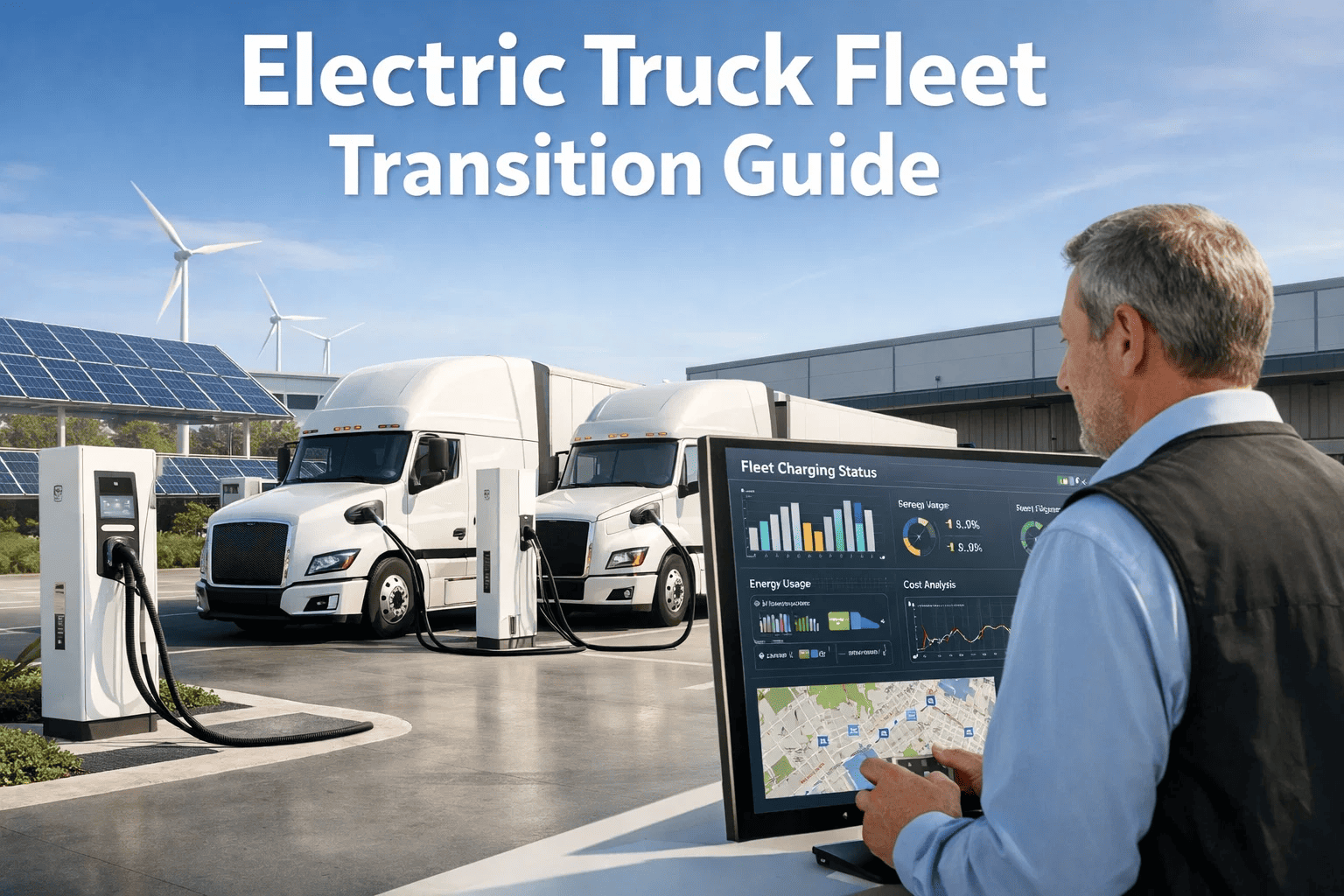
The transition of commercial logistics fleets from diesel to electric trucks is no longer a theoretical future planning exercise — it is an active capital deployment decision that logistics companies across North America and Europe are making with real operational and financial consequences. Battery-electric commercial trucks have achieved sufficient range, payload, and reliability for meaningful deployment in regional and urban distribution applications, and the regulatory, economic, and operational landscape is shifting in ways that make fleet electrification a commercially rational decision for a growing proportion of logistics operations — not solely a sustainability mandate. For logistics fleet executives and operations leaders evaluating electrification, the complexity of the transition is not the technology itself — it is the operational, financial, and organizational transformation required to deploy electric trucks effectively within existing logistics workflows. Book a demo to see how FleetRabbit's fleet management platform supports EV fleet integration, maintenance management, and compliance documentation for logistics operators transitioning to electric.
$0.08-0.14
per mile energy cost advantage of Class 6-7 electric versus diesel at current rates
280-350mi
typical Class 8 battery-electric truck range under full load in mild temperatures
40-60%
lower scheduled maintenance cost for battery-electric versus diesel powertrains
$40,000+
average federal and state incentive value per electric truck for qualifying logistics operators
Electric Truck Fleet Transition Guide for Logistics Companies
A decision framework covering operational suitability assessment, total cost of ownership modeling, charging infrastructure planning, maintenance program transformation, and fleet management requirements for logistics operators preparing for or executing EV fleet transitions
This guide covers Class 4-8 battery-electric commercial trucks for regional and urban logistics applications. Long-haul applications require separate analysis given current technology limitations for routes exceeding 350 miles loaded range.
Guide Summary
A successful logistics fleet electrification transition requires systematic assessment of which routes and vehicle applications are electrically suitable, financial modeling that accounts for the full total cost of ownership including acquisition premiums, energy savings, maintenance reduction, and incentive offsets, infrastructure investment planning for charging at terminal and driver domicile locations, operational procedure adaptation for vehicle range management and charging scheduling, maintenance program transformation from ICE to EV service disciplines, and fleet management platform integration that tracks EV-specific asset data alongside the existing fleet. This guide addresses each dimension in sequence, providing a structured decision framework for logistics fleet executives.
Step One: Operational Suitability Assessment — Which Routes Are Ready for Electric?
Not all routes in a logistics fleet are equally suitable for electrification today. The single most critical operational parameter for EV suitability — daily route mileage — determines whether a given truck-route assignment can be reliably executed on a battery-electric vehicle without range management risk. Class 8 battery-electric trucks available in 2025 and 2026 typically offer 280 to 350 miles of range under full payload in mild temperature conditions, with range reduction of 20 to 35 percent in sub-freezing temperatures. For logistics operators whose depot-to-depot or delivery cycle routes fall within the 180 to 240 mile daily range — accounting for the cold weather reduction buffer and the operational practice of not routinely depleting the battery below 20 percent — Class 8 electric trucks are operationally suitable today without en-route charging infrastructure. Routes significantly beyond this range require either en-route charging (adding operational time) or a mixed fleet strategy.
Fleet managers conducting suitability assessments should extract route mileage data from their fleet management platform's historical records — using actual recorded mileage per vehicle per day rather than scheduled route estimates, which consistently underestimate actual driving distance due to traffic deviation, customer location variation, and yard movement. FleetRabbit's analytics module provides actual vehicle daily mileage from GPS telematics data, enabling accurate identification of which specific vehicles in the fleet regularly operate within EV-suitable mileage ranges. This actuals-based analysis typically reveals that a larger proportion of the fleet is EV-suitable than route schedule planning suggests — and identifies which specific vehicles to prioritize for the initial EV transition wave.
High Suitability
Daily route mileage: Under 180 miles
Operation type: Urban delivery, last-mile, distribution hub shuttle
Depot access: Overnight charging available at company terminal
Climate zone: Mild to moderate (above 20F typical low)
Payload: Consistent with manufacturer rated capacity
Proceed with EV procurement — high confidence operational suitability with current technology
Moderate Suitability — Plan Required
Daily route mileage: 180 to 280 miles
Operation type: Regional distribution, multi-stop delivery
Depot access: Overnight charging available, occasional opportunity charging
Climate zone: Variable — cold weather range reduction requires route flexibility
Payload: Variable loads — range calculation must use maximum payload scenario
Proceed with route analysis and range buffer planning — en-route charging infrastructure assessment required
Limited Suitability — Technology Gap
Daily route mileage: 280 to 400 miles
Operation type: Short regional, dedicated runs with fixed endpoints
Depot access: En-route charging infrastructure required at fixed intermediate point
Climate zone: Cold weather operations significantly reduce feasibility window
Payload: Heavy payload — range reduction under full load must be stress-tested
Pilot feasibility — 90 to 180 day operational trial recommended before full procurement commitment
Not Suitable — Current Technology
Daily route mileage: Consistently above 400 miles
Operation type: Long-haul, OTR, multi-day routes
Depot access: No terminal charging — sleeper cab operation
Climate zone: Extreme cold regions with consistent sub-zero low temperatures
Payload: Maximum GVW consistently — maximum range reduction scenario
Defer — 2027-2030 technology generation expected to address long-haul EV suitability at commercially viable cost
Step Two: Total Cost of Ownership Modeling — The Financial Case for Electric
The financial analysis for electric truck fleet transition is more complex than comparing sticker prices — the acquisition premium of battery-electric trucks relative to diesel equivalents (currently $80,000 to $150,000 premium for Class 8 vehicles) must be evaluated against the multi-year cumulative savings in fuel cost, maintenance cost, and available incentive programs. For many logistics operations in regional and urban applications, the 5-year and 7-year total cost of ownership of battery-electric trucks is favorable or neutral relative to diesel even after accounting for the acquisition premium — and the operators who reach that favorable TCO fastest are those who maximize incentive capture at acquisition and whose operations generate the highest mileage profiles where per-mile savings compound most rapidly.
The federal Alternative Clean Trucks tax credit under the Inflation Reduction Act (Section 45W) provides a credit of 30 percent of the vehicle cost (up to $40,000 for vehicles above 14,000 lbs GVWR, up to $7,500 for lighter commercial vehicles) for vehicles placed in service by qualified commercial entities. State-level incentive programs in California, New York, New Jersey, Washington, and numerous other states add supplementary rebates and voucher programs that can significantly reduce net acquisition cost. Logistics operators with California operations should specifically evaluate the California Air Resources Board's Hybrid and Zero-Emission Truck and Bus Voucher Incentive Project (HVIP), which provides substantial per-vehicle incentives for zero-emission trucks deployed in California. The incentive landscape changes annually — logistics operators planning multi-year transition programs should engage with a fleet electrification consultant to map the current incentive stack available for their specific vehicle types and deployment states.
Acquisition Cost
$135,000 — $160,000
5-Year Fuel Cost (@ $3.85/gal, 7 MPG)
$412,500
5-Year Scheduled Maintenance
$95,000 — $130,000
Engine Component Overhauls
$15,000 — $45,000
Incentives and Tax Credits
None
5-Year Total Cost (Low-High Estimate)
$657,500 — $787,500
Acquisition Cost
$250,000 — $320,000
5-Year Energy Cost (@ $0.12/kWh, 2 kWh/mile)
$180,000
5-Year Scheduled Maintenance
$38,000 — $60,000
Battery Cooling System Service
$8,000 — $18,000
Incentives and Tax Credits
($40,000) — ($90,000)
5-Year Total Cost (Low-High Estimate)
$436,000 — $608,000
This is an illustrative analysis using representative values — actual costs vary significantly by operating region, energy rate, route profile, incentive eligibility, and specific vehicle configuration. Logistics operators should model their specific operation using actual mileage, local energy rates, and confirmed incentive eligibility before making capital commitments.
Step Three: Charging Infrastructure Planning for Logistics Operations
Charging infrastructure is the capital investment category most likely to be underestimated in electric fleet transition planning. Vehicle acquisition cost is visible and benchmarkable at procurement — charging infrastructure cost is site-specific, requires engineering assessment, involves electrical utility capacity upgrades that vary dramatically by terminal location, and includes both the hardware capital cost and the operational integration required to optimize charging schedules relative to fleet dispatch requirements.
The fundamental charging architecture decision for a logistics terminal is Level 2 versus DC Fast Charging (DCFC). Level 2 charging delivers 15 to 25 miles of range per hour of charging — sufficient for overnight charging of vehicles that return to the terminal with sufficient partial charge to complete the overnight Level 2 session before the next departure. DCFC delivers 150 to 350 miles of range in 45 to 90 minutes — enabling meaningful mid-shift opportunity charging for vehicles that cannot complete their daily route on a single overnight charge. The economics strongly favor Level 2 for depot charging in overnight-return fleet operations: Level 2 equipment costs $3,000 to $8,000 per port versus $75,000 to $200,000 per DCFC port, and electricity demand charges for DCFC require sophisticated charge management software to avoid peak demand penalties that eliminate fuel cost savings.
Single-Shift Urban Delivery
Returns to depot nightly, departs morning after 8-10 hour rest
Recommended Architecture
Level 2 (AC) charging at 48-80 amp EVSE per vehicle position. Overnight charge window provides 120-200 miles of range recovery. Managed charging software staggers charge start times to minimize peak demand impact.
Infrastructure Cost: $8,000-$18,000 per stall including installation
Regional Distribution Hub
Mixed return times, some multi-shift operations, depot hub with fleet staging
Recommended Architecture
Level 2 for primary overnight fleet, 2-4 DCFC units for mid-shift vehicles needing rapid recharge before afternoon departure. Energy management system required for demand charge control. Utility upgrade assessment mandatory before hardware procurement.
Infrastructure Cost: $25,000-$85,000 per stall for DCFC, $10,000-$20,000 for Level 2 positions
24-Hour Distribution Center
Continuous operation, short vehicle turnaround, no extended overnight dwell time
Recommended Architecture
High-power DCFC network with vehicle-to-charger assignment scheduling integrated with dispatch systems. Requires sophisticated charge management platform and utility demand response program enrollment. On-site battery storage may be warranted to reduce peak demand charges.
Infrastructure Cost: Requires site-specific engineering assessment — $500K-$2M typical for medium-sized distribution center
Step Four: Maintenance Program Transformation — Servicing Electric Trucks
The maintenance requirements of battery-electric trucks differ substantially from diesel vehicles in ways that affect technician skill requirements, shop equipment needs, parts inventory composition, and PM service intervals. EV powertrain maintenance eliminates many of the highest-frequency service categories in diesel maintenance programs — engine oil and filter changes, coolant flushes, DPF regeneration services, DEF fluid management, and transmission services disappear from the EV PM schedule entirely. This maintenance simplification is a significant contributor to the lower scheduled maintenance cost of EVs versus diesel trucks over the vehicle lifecycle.
However, EV maintenance introduces new service categories requiring specialized technician training and equipment: high-voltage battery system inspection and therapy, battery thermal management system maintenance, regenerative braking system calibration and service, high-voltage component insulation resistance testing, and charging system hardware maintenance for onboard and off-board charging components. These services require EVS (Electric Vehicle Service) technician certification and high-voltage safety training that the current diesel technician workforce has not universally completed. Logistics operators transitioning to EV fleets must account for technician training investment and the transitional period during which shop HV certification coverage may require supplementary dealer service relationships while in-house capability is developed.
Engine oil and filter changes — eliminated (no combustion engine oil)
Diesel Particulate Filter regeneration and cleaning — eliminated (no exhaust system)
DEF system maintenance, tank refill, and SCR catalyst service — eliminated
Transmission fluid changes and transmission service — reduced (single-speed or no transmission)
Turbocharger inspection and service — eliminated
Belt and tensioner service — significantly reduced (fewer accessory drives)
Fuel system maintenance, water separator service — eliminated
Brake service — interval extended due to regenerative braking reducing friction brake use by 50-75%
Tire maintenance — unchanged requirements; EV weight premium may affect wear rates on some positions
Suspension and steering service — unchanged requirements for commercial applications
Lighting and electrical safety systems — unchanged regulatory requirements
HVAC system maintenance — heating load is now fully electric, potentially increasing HVAC service requirements
Battery thermal management system fluid service and inspection — critical for battery health and range preservation
High-voltage insulation resistance testing — periodic safety verification of HV system integrity
Battery management system (BMS) software updates and calibration — requires manufacturer diagnostic tools
Regenerative braking system calibration and functional verification
Onboard charger inspection and connection system maintenance
High-voltage safety inspection — HV cable routing, contactor function, isolation monitoring system
Regulatory Compliance for Electric Truck Fleets
Battery-electric commercial trucks are subject to most of the same FMCSA regulatory requirements as diesel trucks — federal vehicle safety standards, DVIR inspection requirements, driver qualification and hours-of-service rules, and periodic inspection mandates all apply to EVs in commercial use. The major regulatory distinctions involve California Air Resources Board compliance for operators in California (where electric truck deployment relates to Advanced Clean Trucks regulations and the Clean Truck Check compliance program), federal and state reporting requirements for alternative fuel credits, and high-voltage safety regulations that govern technician certification and shop safety programs for vehicles above 60 volts DC (all commercial EVs qualify).
FleetRabbit's inspection and maintenance documentation capabilities apply equally to EV fleet management — DVIR records, PM service documentation, and compliance records for electric trucks are generated through the same digital workflows as diesel vehicles, maintaining the regulatory compliance documentation continuity that FMCSA compliance reviews require regardless of vehicle type. Logistics operators transitioning to EV fleets can manage the mixed fleet — existing diesel vehicles alongside new electric additions — within a single FleetRabbit deployment without parallel record systems for EV versus diesel vehicles. Book a demo to review mixed fleet EV and diesel management in FleetRabbit for your logistics operation.
FMCSA — All Commercial EVs
Federal Motor Vehicle Safety Standards apply to Class 3-8 EVs — same structural, braking, and lighting standards as diesel
DVIR pre-trip and post-trip inspection required — FleetRabbit digital DVIR applies to EV fleet without modification
Annual periodic inspection requirement (CVSA Level I equivalent) — includes battery and HV system visible inspection points
California — ACT and Clean Truck Check
Advanced Clean Trucks regulations phase in ZEV deployment requirements for fleet operators above 100 trucks operating in California
Clean Truck Check program requires OBD data verification for applicable vehicles — EV OBD reporting requirements evolving
CARB SmogCheck EV exemptions simplify periodic inspection compliance for electric trucks
OSHA HV Safety — All EV Operators
OSHA 29 CFR 1910.137 — electrical protective equipment requirements apply to any technician working near HV systems
HV safety training documentation required for all maintenance personnel who service or inspect EV components
Shop safety plan — lockout/tagout procedures for HV systems, first responder EV emergency protocols
Fleet Management Technology for EV Transition: What Changes and What Stays the Same
One of the frequently underestimated operational requirements of an EV fleet transition is the adaptation of fleet management technology to capture EV-specific asset data that has no diesel analog. Battery state of charge (SOC), battery state of health (SOH), charging session records including energy delivered and session duration, range management data for dispatch planning, and battery thermal system performance data are all asset information categories that fleet management platforms must capture and present for effective EV fleet operations. Fleet managers who transition to EV trucks without technology infrastructure that includes these data points lose the operational visibility required to manage EV fleet performance, battery health trends, and charging cost optimization.
FleetRabbit integrates with telematics providers that carry EV-specific data from battery-electric trucks — including SOC, estimated range, and charging status — and presents this data in the vehicle asset record alongside traditional maintenance and compliance information. EV PM schedules in FleetRabbit are configured to reflect the EV-specific service intervals that replace the diesel PM structure — battery thermal management service at manufacturer-specified intervals, HV system inspection scheduling, and charging system maintenance triggers — while retaining the unchanged service categories (brakes, suspension, tires, lights) in the same work order generation workflow. This unified approach allows logistics operators to manage a mixed EV and diesel fleet through a single platform without parallel technology deployments or disconnected maintenance record systems.
Transition Roadmap: A Phased Approach to Fleet Electrification
Route suitability analysis using FleetRabbit historical mileage data — identify EV-suitable vehicle positions
Total cost of ownership modeling for identified routes — 5 and 7 year scenarios with realistic energy rates and incentive stacks
Site assessment for charging infrastructure at primary terminal locations — utility capacity, electrical panel evaluation, permitting requirements
Incentive research and application preparation — federal Section 45W, state voucher programs, utility EV programs
Maintenance capability assessment — technician training requirements, dealer service alignment for in-house capability gap period
Procure 5-20 EV units for highest-suitability routes — establish operational proof of concept before major capital commitment
Install Level 2 charging infrastructure at pilot terminal — validate actual charging performance and electrical system adequacy
Driver orientation and EV operation training — range management, charging protocol, pre-trip EV inspection procedures
Configure FleetRabbit EV asset records — EV-specific PM schedules, telematics integration for SOC/SOH data, charging session tracking
Technician HV safety training completion — certify all maintenance staff who will service EV units before first EV delivery
Actual versus projected TCO comparison — validate energy cost, maintenance savings, and range performance against planning assumptions
Charging infrastructure performance review — identify capacity gaps, demand charge optimization opportunities, charging schedule refinement
Driver feedback integration — identify operational friction points, range management challenges, and training gaps from actual operation
Maintenance program review — actual service intervals and emerging EV-specific issues versus OEM projections
Expand EV procurement to all identified suitable routes — align replacement cycle with existing diesel vehicle lifecycle completion where possible
Expand charging infrastructure across all terminal locations with validated architecture from pilot learnings
Develop in-house EV maintenance capability — advanced technician training, dealer service relationships for specialty work
Integrate EV fleet data into executive reporting — energy cost per mile, charging utilization, battery health fleet trends in FleetRabbit analytics
Continuous suitability reassessment — evaluate additional route categories as EV range technology improves each vehicle generation
Frequently Asked Questions
QHow significantly do cold temperatures affect the operational range of commercial electric trucks and how should logistics fleet managers account for this in planning?
Cold temperature range reduction is one of the most operationally significant variables in commercial EV fleet management and one of the most important to account for in route suitability planning. Class 8 battery-electric trucks typically experience 20 to 35 percent range reduction at temperatures in the 10 to 25 degrees Fahrenheit range compared to mild temperature performance. At temperatures below 0 degrees Fahrenheit, range reduction can reach 40 to 50 percent depending on the specific battery chemistry and whether the vehicle is equipped with battery pre-conditioning systems. Fleet managers planning EV deployment in northern climate regions should conduct route suitability analysis using the vehicle's cold weather range specification (not the mild weather range) as the constraint. For operations with significant seasonal variation, the standard approach is to use the winter range specification as the binding constraint, accepting that summer operations will have range margin, rather than optimizing for average conditions and accepting range risk in winter months.
QWhat is the current state of battery warranty coverage for commercial electric trucks and how should fleet managers evaluate warranty terms in procurement?
Leading commercial EV manufacturers currently offer battery warranties in the 5-year or 500,000 mile range for Class 8 vehicles, with specific coverage terms that vary significantly regarding what constitutes a covered warranty event. Battery capacity degradation below 70-80 percent of original capacity (the "state of health" threshold) is typically covered under warranty within the warranty period. Physical damage, capacity degradation from improper charging practices (consistent deep discharge below the manufacturer's recommended minimum state of charge, overcharging above maximum thresholds), and damage from thermal events outside normal operating parameters may be excluded. Fleet managers reviewing commercial EV battery warranty terms should specifically evaluate: the SOH threshold at which the battery is covered for replacement or remediation, whether the warranty is transferable if the vehicle is remarketed during the warranty period, and what documentation the manufacturer requires to validate warranty claims. FleetRabbit's maintenance records and telematics data can provide the vehicle usage history documentation that EV battery warranty claims typically require.
Book a demo to review how FleetRabbit tracks EV battery health data and maintenance records that support warranty documentation requirements.
QHow should logistics operators handle the driver training requirements for electric truck operation?
EV driver training requires a structured program covering both the operational differences of electric trucks (range management, regenerative braking behavior, charging procedures, cold weather range awareness) and the safety-specific aspects of operating a high-voltage vehicle (what drivers should and should not do when they observe electrical system warning indicators, emergency procedure if the vehicle is involved in an accident involving damage to the battery area, and the importance of not opening HV system access panels or attempting to diagnose HV system issues themselves). Most commercial EV manufacturers provide new vehicle orientation training as part of the delivery process — this should be considered the starting point, not the complete training program. Logistics operators should supplement manufacturer orientation with route-specific range management training, fleet charging protocol training, and DVIR training that covers EV-specific inspection points including charging port condition, visible HV cable integrity, and battery thermal management system indicator review.
QHow does FleetRabbit specifically support the management of a mixed EV and diesel fleet during the transition period?
FleetRabbit's asset management architecture treats battery-electric and diesel vehicles as distinct asset types within the same fleet registry — each with configurable PM schedules, maintenance documentation requirements, and telematics data integration appropriate to their powertrain type. A logistics operator managing 200 diesel trucks and 30 electric trucks in transition manages all 230 vehicles through the same FleetRabbit dashboards, with EV-specific data points (SOC, range estimate, charging status, battery SOH) displayed in the EV asset record alongside the vehicle profile, registration, and inspection history that apply to both vehicle types. Maintenance work orders for EV-specific service categories (battery thermal management, HV inspection) are generated by EV-configured PM templates at OEM-specified intervals, integrated with the same work order management system, technician assignments, and parts inventory tracking that manages diesel PM work orders. This unified approach eliminates the need for parallel systems during the transition — a significant operational simplification for fleet managers managing both powertrain types simultaneously during a multi-year transition program.
Start Your EV Fleet Transition with the Right Management Infrastructure in Place
FleetRabbit supports mixed EV and diesel fleet management — unified asset registry, EV-specific PM scheduling, telematics integration for battery and range data, and compliance documentation — so your transition adds capability without adding system complexity.
EV Asset Management
Mixed Fleet Operations
EV PM Scheduling
Battery Health Tracking
Compliance Documentation
Transition Analytics
April 21, 2026
By Jason Smith
All Posts