.png)
FMCSA compliance represents one of the most complex regulatory environments in commercial transportation. The Federal Motor Carrier Safety Administration enforces regulations across dozens of operational areas, and the consequences of non-compliance range from minor citations to operating authority revocation. For fleet managers, understanding FMCSA requirements is not optional, it is fundamental to legal operation. This comprehensive FMCSA compliance guide covers the regulations that matter most to transportation fleets: ELD mandate requirements, Hours of Service rules, driver qualification files, DVIR documentation, vehicle safety standards, and audit preparation. Whether you operate a small regional fleet or manage 100+ trucks, this guide provides the knowledge and frameworks needed to maintain compliant operations and confidently navigate FMCSA oversight.
2026 FMCSA Compliance Landscape
FMCSA issued over 38,000 enforcement actions in 2024, with median civil penalties exceeding $2,800 per violation. New entrant carriers face mandatory safety audits within 12 months of receiving operating authority. Existing carriers with elevated CSA BASIC scores trigger compliance interventions that can result in conditional operating authority or remedial audits. Technology requirements continue evolving, with ELD mandates now mature and agencies developing additional telematics and safety monitoring standards. Fleets maintaining systematic compliance programs with documented processes and automated tracking experience significantly fewer violations than fleets relying on manual oversight.
Stay FMCSA Compliant With Real-Time Visibility
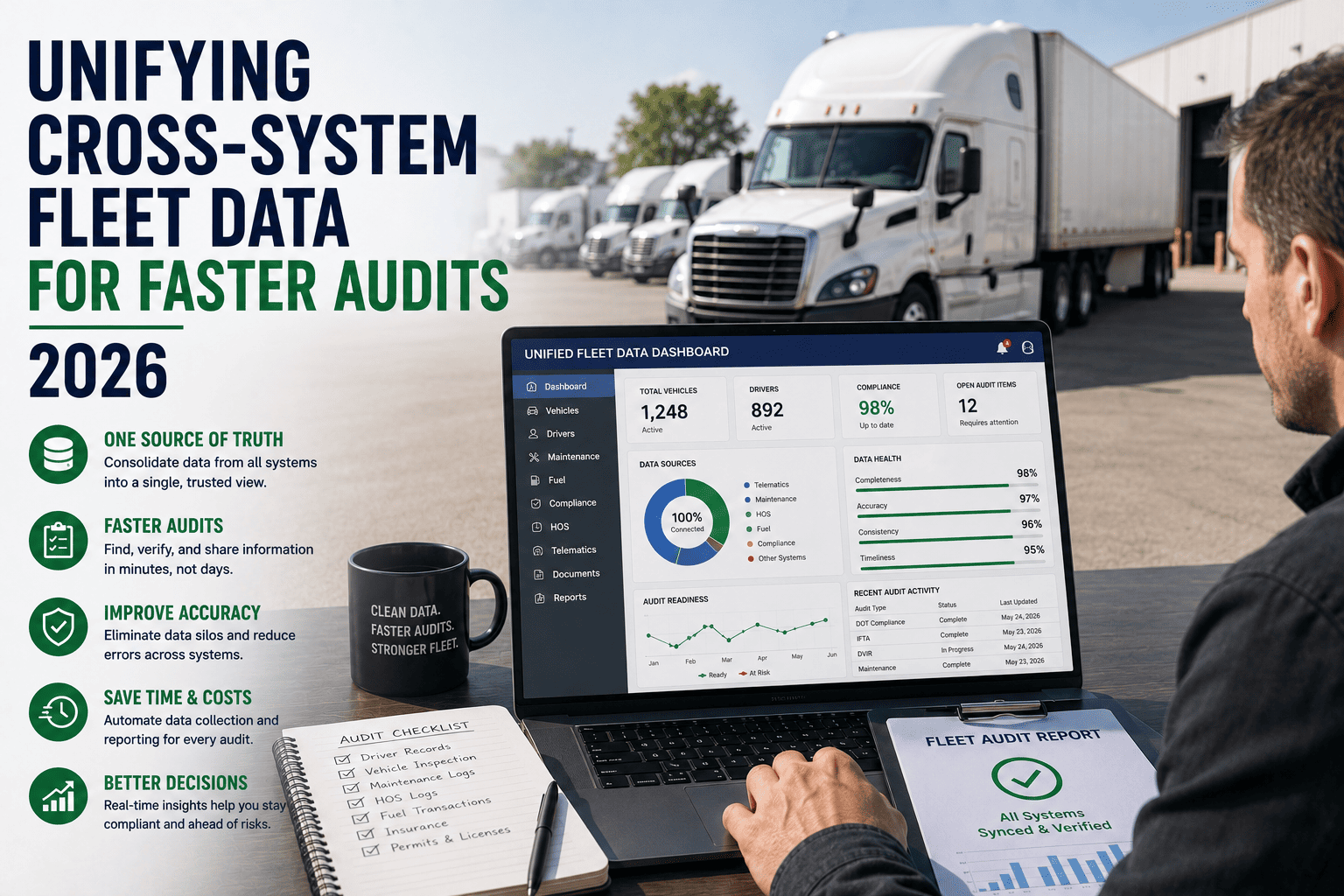
FleetRabbit automates compliance tracking across DVIR, HOS, driver qualifications, and vehicle inspections. Stay audit-ready every day with automated alerts and instant compliance reports.
Understanding FMCSA Authority and Scope
The Federal Motor Carrier Safety Administration operates under authority granted by Congress to regulate commercial motor vehicle operations in interstate commerce. FMCSA jurisdiction covers motor carriers operating vehicles requiring a commercial driver's license, with some exceptions for agricultural operations, certain government agencies, and manufacturers transporting their own products. FMCSA regulatory authority extends to vehicle operations, driver qualifications, hours of service, hazardous materials transportation, and safety practices. The agency conducts roadside inspections, safety audits, compliance reviews, and investigates complaints from drivers, safety advocates, and competing carriers. Understanding FMCSA authority helps fleet managers recognize which operations fall under federal oversight and which may fall under state or local jurisdiction instead.
FMCSA Enforcement Mechanisms
FMCSA enforces regulations through multiple mechanisms. Roadside inspections conducted during traffic stops can result in immediate out-of-service orders for serious safety defects. Compliance Safety Accountability interventions target carriers with elevated CSA BASIC scores. Safety audits examine systematic compliance programs and require carriers to demonstrate they maintain safe operations practices. Complaint investigations follow reports from drivers, safety advocates, or competing carriers alleging violations. Civil penalties range from hundreds to tens of thousands of dollars depending on violation severity and remediation. Operating authority suspension or revocation represents the most severe sanction, typically reserved for serious safety violations or repeated non-compliance. Understanding these enforcement mechanisms helps fleet managers appreciate the importance of maintaining proactive compliance programs.
Electronic Logging Device Mandate: Requirements and Compliance
The Electronic Logging Device mandate, which took effect in December 2017, requires most commercial motor vehicle drivers to use FMCSA-certified ELDs instead of paper logs. The mandate applies to all drivers operating vehicles requiring a commercial driver's license and subject to Hours of Service regulations, with limited exemptions. ELDs automatically record driving time, on-duty time, off-duty time, and sleeper berth time based on vehicle engine data. This automation eliminates falsified logs while improving accuracy of Hours of Service compliance tracking.
ELD Mandate Exemptions and Exceptions
Limited exemptions exist to the ELD mandate. Drivers operating vehicles manufactured before model year 2000 are exempt because these vehicles lack the engine data interface required for ELD integration. Short-haul drivers who qualify for the FMCSA timecard exception can maintain records of duty status on paper timecards for up to 8 days per month. Drivers using paper logs for no more than 8 days in a 30-day period are exempt. Drive-away and tow-away operations have limited ELD requirements. Agricultural operations transporting agricultural products have exemptions. Government agencies operating vehicles are exempt. Understanding which operations qualify for exemptions helps carriers determine whether ELD implementation is mandatory for specific vehicle categories or drivers.
ELD Certification and Vendor Approval
ELDs must be certified by FMCSA and installed by approved vendors. FMCSA maintains a list of approved ELD vendors that fleets can select from. Each ELD vendor's solution must comply with FMCSA technical specifications regarding data recording accuracy, data transmission, and user interfaces. Certified ELDs must record 16 data fields including vehicle identification, driver identification, codriver identification, record date, location, odometer reading, and duty status changes. Fleets selecting ELD solutions should verify vendors maintain current FMCSA certification and provide support for regulatory changes. ELD vendor stability matters because fleets depend on vendors for ongoing software updates and technical support.
ELD Record Retention and Roadside Inspection
Carriers must retain ELD records for a minimum of six months. Drivers must have ELD records available for review during roadside inspections. Most ELD systems allow drivers to retrieve records directly from the ELD interface on their mobile devices or tablets. During roadside inspections, FMCSA inspectors can request ELD records going back multiple weeks to verify Hours of Service compliance. Drivers unable to produce records face citation. Some carriers maintain backup paper records for situations where ELD systems malfunction, ensuring drivers can always produce records even if the electronic system fails.
Hours of Service Regulations: The Core Rules
Hours of Service regulations under 49 CFR Part 395 establish maximum driving time limits and mandatory rest requirements. These rules exist because fatigue significantly impairs driver judgment and increases accident risk. Understanding HOS rules is critical because violations are among the most frequently cited FMCSA violations during roadside inspections and compliance audits.
The 11-Hour Driving Limit
Drivers may drive a maximum of 11 hours after having 10 consecutive hours off duty. Once a driver reaches 11 hours of driving, they must stop driving and take rest time. This limit cannot be extended regardless of operational pressure or circumstances. Drivers cannot volunteer for extra driving hours. Once 11 hours of driving are accumulated, the driver must stop. Off-duty time includes any time the driver is not on duty and not driving. Sleeper berth time counts as off-duty time toward the 10-hour requirement. The 11-hour limit resets after the driver completes 10 consecutive hours off duty.
The 14-Hour On-Duty Window
Drivers may not drive beyond the 14th consecutive hour after coming on duty, regardless of actual driving hours or off-duty time taken during that period. The 14-hour window is absolute and cannot be extended. For example, if a driver comes on duty at 6 AM, they cannot drive after 8 PM that same day, even if they have accumulated only 8 hours of driving time. Off-duty time and sleeper berth time taken during the 14-hour window do not extend the window. Once the 14th hour arrives, driving must stop. This rule exists to limit the cumulative effects of fatigue from the entire duty period, not just actual driving time.
The 30-Minute Break Requirement
Drivers must take a 30-minute break after accumulating 8 hours of cumulative driving time. The break must involve no driving. Drivers can satisfy the break requirement through off-duty time, sleeper berth time, or certain on-duty non-driving activities. Once a driver takes a qualifying break, the 8-hour driving counter resets. For example, if a driver has accumulated 8 hours of driving, takes a 30-minute break, then drives 3 more hours, they have complied with the break requirement. The break requirement exists independently from the 11-hour driving limit and the 14-hour on-duty window, so drivers must comply with all three rules simultaneously.
The 60/70-Hour Weekly Limit
Drivers may not drive after accumulating 60 hours on duty in 7 consecutive days or 70 hours on duty in 8 consecutive days. The applicable limit depends on the carrier's selected duty cycle. Carriers typically operate on 7-day cycles counting hours from Sunday through Saturday or on 8-day cycles. Once a driver reaches the weekly limit, they cannot drive until they have 34 consecutive hours off duty, which resets the weekly counter. This rule prevents drivers from working excessive hours week after week without substantial rest periods. The 34-hour restart provision allows drivers to reset their weekly hours by taking 34 consecutive hours off duty. However, the 34-hour restart must include two periods between 1 AM and 5 AM to be valid under recent regulatory amendments.
| HOS Rule | Limit or Requirement | Reset Trigger | Violation Penalty |
|---|---|---|---|
| 11-Hour Driving | Maximum 11 hours driving after 10 hours off | 10 consecutive hours off duty | $1,000-$16,000 per violation |
| 14-Hour Window | No driving after 14th hour of duty | After 34 consecutive hours off | $1,000-$16,000 per violation |
| 30-Minute Break | Break required after 8 hours driving | After qualifying 30-minute break | $500-$8,000 per violation |
| 60/70-Hour Weekly | 60 hours in 7 days or 70 hours in 8 days | 34 consecutive hours off duty | $1,000-$16,000 per violation |
Driver Qualification Files and the Clearinghouse
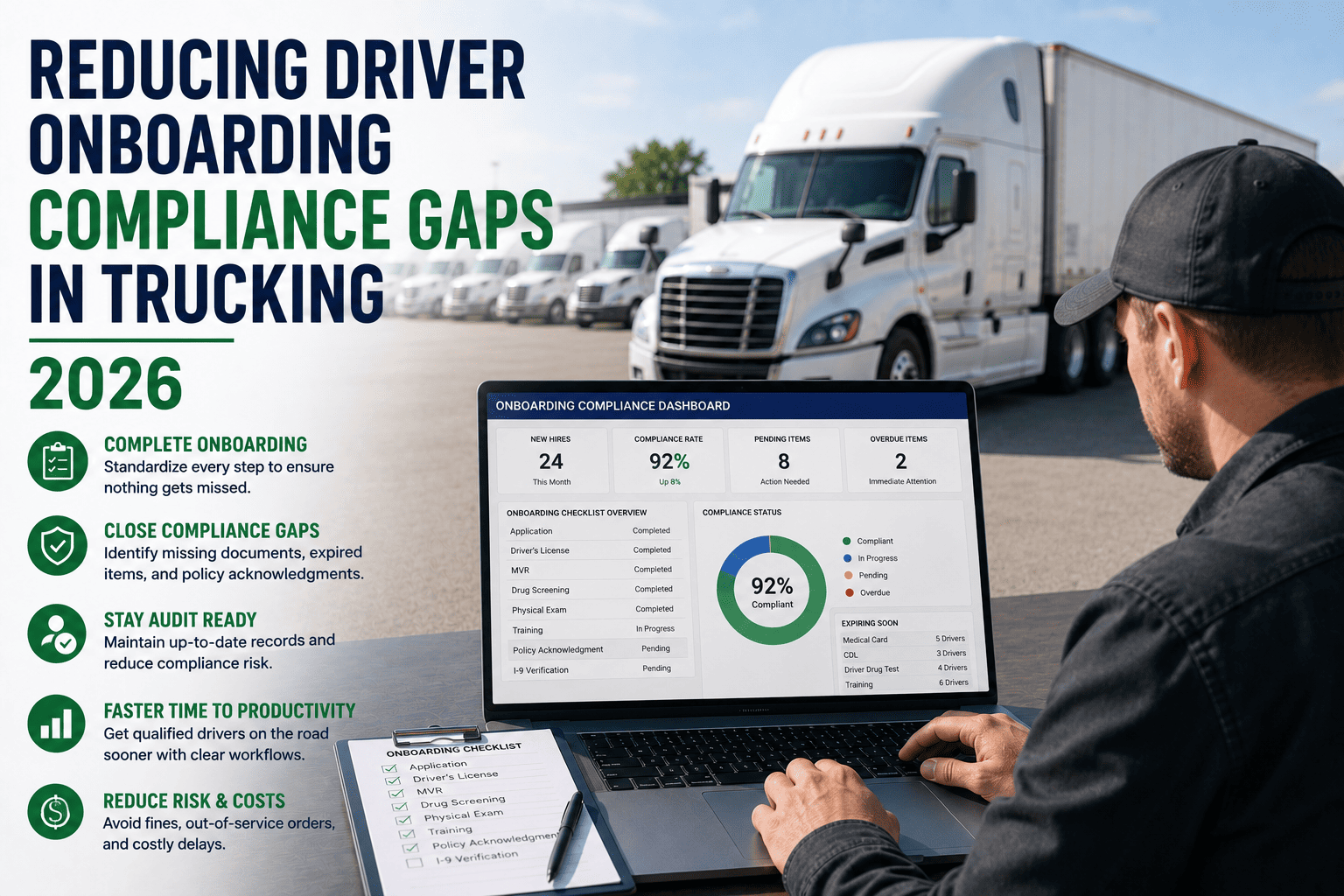
49 CFR Part 391 requires carriers to maintain a driver qualification file for every CDL driver. These files must be current, complete, and available for review. The FMCSA Drug and Alcohol Clearinghouse adds a new dimension to driver qualification management by requiring carriers to query federal drug and alcohol violation databases before hiring and annually for current drivers.
Essential Driver Qualification File Documents
Every driver qualification file must contain specific documents. The driver application must cover employment history for the past 10 years. A current CDL with appropriate endorsements is required. Motor Vehicle Records must be obtained at hire and annually from all states where the driver held a license in the past 3 years. A current DOT medical examiner's certificate with standard 24-month validity is required. Medical certificate status must be verified on CDLIS (Commercial Driver's License Information System). A road test certificate or equivalent is required before the driver operates the assigned vehicle type. Previous employer inquiries requesting safety performance history must be documented for all DOT-regulated employers in the past 3 years. FMCSA Drug and Alcohol Clearinghouse pre-employment full query results must be on file. Annual MVR reviews with supervisor certification are required. Annual driver certification reviewing violations in the prior 12 months is required. Missing any of these documents creates audit findings.
The FMCSA Drug and Alcohol Clearinghouse
The Clearinghouse is a federal database recording CDL driver drug and alcohol program violations. All carriers must conduct a full pre-employment query on every new CDL driver before allowing them to operate commercial vehicles. Current employees require an annual limited query. Results must be documented in the driver qualification file. If the Clearinghouse reveals a violation, the driver cannot be hired or employed until they complete return-to-duty processes including treatment, counseling, and follow-up testing. Non-compliance with Clearinghouse requirements constitutes a serious audit finding. Many carriers integrate Clearinghouse queries into their hiring processes automatically.
DVIR Requirements and Compliance
49 CFR Part 396.11 and 396.13 establish Driver Vehicle Inspection Report requirements. Drivers must complete post-trip DVIRs documenting any defects discovered during operation. The next driver must review and sign the previous report before operating the vehicle. Mechanics must certify that repairs were made or that no repairs were needed. Complete DVIR documentation is essential for FMCSA compliance and reduces the risk of roadside out-of-service violations.
DVIR Documentation Requirements
DVIRs must document specific elements. Vehicles operated during the day require post-trip reports if defects are discovered. Reports must identify the vehicle, the driver, and the date. Defects must be described specifically with location and severity. Drivers must sign the report. The next driver must review and sign before operating the vehicle. A qualified mechanic must sign certifying that repairs were made or were not necessary. Electronic DVIR systems capturing these elements electronically are FMCSA-compliant. Paper forms are acceptable but electronic systems provide better audit trails and defect tracking.
DVIR Recordkeeping and Retention
DVIRs must be retained at the motor carrier's principal place of business for a minimum of three months. During roadside inspections, the current trip's DVIR must be available for immediate review. Most violations are cited when drivers cannot produce current DVIRs documenting recent inspections. Electronic DVIR systems that make records instantly retrievable on driver mobile devices support roadside compliance. Paper DVIRs that sit in office files create risk because drivers do not have immediate access during inspections.
Automate FMCSA Compliance Across Your Fleet
FleetRabbit centralizes driver qualifications, HOS tracking, DVIRs, and vehicle maintenance into one platform. Generate audit-ready compliance reports in minutes and receive alerts before violations occur.
Vehicle Safety Standards and Roadside Inspection
49 CFR Parts 393 and 396 establish specific vehicle safety equipment requirements. These regulations define which components must be present, functional, and properly maintained on all commercial motor vehicles. Roadside inspections focus heavily on vehicle safety because equipment failures directly cause accidents and fatalities.
Critical Safety Components and Out-of-Service Standards
Brake system failures represent the leading cause of vehicle out-of-service orders. Service brakes and parking brakes must function within specification. Air brake system pressure must remain within required ranges. Tires must have minimum tread depth with 4/32 inch on front tires and 2/32 inch on rear tires. Bald tires trigger immediate out-of-service orders. Lighting must be fully functional including headlights, tail lights, brake lights, and turn signals. Reflectors must be present and visible. Coupling devices including fifth wheels and safety chains must be secure. Emergency equipment including fire extinguishers and reflective triangles must be present. Steering must have free play within specification with no looseness in steering components. These components are inspected during pre-trip inspections by drivers, and many are inspected during roadside Level I inspections by FMCSA.
FMCSA Compliance Audit Types and Preparation
FMCSA conducts two primary types of compliance audits. New Entrant Safety Audits are mandatory within 12 months of receiving operating authority. Compliance Safety Accountability interventions target existing carriers with elevated CSA BASIC scores in specific violation categories. Both audit types examine the same core areas and require carriers to demonstrate systematic compliance programs.
What FMCSA Auditors Examine
FMCSA auditors examine driver qualification files for completeness and currency. They review ELD records and paper logs if applicable to verify Hours of Service compliance. They inspect maintenance records and work orders showing preventive maintenance is performed systematically. They review DVIR documentation and defect repair records. They examine the drug and alcohol testing program including Clearinghouse queries and random testing records. They review accident records and procedures for post-accident investigation and testing. Auditors determine whether carriers maintain written policies and procedures documenting their compliance approach. Documentation that the safety director has responsibility for compliance programs is important. Evidence of driver training on safety policies and procedures is examined. Auditors ultimately assess whether the carrier operates a systematic compliance program or maintains only sporadic compliance efforts.
Preparing for FMCSA Compliance Audits
Fleets should prepare for audits continuously rather than waiting until an audit notice arrives. Maintain all required documents in organized, searchable formats. Driver qualification files should be complete and current with no expired documents. ELD records should be accessible and retained for at least six months. Maintenance records should document every service completed. DVIRs should be retained for three months. Accident records should include investigations and corrective actions. When an audit notice arrives, fleets should gather all required documentation, create an organized file structure, and prepare a summary demonstrating systematic compliance. Auditors typically conduct audits on-site at the carrier's principal place of business, so having organized documentation accessible immediately is important.
Frequently Asked Questions: FMCSA Compliance for Transportation Fleets
Q: What is the difference between FMCSA and DOT?
FMCSA is an agency within the Department of Transportation responsible for motor carrier safety. DOT is the broader department that oversees all transportation modes. For transportation fleet managers, FMCSA represents the regulatory body enforcing commercial vehicle rules. The terms are sometimes used interchangeably but FMCSA is the specific agency you need to comply with.
Q: How often do FMCSA inspectors conduct roadside inspections?
FMCSA conducts approximately 3-5 million roadside inspections annually across all commercial vehicles. Individual fleets experience varying inspection frequency depending on location and fleet size. Some fleets experience multiple roadside inspections monthly while others may go months without inspection. Compliance readiness requires assuming inspections can occur any time.
Q: What is CSA BASIC and how does it affect my fleet?
CSA BASIC stands for Compliance Safety Accountability. FMCSA tracks carrier performance across multiple categories including unsafe driving, hours of service violations, maintenance, driver fitness, and hazardous materials handling. High BASIC scores can trigger compliance interventions or conditional operating authority. FleetRabbit helps reduce violations across all BASIC categories through systematic tracking and reporting.
Q: Can drivers refuse ELDs or use paper logs instead?
ELDs are mandatory for most CDL drivers operating regulated vehicles. Exemptions exist for pre-2000 vehicles and certain specialized operations but most fleets must use certified ELDs. Drivers cannot opt out. Carriers selecting FMCSA-certified ELD vendors ensure compliance with federal requirements and ongoing regulatory updates.
Q: What happens if a driver exceeds Hours of Service limits?
Exceeding HOS limits results in FMCSA violations and civil penalties typically ranging from $1,000 to $16,000. Repeated violations can result in elevated CSA scores triggering compliance interventions. Carriers are responsible for monitoring driver HOS compliance. Start a free trial to monitor HOS automatically or book a demo to see how real-time alerts prevent violations.
Q: How long must driver qualification files be kept?
Active driver qualification files must be retained for the entire duration of employment plus three years after driver separation. MVR records must be kept for three years. Drug and alcohol testing records have varying retention requirements from one to five years depending on record type. Documentation of retention timelines prevents accidental document disposal before retention requirements are met.
Q: What are typical FMCSA civil penalties and fines?
FMCSA penalties range from a few hundred dollars for minor violations to tens of thousands for serious safety violations. HOS violations typically range $1,000-$16,000. Equipment violations range $500-$8,000. Serious violations like falsified records can exceed $30,000. Operating authority revocation represents the harshest sanction. Compliance programs reduce violation frequency and associated penalties significantly.
Q: Do I need a Designated Safety Officer for FMCSA compliance?
FMCSA does not mandate a specific safety officer title but does require carriers to have identifiable personnel responsible for compliance. Larger fleets often designate a full-time safety director while smaller fleets may assign compliance responsibility to an existing manager. Documented responsibility assignment demonstrates systematic compliance to auditors.
Q: Can FleetRabbit help prepare for FMCSA audits?
Yes. FleetRabbit centralizes all compliance documentation in one platform. Generate audit-ready reports for driver qualifications, maintenance records, DVIR history, and HOS compliance in minutes. Start your free trial or book my demo to see audit preparation tools in action.
Master FMCSA Compliance With Systematic Tracking
FMCSA compliance is complex but achievable with the right tools. FleetRabbit automates tracking across all regulatory areas so your fleet stays audit-ready every single day.