One missed Clearinghouse query is all it takes to put your fleet out of compliance, and one driver in prohibited status behind the wheel is all it takes to put your safety record and your authority at risk. The FMCSA Drug and Alcohol Clearinghouse closed the loophole that once let a driver with an unresolved violation simply move to the next carrier without anyone knowing. For fleet managers, that means Clearinghouse queries are no longer a once-a-year afterthought, they are a recurring compliance obligation with a hard deadline and real financial exposure if it slips.
Every employer of CDL drivers must run a full Clearinghouse query before a new driver's first safety-sensitive function and at least one query per driver every 12 months. Violations and refusals must be reported within days of occurring, and any driver found in prohibited status must be removed from safety-sensitive duty immediately. Automated query scheduling keeps your fleet ahead of every deadline instead of discovering a gap during an audit.
What The Clearinghouse Actually Tracks
The Clearinghouse is a secure federal database that records drug and alcohol program violations for every CDL and CLP holder performing safety-sensitive functions. It gives employers, state licensing agencies, and FMCSA shared visibility into a driver's violation history, so a positive test or a refusal at one carrier follows that driver rather than disappearing when they change jobs. As of early 2026, well over 200,000 CDL holders sit in prohibited status nationwide, which means the odds of unknowingly onboarding or continuing to employ a prohibited driver are higher than most fleet managers assume.
Limited Query Versus Full Query
Employers can run an inexpensive limited query first for annual checks. If it comes back clean, that driver is compliant for the year. If the limited query surfaces a record, the employer must immediately follow up with a full query, which requires the driver's electronic consent and reveals complete violation details. Using a limited query in place of a required full pre-employment query is one of the most common mistakes fleets make.
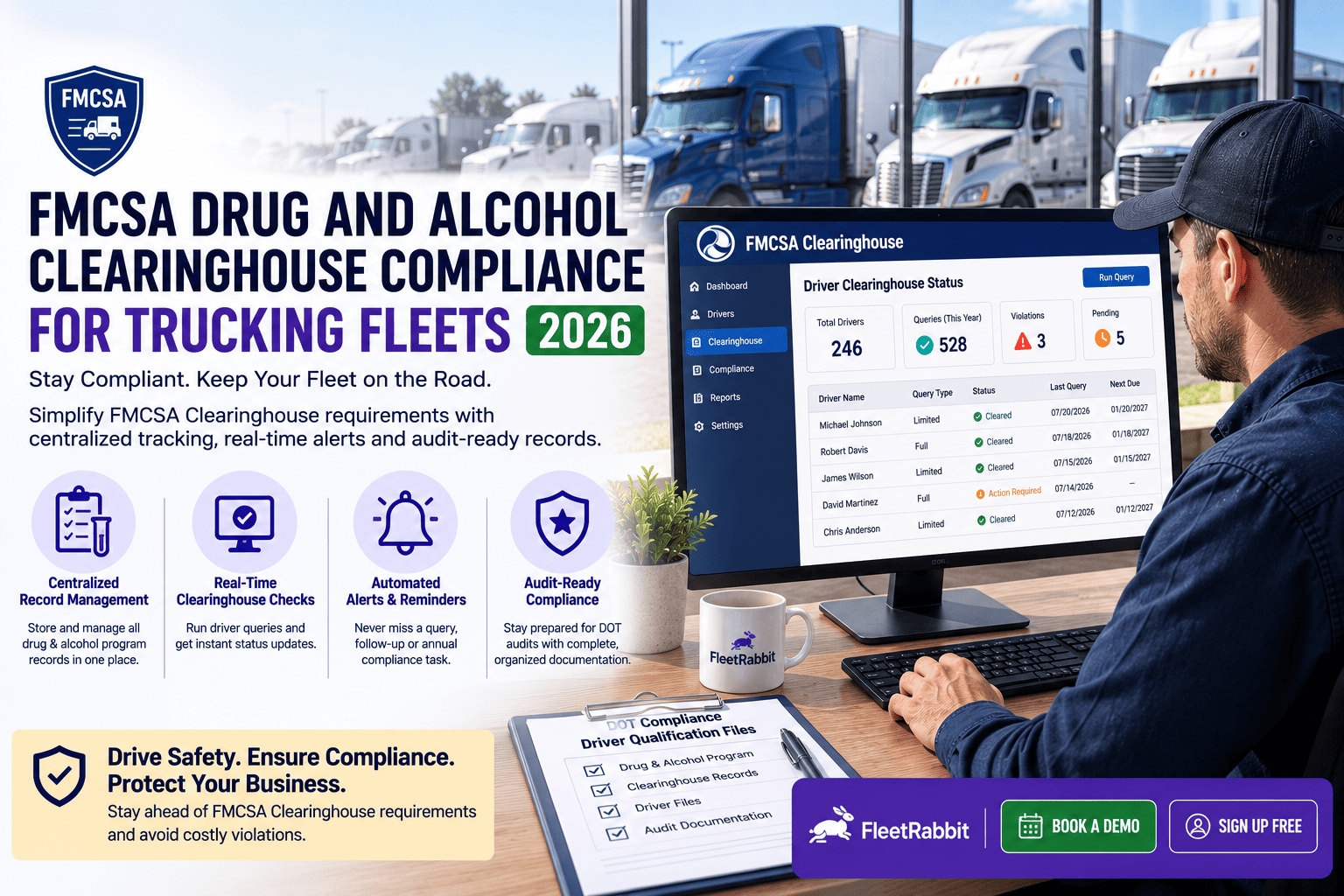
FleetRabbit tracks every driver's pre-employment and annual query status in one dashboard, flagging deadlines before they're missed. Sign up free to see your fleet's current query status, or book a demo to walk through your compliance gaps together.
Employer Obligations At Every Stage
Clearinghouse compliance isn't one task, it's a set of obligations that repeat across the entire employment relationship. The table below breaks down what's required at each stage and where fleets most commonly slip.
| Compliance Stage | What's Required | Common Mistake | How Automation Helps |
|---|---|---|---|
| Pre-Employment | Full query with driver consent before the first safety-sensitive function | Allowing a driver to start work before the query result comes back | Onboarding workflow blocks dispatch until the query is confirmed clean |
| Annual Query | At least one query per current driver within a rolling 12-month window | Tracking deadlines by hire date manually across a large roster | Automated reminders fire well before each driver's 12-month window closes |
| Violation Reporting | Employers must report confirmed violations and test refusals within days of occurrence | Delayed reporting due to manual documentation processes | Digital reporting workflows capture and submit violation data promptly |
| Prohibited Status Response | Immediate removal from safety-sensitive duty when a violation is found | Delayed action while awaiting manual confirmation of query results | Real-time status alerts trigger immediate dispatch holds for flagged drivers |
| Return-To-Duty | Substance abuse professional evaluation, treatment, and follow-up testing before reinstatement | Incomplete documentation of the RTD process in the driver's file | Centralized records tie every RTD milestone to the driver's compliance file |
Understanding The Return-To-Duty Process
A driver flagged with a violation in the Clearinghouse cannot simply wait it out. FMCSA requires a defined sequence before that driver can return to safety-sensitive work, and every step needs to be documented.
Substance Abuse Professional Evaluation
The driver must be evaluated by a DOT-qualified substance abuse professional, who determines what treatment or education is needed before the driver can be considered for return-to-duty testing.
Follow-Up Testing Program
Once treatment is complete, the driver must pass a return-to-duty test and then remain subject to a follow-up testing schedule determined by the substance abuse professional, which can extend well beyond the initial return to work.
Ongoing Employer Verification
Throughout this process, the employer is responsible for confirming each milestone is met and documented before allowing the driver back into a safety-sensitive role. Skipping this verification exposes the fleet to significant liability if an incident occurs afterward.
FleetRabbit centralizes Clearinghouse queries, violation reports, and return-to-duty milestones so nothing falls through the cracks. Start your free sign up today, or book a 30-minute demo to see how it fits your fleet.
Building A Clearinghouse Compliance Routine
Fleets that stay ahead of Clearinghouse requirements share the same habit: they don't treat queries as a once-a-year task tied to a single calendar deadline. Instead, queries are scheduled around each driver's individual hire anniversary, violation reports are filed the moment an incident occurs rather than at the end of the week, and query records are stored directly in each driver's qualification file so nothing needs to be reconstructed later. A quarterly review of every driver's current query status, cross-checked against upcoming anniversaries, catches gaps months before they become violations during a compliance review.
Making Clearinghouse Compliance Routine, Not Risky
Clearinghouse compliance is entirely manageable once queries are scheduled automatically instead of tracked by memory. The fleets that get caught off guard are almost always the ones relying on a single annual reminder rather than a system that watches every driver's individual timeline continuously.
FleetRabbit automates pre-employment and annual queries, tracks violation reports, and monitors return-to-duty milestones so your fleet stays compliant year round without the manual tracking.