You already know the software would help. Getting a CFO or ops director to sign off on it is a different problem entirely. Most fleet management software proposals do not get rejected because the technology is weak. They get rejected because they lead with features instead of dollars, and finance teams do not fund feature lists. Building a business case that actually gets approved in 2026 means speaking the language every stakeholder in the room actually cares about, starting with what doing nothing is already costing you.
A business case for fleet management software gets approved when it opens with the cost of your current manual process, uses your own twelve months of data as a baseline, presents conservative savings ranges instead of a single optimistic number, and states payback in weeks rather than a percentage. Most fleets that build the case this way see three to five times their software cost back within the first year, with payback landing inside the first two to three months.
Why Strong Software Still Gets Rejected
Leadership rarely says no because they doubt fleet software works. They say no to how it was pitched. Three patterns show up again and again in proposals that stall in committee.
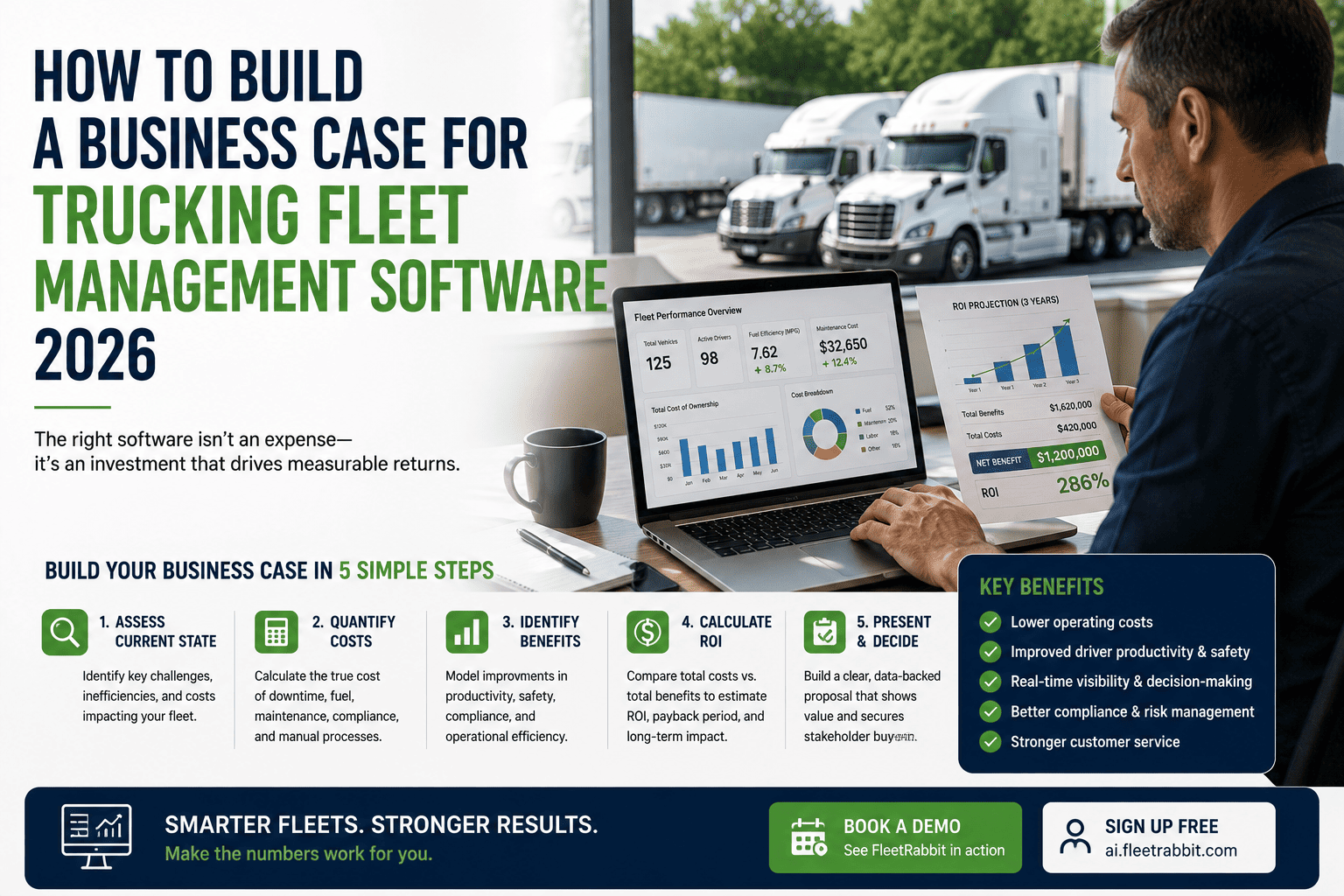
The Five-Step Framework That Gets Approved
A business case that survives finance committee scrutiny follows a consistent shape. Each step builds directly on the one before it, so skipping ahead usually weakens the whole proposal.
Step 1: Establish Your Baseline
Pull twelve months of actual spending across fuel, maintenance, labor, insurance, and violations. This becomes the number every projected saving gets measured against, and it is the single most persuasive input in the entire case because it belongs to your fleet, not an industry report.
Step 2: Map Every Savings Category
Fleet software ROI rarely comes from one place. It stacks across fuel efficiency, preventive maintenance, reduced unplanned downtime, compliance automation, and administrative time recovered from manual reporting. Capturing all five categories, rather than fuel savings alone, is what separates a strong case from a modest one.
Step 3: Use Conservative Ranges
Present the low end of every savings range rather than the high end. Most finance teams accept mid-range projections without much pushback, and a conservative estimate that the real results later beat builds far more credibility than a number that eventually needs walking back.
Step 4: State Payback In Weeks
A percentage ROI figure is abstract. A payback period is not. Framing the software cost as a small line item, typically well under two percent of total fleet operating cost, that reduces the remaining spend by ten to twenty-five percent, and showing that it pays for itself within the first few weeks of use, is the version of the story that actually clears a budget meeting.
Step 5: Separate The Soft Benefits
Compliance readiness, driver retention, and audit preparation resist clean monetization but still matter to a board. Present these in their own section instead of folding them into the financial model, since forcing soft benefits into a hard dollar figure weakens the credibility of both.
FleetRabbit's analytics dashboard tracks downtime events, maintenance cost per vehicle, fuel spend, and compliance status automatically, generating a monthly report you can hand straight to a finance director. See it running on your own fleet by choosing to start a free trial today.
Where The Numbers Actually Come From
Every fleet software business case is built from the same handful of savings streams. Knowing what typically shows up in each one makes the baseline conversation with finance much faster.
| Savings Category | Typical Impact Range | Where It Comes From |
|---|---|---|
| Fuel Efficiency | 10 to 15 percent reduction | Idle time reduction, optimized routing, and driver behavior scoring |
| Maintenance Cost | 18 to 25 percent reduction | Automated preventive schedules based on mileage, engine hours, and calendar intervals |
| Unplanned Downtime | $500 to $1,000 saved per prevented breakdown day | Early fault detection catching issues before they become roadside failures |
| Compliance Administration | Hours of manual reporting recovered weekly | Digital inspections, automated documentation, and audit-ready reporting |
Speaking Each Stakeholder's Language
A single business case rarely convinces every reviewer with the same argument. Finance, operations, and compliance stakeholders are each listening for something different, and addressing all three inside one proposal is what gets it across the finish line without another round of questions.
Finance Wants Payback, Not Promises
Financial stakeholders focus on payback period and the size of the software line item relative to total operating spend. A clear before-and-after cost comparison, backed by your own twelve-month baseline, answers their core question faster than any percentage figure.
Operations Wants Fewer Fires To Put Out
Operations leaders care about downtime reduction, route efficiency, and how much less time gets spent chasing spreadsheets. Showing a reduction in emergency repair volume speaks directly to their day-to-day workload.
Compliance Wants Evidence On Demand
Compliance stakeholders focus on audit readiness and how quickly documentation can be produced when a regulator asks. A digital record that generates an audit package in minutes rather than days is often the single most persuasive point in this part of the room.
FleetRabbit's team can build an itemized ROI model using your actual maintenance spend, fuel data, and downtime history, no generic assumptions. Ready to see the numbers finance will actually approve? Book a free demo and we will walk through it together.
Turning The Model Into Real Evidence
A projection convinces a committee once. Live results convince them every year after that. Requesting a short pilot on a single site or a subset of vehicles converts the business case from a forecast into evidence, which removes most of the remaining approval risk before the full rollout decision is even made.
Run A Small Pilot Before The Full Rollout
A sixty-day pilot on a handful of vehicles produces real before-and-after numbers from your own operation. That data, not a vendor's case study, is what makes the second budget conversation, the one for full fleet rollout, considerably easier than the first.
Report On The Same Cadence As Your Baseline
Comparing monthly results against the original twelve-month baseline keeps the business case alive well past the initial approval. It also gives fleet managers a ready-made monthly report to hand directly to a finance director without extra manual work.
Stop guessing at industry averages and build the case on your own fleet's numbers instead. FleetRabbit's analytics turn twelve months of maintenance, fuel, and downtime data into a report finance can approve on sight. Start free and see your real savings potential today.