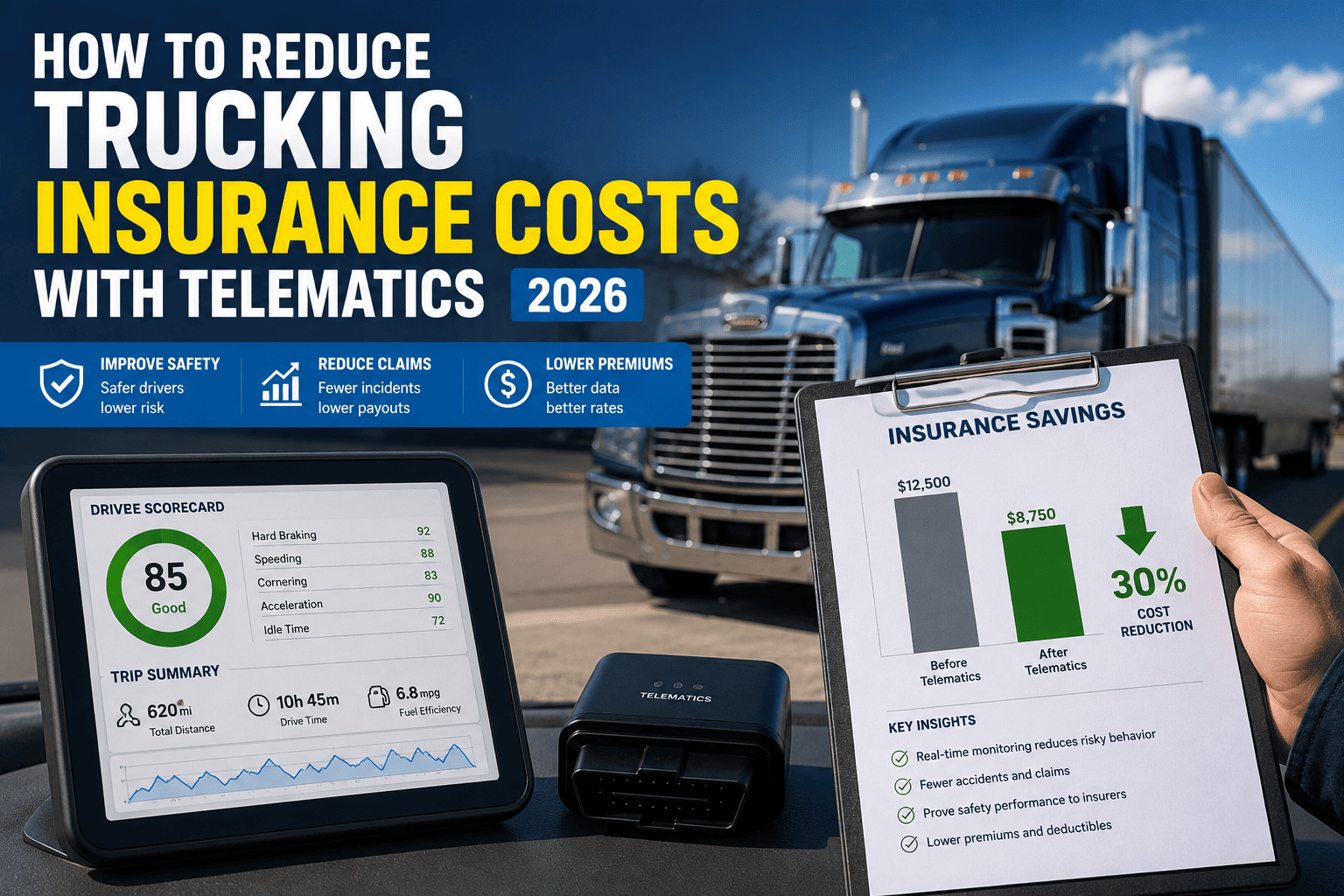
Every trucking fleet manager has felt it at renewal time: the premium goes up again, even after a clean year with no major claims. Commercial auto insurance is running at record highs, nuclear verdicts against trucking companies are climbing into the hundreds of millions, and carriers have responded by pricing risk more conservatively across the entire industry rather than fleet by fleet. The good news is that insurers have also built a way out of that trap. Telematics data lets a fleet prove exactly how safely it operates, and in 2026 that proof is the single biggest lever available for reducing trucking insurance costs.
Telematics-equipped trucking fleets are securing insurance premium reductions of 10 to 30 percent by giving underwriters verified data on hard braking, speeding, following distance, and distraction events instead of relying on industry averages. Roughly 60 percent of commercial fleet insurers now use telematics data across some part of their pricing, up sharply from just a few years ago. The fleets seeing the biggest discounts pair the data with active driver coaching and AI dash cams, since insurers reward documented improvement, not just installed hardware.
Why Trucking Insurance Costs Keep Climbing
Nuclear verdicts against trucking companies have become a defining risk in commercial auto insurance, with billions of dollars awarded across a small number of cases and the largest "thermonuclear" verdicts over 100 million dollars becoming far more common than they were just a few years ago. Insurers have responded by pricing per-mile risk at record levels, and without hard data proving your fleet's actual behavior, a carrier has no choice but to price you at the market average, which in this environment means absorbing the cost of the industry's worst outcomes even if your own trucks have never had a serious incident.
That is exactly the gap telematics closes. Instead of judging a fleet on blunt inputs like years in business, vehicle count, and zip code, insurers using telematics data can see the difference between a fleet with frequent harsh braking events and late-night speeding versus one that catches and corrects unsafe habits quickly. Once that distinction is visible, the pricing conversation stops being about industry averages and starts being about your fleet's actual evidence.
The Behavior Metrics Underwriters Actually Score
These four signals correlate most strongly with claim frequency and severity, which is why they carry the most weight in a usage-based pricing review. Roughly 70 percent of commercial fleet crashes involve some form of distracted driving, making it one of the highest-leverage metrics a fleet can improve, and AI-equipped dash cams can now detect phone use and drowsiness in real time rather than relying on after-the-fact reporting.
Three Ways Insurers Are Structuring Telematics Pricing
Pay-As-You-Drive
A base rate plus a per-mile cost, best suited to lower-mileage fleets that want their premium to reflect actual usage rather than a flat annual estimate.
Pay-How-You-Drive
Premiums calculated directly from behavior scores like hard braking and speeding, rewarding fleets that already operate with strong driving discipline.
Manage-How-You-Drive
Adds active coaching and continuous monitoring on top of behavior scoring, offering the deepest discounts for fleets committed to ongoing improvement.
FleetRabbit captures hard braking, speeding, distraction, and hours-of-service data in one exportable safety report built for renewal conversations. Sign up for free to see your fleet's current safety profile, or book a demo before your next renewal.
What a Realistic Discount Looks Like
The numbers vary by fleet size and starting risk profile, but the pattern is consistent: telematics investment costs a fraction of what it saves once premium reduction, accident avoidance, and fuel savings are added together. Here is what that math looks like for a mid-size fleet.
| Savings Category | Typical Annual Impact | What Drives It |
|---|---|---|
| Premium Discount | 10 to 30 percent of annual premium | Verified behavior data shared at renewal |
| Accident Reduction | Roughly 22 percent fewer incidents | Real-time coaching on risky behavior |
| Fuel Savings | Around 10 percent reduction | Reduced idle time and optimized routing |
| Litigation Defense | Faster, cheaper claims resolution | Timestamped dash cam and telematics evidence |
Building a Program That Actually Moves the Number
Dash Cams Turn Disputed Claims Into Fast Resolutions
When dash cam footage is missing from a claim file, the larger commercial vehicle is frequently assumed to be at fault by default in a disputed crash. With usable forward and interior video on file, adjusters can resolve liability in a fraction of the time, and most nuisance settlements collapse once the footage shows exactly what happened in the seconds before impact.
Coaching Is What Separates a Discount From a Surcharge
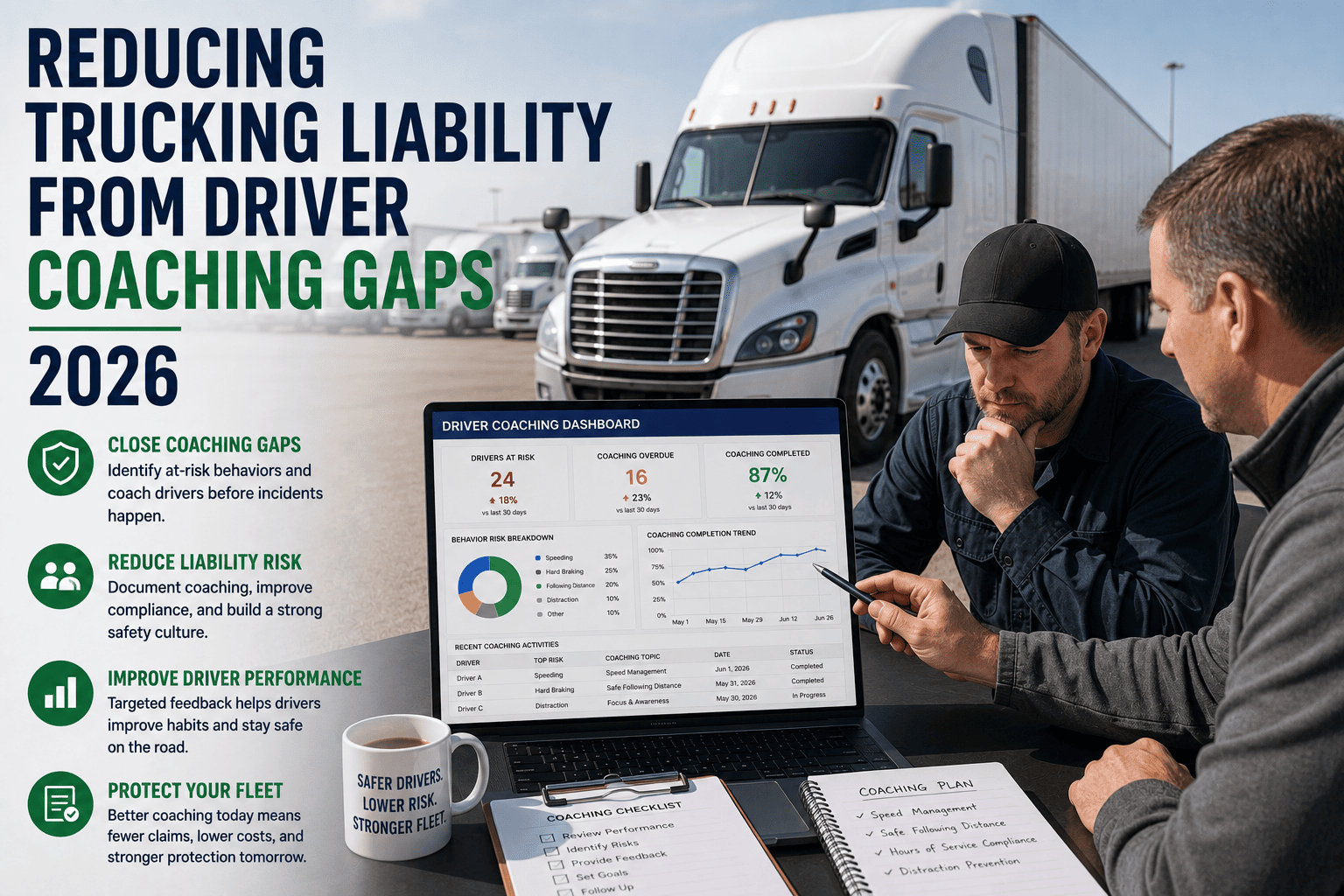
Passive data collection alone earns minimal discounts, because an underwriter cares about improvement, not just installed hardware. Documented coaching sessions tied to specific telematics events show insurers that unsafe behavior gets corrected quickly rather than repeated, which is the exact evidence that moves a fleet from average pricing to a genuine discount.
A Written Safety Policy Protects the Program
A clear written policy covering what data is collected, how it is used for coaching, and what drivers can expect keeps a telematics program framed as a safety and professional development tool rather than surveillance, which improves both driver buy-in and the quality of the data your program produces.
Getting Started Before Your Next Renewal
Review Current Data
Pull your existing telematics, claims, and premium history to identify your top risk factors before setting improvement goals.
Set Specific Targets
Turn broad goals into measurable targets for hard braking, speeding, and distraction events by driver and by fleet.
Coach Consistently
Connect flagged events directly to structured coaching conversations so improvement is documented, not just assumed.
Present the Trend at Renewal
Hand your broker a clean, verified data package well before quotes are issued so underwriters price you against your evidence.
Your fleet is probably safer than your current premium reflects. FleetRabbit captures the exact behavior data underwriters ask for and packages it into a renewal-ready report your broker can use immediately. Sign up for free and start building your safety trend today, or book a demo to walk through it with our team.