Insurance renewal season used to mean bracing for another increase and hoping the underwriter did not ask too many questions. That is changing fast. In 2026, underwriters are pricing commercial fleets on documented behavior instead of industry averages, and fleets that can show a clean, improving safety trend are walking into renewals with leverage instead of dread. The fleets earning the biggest discounts are not necessarily the ones with the newest trucks. They are the ones with the best evidence.
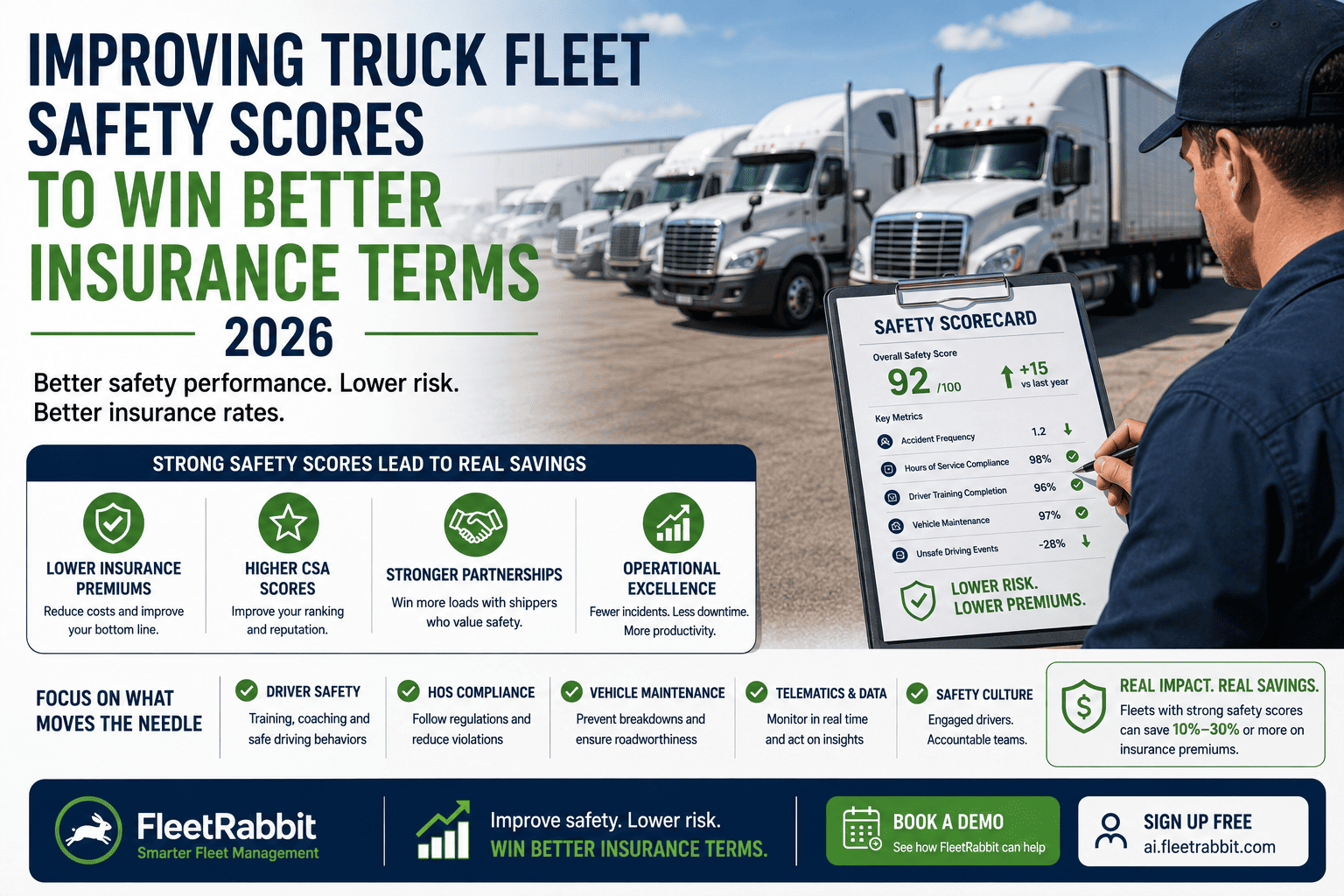
Improving a fleet's safety score for better insurance terms comes down to three things: capturing the specific behaviors underwriters now price directly, such as harsh braking, distraction, and unauthorized use; turning that data into a documented coaching and improvement program rather than a passive camera feed; and presenting it in a format insurers can verify at renewal. Fleets that combine AI dash cams with active coaching commonly see premium reductions in the 10 to 30 percent range, often covering the entire cost of the safety program in a single renewal cycle.
What Underwriters Are Actually Pricing In 2026
Commercial insurers have moved well past mileage and loss history as the only inputs. Today's underwriting models look for specific, granular behaviors that correlate directly with claim frequency and severity.
Why Consistency Matters More Than A Perfect Month
Insurers want to see a clean, steady trend over time, not a single strong month wrapped in an otherwise thin record. A fleet running cameras on nearly every trip with steady month-over-month improvement reads as far more credible to an underwriter than a fleet claiming a flawless record with sparse or inconsistent data.
FleetRabbit captures harsh braking, distraction, and compliance events automatically, then packages them into a safety trend report an underwriter can actually use. Ready to see where your fleet stands? You can start a free trial today.
The Safety Stack That Actually Moves The Score
No single tool carries a fleet's safety score on its own. The strongest results come from layering a few specific technologies together and using the data actively rather than letting it sit unreviewed.
AI Dash Cams For Real-Time Detection
Modern AI-powered cameras run multiple detection models at once, flagging distracted driving, fatigue, tailgating, and collision risk as it happens rather than after the fact. Fleets deploying this technology commonly report a meaningful drop in distracted-driving incidents within the first ninety days.
Telematics And Driver Scoring
Pairing cameras with telematics turns individual events into a fleet-wide driver score, tracking harsh braking, speeding, and unauthorized vehicle use over time. That combined data set is what most underwriting discount programs are actually built around.
Structured Driver Coaching
Data alone does not move a premium. A risky event that gets coached and corrected within days reads very differently to an underwriter than the same event repeating unaddressed month after month. Documented coaching completion is often the single factor that separates a modest discount from a substantial one.
Exoneration And Claims Evidence
A single video-supported not-at-fault exoneration on a serious claim can save tens of thousands of dollars, frequently covering the cost of an entire camera program in one event. Underwriters increasingly view this exoneration history as its own form of evidence.
| Safety Measure | Typical Premium Impact | What Insurers Want To See |
|---|---|---|
| AI Dash Cams Alone | 10 to 15 percent discount | Consistent recording coverage across the majority of trips |
| Telematics-Enabled Coaching | Around 15 percent rebate | Documented training completion tied to flagged events |
| Combined Camera And Coaching Program | 15 to 30 percent reduction | Declining event frequency plus a clear improvement narrative |
| Verified Not-At-Fault Exoneration | Tens of thousands saved per claim | Time-stamped video evidence attached directly to the claim file |
Presenting Your Safety Data At Renewal
Even strong safety performance can go unrewarded if it is not packaged the way an underwriter expects to review it. How the data is presented at renewal time matters almost as much as the performance itself.
Format The Renewal Package Like An Underwriter
Safety trends, driver scorecards, and training documentation should be exportable in a single, consistent format rather than assembled manually each renewal cycle. A clean, repeatable package signals an organized safety program before the underwriter reads a single number.
Compare Programs, Not Just Prices
Not every carrier weighs telematics data the same way. Comparing how different insurers treat camera and coaching data, rather than only comparing quoted premiums, often reveals meaningfully different discount structures for the same underlying safety record.
FleetRabbit builds exportable safety trend reports, driver scorecards, and coaching documentation formatted the way underwriters expect to see them. Want to see what your renewal package could look like? Book a free demo and we'll show you.
Building The Habit, Not Just The Hardware
The fleets seeing the largest discounts rarely have the most expensive equipment. They have the most consistent review habits.
Review Events Weekly, Not At Renewal
Waiting until renewal season to look at safety data means missing months of coachable moments. A weekly review cadence catches developing habits early, which is exactly the improvement trend underwriters respond to.
Recognize Improvement, Not Just Flag Problems
Programs that pair camera data with visible recognition for improving drivers tend to outperform purely corrective programs on almost every metric an insurer looks at, since drivers stay engaged with the coaching process instead of tuning it out.
Underwriters are already pricing your fleet on behavior, not averages. FleetRabbit helps you capture the right safety signals, coach drivers consistently, and package the results into a renewal-ready report. Start free and see where your safety score stands today.