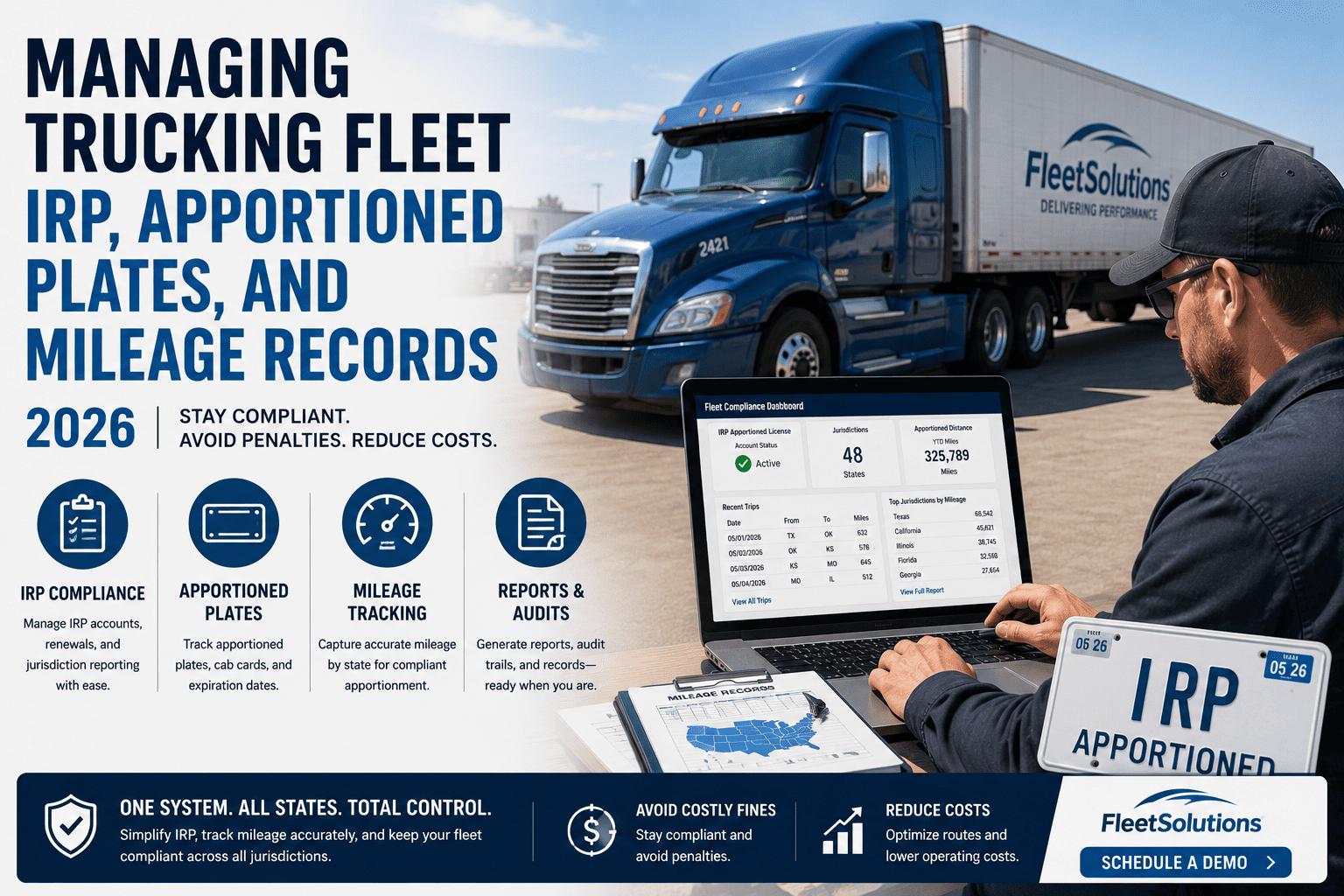
Every trucking company that crosses a state line is one missing mileage log away from a registration headache. IRP apportioned plates let your trucks legally run across every member jurisdiction on a single plate, but that convenience comes with a strict condition: you must track and prove exactly how many miles each vehicle drove in each state or province. Fleets that treat this as a once-a-year renewal task instead of a daily discipline are the ones who get flagged in an audit, hit with supplemental fees, or stuck rebuilding twelve months of trip data from memory.
IRP apportioned plates require every qualifying vehicle over 26,001 pounds operating in two or more jurisdictions to register through a base jurisdiction and report actual jurisdiction-by-jurisdiction mileage. Records must be retained for 3 to 4 years depending on your base state, and audits can review that entire window at once. Automated mileage tracking removes the manual guesswork and keeps every renewal audit-ready.
Why Apportioned Plates Exist In The First Place
Before IRP, a carrier running loads through six states needed six separate registrations, six separate fee schedules, and six separate renewal dates. The International Registration Plan replaced that with one apportioned plate and one cab card, honored across every member jurisdiction. In exchange, your base jurisdiction only issues that plate once you can show, and keep showing, exactly how many miles each vehicle traveled in each state or province during the reporting period.
Who Actually Needs An Apportioned Plate
If a power unit weighs 26,001 pounds or more, has three or more axles regardless of weight, or is used in combination to exceed that weight threshold, and it operates in two or more jurisdictions, it needs IRP registration. Running without it once you meet those criteria is treated as a registration violation in every jurisdiction you cross, not just your home state.
FleetRabbit captures state-by-state mileage automatically from your existing telematics data, organizes it by vehicle and reporting period, and keeps every record audit-ready year round. You can sign up free and connect your fleet in minutes, or book a demo to see your first renewal report built for you.
What Your Jurisdiction Mileage Records Must Show
Auditors are not looking for a rough estimate. Base jurisdictions expect trip-level detail that reconstructs exactly where a vehicle traveled, and manual logs are the first thing that fall apart under review. Below is a breakdown of the core record types most IRP offices expect to see, and what tends to go wrong with each.
| Record Type | What It Must Include | Common Failure Point | How Automation Helps |
|---|---|---|---|
| Trip Distance Logs | Origin, destination, route, and total miles per trip, broken out by jurisdiction crossed | Drivers estimate miles at day's end instead of recording actual routes | GPS-based tracking logs jurisdiction crossings automatically as they happen |
| Vehicle Identification | VIN, unit number, and fleet assignment matched to every mileage entry | Spreadsheets mix up units when vehicles are reassigned mid-quarter | Digital records tie mileage permanently to the correct vehicle profile |
| Fuel and IFTA Cross-Reference | Fuel purchase records that reconcile with reported jurisdiction mileage | IFTA fuel data and IRP mileage data are tracked in two separate, mismatched systems | One shared dataset feeds both IRP renewals and IFTA filings consistently |
| Supporting Source Documents | ELD reports, dispatch records, and permits that back up every mileage figure | Paper trip sheets get lost, damaged, or simply never filed | Cloud storage keeps every source document retrievable for the full audit window |
| Annual Renewal Summary | Total fleet miles by jurisdiction, ready to submit at renewal time | Manual tallying at renewal season introduces errors and missed jurisdictions | Automated reports generate the full-year summary in a single click |
The IRP Renewal Cycle, Step By Step
Understanding where your fleet sits in the annual cycle makes the difference between a routine renewal and a scramble. Most fleets move through the same four stages every reporting year, and each one depends entirely on the mileage data collected in the stage before it.
Stage One: Continuous Mileage Capture
Every mile driven during the reporting period needs to be logged by jurisdiction as it happens. This is the stage where most compliance gaps are created, usually because tracking is left to end-of-week memory instead of real-time capture.
Stage Two: Quarterly Reconciliation
Smart fleets reconcile mileage against fuel purchases and dispatch records every quarter rather than waiting for renewal. Catching a mismatch in March is a five-minute fix. Catching it during a renewal deadline in December is a fire drill.
Stage Three: Annual Renewal Filing
Your base jurisdiction calculates the mileage percentage for each state or province and applies it to that jurisdiction's registration fee. Filing with clean, organized mileage records means no delays, no rejected applications, and no supplemental fee disputes.
Stage Four: Audit Readiness
Even in a year without a scheduled audit, records need to sit ready to produce for the full retention window. Jurisdictions can and do request historical data outside the renewal cycle, so treating every quarter as audit-ready avoids year-end panic.
FleetRabbit tracks continuous jurisdiction mileage, flags reconciliation gaps quarterly, and produces renewal-ready summaries the moment your filing window opens. Start your free sign up to connect your fleet today, or book a 30-minute demo to walk through your specific jurisdictions.
Common Mistakes That Trigger IRP Audit Flags
Certain patterns in mileage reporting draw closer scrutiny from IRP offices. Average miles per jurisdiction that jump sharply from one renewal to the next, base jurisdiction mileage that looks unrealistically low, and mismatches between reported IRP miles and IFTA fuel tax filings are all common triggers. A vehicle reassigned between fleets without updated records, or a driver switching from ELD tracking to manual logs mid-quarter, can also create the kind of inconsistency that invites a closer look.
The fix is rarely dramatic. Fleets that keep one consistent, automated source of mileage truth across both IRP and IFTA reporting simply do not generate the red flags that come from two systems telling two different stories about the same trucks.
Building A Simple IRP Compliance Checklist
A short, repeatable checklist keeps mileage compliance from depending on any single person's memory. Confirm your base jurisdiction still matches your actual operations, verify every qualifying vehicle carries a current cab card, capture jurisdiction mileage continuously rather than in batches, reconcile that mileage against fuel records every quarter, and archive supporting documents the moment they are generated rather than at year-end. Fleets that run this checklist quarterly rarely face a difficult renewal season.
Turning Registration Compliance Into A Non-Issue
IRP compliance is one of the few operational areas where the right system removes almost all of the risk. Once mileage capture is automatic and reconciled every quarter, renewal season stops being a scramble and audits stop being a threat. The fleets that struggle with IRP are almost always the ones still relying on manual logs and end-of-year memory rather than continuous, organized data.
FleetRabbit automatically tracks jurisdiction-by-jurisdiction mileage, reconciles it with your fuel data, and keeps every record ready for renewal or audit. No manual logs, no year-end scramble, no guesswork on fees.