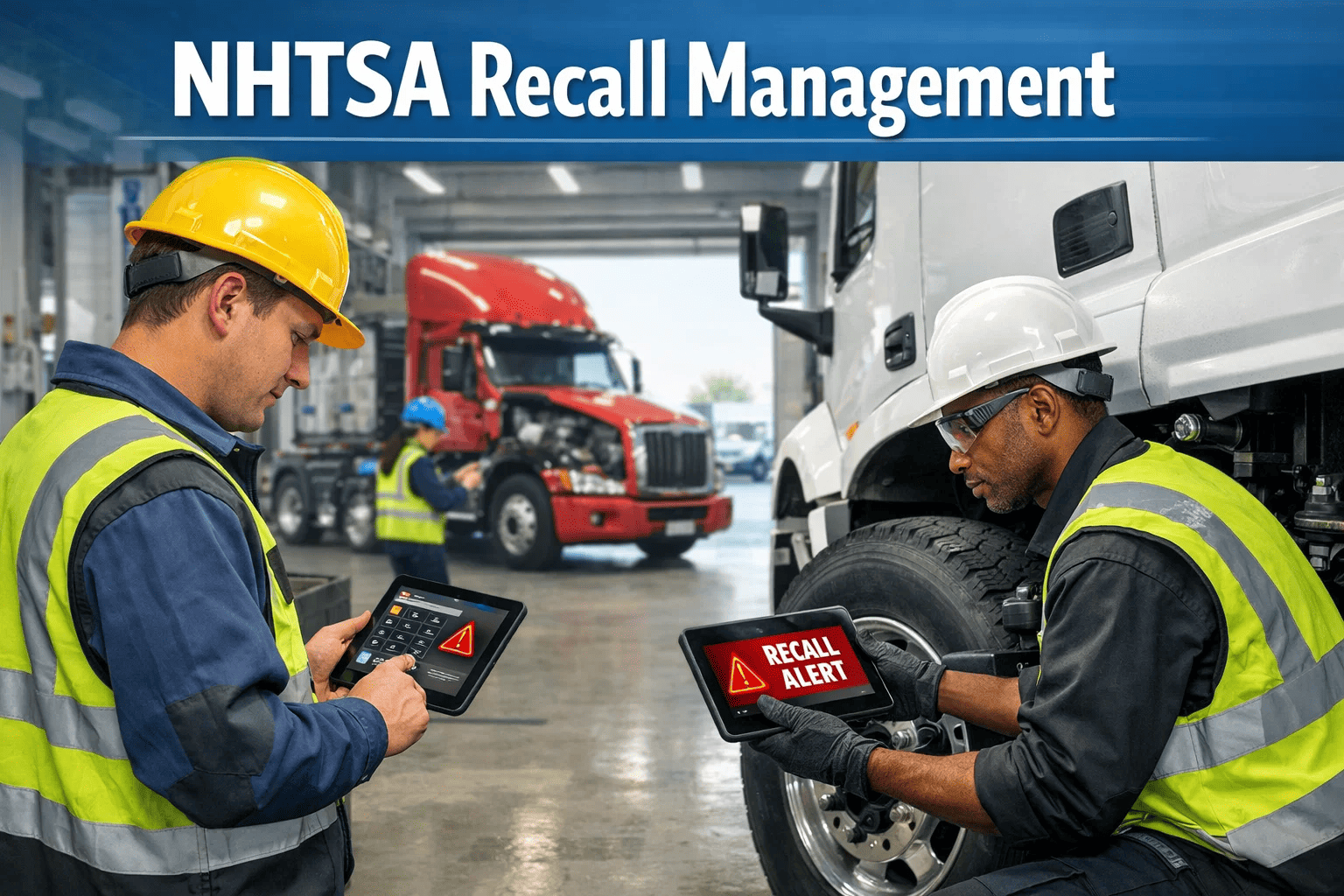
Vehicle recalls in commercial trucking carry a degree of operational and liability consequence that no other maintenance management scenario can match. When the National Highway Traffic Safety Administration issues a recall affecting a component of a commercial motor vehicle, the carrier is not merely advised to schedule a repair — it is operating under a federally documented safety defect finding that creates liability exposure if the vehicle is involved in an incident before the recall remedy is applied. For fleet managers managing 50 to 500 commercial vehicles, the administrative challenge of maintaining awareness of every active recall affecting their specific vehicle population, tracking which units have received the remedy, and producing documentation proving completed recall work in response to a DOT safety audit, represents a compliance function that most fleets currently handle through manual processes that are error-prone, time-consuming, and increasingly inadequate as recall volumes from manufacturers have trended upward over the past decade. FleetRabbit's Recall Tracking feature provides commercial fleet operators with an automated, integrated recall management capability that eliminates the manual monitoring burden, documents remedy completion against individual asset records, and maintains the compliance evidence that DOT auditors and safety investigators require. Book a demo to review how FleetRabbit's recall tracking capability addresses recall compliance in your specific commercial vehicle fleet.
Compliance Context
Under 49 CFR Part 579, commercial motor vehicle operators have an obligation to remedy safety defects on vehicles for which a recall has been issued. Operating a vehicle with an open recall, particularly one classified as Safety Defect or Defect Involving Risk of Fire, creates documented liability exposure that directly affects CSA scores, insurance positions, and litigation outcomes in the event of a vehicle-involved accident.
Regulatory Basis
NHTSA Safety Recall Program, 49 CFR Part 573, 49 CFR Part 579
Fleet Types Affected
All commercial motor vehicle operators subject to FMCSA jurisdiction — trucking, transit, school bus, motorcoach, vocational
FleetRabbit Capability
Automated Recall Tracking, VIN-Level Alert Matching, Remedy Work Order Integration, DOT Documentation Export
Compliance Risk Without Tracking
Liability in incident involving open-recall vehicle, CSA score impact, DOT citation, insurance coverage disputes
Industry Trend
Recall volume from major commercial vehicle manufacturers has increased significantly over the past five years — manual monitoring approaches are structurally inadequate for current recall frequency
Publication Guide Type
Safety and Compliance Guide for Fleet Managers and Operations Executives in Transportation and Logistics
Guide Summary
This guide explains how NHTSA's commercial vehicle recall program works, why manual recall monitoring creates unacceptable liability and compliance gaps for fleet managers, what an effective automated recall management program requires, and how FleetRabbit's Recall Tracking feature delivers VIN-level recall monitoring, alerting, and documentation for commercial vehicle fleets of all sizes.
How NHTSA Recall Management Works for Commercial Motor Vehicles
The National Highway Traffic Safety Administration administers the federal safety recall program under authority granted by the National Traffic and Motor Vehicle Safety Act and the Transportation Recall Enhancement, Accountability, and Documentation Act. When NHTSA determines that a vehicle, vehicle equipment, tire, or child restraint contains a defect related to motor vehicle safety — or fails to comply with a Federal Motor Vehicle Safety Standard — the manufacturer is required to notify all owners and correct the defect at no charge within a reasonable time. For commercial vehicle fleets, the notification obligation runs to the registered owner of record, which in a fleet context is typically the carrier entity in the DOT registration system.
Recall notifications for commercial vehicles are issued by NHTSA and distributed to registered owners through the manufacturer's notification program. The manufacturer is required to notify each owner of record of the recall by first-class mail — and in some cases electronically — within a defined period of the recall decision. However, the reliability of this notification system for commercial fleets has well-documented limitations. Fleet vehicles registered to corporate entities at a central address may have notifications routed to an accounts payable department with no connection to the fleet management function. Vehicles acquired through dealer purchases may have registrations lagging the actual fleet deployment date. And in fleets with high vehicle turnover, the NHTSA registered owner database may not reflect the current operator of a specific vehicle.
The practical consequence of these notification reliability limitations is that fleet managers at commercial carriers cannot rely on receiving manufacturer recall notifications as an effective early warning system. By the time a fleet manager becomes aware of a recall affecting a specific unit through the manufacturer's notification — if that notification arrives at all through the administrative routing of a corporate fleet entity — the recall may have been outstanding for weeks or months, creating a window of liability exposure that would not have existed with proactive monitoring.
The Liability Landscape for Fleets Operating Vehicles with Open Recalls
The liability implications of operating a commercial motor vehicle with an unaddressed open recall are substantial and have been increasingly tested in commercial vehicle litigation over the past decade. When a vehicle involved in a serious accident is subsequently found to have had an unaddressed safety recall at the time of the incident, plaintiffs' attorneys routinely use the open recall finding to support negligence claims for failure to maintain the vehicle in a safe operating condition — a claim that is considerably easier to establish when there is a documented NHTSA determination that the vehicle had a known safety defect. The carrier's ability to defend against this characterization depends largely on whether it can demonstrate that it had a systematic recall monitoring and remediation program in place and that the failure to remedy was the result of notification failure rather than operational neglect.
Carriers who can produce documentation showing an active recall tracking system, regular monitoring of NHTSA databases against their VIN inventory, timely scheduling of remedy appointments upon receipt of recall alerts, and completed work order records confirming remedy installation, are in a substantially stronger legal position than carriers whose only defense is that they did not receive the manufacturer's notification. FleetRabbit's recall tracking provides exactly this documentary foundation — not after an incident, but as a continuous operational process that generates the compliance evidence proactively, before any adverse event requires it.
Why Manual Recall Monitoring Fails for Commercial Fleets
01
NHTSA Database Scale Exceeds Manual Review Capacity
The NHTSA recall database receives hundreds of new recall entries per year covering passenger vehicles, medium-duty trucks, heavy commercial vehicles, trailers, tires, and motorcoaches. A fleet manager manually monitoring the database for recalls affecting their specific vehicle population would need to review each new recall entry against every VIN in the fleet — a process that becomes practically unmanageable for fleets above 50 units and completely unreliable above 100 units without dedicated compliance staff and structured screening processes.
02
Manufacturer Notifications Do Not Reach Fleet Management
As described above, manufacturer recall notifications are sent to the registered owner of record, which in commercial fleet operations is often a corporate entity address that routes to a finance or administrative department without fleet management visibility. Fleet managers at carriers that have processed recall notifications manually report frequent cases where notifications were received and filed by non-fleet administrative staff without generating any action at the maintenance or operations level — creating a documentation trail that proves receipt but not response.
03
No Systematic Remedy Scheduling or Documentation
Even when a fleet manager becomes aware of a recall affecting a specific unit, the process of scheduling the remedy appointment, confirming that the work is completed by the dealership or authorized service center, and documenting the completion against the vehicle's maintenance record requires a structured workflow that manual tracking in spreadsheets or email threads consistently fails to maintain at scale. The absence of linked documentation connecting recall identification to remedy completion creates compliance evidence gaps that are problematic in both DOT audit and litigation contexts.
04
Acquired Vehicles Carry Unknown Recall History
Vehicles acquired through purchase or lease often arrive in the fleet with unresolved recall items from the prior ownership period. Without systematic VIN-level recall screening at the time of fleet acquisition, carriers may integrate vehicles with open recalls into their operating fleet without any awareness of the outstanding safety issues — creating immediate liability exposure from the date the vehicle enters service without remedy disclosure in the acquisition documentation.
How FleetRabbit's Recall Tracking Feature Works
FleetRabbit's Recall Tracking feature is built into the platform's asset management and compliance infrastructure, integrating recall monitoring, alert generation, remedy scheduling, and documentation into the same workflow environment that fleet managers use for preventive maintenance scheduling, DVIR management, and parts tracking. This integration means that recall management is not an additional software process requiring a separate login or parallel workflow — it is a native function of the fleet management platform that fleet managers and maintenance coordinators are already using for daily operations.
The foundational layer of FleetRabbit's recall capability is VIN-level monitoring against the NHTSA recall database. Every vehicle registered in the FleetRabbit asset registry with a complete VIN is automatically screened against open recall data, with alerts generated when a recall affecting a specific registered VIN is identified. The alert includes the NHTSA recall campaign number, the component or system subject to the recall, the nature of the safety defect as described by NHTSA, the manufacturer's remedy description where published, and the urgency classification of the recall. This information is surfaced to the fleet manager in the platform dashboard without requiring the fleet manager to initiate a manual database search — the monitoring occurs automatically in the background and generates alerts only when a recall match is confirmed.
Core Recall Tracking Capabilities
Automated VIN-Level NHTSA Screening
All VINs registered in the FleetRabbit asset registry are continuously screened against NHTSA recall data. Fleet managers do not need to initiate individual VIN lookups — the platform identifies recall matches automatically and presents them as prioritized compliance alerts in the dashboard.
Recall Alert Dashboard with Prioritization
Open recalls are surfaced in a dedicated compliance dashboard that presents active recall alerts sorted by urgency classification, time since identification, and vehicle operational status. Fleet managers can see at a glance which units have open recalls, what the recall addresses, and which units are in active service versus temporarily out of service for other reasons.
Remedy Work Order Integration
When a recall alert is confirmed, the fleet manager can generate a maintenance work order directly from the recall alert entry, linking the recall campaign number to the work order. When the remedy is completed and the work order is closed with the dealer or service center confirmation, the completion is documented against the vehicle's asset record with date, work order number, and facility information.
Fleet-Wide Recall Status View
The portfolio-level recall dashboard shows the total number of open recalls across the fleet, the distribution of affected vehicles, the percentage of identified recalls with repair appointments scheduled, and the percentage with completed remedies documented. This consolidated view gives both fleet managers and operations executives a continuous compliance status picture without requiring individual vehicle-by-vehicle review.
Documentation and Audit Capabilities
DOT Audit-Ready Recall Records
FleetRabbit generates recall compliance reports that include the NHTSA campaign number, affected vehicle identification, alert date, scheduled remedy date, and remedy completion documentation for every recall in the system's history. These reports are formatted for submission to FMCSA auditors and provide the evidentiary chain that demonstrates a systematic recall management program.
New Acquisition VIN Screening
When a new vehicle is added to the FleetRabbit asset registry, the VIN is immediately screened against current NHTSA recall data. Any open recalls on the vehicle prior to its addition to the fleet are identified and presented as alerts, ensuring that acquired vehicles with unknown recall histories are screened before they enter active service.
Fleet Manager Email and Dashboard Alerts
New recall matches generate immediate email notifications to configured fleet manager and compliance officer recipients, with the dashboard alert appearing simultaneously for platform users. This dual-channel notification ensures that recall information reaches the responsible personnel regardless of whether they are currently active in the platform when a new recall is identified.
Recall History Retention
Completed recall remedies are retained in the FleetRabbit vehicle history archive indefinitely, providing a permanent documented compliance record that is accessible for carrier safety reviews, insurance audits, and litigation discovery without requiring paper record retrieval or manual history reconstruction.
Recall Categories Affecting Commercial Vehicle Fleets: What Fleet Managers Need to Know
NHTSA classifies safety recalls into categories based on the severity of the safety risk and the urgency of the remedy requirement. Fleet managers managing high-risk recall categories need to understand the operational implications of each classification and how FleetRabbit's alert prioritization reflects those implications in the compliance dashboard.
Safety Defect
Safety Defect Recall
The most serious recall classification, issued when NHTSA determines that the defect creates an unreasonable risk of accident, injury, or death. For commercial vehicles, common safety defect recall categories include brake system component failures, steering component defects, fuel system leaks, and tire bead detachment issues. Operational guidance for safety defect recalls varies — some require immediate remedy before continued operation, while others permit continued operation with interim precautions until the remedy is available.
Component Failure
Component Failure Risk Recall
Recall classifications addressing component failure modes that create a heightened risk of accident without meeting the immediate stop-operation threshold of a Safety Defect recall. Airbag inflator recalls, fire risk recalls involving electrical systems or fuel lines, and axle component recalls affecting load handling security fall into this category. These recalls require prompt scheduling of remedy appointments and fleet manager monitoring to ensure affected units receive the remedy within the manufacturer's recommended remedy window.
Equipment Compliance
FMVSS Compliance Recall
Recalls issued because a vehicle or component fails to comply with a Federal Motor Vehicle Safety Standard, even where the non-compliance does not create an immediate operational safety risk. These recalls address lighting system deficiencies, label requirements, emission control documentation, and similar regulatory compliance matters. While operationally less urgent than Safety Defect recalls, FMVSS compliance recalls must be documented and remedied to maintain a complete compliance record for DOT audit purposes.
Emission and OBD
Emissions and OBD System Recall
Recalls addressing emissions system calibration, OBD diagnostic parameter settings, or SCR system software that affect the vehicle's compliance with EPA emissions standards. These recalls are particularly relevant for carriers operating in California and other states that adopt CARB emission standards, as noncompliant emission control systems can generate CARB enforcement exposure beyond the NHTSA recall context.
Integrating Recall Management with the Broader Fleet Maintenance Program
Effective recall management in commercial vehicle operations cannot be treated as a standalone compliance function isolated from the broader preventive maintenance and asset management program. Recall remedies typically require dealer or authorized service center appointments that must be coordinated with the vehicle's operational schedule, preventive maintenance calendar, and dispatch commitments. When recall management lives in a separate administrative process — a compliance officer's spreadsheet, a manual tickler system, or an email folder — it creates scheduling coordination challenges that delay remedy appointments and extend open recall exposure periods unnecessarily.
FleetRabbit's recall tracking is integrated directly with the platform's maintenance scheduling infrastructure, allowing fleet managers to coordinate recall remedy appointments alongside existing scheduled PM work to minimize total shop visits and vehicle out-of-service time. When a recall alert is generated for a vehicle that has a PM service scheduled within the next two to four weeks, the fleet manager can flag the manufacturer for combined service — scheduling the recall remedy at the same dealer visit as the oil change or other scheduled service — reducing the total number of shop visits required and the associated driver and tractor out-of-service time. This scheduling integration is available because recall management, PM scheduling, and work order management all live in the same FleetRabbit platform, eliminating the coordination gap that exists when these functions run in separate systems.
The parts and inventory module is also relevant to recall management for fleets that perform some recall remedy work internally rather than routing all units to the dealership. When a recall remedy involves a component replacement that can be completed by the carrier's own shop — as is the case for some FMVSS compliance recall items and certain component replacements where the manufacturer has authorized third-party completion of the remedy — the parts associated with the recall can be tracked through FleetRabbit's parts and inventory module, ensuring that remedy parts availability is managed as part of the materials planning process rather than discovered as a constraint only when the vehicle arrives at the shop.
What a Complete Recall Compliance Documentation Package Looks Like
For DOT safety audits, liability defense, and insurance program compliance reviews, the documentation that demonstrates systematic recall management must be specific, complete, and organized to satisfy the expectations of a professional auditor or legal reviewer. Recall compliance documentation assembled from manual records — email threads, spreadsheet entries, paper dealer work orders filed in a physical folder — consistently presents gaps that create compliance uncertainty even when the underlying remedies were actually completed. FleetRabbit structures the documentation that FleetRabbit generates automatically into the format that professional compliance reviewers expect.
FleetRabbit Recall Compliance Documentation Components
Recall Alert Record
Timestamped entry showing the date the recall was identified in the NHTSA database match, the NHTSA campaign number, the affected VIN, and the recall classification — establishing that the carrier had documented awareness of the recall from the date of identification.
Remedy Scheduling Documentation
Work order entry showing the date the remedy appointment was scheduled, the authorized facility, the scheduled appointment date, and any interim operational restrictions applied to the vehicle pending remedy completion — demonstrating that the carrier acted promptly to schedule the remedy upon awareness.
Completed Remedy Work Order
Closed work order with the dealer or service center confirmation number, the date of remedy completion, the technician or facility performing the work, and any post-remedy inspection confirmation — establishing that the recall remedy was applied and documented against the specific vehicle's asset record.
Fleet-Level Recall Status Report
Portfolio-level summary report showing all recalls identified during the reporting period, the status of each at the reporting date, and the percentage of identified recalls with completed remedy documentation — providing the executive and audit-level view of the carrier's overall recall compliance posture.
New Acquisition Screening Record
Documentation of the recall screening performed at the time each new vehicle was added to the fleet registry, confirming that the VIN was checked against current NHTSA data upon acquisition — demonstrating due diligence in the fleet acquisition and integration process.
Historical Archive Access
Searchable historical archive of all recall records — alerts, work orders, and completions — retained in the vehicle's FleetRabbit asset record for the life of the vehicle's fleet registration, accessible for litigation discovery, insurance audit, or DOT inquiry without requiring paper record retrieval or manual reconstruction.
Recall Management Obligations by Carrier Size and Fleet Type
Different carrier categories face different practical recall management challenges based on fleet size, vehicle mix, geographic operating area, and organizational structure. The following analysis addresses how FleetRabbit's recall tracking capabilities map to the specific challenges of each major commercial fleet category in the transportation and logistics industry.
Small Carriers: 5 to 50 Units
Owner-operators and small carriers managing fleets of 5 to 50 units typically do not have dedicated compliance staff, placing the recall monitoring burden on the fleet manager or owner personally. FleetRabbit's automated VIN screening eliminates the manual database monitoring requirement for this segment — a critical value because small carriers are statistically more likely to have open recalls than large carriers, and less likely to have systematic processes for identifying them. The platform provides enterprise-grade recall monitoring with no additional administrative overhead beyond registering vehicles in the asset registry.
Mid-Size Carriers: 50 to 300 Units
Mid-size carriers have fleet sizes where manual recall monitoring is structurally inadequate — too many VINs to screen manually, and sufficient operational complexity to create significant delays between recall identification and remedy scheduling when the process is not systematized. FleetRabbit's integrated recall and maintenance scheduling capability is particularly valuable for this segment, as coordinating recall remedy appointments with existing PM schedules requires the kind of cross-functional data access that only a unified platform provides efficiently.
Large Carriers: 300 to 2,000+ Units
Large carrier recall compliance is a significant administrative function that, without integrated tooling, requires dedicated compliance staff time for monitoring, tracking, and documentation. For carriers with mixed vehicle populations — multiple makes, model years, and equipment types — the recall monitoring surface is particularly large and the probability of overlapping active recalls across the fleet at any given time is high. FleetRabbit's fleet-level recall status dashboard provides the portfolio view that compliance directors at large carriers require to track open recall exposure across the full asset inventory without conducting individual VIN inquiries.
Specialty Fleet Operators: Hazmat, Tanker, Oversize
Carriers operating specialized commercial vehicles — hazardous materials tankers, oversized load carriers, livestock haulers, and specialized construction equipment transporters — face heightened recall management obligations because the consequences of a safety defect in their specific vehicle type are typically more severe than for standard dry van trucking. Brake, steering, and cargo securement recalls on vehicles carrying hazardous materials or oversized loads carry incident consequences that justify the highest priority recall management posture — which FleetRabbit supports through alert prioritization by vehicle type and recall classification urgency.
Frequently Asked Questions About NHTSA Recall Management for Commercial Fleets
Is a commercial motor vehicle carrier legally required to remedy a recall before operating the affected vehicle?
The legal obligation depends on the classification and urgency of the specific recall. For recalls classified as Safety Defect with an immediate operational risk, FMCSA may issue out-of-service orders for affected vehicles, effectively prohibiting operation until the remedy is applied. For most other recall categories, the carrier is obligated to remedy the defect within a reasonable time but is not automatically prohibited from operating the vehicle in the interim — though operating with a known open recall creates documented liability exposure that can affect litigation outcomes if the vehicle is involved in an incident during the open recall period. FleetRabbit's documentation of both the recall identification date and the remedy completion date establishes the timeline that is critical in both regulatory and legal contexts.
How does FleetRabbit receive NHTSA recall data — is the database match done in real time?
FleetRabbit synchronizes with NHTSA recall database updates on a regular basis, ensuring that new recall campaigns affecting registered VINs generate alerts promptly after NHTSA publishes the recall data. The VIN-level matching is performed automatically against every vehicle in the fleet's asset registry with each database update, without requiring the fleet manager to initiate individual searches. New vehicles added to the fleet registry are screened against current recall data immediately upon registration.
Can FleetRabbit track recall status for trailers, not just tractors and power units?
Yes. FleetRabbit's recall tracking applies to all asset types in the fleet registry that have a VIN registered in the NHTSA database system — including trailers, semi-trailers, and other towed equipment that are subject to NHTSA recall authority. Trailer recalls, which typically address lighting system components, landing gear, brake actuator systems, and structural components, are managed through the same recall tracking workflow as tractor recalls, providing a complete commercial vehicle fleet recall compliance picture from a single platform.
How does the recall work order integration work when the remedy must be performed at a manufacturer dealership rather than the carrier's own shop?
FleetRabbit generates a maintenance work order from the recall alert that can be designated as a vendor-performed work order with the dealership or authorized service center as the service provider. When the vendor completes the work and the carrier receives the dealer repair order confirming the remedy, the fleet manager closes the work order in FleetRabbit and attaches the dealer documentation. The completed vendor work order, including the dealer documentation attachment, is linked to the vehicle's asset record as the permanent remedy completion record. This process works equally for dealer-performed recalls and for recalls where the manufacturer authorizes remedy completion at independent service facilities.
What happens to the recall record in FleetRabbit when a vehicle is sold or de-registered from the fleet?
When a vehicle is removed from active fleet status in FleetRabbit, its complete recall and maintenance history record is retained in the archive. Fleet managers can access the recall history for disposed vehicles to respond to inquiries from subsequent owners, insurers, or legal parties without reconstructing records from paper sources. This archival retention is particularly important for carriers managing vehicles that were sold with open recalls — the archived record documents whether the recall was disclosed at the time of sale and what the recall status was at the disposition date.
Complete NHTSA Recall Compliance Starts with Automated VIN Monitoring
FleetRabbit's Recall Tracking feature eliminates the manual monitoring burden that makes recall compliance unreliable for commercial fleets of any size. VIN-level NHTSA monitoring, automated alerts, remedy work order integration, and permanent DOT-audit-ready documentation are all available within the same platform your maintenance team uses for daily operations — no additional software, no additional workflow, no compliance gaps.
NHTSA Recall Monitoring
VIN-Level Alerts
Remedy Work Orders
DOT Audit Documentation
Fleet Compliance Dashboard
Trailer Recall Tracking
April 18, 2026
By Jason Smith
All Posts