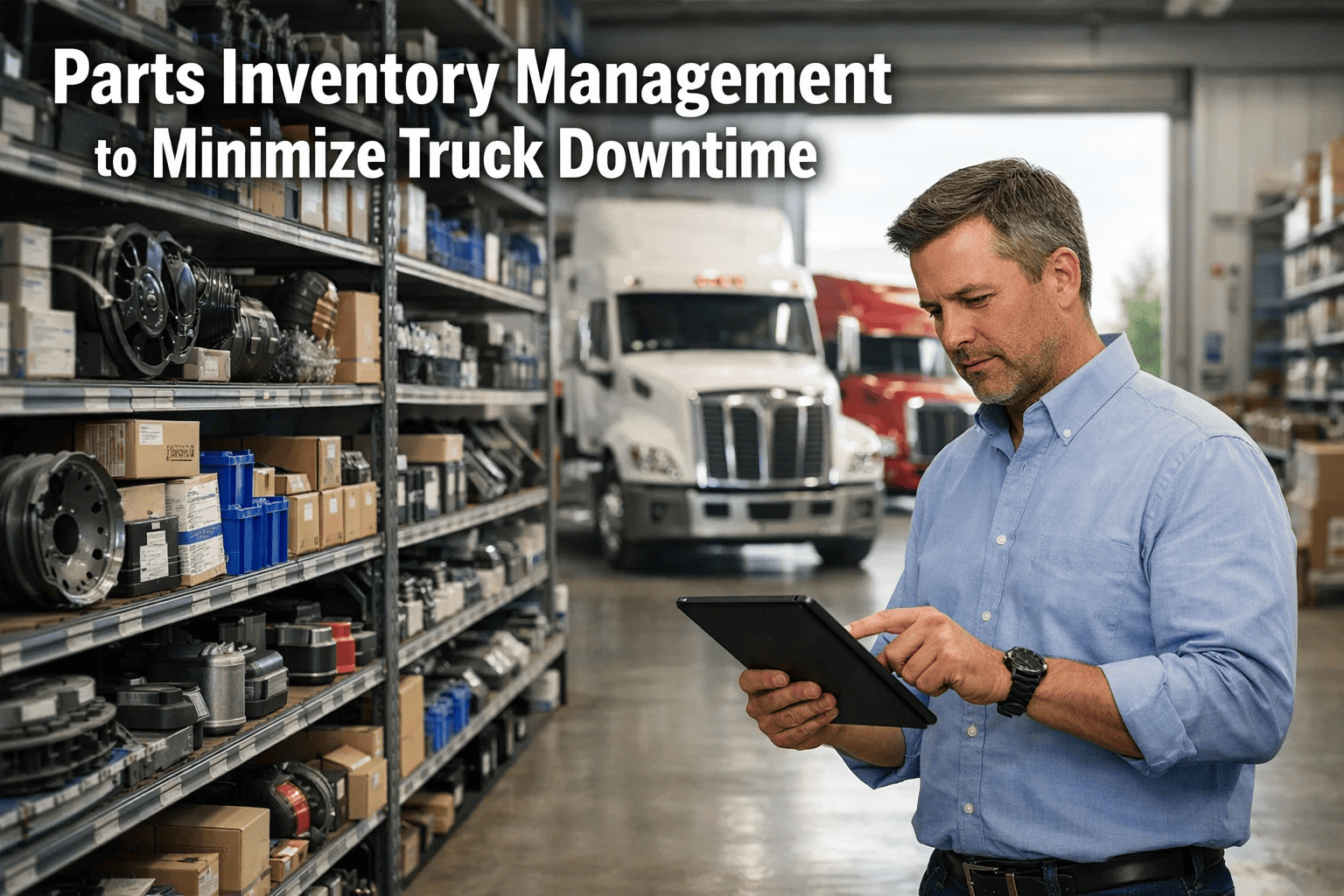
Parts inventory mismanagement is one of the most avoidable sources of extended vehicle downtime in commercial trucking fleets. Every hour a truck sits in the shop waiting for a part that should have been in stock is an hour of lost revenue, missed loads, and frustrated drivers — and the compounding effect across a large fleet can translate into hundreds of thousands of dollars in annual operating cost drag that does not appear on any single line item but accumulates steadily in the gap between planned maintenance intervals and actual vehicle availability. The trucking operations that manage parts inventory most effectively share a common discipline: they treat parts inventory as a strategic operating asset, not a passive stockroom expense, and they use integrated fleet management data to make decisions about what to stock, at what quantity, and when to reorder with the same analytical rigor they apply to fuel, maintenance scheduling, and driver compliance. This guide examines the structural reasons why parts inventory management fails in most trucking fleets, the operational consequences of inventory gaps, and how FleetRabbit's integrated fleet management platform gives fleet managers and operations executives the parts tracking, work order integration, and reorder alert capabilities needed to minimize truck downtime across both small regional carriers and large multi-terminal trucking operations. Book a demo to see how FleetRabbit integrates parts inventory tracking with preventive maintenance schedules and work order management for your fleet.
67%
of unscheduled shop visits involve waiting for parts not in stock at the time of the repair event
$1,200
average revenue loss per truck per day of unplanned downtime in long-haul and regional trucking operations
3.4 days
average repair cycle extension caused by parts unavailability versus repairs completed with on-hand inventory
22%
of fleet maintenance budgets consumed by emergency parts procurement at premium pricing when planned stock is absent
What This Guide Covers
Why fleet parts inventory fails despite established stocking policies
The full operational cost of parts-related truck downtime
Parts classification frameworks that match stock to vehicle failure patterns
How FleetRabbit connects parts inventory to PM schedules and work orders
Automated reorder alert configuration for high-criticality parts categories
Multi-terminal parts inventory coordination across distributed fleet operations
Building the business case for inventory investment with downtime cost data
KPIs and reporting frameworks for parts program executive visibility
Why Parts Inventory Programs Fail in Commercial Trucking Fleets
Fleet managers who have implemented a parts stocking policy and still find themselves ordering emergency parts on a weekly basis are not encountering bad luck — they are encountering the predictable failure modes of an inventory program that was designed without the data integration required to remain current with a fleet's actual failure patterns. Parts inventory programs fail for four primary structural reasons, and understanding each is prerequisite to building a system that actually reduces unplanned downtime rather than simply making the problem more expensive by adding stock without strategic allocation.
The first failure mode is static stocking lists that do not reflect current fleet composition. A parts list built for a fleet of 2018-vintage Peterbilt 579s will systematically understock the components that fail most frequently on 2022-vintage Kenworth T680s or newer Freightliner Cascadias acquired in subsequent tractor purchases. Fleet composition changes continuously through acquisition cycles, trade decisions, and lease returns, but parts inventory lists are often reviewed annually at best — leaving a growing gap between the parts on hand and the parts the current fleet actually consumes.
The second failure mode is inventory tracking that is disconnected from work order history. When parts usage is recorded on paper shop tickets or in a separate tracking system from the fleet management platform where work orders are created and closed, the consumption data needed to identify reorder points is unavailable or requires manual reconciliation that few service managers have time to do consistently. The result is a stocking system run on institutional memory and experience rather than actual consumption data — which works well when experienced service managers are present and fails when they are absent, on vacation, or replaced.
The third failure mode is the absence of failure pattern analysis linking vehicle inspection findings to parts consumption. Vehicles that show specific condition findings on DVIR inspections or PM inspections — elevated wear metal readings, vibration signatures, visible wear pattern indicators — are statistically more likely to require specific parts within defined mileage windows. Fleets that capture inspection data in a system that can be analyzed against subsequent work order parts consumption can identify these leading indicators and pre-stage parts before the breakdown occurs. Fleets that capture inspection data on paper or in disconnected systems cannot.
The fourth failure mode is single-location inventory thinking in multi-terminal operations. Large trucking companies operating maintenance facilities at multiple terminals frequently find that parts are overstocked at one location and unavailable at another when needed — a distribution problem rather than a total inventory problem. Without real-time visibility into parts inventory across all locations from a single management interface, the response to a parts-out event at one terminal is an emergency purchase rather than an inter-terminal transfer that would have resolved the need at lower cost.
01
Static Stocking Lists
Parts lists built around historical fleet composition become progressively less accurate as vehicle mix changes through acquisition cycles, lease programs, and trade-in decisions — without a mechanism to update stocking requirements when fleet records change.
02
Disconnected Inventory and Work Orders
When parts usage is tracked separately from the work order system, consumption data cannot generate automatic reorder signals or trend analysis — leaving stocking decisions to judgment rather than actual usage history.
03
No Inspection-to-Parts Linkage
Inspection findings that predict imminent component failure are not connected to parts staging decisions — so the part needed for the predictable repair is ordered after breakdown rather than pre-staged from the inspection finding.
04
No Cross-Terminal Visibility
Multi-terminal operations without centralized inventory visibility default to emergency purchasing when the needed part is out of stock locally — even when the same part is overstocked at a nearby terminal a short transfer away.
The Complete Cost of Parts-Related Downtime in Trucking Operations
Fleet managers building an internal business case for investment in parts inventory management infrastructure consistently underestimate the full cost of parts-related downtime because the most visible component — the premium pricing paid for emergency parts procurement — is typically only a fraction of the total economic consequence. A disciplined cost model for parts-related downtime includes five categories, each of which should be quantified separately when building the case for inventory program investment.
Revenue Loss per Day
$800 to $1,400
At an average revenue per truck per day of $1,000 to $1,400 in long-haul operations and $800 to $1,100 in regional operations, each additional day of downtime caused by parts unavailability carries a direct revenue consequence. For a 50-truck fleet experiencing an average of 1.5 additional downtime days per vehicle per year due to parts delays, the annual revenue impact exceeds $75,000 on conservative assumptions.
Emergency Parts Premium
15% to 40%
Emergency parts procurement — expedited shipping, after-hours dealer purchase, or spot-market sourcing — consistently costs 15 to 40 percent more than the same part purchased through planned procurement channels. For high-cost components such as injectors, turbochargers, and aftertreatment system components, this premium can represent hundreds of dollars per event.
Driver Detention and Downtime Pay
$180 to $340/day
Drivers waiting for vehicle repairs in the shop — or stranded roadside waiting for a service vehicle with the needed part — generate detention pay obligations that vary by carrier pay structure but commonly range from $180 to $340 per driver per delay day. For owner-operators under lease agreements, the carrier's exposure may also include guaranteed minimum payment provisions that apply regardless of whether the truck operates.
Load Rejection and Customer Penalty
$250 to $2,000
When vehicle unavailability causes a carrier to miss pickup commitments, the consequences range from load rejection fees under spot contracts to more significant consequences under dedicated service agreements and contracted freight programs. For carriers operating under dedicated contracts with service level provisions, a recurring downtime pattern can trigger contract penalties or, in extreme cases, volume reallocation that affects long-term revenue stability.
Service Labor Inefficiency
40% to 60% waste
Labor hours paid to technicians who are waiting for parts rather than performing repairs represent a direct productivity loss. In fleets where shop capacity is constrained, a parts delay that holds a technician idle for four hours is not only the cost of those four idle hours — it is the cost of the four hours plus the downstream backlog that accumulates when other vehicles cannot enter the service bay the idle technician is occupying.
Parts Classification Frameworks That Match Stock to Vehicle Failure Patterns
Effective parts inventory strategy begins with a classification framework that distinguishes between parts categories based on failure frequency, downtime consequence, lead time, and cost — not simply based on how often they have been ordered historically. The failure pattern data for commercial trucking fleets follows predictable distributions that make systematic classification feasible, and fleets that build their stocking strategy around these patterns consistently achieve higher parts availability at lower total inventory carrying costs than fleets that stock broadly without prioritization.
| Parts Category |
Failure Pattern |
Recommended Stocking Strategy |
Reorder Trigger |
| Filters and Fluids |
Predictable PM interval consumption — oil filters, air filters, fuel filters, DEF |
Stock to PM schedule volume with 30-day buffer minimum. Reorder automatically at 50% of monthly consumption volume |
PM schedule integration via FleetRabbit — forecast consumption 60 days forward |
| Brake Components |
Semi-predictable wear consumption — brake shoes, pads, drums, rotors, slack adjusters |
Stock based on inspection finding frequency. High-mileage fleets should maintain 4-week supply of brake shoe and pad inventory |
DVIR brake defect findings tracked in FleetRabbit trigger parts pre-staging flag |
| Lighting and Electrical |
High-frequency random failure — marker lights, turn signals, conspicuity tape, connectors |
Maintain high on-hand counts due to DVIR frequency and CSA violation consequence. Never run below 2-week supply |
Weekly DVIR defect report from FleetRabbit drives automatic consumption tracking and reorder |
| Tires and Wheels |
Combination of scheduled replacement and unplanned damage — blowouts, road hazard |
Maintain pre-negotiated dealer account for rapid access. Stock road hazard repair supplies and steer axle emergency spares |
FleetRabbit tire condition records from inspections flag tires approaching replacement threshold |
| Belts, Hoses, and Seals |
Age and mileage-driven degradation — predictable lifecycle with catastrophic failure risk |
Stock vehicle-specific belt and hose kits for high-population vehicle models. Replace on PM schedule rather than waiting for failure |
PM interval schedule in FleetRabbit generates automatic parts consumption forecast |
| Injectors and Fuel System |
High-cost, unpredictable failure — significant downtime and emergency premium on parts |
For large fleets, maintain 2-4 remanufactured injector sets per engine model. Smaller fleets rely on rapid dealer supply agreements |
Oil analysis metal content trend in FleetRabbit flags early injector wear before failure event |
| DPF and Aftertreatment |
Progressive soot loading — predictable cleaning interval with failure risk in high-idle operations |
Maintain DPF cleaning service agreement with defined turnaround. Stock DPF gaskets and sensors for self-service cleaning fleets |
FleetRabbit idle analytics correlate to DPF cleaning frequency — proactive scheduling from data |
How FleetRabbit Connects Parts Inventory to Preventive Maintenance and Work Orders
The central capability gap in most fleet parts inventory programs is the absence of a live connection between the parts stock record and the maintenance work being planned, scheduled, and executed against the fleet. When parts inventory is tracked in a shop management system or a simple spreadsheet that does not communicate with the platform where PM schedules are built and work orders are generated, the service manager has to manually reconcile upcoming maintenance workload with current parts availability — a process that works inconsistently and fails at precisely the moments when it matters most: when multiple vehicles are approaching a service interval simultaneously, when a surge in roadside breakdowns overwhelms normal stocking levels, or when a new vehicle model joins the fleet with different parts requirements than the existing inventory is designed to support.
FleetRabbit addresses this gap by building parts inventory tracking into the same platform where preventive maintenance schedules are configured and work orders are created and managed. When a PM task is scheduled for a vehicle, FleetRabbit can check current parts inventory against the parts required for that PM task and flag potential shortfalls before the vehicle arrives in the shop — giving service managers time to order needed parts proactively rather than discovering the shortage when the vehicle is already on the lift waiting for service. When a work order is completed and parts are consumed, the inventory record is updated automatically from the work order, maintaining an accurate running inventory count without a separate manual data entry step.
FleetRabbit Parts and PM Integration
See how FleetRabbit's work order management, PM scheduling, and parts inventory tracking work together in a unified platform to reduce parts-related truck downtime across your entire fleet operation.
Configuring Automated Reorder Alerts for High-Criticality Parts
The automated reorder alert is the operational mechanism that prevents the inventory gap from developing in the first place — but its effectiveness depends entirely on the accuracy of the minimum stock level and reorder point configuration that drives the alert. Fleet managers who configure reorder alerts at arbitrary round numbers without grounding them in actual consumption data will find that alerts fire too early and create unnecessary procurement activity, or too late and fail to prevent the stockout they were designed to prevent. The correct configuration approach uses work order consumption history from FleetRabbit to calculate data-driven minimum stock levels for each parts category, and then sets the reorder alert at the point where an order placed at the configured vendor's standard lead time will arrive before the minimum stock level threshold is crossed.
Step 01
Extract 12-Month Consumption History by Parts Category
Pull 12 months of work order parts consumption data from FleetRabbit for each parts category. Calculate total units consumed per month, average monthly consumption, and peak month consumption. The peak month value will inform the safety stock calculation.
Step 02
Calculate Lead Time for Each Supplier
Document the standard order-to-receipt lead time for each parts category from the primary and secondary suppliers. Lead times vary dramatically — local dealer stock for common parts may be same-day while OEM specialty components on backorder can require 15 to 30 days. The reorder point must account for the full lead time of the longest-needed procurement scenario.
Step 03
Set Safety Stock Level at Peak Consumption Times Lead Time
Safety stock — the inventory cushion that prevents stockout during periods of above-average consumption or extended lead time — should equal peak monthly consumption multiplied by the fraction of a month equal to the lead time. For a part consumed at 20 units per month at peak, with a 10-day lead time, safety stock is approximately 6 to 7 units.
Step 04
Configure Reorder Point as Average Consumption Times Lead Time Plus Safety Stock
The reorder point — the on-hand inventory level that triggers the alert — equals average monthly consumption multiplied by the lead time fraction plus safety stock. For the same example: average consumption of 15 units per month over a 10-day lead time is 5 units, plus 7 units safety stock, equals a reorder point of 12 units on hand. Enter this value as the minimum threshold in FleetRabbit's alert configuration.
Step 05
Review and Update Minimum Levels Quarterly
Consumption rates change as fleet composition shifts, routing patterns evolve, and seasonal maintenance cycles create demand variations. Quarterly review of FleetRabbit consumption data against configured minimum levels ensures that alert thresholds remain accurate rather than becoming progressively disconnected from actual fleet consumption patterns over time.
Multi-Terminal Parts Inventory Coordination for Distributed Fleet Operations
Trucking companies operating maintenance facilities at multiple terminal locations face parts inventory challenges that single-location operations do not encounter — and the most economically significant of these challenges is the simultaneous occurrence of stockout at one terminal and overstock of the same part at another. Without centralized inventory visibility across all terminal locations, the response to a parts-out event is always an emergency purchase from an external supplier, even when the needed part is sitting in excess quantity on a shelf at a terminal 200 miles away. The carrying cost of the overstocked terminal's excess inventory and the emergency purchase premium at the understocked terminal represent a combined inefficiency that, across a large multi-terminal fleet, can total hundreds of thousands of dollars annually.
FleetRabbit's multi-site fleet management architecture provides fleet managers and VP of Operations stakeholders with a consolidated view of parts inventory across all terminal locations from a single dashboard. When a reorder alert fires at one terminal, the fleet manager can immediately check whether the same part is overstocked at another terminal before placing an external purchase order — enabling a lower-cost inter-terminal transfer that resolves the immediate need while also reducing the carrying cost burden at the overstocked location. Over time, this inter-terminal visibility enables a more strategic allocation of central parts purchasing across the fleet's distribution of terminals, reducing the total inventory investment required to maintain consistent parts availability across all locations simultaneously.
Challenge
Distributed Inventory Blind Spots
Multi-terminal operations without centralized visibility default to emergency purchasing when local stock is exhausted — even when the same parts are overstocked at a nearby location, generating dual costs of excess carrying at one terminal and premium procurement at another.
FleetRabbit Solution
Centralized Multi-Site Dashboard
Fleet managers see inventory positions across all terminal locations in one view. Reorder alerts include cross-terminal availability data, enabling inter-terminal transfer decisions before external procurement is initiated.
Operational Outcome
15% to 25% Inventory Cost Reduction
Multi-terminal fleets using centralized inventory management consistently report 15 to 25 percent reductions in total parts procurement cost within 12 months — driven by reduced emergency purchasing and more strategic central stock allocation across terminal network.
FleetRabbit Capabilities That Directly Reduce Parts-Driven Truck Downtime
Fleet managers evaluating FleetRabbit for parts inventory management most commonly ask the same question: how does this platform reduce the specific downtime events we experience most frequently, rather than just providing better visibility into the problem? The answer lies in the integration architecture that connects inspection findings, PM schedules, work orders, and parts inventory into a single operational data flow — enabling actions at each stage of the maintenance process that prevent the next stage from becoming an unplanned event.
Preventive Maintenance
FleetRabbit forwards PM schedule data to parts inventory forecasting, generating a 90-day consumption projection that allows planned procurement at contracted pricing. Parts required for scheduled PM tasks are flagged as committed inventory, preventing them from being consumed on ad-hoc work orders that would then cause a PM parts shortage when the scheduled vehicle arrives in the shop.
Inspection and Defect Management
DVIR and periodic inspection findings recorded in FleetRabbit are automatically categorized by defect type. For defect categories that have a high historical correlation with subsequent repair work orders — brake defects, lighting defects, tire condition findings — the platform flags associated parts for pre-staging inquiry, giving service managers a proactive signal that specific inventory may be needed in the near term.
Work Order Parts Recording
Technicians recording repair activity in FleetRabbit work orders document parts used directly in the work order record. This consumption recording does three things simultaneously: it updates the live inventory count, it adds to the historical consumption data that drives reorder point calibration, and it creates a cost record against the vehicle's lifetime maintenance expenditure for asset lifecycle analysis.
Reorder Alert and Procurement Workflow
When inventory falls to the configured minimum threshold, FleetRabbit's alert system notifies the designated parts administrator with the part number, on-hand count, consumption rate, and recommended order quantity. The alert includes vendor contact information from the supplier record, reducing the order initiation time from alert to purchase order placement.
Executive Cost Reporting
FleetRabbit generates consolidated parts cost reports for VP of Operations and CFO stakeholders, showing total parts expenditure by terminal, by vehicle, and by parts category — with trend lines that quantify the cost reduction trajectory as the inventory management program matures. This executive visibility provides the data foundation for continued investment in inventory optimization and the organizational accountability required to sustain program discipline.
Building the Business Case for Parts Inventory Investment
The decision to invest in structured parts inventory management — including the software integration, the working capital increase required to bring stock to optimal levels, and the process changes required to maintain data discipline across the shop team — requires a credible return-on-investment calculation that converts abstract operational improvements into the financial terms that CFO and ownership stakeholders respond to. The ROI calculation for parts inventory investment is straightforward when the baseline data is available, and FleetRabbit's historical work order and downtime reporting provides the baseline data needed to construct it with confidence.
Current State: Parts-Related Downtime Days
150 days per year across fleet (1.5 days per truck average)
Revenue Loss per Downtime Day
$1,000 average per truck per day
Current Annual Revenue Loss from Parts Delays
$150,000 per year
Emergency Procurement Premium (at 25% above planned rate)
$35,000 to $50,000 per year
Target: Reduce Parts-Related Downtime by 60%
90 fewer downtime days per year
Revenue Recovery at 60% Downtime Reduction
$90,000 per year
Total Annual Benefit (Revenue + Procurement Premium Reduction)
$115,000 to $140,000 conservatively
Key Performance Indicators for Fleet Parts Inventory Management
Parts inventory management programs that are measured only by absence — the number of times a part was not available when needed — consistently underperform programs that track a structured set of positive leading and lagging indicators. The following KPI framework gives fleet managers and their operations leadership the measurement structure needed to evaluate program performance, identify improvement opportunities, and demonstrate the financial impact of inventory improvements in terms that motivate continued organizational support.
Parts Fill Rate
Percentage of work order parts requests fulfilled from on-hand inventory without emergency procurement. Target: 92% or higher for PM and wear components; 75% or higher for emergency repair components.
Source: FleetRabbit work order parts recording versus emergency purchase records
Stockout Events per Month
Number of occasions per month where a required part was not available in stock, resulting in delayed repair start or emergency procurement. Baseline measurement before program launch defines the improvement benchmark.
Source: FleetRabbit reorder alert log and emergency purchase order history
Average Parts Wait Time per Repair
Average elapsed time between work order open and repair start attributable specifically to parts unavailability. Fleet-wide average should decline as inventory program matures. Target below 4 hours for planned repairs.
Source: FleetRabbit work order timestamps comparing open-to-start intervals by repair type
Emergency Procurement Spend Ratio
Emergency procurement spend as a percentage of total parts spend. Target reduction of this ratio by 40% within 12 months of structured inventory program implementation. Sustained target below 8% of total parts spend.
Source: FleetRabbit parts cost records distinguished by procurement channel and urgency classification
Inventory Accuracy Rate
Percentage of parts categories where the system record inventory count matches the physical count on quarterly reconciliation. Target above 95% accuracy. Accuracy below this level indicates consumption recording discipline failures that require process correction.
Source: Quarterly physical count compared to FleetRabbit inventory records by SKU
PM Parts Availability Rate
Percentage of scheduled PM visits where all required parts were on hand at the time the vehicle arrived for service. A high PM parts availability rate prevents service delays and the cascading effects of deferred maintenance on vehicle reliability.
Source: FleetRabbit PM schedule completion data combined with parts availability log for each service event
Frequently Asked Questions: Parts Inventory Management for Fleet Managers
How does FleetRabbit handle parts inventory for fleets with mixed vehicle makes and models that require different parts across the fleet?
FleetRabbit maintains parts records linked to specific vehicle makes, models, and engine configurations in the asset registry. When a PM task or work order is created for a specific vehicle, the parts requirements associated with that vehicle's configuration are automatically applied, ensuring that the correct part numbers are consumed from inventory rather than similar-but-incorrect parts for a different variant. For mixed fleets with multiple truck makes and engine families, this vehicle-specific parts linkage is the mechanism that prevents cross-inventory confusion and ensures that consumption data feeds the reorder alert for the correct parts category.
Can FleetRabbit's parts inventory alerts be configured to notify different people for different parts categories or urgency levels?
Yes. FleetRabbit supports configurable alert routing by parts category and urgency level. High-criticality parts — components where a stockout would immediately halt a vehicle — can be configured to alert both the service manager and the fleet director simultaneously. Routine reorder alerts for consumable parts can be directed to the parts administrator alone. This tiered alert routing ensures that critical inventory situations receive the escalation attention they require without flooding executive-level stakeholders with routine procurement notifications.
How should a fleet begin its parts inventory program if it has no historical consumption data to build reorder points from?
Fleet managers starting a parts inventory program without historical consumption data should use a two-phase approach. In phase one — typically the first 90 days on FleetRabbit — configure conservative (high) minimum stock levels based on industry benchmarks for the fleet's vehicle types and operational profile, and begin recording all parts consumption through work orders to build the consumption history needed for precise reorder point calculation. In phase two — months four through six — use the 90-day consumption data to recalibrate minimum stock levels and reorder alerts based on actual fleet experience rather than industry benchmarks. The initial overstocking cost of phase one is typically recovered within the first 12 months through emergency procurement cost reduction as the program matures.
What is the relationship between FleetRabbit's parts inventory module and the platform's preventive maintenance scheduling feature?
FleetRabbit's PM scheduling and parts inventory modules share the same underlying vehicle and maintenance data. When a PM interval is set for a vehicle — oil change every 15,000 miles, brake inspection every 20,000 miles — and the vehicle approaches that interval, the platform generates both a service due notification and a parts availability check against the inventory record for the parts required to complete that specific PM task. This dual-output capability means service managers receive advance notice of both the upcoming service need and any parts gaps that need to be resolved before the vehicle arrives in the shop — converting reactive parts ordering into a proactive, scheduled procurement process aligned with the PM calendar.
How does FleetRabbit support the documentation trail required when parts are transferred between terminals in a multi-location fleet?
FleetRabbit supports inter-terminal parts transfer documentation through the inventory management record, which allows fleet managers to record a transfer event that decrements the source terminal's inventory and increments the destination terminal's inventory simultaneously, creating an auditable trail of the transfer quantity, date, requesting party, and authorizing manager. This documentation is important both for inventory accuracy and for the internal cost allocation between terminals that many larger fleets track for departmental P&L reporting purposes.
Stop Losing Revenue to Parts That Should Have Been in Stock
FleetRabbit gives fleet managers and operations executives the integrated parts inventory tracking, automated reorder alerts, PM-linked forecasting, and multi-terminal visibility needed to eliminate the inventory gaps that extend truck downtime and inflate maintenance costs. The same platform that schedules preventive maintenance, manages work orders, and tracks driver compliance also manages the parts inventory that makes it all possible — without requiring a separate shop management system or manual data reconciliation to keep inventory records current.
Parts Inventory Management
Automated Reorder Alerts
PM-Linked Forecasting
Work Order Integration
Multi-Terminal Visibility
Truck Downtime Reduction
April 18, 2026
By Jason Smith
All Posts