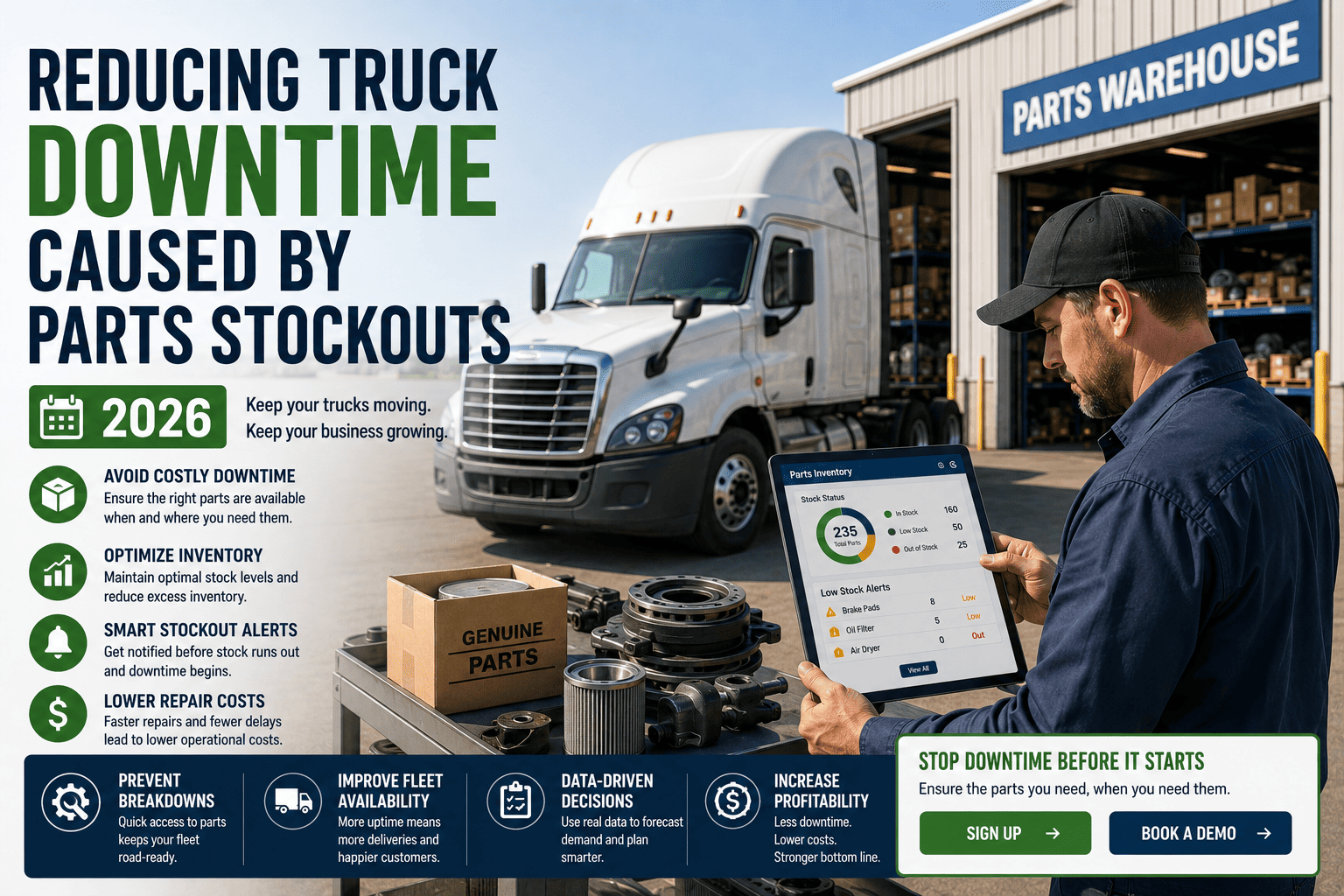
A forty-dollar hydraulic fitting can idle a three-hundred-thousand-dollar truck for days, and the reason is rarely the part itself, it is that nobody knew the stock had run out until a technician walked to an empty bin. Parts stockouts are one of the most preventable causes of fleet downtime, yet they remain one of the most common, because most fleets are still managing inventory on intuition and spreadsheets rather than actual consumption data. This guide breaks down exactly how stockouts turn into downtime, what it really costs, and how fleet managers can build a parts system that keeps critical components on the shelf before a truck ever needs them.
Vehicle downtime from a missing part typically costs 448 to 760 dollars per day, and a single critical stockout can total 10,000 to 20,000 dollars once emergency shipping, overtime, and missed routes are included. Fleets that switch from intuition-based to calculation-based reorder points cut stockout frequency by up to 60 percent within 90 days, and automated min and max inventory control has been shown to reduce stockout events by as much as 91 percent.
How A Missing Part Becomes A Multi-Day Breakdown
Stockouts rarely feel dramatic in the moment. A technician reaches for a part, finds the bin empty, and moves on to the next task while someone figures out ordering. That small delay is where the real cost begins, and it compounds quickly once you trace the full chain of events.
The Real Cost Of A Single Stockout
Vehicle downtime is expensive on its own, but a stockout adds layers of cost that a normal scheduled repair never incurs. Understanding the full picture makes it easier to justify investing in a proper inventory system before the next emergency order hits.
These costs rarely stop at the invoice for the part itself. Overtime labor stacks up as technicians wait on parts instead of moving to the next job. Delivery penalties accumulate when a route gets missed because the truck assigned to it is parked. Across a fleet running average breakdown rates, the operational hours lost to unplanned maintenance and parts delays add up fast, and most of it traces back to inventory visibility that simply was not there when the part was needed.
FleetRabbit tracks every part against real usage history and flags shortages before a technician ever reaches for an empty bin. Sign up free and import your parts inventory in under an hour.
Why Fleets Actually Run Out Of Critical Parts
Stockouts are rarely caused by bad luck. They are almost always a symptom of how inventory decisions get made. The average commercial fleet wastes a meaningful share of its parts budget on rush orders, duplicate stock, and obsolete inventory sitting untouched for years, and the root cause is usually one of the same three patterns.
Reorder Points Based On Guesswork
Many fleets set reorder thresholds once, based on gut feeling, and never revisit them as usage patterns shift. A part that used to move slowly can suddenly become high-demand as the fleet ages, and a static reorder point never catches that change.
Manual Logging With A Built-In Delay
When parts usage is recorded by hand instead of automatically, there is often a multi-hour gap between a part being used and the inventory count actually reflecting it. During that window, decisions get made on data that is already wrong.
Single-Supplier Dependency
Fleets relying on one supplier for critical parts have no fallback when that supplier faces a delay. Qualifying a secondary supplier for high-impact parts closes that gap and has been shown to meaningfully cut supply-related stockouts.
Calculating Reorder Points That Actually Prevent Stockouts
A reorder point is the stock level that triggers a new order, calculated so the replacement arrives before you run out. The formula combines three real numbers rather than a guess: average daily usage, supplier lead time in days, and a safety stock buffer sized to account for demand variability. Parts with unpredictable failure patterns need a larger buffer than parts that wear out on a predictable mileage or time cycle.
| Part Category | Demand Pattern | Recommended Safety Stock | Forecasting Approach |
|---|---|---|---|
| Scheduled Wear Parts | Predictable, mileage or time based | Low to moderate buffer | Forecast weeks in advance from maintenance schedules |
| Critical Failure Parts | Irregular, high downtime impact if missing | High buffer regardless of cost | Track failure history closely, never let stock hit zero |
| Low-Velocity Specialty Parts | Rare, vehicle or model specific | Minimal or zero on-hand stock | Order on demand with expedited supplier agreements |
Why This Math Actually Works
Fleets that migrate from intuition-based to calculation-based reorder points reduce stockout frequency by roughly 60 percent within 90 days, simply because the trigger point reflects real consumption instead of a number someone picked when the storeroom was first stocked.
Applying The 80/20 Rule To Critical Parts
Not every part deserves the same inventory attention. A small share of your parts catalog is responsible for most of your downtime risk, and identifying that group is one of the highest-leverage moves in stockout prevention.
FleetRabbit categorizes every part by demand pattern and forecasts predictable-cycle parts weeks in advance, so you stock what matters and stop tying up cash in parts that rarely move. Book a 30-minute demo to see it applied to your own catalog.
Building A Stockout-Proof Inventory System
Fixing stockouts permanently requires connecting inventory to the rest of your maintenance operation, not treating it as an isolated storeroom problem. The fleets seeing the biggest improvement follow the same sequence.
Track Actual Usage History, Not Estimates
Pull twelve months of real consumption data from your work orders for every part number. Estimated usage consistently misses seasonal patterns and fleet-age shifts that actual data catches immediately.
Automate Parts Deduction From Work Orders
When a technician installs a part, inventory should update instantly rather than through end-of-day batch processing. That real-time deduction is what allows a reorder trigger to fire before the shelf actually hits zero.
Set Calculated Min and Max Thresholds
Replace guessed reorder points with thresholds calculated from usage rate, supplier lead time, and demand variability, and revisit them quarterly as your fleet's parts consumption naturally shifts over time.
Qualify A Second Supplier For Critical Parts
For the parts identified in your critical 20 percent, keep a backup supplier relationship active so a single vendor delay never becomes a fleet-wide stockout.
Measuring Whether Your Inventory System Is Actually Working
A stockout-proof system should show measurable movement in a few clear indicators. Track stockout frequency per month and watch it trend toward zero for parts in your critical 20 percent. Track the delay between a part being used and inventory reflecting that usage, aiming to compress it from hours down to real time. Track emergency order frequency, since every rush order at three to five times standard cost is a signal your reorder points need retuning. Track inventory carrying cost as a percentage of your total parts budget, since a well-tuned system typically reduces that figure by 30 to 40 percent even while stockouts drop.
Key Takeaways On Preventing Stockout-Driven Downtime
A parts stockout is almost never about the part itself, it is about the visibility gap that let the shelf go empty without anyone noticing. That gap is entirely closeable. Real-time usage tracking, calculated reorder points, an 80/20 approach to safety stock, and a qualified backup supplier for critical parts together turn stockouts from a recurring surprise into a rare, well-managed exception.
The math favors acting sooner rather than later. A single avoided stockout, at 448 to 760 dollars per day of downtime, often covers the cost of a proper inventory system many times over, and the fleets already making this shift are reporting far fewer emergency orders and meaningfully lower carrying costs within the first quarter of implementation.
FleetRabbit connects parts inventory directly to work orders and maintenance schedules, tracking real usage, automating reorder triggers, and keeping critical parts on the shelf before a truck ever needs them.