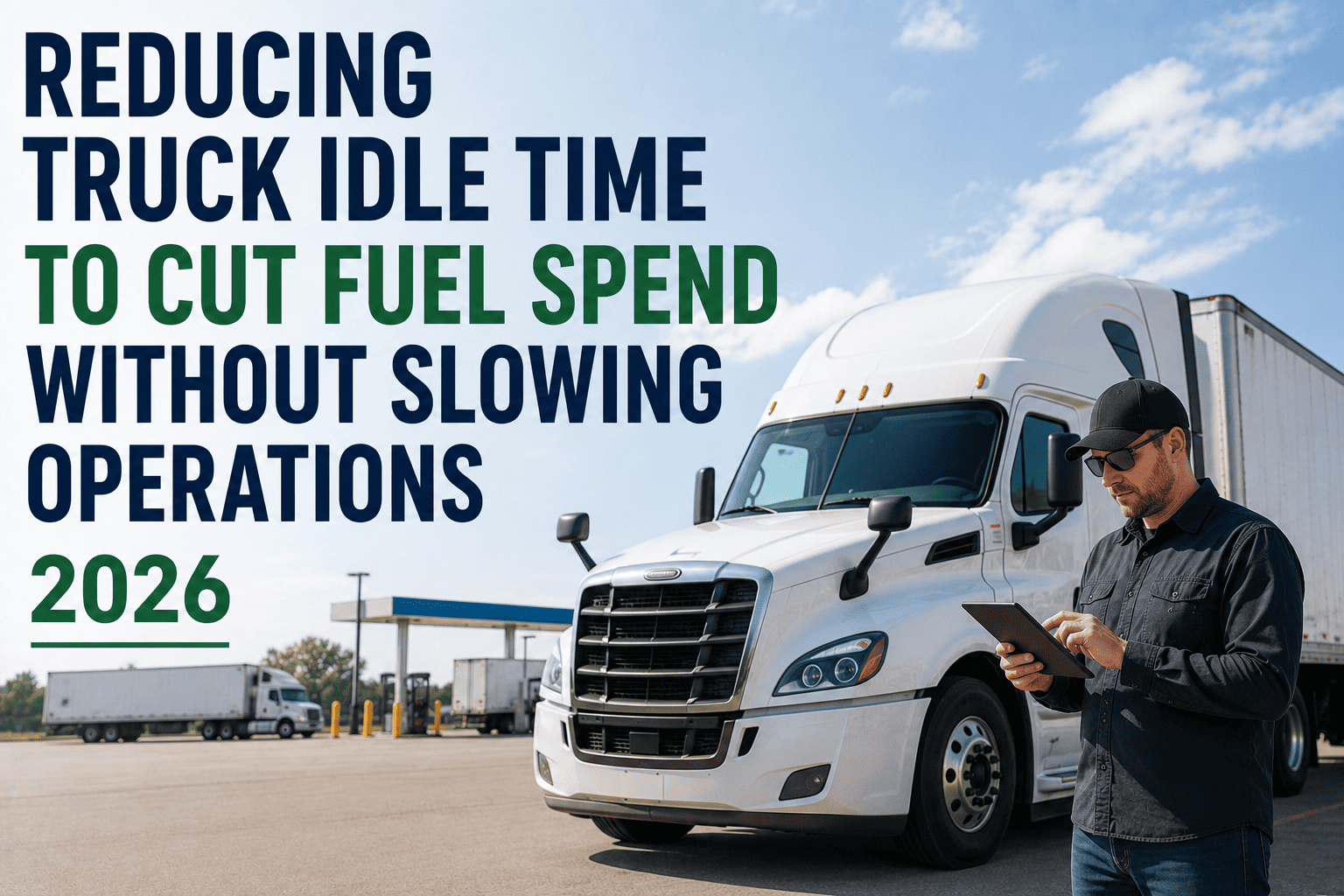
A truck sitting still with the engine running looks harmless. It isn't moving, it isn't hauling freight, and it feels like a non-event. But idle time is one of the few fleet costs that burns real money for zero output, hour after hour, truck after truck. Most fleets never measure it closely enough to see how large it has grown, because it never shows up as a single line item. It hides inside the fuel bill, inside engine hours, inside maintenance intervals that arrive sooner than expected. Reducing it doesn't require slower routes, fewer loads, or any operational sacrifice. It only requires visibility into something that is already happening in plain sight.
A Class 8 truck idling 6 to 8 hours a day burns roughly 0.8 gallons of diesel per hour for zero miles driven. Across a 100-truck fleet, that adds up to more than 58000 dollars in wasted fuel annually. Telematics-based idle monitoring paired with driver coaching cuts idle time by 30 to 35 percent within the first six months, often paying for itself inside a single fuel cycle.
Idle Hours Per Truck
Diesel Wasted Per Hour
What Coaching Recovers
Why Idle Time Quietly Becomes a Budget Problem
Idle time grows in small, reasonable-looking increments. A driver runs the engine for cab comfort during a 20-minute dock wait. Another idles through a lunch break rather than restart later. A third warms the engine out of habit before a cold-morning start. None of these moments feel like waste in isolation. Stacked across a full year and a full fleet, they become one of the largest controllable costs most trucking operations carry, and one of the least visible on a standard expense report.
The reason idle time stays invisible is structural. Fuel invoices show total gallons purchased, not gallons burned while stationary. Maintenance records show when an oil change happened, not that it happened early because idle hours inflated engine time. A fleet manager reviewing monthly numbers sees rising fuel costs and assumes routes got longer or diesel got more expensive. Often, the real story is sitting in plain sight: engines running with nothing to show for it.
This is also why idle reduction is the fastest fuel-saving opportunity available to most fleets. It requires no new trucks, no route redesign, and no infrastructure spend to start. It only requires turning on the visibility that tells you where the hours are going, then giving drivers a reason to change a habit that nobody set out to form. Sign up for FleetRabbit and that visibility is live across your fleet within days.
Where Idle Hours Actually Come From
| Idle Source | Typical Share of Idle Time | Why It Happens | How to Reduce It |
|---|---|---|---|
| Cab comfort | 30 to 40 percent | Heating or cooling the cab during breaks and rest periods | Auxiliary power units or battery HVAC systems remove the need for the main engine |
| Waiting on dispatch or dock | 20 to 30 percent | Engine left running during loading, unloading, or queue delays | Geofenced shutdown alerts and better dock scheduling coordination |
| Habitual warm-up or cool-down | 10 to 15 percent | Drivers running the engine before a start or after a stop out of routine | Driver education and automatic engine shutoff timers |
| Traffic and stop-and-go delay | 10 to 15 percent | Engine running while stationary in congestion | Route optimization to avoid known congestion windows |
| Power take-off operation | 5 to 10 percent | Operational idling for lift gates, mixers, or pumps that need engine power | Classify as justified idle and exclude from driver coaching scores |
Distinguishing operational idling from avoidable idling matters. A concrete mixer running its drum or a lift gate cycling under power take-off is doing real work. The opportunity sits in the other categories, where the engine runs and nothing happens at all.
Idle Monitoring That Actually Gets Used
FleetRabbit separates avoidable idle from operational idle automatically, so coaching conversations focus on the time that's actually recoverable. Real-time alerts, weekly scorecards, and fleet-wide idle cost tracking, live in days.
Four Steps to Cut Idle Time Without Slowing Operations
Establish your idle baseline
Pull current idle hours per truck and per driver for the last 30 days before changing anything. You cannot prove improvement, or justify the program to leadership, without a starting number.
Separate avoidable idle from operational idle
Power take-off operations, traffic delays, and required rest-period climate control are not the target. Isolating true waste keeps coaching focused and keeps drivers from feeling unfairly penalized.
Set real-time alerts, not monthly reports
An alert that fires after 10 minutes of avoidable idle changes behavior in the moment. A report reviewed three weeks later only explains what already happened.
Turn data into a weekly driver scorecard
Fleets that pair monitoring with visible, recurring feedback see idle drop twice as far as fleets using monitoring alone. Recognition and small incentives outperform penalties for sustained change.
Most of this can run manually for a small fleet with a spreadsheet and a patient manager. At scale, it becomes a full-time job that nobody has time for, which is exactly why automated tracking matters more as your truck count grows. Book a demo to see how this four-step process runs automatically inside FleetRabbit.
What Idle Reduction Is Actually Worth
One truck idling 7 hours a day, 300 days a year, at 0.8 gal/hr
≈ $5,880 / yearSame idle pattern, fleet of 25 trucks
≈ $147,000 / yearSame idle pattern, fleet of 100 trucks
≈ $588,000 / yearCutting that idle pattern by just 30 percent on a 100-truck fleet recovers roughly 176,000 dollars a year in fuel alone, before counting reduced engine wear or extended maintenance intervals.
Beyond Fuel: The Hidden Maintenance Cost of Idling
Hours Without Movement
Maintenance Arrives Early
Anti-Idling Penalties
Choosing the Right Idle Reduction Approach
Not every fleet needs the same fix. The right combination depends on idle hours per truck, climate, and whether idling happens mostly overnight, mid-route, or at fixed locations like docks and yards.
Start here if idle hours are moderate
- Telematics-based idle monitoring and alerts
- Automatic engine shutoff after a preset threshold
- Weekly driver scorecards tied to fleet ranking
Add this if idle hours stay high
- Auxiliary power units for overnight climate control
- Shore power at yards and distribution centers
- Geofenced shutdown prompts at known wait locations
Most fleets see the fastest return from the first column. Monitoring and coaching require no capital investment and typically pay back within a single fuel cycle, which is why it makes sense to start there before adding hardware. A free sign up with FleetRabbit gives you the monitoring layer immediately, with no commitment required to test it against your own fleet's numbers.
Benchmarks Worth Tracking
| Metric | Healthy Range | Investigate Above |
|---|---|---|
| Idle time as % of engine-on hours | Under 15% | Above 25% |
| Avoidable idle minutes per truck, daily | Under 20 minutes | Above 45 minutes |
| Idle fuel cost per truck, annually | Under $2,500 | Above $4,500 |
| Fleets using electronic engine controls | Industry average 83% | Below 60% lags peers |
Frequently Asked Questions
The Bottom Line on Idle Time
Idle time is the rare fleet cost that can shrink without touching a single route, hiring a single driver, or buying a single truck. The fuel is already in the tank. The only question is whether it turns into miles or evaporates while the truck sits still. Fleets that measure idle hours by truck, separate avoidable from operational idle, and give drivers weekly feedback consistently recover 30 percent or more of that wasted fuel within months, not years.
The gap between a fleet that tracks idle time and one that doesn't is rarely a difference in driver quality. It's a difference in visibility. Once idle hours are visible, per truck and per driver, the savings tend to follow on their own.
Find Out What Your Fleet's Idle Time Is Really Costing
FleetRabbit tracks idle hours by truck and driver automatically, separates avoidable idle from operational idle, and turns the data into weekly scorecards your team will actually use. See where the fuel is going before your next fill-up.