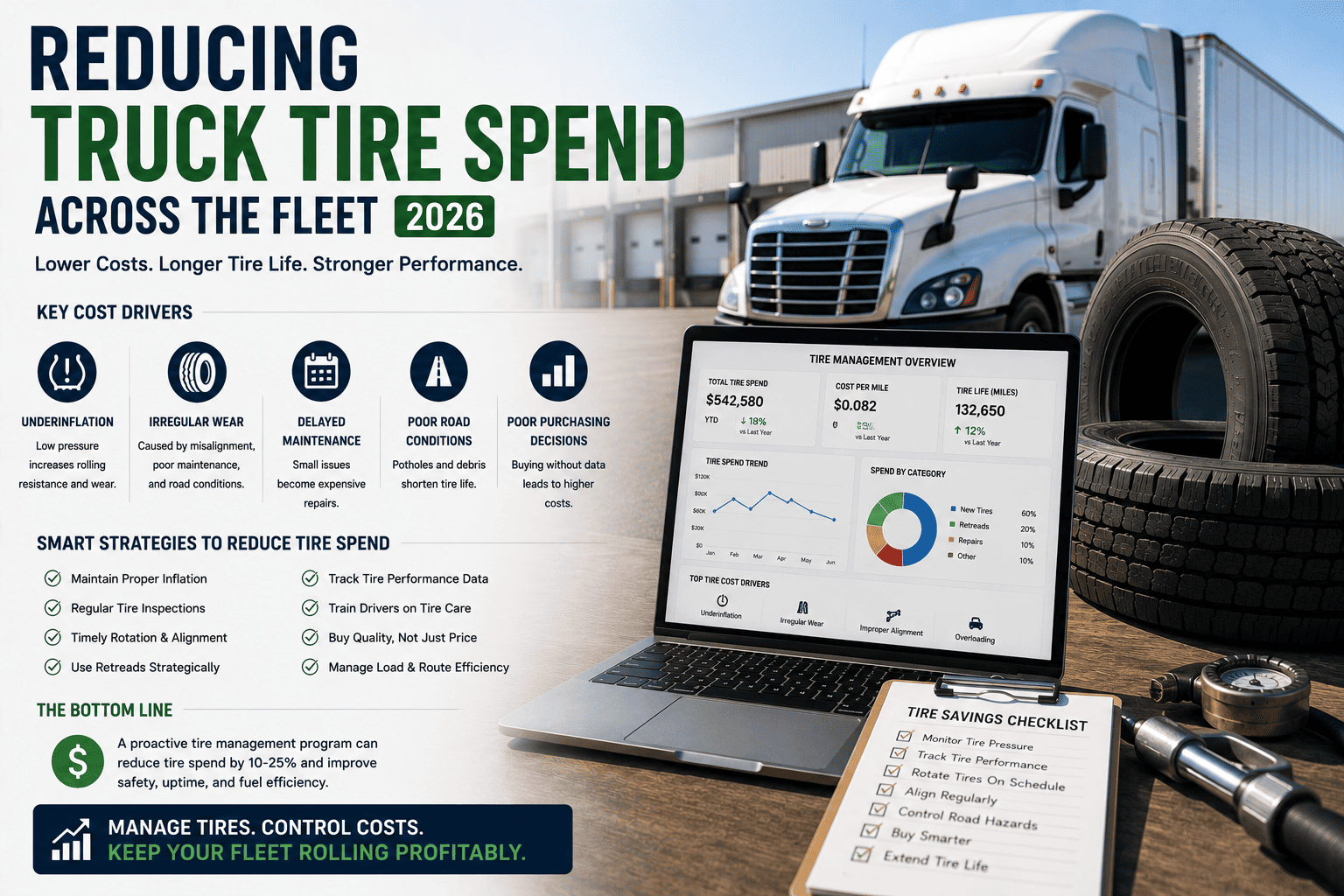
Tires rarely get the attention fuel and maintenance budgets do, yet they quietly consume 10 to 15 percent of total fleet operating cost, putting them right alongside fuel as one of the three biggest line items a fleet manager controls. The frustrating part is how much of that spend is avoidable. A tire that's ten pounds under pressure, a steer axle that's slightly out of alignment, or a rotation schedule that keeps slipping doesn't look like an emergency on any given day, yet compounded across a fleet and a full year of miles, these small gaps quietly cost thousands of dollars per truck. Reducing truck tire spend isn't about buying cheaper tires. It's about catching the small, everyday issues before they turn into an early replacement.
Fleets reduce truck tire spend by controlling four levers: keeping tires at correct pressure, catching alignment issues early, following a consistent rotation schedule, and running a disciplined retread program on drive and trailer positions. Structured tire management programs typically cut total tire-related operating cost by 3 to 5 percent, which for a 50-truck fleet translates to $75,000 to $150,000 in annual savings. Digital inspection and tire tracking software makes these levers measurable instead of anecdotal. You can sign up for FleetRabbit to see tire tracking running on your own fleet.
Why Tire Spend Is Bigger Than It Looks
Most fleet managers see tire cost as the purchase price on an invoice, but that number is only the starting point. Poor tire management costs the average commercial fleet an estimated $2,500 to $4,000 per vehicle every year once you account for premature replacements, wasted fuel, unplanned road calls, and lost retread value. Multiply that across even a modest fleet and the number stops looking like a rounding error on the budget.
The Four Levers That Actually Move Tire Spend
Nearly every avoidable tire cost traces back to one of four controllable factors: inflation pressure, alignment, rotation discipline, and retread strategy. Fleets that systematically manage all four consistently outperform fleets that only react when a tire fails on the road.
| Lever | What Happens When It's Ignored | Cost Impact |
|---|---|---|
| Inflation Pressure | A tire underinflated by 10 PSI can wear up to 20 percent faster and burns noticeably more fuel | Thousands per truck annually in wasted fuel and early replacement |
| Alignment | A steer axle just 1/16 inch out of spec drags a tire sideways roughly 7 feet per mile driven | Can cut a tire's expected life in half over 100,000 miles |
| Rotation Discipline | Skipping systematic rotation lets wear concentrate unevenly across positions | Roughly 25 percent shorter tire lifespan fleet-wide |
| Retread Strategy | Scrapping casings instead of retreading throws away remaining tire value | Retreads cost 40 to 60 percent less while delivering most of the mileage |
Inflation Pressure: The Cheapest Fix With the Biggest Payoff
Underinflation is the single most common and most expensive tire problem on any fleet, and it's largely invisible without a system to catch it. As a rough industry rule, every 10 percent a tire is underinflated costs about 1 percent in fuel economy, and the excess flexing generates heat that shortens tire life on top of the fuel penalty. FMCSA data has found that fewer than half of heavy commercial vehicle tires stay within 5 PSI of target, which means manual spot checks alone simply aren't catching the problem at the scale most fleets need.
Why Manual Checks Fall Short
A driver's pre-trip walk-around catches an obviously flat tire, but it rarely catches the 10 to 15 PSI gap that's quietly costing fuel and tread life every single day. Tire pressure monitoring paired with a digital inspection record closes that gap by flagging pressure drift before it becomes a wear problem or a roadside violation.
What Good Inflation Discipline Looks Like
Cold pressure checks against the tire's rated specification, logged consistently rather than sporadically, are what separate fleets that get full tire life from fleets that don't. The goal isn't a single perfect check, it's a routine that catches drift week over week before it compounds.
FleetRabbit's digital inspections capture tire pressure and tread condition at every pre-trip, flag drift before it becomes a wear problem, and build a per-tire history that shows exactly where your fleet is losing money. See it on your own trucks by choosing to start a free trial or book a short demo.
Alignment and Rotation: The Wear You Don't See Coming
Misalignment is one of the most underestimated tire cost drivers because the damage happens gradually and rarely shows up as an obvious defect during a walk-around. A steer axle sitting just slightly out of toe specification drags a tire sideways over every mile driven, and over the course of 100,000 miles that scrubbing can destroy an expensive steer tire in half its expected life. A routine alignment check costs far less than the tire it protects.
Building a Rotation Schedule That Actually Holds
Rotation only works if it happens on schedule and if alignment issues aren't undoing the benefit at the same time. Fleets that track rotation intervals by vehicle, rather than relying on memory or a paper log that's easy to skip during a busy week, consistently get more even wear and longer tire life across every position.
Getting More Life Out of Every Casing With Retreads
Nearly half of all replacement truck tires in North America are retreads, and major fleets rely on them heavily because a well-maintained casing can support two to three retread cycles at a fraction of new tire cost. The economics only work, though, if casings are tracked and protected. Overheating from underinflation, road hazard damage, and running a casing too long before pulling it can eliminate its retread potential entirely, turning what should have been two or three more tire lives into a total loss.
What to Look For in Tire Management Software
Software that just logs a tire change after the fact doesn't move the needle. The platforms that actually reduce spend capture tread depth and pressure at every inspection, flag vehicles trending toward a violation before roadside does, and roll all of that data up into per-tire and per-position cost tracking so decisions are based on data rather than habit.
Turning Tire Data Into a Purchasing Advantage
Once a fleet can see cost per mile by tire brand, position, and retread generation, purchasing decisions stop being guesswork. A slightly more expensive tire that delivers meaningfully more miles or better fuel economy often wins on total cost, but only if the fleet has the data to prove it. You can start building that dataset by choosing to sign up for a free trial today.
Underinflation, misalignment, and skipped rotations rarely look urgent day to day, but they quietly drain thousands per truck every year. FleetRabbit gives your team the digital inspection and tire tracking tools to catch these issues early and turn tire spend into a managed, measurable cost instead of a surprise.