Every fleet manager has lived through this call. The insurance agent phones a few weeks before renewal with a number that's 20 or 30 percent higher than last year, and the only real explanation offered is "the market's changing." No claim happened. No major incident occurred. Yet the premium jumped anyway, because the only thing the underwriter had to go on was a once-a-year snapshot of claims history and a zip code. In 2026, that snapshot approach is exactly what's costing fleets money, and the ones avoiding renewal surprises altogether are the ones treating safety and compliance data as something to build all year long, not something to scramble for the week before the policy comes up.
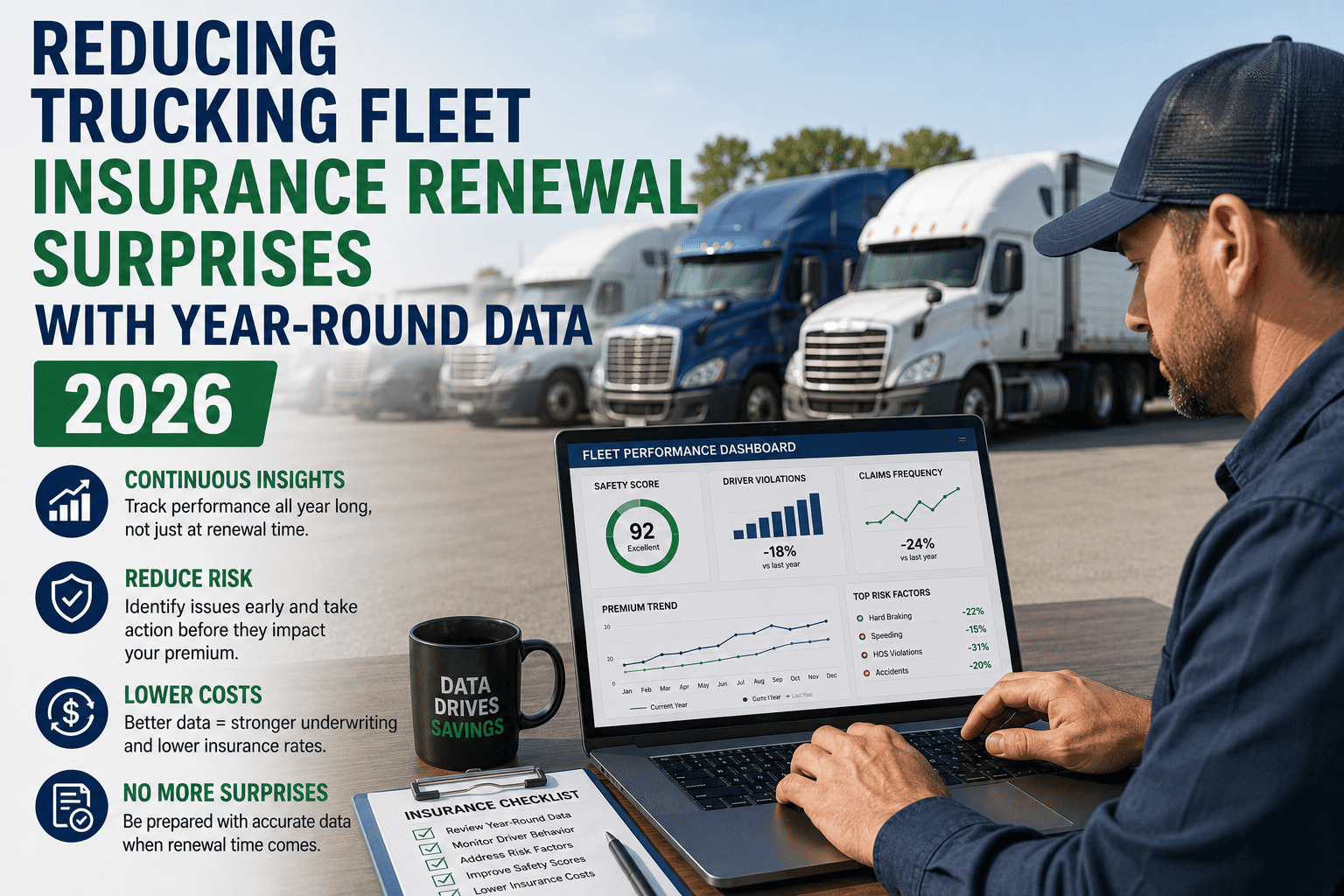
Fleet insurance renewal surprises happen because underwriters historically had almost nothing to evaluate beyond claims history and vehicle count. Fleets that continuously track driver behavior, HOS compliance, and maintenance records throughout the year walk into renewal with proof of safe operations instead of hoping for a fair number. Roughly 60 percent of insurers already factor telematics data into underwriting, and fleets sharing that data proactively are seeing 15 to 30 percent premium reductions instead of double-digit increases.
Why Renewals Feel Like a Surprise Every Year
For decades, commercial auto underwriting ran on a handful of blunt inputs: years in business, claims history, vehicle count, and zip code. None of that tells an insurer whether a driver brakes hard at intersections, whether hours of service limits are consistently respected, or whether a fleet's maintenance program actually prevents breakdowns instead of reacting to them. With nuclear verdicts against trucking companies climbing sharply in recent years, insurers have responded by pricing risk more conservatively across the board, which means fleets with no data story of their own get grouped with the riskiest operators by default.
The fix isn't waiting for the agent's call and hoping for the best. It's building a continuous record of safety and compliance performance so that by the time renewal arrives, the underwriter is reviewing evidence instead of guessing.
The 90-Day Rule Most Fleets Miss
Most underwriters want at least 90 days of consistent, high-quality data before they'll factor it into a risk assessment, which means the safety data a fleet starts collecting the week before renewal is already too late to matter for that term. Fleets that treat data collection as a year-round habit instead of a pre-renewal scramble are the ones whose numbers are actually usable when the conversation happens.
FleetRabbit tracks driver behavior, HOS compliance, and maintenance history continuously, so your fleet has a renewal-ready story every single term. Sign up free and start building your safety record today.
What Underwriters Actually Want to See
Insurers cannot reward what they cannot see. A fleet running dashcams and GPS tracking but keeping that data internal is leaving discounts on the table, since the underwriter has no way to distinguish a genuinely safe operation from one that simply hasn't had a reported claim yet. A well-built safety record, sometimes called a safety binder, gives the underwriter the specific proof points that actually move a renewal conversation.
Snapshot Underwriting vs. Year-Round Data
The difference between a fleet that gets surprised at renewal and one that gets rewarded almost always comes down to whether data collection happens continuously or only when the renewal date forces the issue.
| Renewal Factor | Snapshot Approach | Year-Round Data Approach |
|---|---|---|
| Driver Behavior | Unknown to the underwriter beyond claims history | Documented scorecards trending safer month over month |
| HOS Compliance | Only surfaces if a violation triggers an audit | Continuous compliance record presented proactively |
| Maintenance Practice | Assumed based on vehicle age and mileage alone | Verified through digital inspection and PM records |
| Negotiating Position | Reactive, accepting whatever the market quotes | Proactive, presenting evidence before the quote is set |
Why Coaching Speed Matters More Than the Data Itself
Collecting telematics data on its own earns minimal discounts. The fleets seeing the biggest gains are the ones actively using the data to coach drivers and correct behavior within days rather than months, since that feedback loop is what turns raw sensor data into a documented downward trend an underwriter can actually price against.
Turning Documentation Into Negotiating Leverage
Presenting six months to a year of clean telematics, HOS, and maintenance data at the negotiating table is far more persuasive than a verbal claim of running a safe fleet. If your renewal has felt unpredictable in past years, book a free demo to see how a year-round data record changes that conversation.
FleetRabbit packages driver scorecards, HOS records, and maintenance history into a renewal-ready report your broker can bring straight to the negotiating table.
Frequently Asked Questions
FleetRabbit turns everyday driver, compliance, and maintenance data into the proof underwriters actually want to see, so your next renewal rewards safe operations instead of guessing at them.