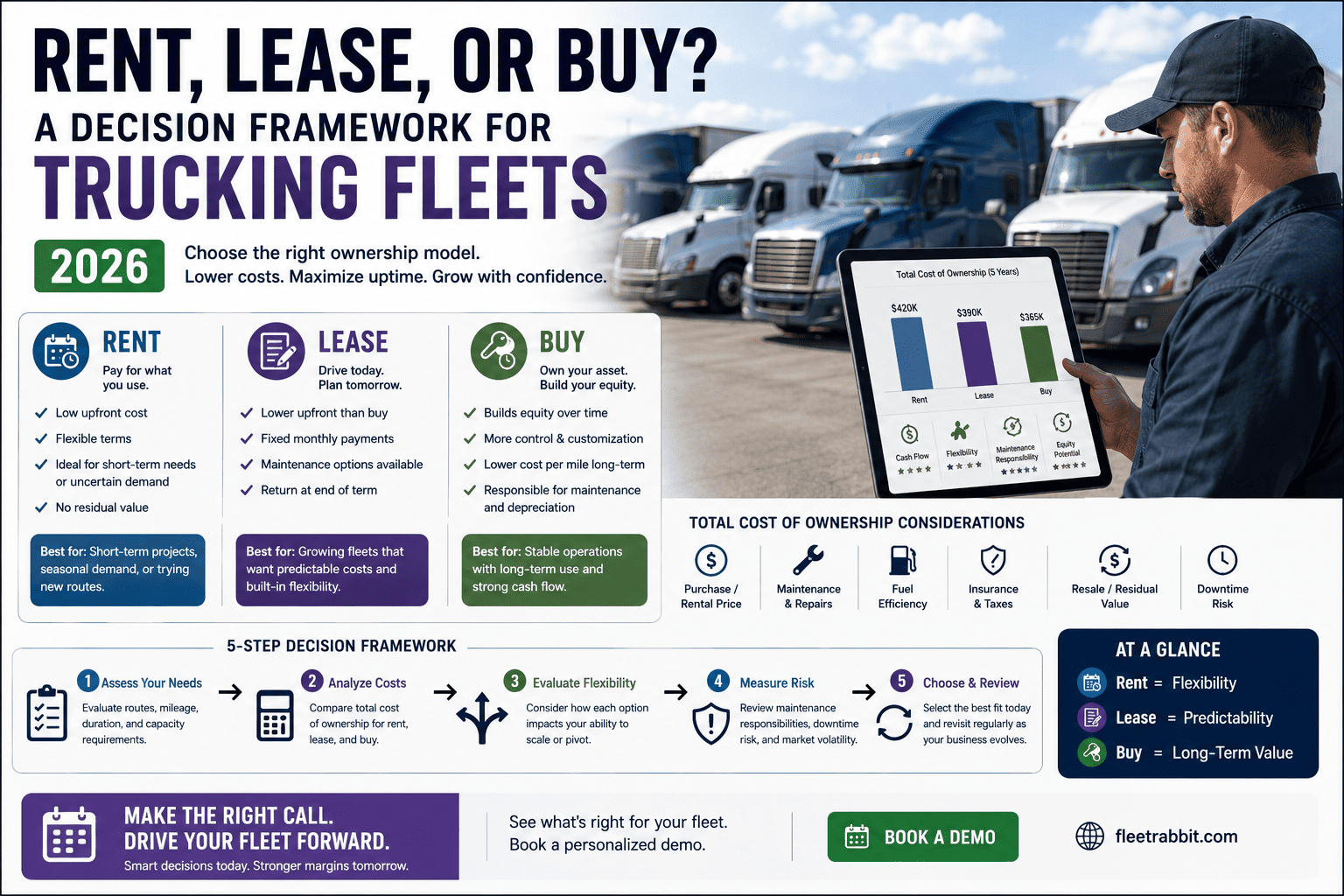
Every fleet manager eventually asks the same question in a different disguise: should we rent this truck, lease it, or just buy it outright. The honest answer is that no single option is right for every vehicle in your fleet. It depends on how much that truck will actually run, how predictable your demand is, and how much cash you can afford to tie up in a depreciating asset.
This guide breaks the decision down into a framework you can apply vehicle by vehicle instead of guessing. If you want to see this analysis run automatically against your own fleet data, you can sign up for FleetRabbit in a few minutes, or book a demo to walk through your specific acquisition strategy with our team.
Renting fits short-term or unpredictable needs where a vehicle runs well under 30 percent of available hours. Leasing, especially a Terminal Rental Adjustment Clause structure, fits high-utilization, long-term, or custom-spec vehicles without tying up capital, and it now covers roughly 80 percent of heavy-duty vehicle contracts. Buying makes sense once utilization consistently clears 60 to 70 percent and demand is stable enough to justify owning a depreciating asset outright. The right fleet uses all three, matched to how each vehicle is actually used.
Rent, Lease, or Buy: Side by Side
Before getting into the math, it helps to see how the three models actually differ in practice, not just in theory.
The Utilization Test That Decides It
Utilization, the share of available hours a vehicle actually operates, is the single clearest signal for which model fits. Once you know that number for a vehicle, the decision mostly makes itself.
Below roughly 30 percent utilization, renting usually wins on cost. Between 30 and 60-70 percent, leasing balances flexibility with predictable pricing. Above that threshold, owning typically delivers the lowest cost per mile.
Why Utilization Beats Gut Feeling
A truck that runs 25 percent of available hours under a purchase model is still accruing depreciation, insurance, and financing costs on every one of its idle days. A rental only costs money while it's actually working. Flip that logic for a vehicle running 80 percent of the time: the daily rental premium adds up fast, while an owned vehicle spreads its fixed costs across far more productive hours.
A Quick Gut Check
If you're not sure where a vehicle sits, ask whether it runs more than 60 to 70 percent of available hours. A yes points toward buying. A clear no, especially with seasonal or project-based demand, points toward renting. Anything in between is lease territory.
| Factor | Rent | Lease | Buy |
|---|---|---|---|
| Cash Flow Impact | Lowest commitment, highest per-day cost | Predictable monthly payment, capital preserved | Highest upfront cost, capital tied up long-term |
| Maintenance Responsibility | Typically covered by rental provider | Often bundled into lease structure | Fully on the owning fleet |
| Best Utilization Range | Under 30% of available hours | 30% to 60-70% of available hours | Above 60-70% of available hours |
| Flexibility to Adjust Fleet Size | Highest, no long-term obligation | Moderate, term commitment applies | Lowest, disposal takes planning |
| Fit For Custom Upfitting | Limited to standard spec available | Strong fit, especially TRAC structures | Strong fit, full control over spec |
FleetRabbit tracks actual utilization, cost per mile, and maintenance spend across your fleet, so the rent, lease, or buy decision is based on data instead of a guess. Sign up to start tracking your fleet today, or book a demo and we'll run the numbers on your current vehicles together.
Understanding the TRAC Lease
Terminal Rental Adjustment Clause leasing has become the dominant structure in commercial trucking, covering roughly 80 percent of heavy-duty vehicle contracts, largely because it splits the difference between renting and buying so effectively.
How the Residual Risk Works
In a TRAC lease, your fleet takes on the residual value risk at the end of the term. If the truck sells for more than its projected residual value, that equity comes back to your business. If it sells for less, your fleet covers the difference. That structure rewards fleets that maintain their vehicles well, since better condition at end-of-term translates directly into a better resale outcome.
Where TRAC Leasing Fits Best
This structure works particularly well for vehicles expected to stay in service 5 to 7 years, trucks with specialized bodies like cranes or refrigeration units where standardized valuations are difficult, and high-mileage routes exceeding 100,000 miles annually where a standard mileage-capped lease would trigger steep penalties.
The 5-Point Audit Before You Decide
Rather than deciding vehicle by vehicle on instinct, run each acquisition candidate through the same short checklist.
Why 2026 Is Tilting Fleets Toward Flexibility
Financing costs remain elevated compared to the prior decade's average, and freight demand through 2026 has been described as an inflection point rather than a full rebound, uneven enough that many fleets are hesitant to lock capital into long-term ownership. That combination is pushing more fleets toward leasing and rental capacity that can flex with demand, reserving outright purchase for vehicles where utilization and timing are highly certain.
FleetRabbit gives you the utilization, cost per mile, and maintenance history behind every rent, lease, or buy decision, so your fleet strategy holds up under scrutiny. Sign up to connect your fleet, or book a demo and let our team walk through your specific acquisition mix.
Frequently Asked Questions
The right mix of renting, leasing, and buying comes down to data most fleets already have but rarely see in one place. FleetRabbit puts utilization, cost per mile, and maintenance history side by side so every acquisition decision is backed by numbers.